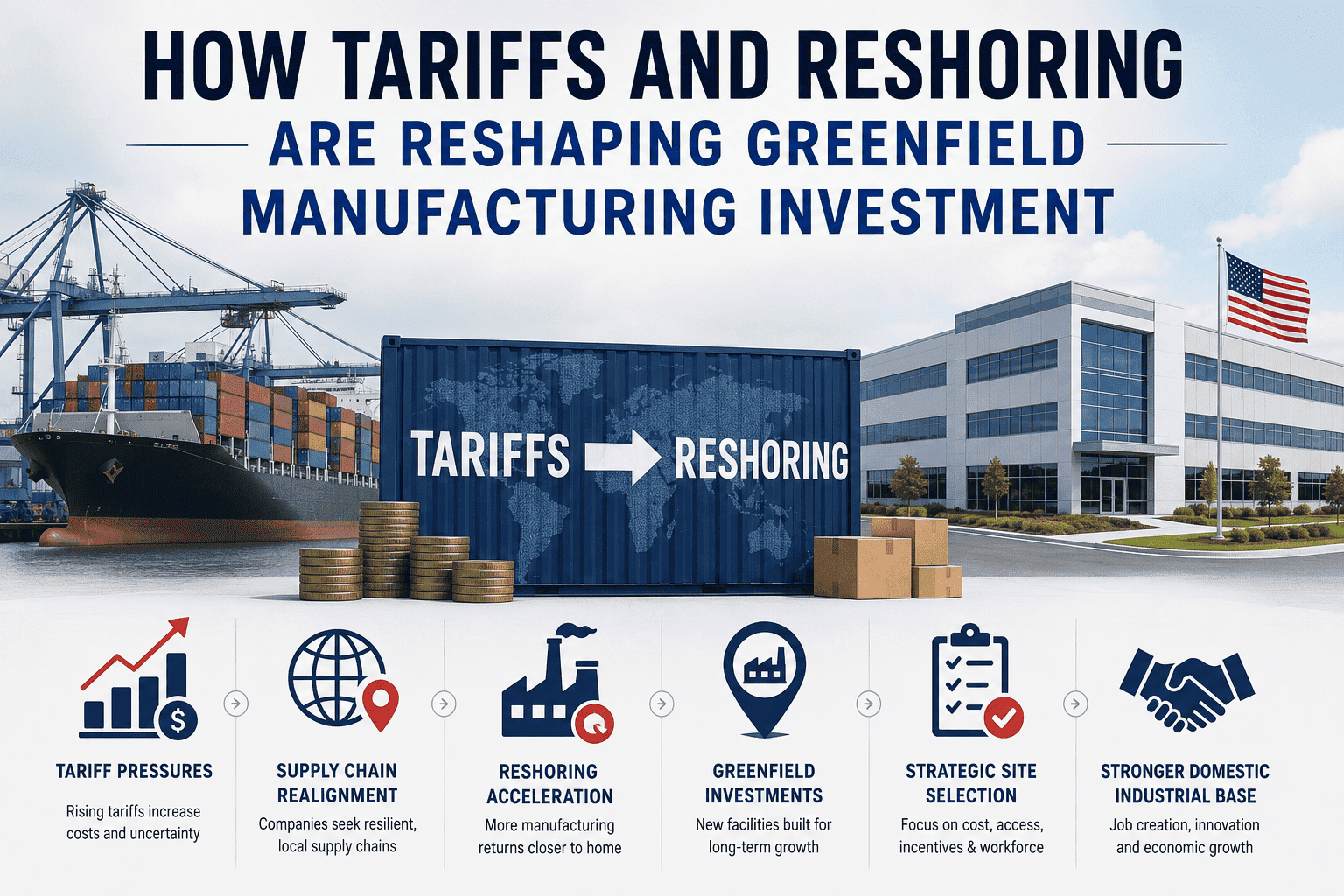
The 2025–2026 tariff regime is not a temporary disruption — it's a structural reset of how greenfield CapEx decisions get made. Manufacturers announced $1.7 trillion in new US manufacturing investments in 6 months after the April 2025 tariff wave. Section 232 duties reach 50% on steel, aluminum, and 400+ derivative products. China's trade-weighted tariff sits at 41% versus Vietnam at 18%, Thailand at 16%, and Malaysia at 11%. The decision facing every greenfield builder is which of four strategic responses to embed in the CapEx model: absorb, pass through, reshore, or diversify. Book a tariff scenario consultation to model your exposure.
Tariffs & Greenfield CapEx · Manufacturing Strategy 2026
The 4 Strategic Responses Reshaping CapEx Decisions Right Now
01
Cost Pass-Through
Raise Prices to Customers
32%
of manufacturers passing 100% of tariff costs
Tactical, fastest to execute. Risks competitive position and long-term customer trust if competitors absorb instead.
When it fits: Differentiated product, low price elasticity
02
Margin Absorption
Absorb Costs Into Margin
42%
using mixed absorb + pass-through strategy
Protects market share short-term but compresses operating margin. Sustainable only if tariffs are temporary — and they aren't.
When it fits: Strong margin headroom, brand-sensitive markets
03
US Reshoring
Build Greenfield in US
36%
actively pursuing US production shift
Structural fix. 18 to 36 month build timeline means tariff regime may shift during construction. Requires automation to offset labor cost gap.
When it fits: High tariff exposure, strategic product, IRA/CHIPS eligibility
04
Geographic Diversification
Shift to Lower-Tariff Origin
30%
moving to Vietnam, Mexico, Thailand, Morocco
Hedges tariff exposure without full US cost stack. 23 percentage point gap between China and ASEAN tariffs. Watch transshipment scrutiny.
When it fits: Cost-sensitive products, established supplier networks
$1.7TNew US manufacturing investments announced post-tariffs
86%Of manufacturers passing some tariff cost to customers
41% vs 18%China vs Vietnam trade-weighted average tariffs
90%Of manufacturers very/moderately concerned about volatility
What's Actually Tariffed: The Section 232 Stack Hitting Greenfield Builders
The headline tariff rates are only one layer. Greenfield builders face cascading tariffs — Section 232 on raw materials, Section 301 on Chinese imports, and reciprocal tariffs on finished equipment. Each layer compounds the next, and the stack is still expanding through 2026.
Steel & Aluminum
50%
Section 232. Applied to raw materials AND 407+ derivative products (machine parts, structural elements, finished equipment containing steel content).
Hits: Construction materials, equipment frames, structural steel
Copper
50%
Section 232. Critical for electrical infrastructure, wiring, busbars, transformers, motor windings. Derivative expansion ongoing.
Hits: Electrical systems, motor controls, building wiring
Timber & Lumber
10–25%
Section 232 effective October 2025. Increases scheduled to 30–50% on January 1, 2026 for select categories.
Hits: Construction materials, plant interior buildout
Robotics & Industrial Machinery
Pending
Section 232 investigation announced September 2025. Public comments closed October 2025. Tariff determination expected H1 2026.
Hits: Robots, CNC equipment, automation systems
China (Reciprocal + 301)
41% avg
Trade-weighted average across product categories. Reaches 55%+ on Section 301 categories like batteries, semiconductors, EVs.
Hits: Electronic components, batteries, finished equipment
Pharmaceuticals
Up to 100%
Section 232 investigation completed 2025. Up to 100% on branded drugs, with carveouts for companies building US plants.
Hits: Active ingredients, finished drug products, contract manufacturing
The Regional Tariff Gap That's Redrawing Supply Chains
The trade-weighted tariff gap between major sourcing regions has widened from 7 percentage points in January 2025 to 24–30 points today. That gap is the single largest driver of supplier base reshuffling in 2026 — and the data point every greenfield CapEx model must include.
India
Russia oil tariff drag
Vietnam
Top diversification target
Thailand
Auto & electronics shift
EU / Japan / South Korea
Allied trade carveouts
Malaysia
Semiconductor & electronics
Morocco / Costa Rica
Emerging reshoring partners
Want to model your specific tariff exposure against alternative sourcing geographies? Book a tariff scenario consultation — we will run the full regional comparison against your bill of materials.
The 5-Step Tariff Scenario Framework for Greenfield CapEx
Tariff volatility is the bigger problem than tariff level. The constant changes break static financial models. Disciplined greenfield builders run scenario planning across five distinct steps — building tariff exposure into the CapEx model from day one rather than treating it as an external shock.
Map Tariff Exposure on the BOM
Every line in the bill of materials gets tagged with country of origin, current tariff rate, and Section 232 derivative exposure. Hidden steel content in finished equipment is the most-missed category.
Model 3 Tariff Scenarios
Status quo / escalation (tariffs expand to more categories) / partial rollback (Supreme Court rulings, election shifts). Run CapEx and 5-year OpEx against each — the spread is the project's tariff risk envelope.
Identify Strategic Response per Category
Not every BOM category needs the same response. Hot-rolled steel may reshore; specialty alloys may shift to Vietnam; finished automation may absorb. The response matrix gets built per-category, not per-project.
Stack Eligible Incentives
CHIPS Act, IRA Section 48C and 45X, state job credits, property tax abatement, FTZ designation. The incentive stack can offset 15–30% of CapEx for qualifying projects — directly countering tariff exposure.
Build AI-Driven Continuous Scenario Refresh
Tariffs change quarterly. The CapEx model needs to refresh automatically when rates change. AI-driven scenario planning re-runs the entire model in hours when a new Section 232 determination drops.
Model Tariff Exposure Across 3 Scenarios — Before CapEx Approval
iFactory's tariff scenario consultation maps your bill of materials against current and pending Section 232 actions, runs the 5-step framework, models 3 tariff scenarios over the 5-year horizon, stacks eligible incentives, and produces the CapEx model that survives volatility — all delivered before board approval.
The 3 Tariff-Driven Risks Compounding Across Every Greenfield Project
Beyond direct cost impact, three secondary risks now ripple through every greenfield CapEx decision. Each one breaks the assumptions in pre-2025 financial models — and each requires a deliberate mitigation built into the project plan.
01
Volatility Risk
"It's not the tariffs that are the issue, it's the volatility."
Tariff rates change quarterly. New Section 232 investigations open. Reciprocal tariffs shift on diplomatic developments. Static CapEx models built on a single tariff snapshot break within 12 months of approval.
Mitigation: Quarterly model refresh built into governance
02
Build-Window Risk
"4 to 6 years to build a sterile injectables plant."
Greenfield construction takes 18 months to 6 years depending on industry. The tariff regime that justified the project at FID may differ materially from the one at startup — undermining the original ROI case.
Mitigation: Phase construction to retain optionality
03
Supplier Ecosystem Risk
"New US plants risk becoming costly assembly hubs."
Reshoring final assembly without reshoring the supplier base creates a plant dependent on imported components — vulnerable to the same tariffs the reshoring was meant to escape. The supplier base takes years to mature.
Mitigation: Tier 2/3 supplier reshoring sequencing
Expert Perspective: Why Tariff Volatility Reshapes CapEx More Than Tariff Levels
The conversation we have with greenfield builders in 2026 has shifted significantly from 2024. Then, tariffs were one of dozens of inputs to the CapEx model. Now, tariffs ARE the model — every other line item gets recalculated against the tariff envelope. The honest read is that most pre-2025 financial models are now obsolete. They were built assuming tariff stability and 30-year global supply chains. The 2026 reality is quarterly tariff rate changes, Section 232 investigations on robotics and industrial machinery now pending, and a build window of 18 to 60 months during which the tariff regime can shift multiple times. The disciplined approach is to stop trying to predict tariffs and start designing CapEx for tariff optionality — modular scope, phased construction, multi-source supplier networks, and continuous scenario refresh. The plants that win the next decade will be the ones whose financial models were never bound to a single tariff scenario in the first place.
— iFactory Greenfield Consulting, Tariff Scenario Practice 2025 to 2026
3 scenarios
Minimum tariff cases every greenfield CapEx now models
15–30%
CapEx offset from stacked federal/state/local incentives
Quarterly
Scenario refresh cycle disciplined builders now run
Ready to rebuild your CapEx model around tariff optionality rather than tariff prediction? Talk to our greenfield strategy team — we will run the 3-scenario model against your project.
Design Greenfield CapEx for Tariff Optionality — Not Tariff Prediction
iFactory's tariff scenario consultation maps BOM exposure, runs 3-scenario CapEx modeling, identifies strategic response per category, stacks eligible federal-state-local incentives, and builds AI-driven continuous scenario refresh — all delivered before construction documents close.
Frequently Asked Questions
How much have tariffs actually increased greenfield CapEx in 2026?
Direct tariff impact on greenfield CapEx ranges from 8 to 25% of total project cost depending on bill of materials origin and Section 232 derivative exposure. Steel, aluminum, and copper at 50% tariffs hit structural and electrical line items hard. The cascading effect through finished equipment containing tariffed materials adds another 5 to 12%. Stacked incentives (CHIPS, IRA, state) typically offset 15 to 30% of qualifying CapEx, partially countering exposure.
Should we reshore or diversify to lower-tariff countries?
Most disciplined builders pursue both. Reshore strategically — products with high tariff exposure, national security relevance, or IRA/CHIPS eligibility. Diversify to Vietnam, Thailand, Mexico, or Morocco for cost-sensitive components where ASEAN/USMCA tariffs are 18 to 25 points lower than China. The trade-weighted China-Vietnam gap of 24 to 30 percentage points makes geographic diversification the highest-ROI move for cost-driven supply categories.
How do we handle tariff volatility in a multi-year CapEx model?
Stop trying to predict tariffs. Build the model around tariff optionality instead — modular project scope, phased construction with go/no-go decision points, multi-source supplier networks, and continuous scenario refresh. Run minimum 3 scenarios: status quo, escalation, and partial rollback. The financial spread between scenarios is the project's tariff risk envelope, and CapEx governance should refresh quarterly when new tariff actions drop.
Are the $1.7 trillion in announced US manufacturing investments actually getting built?
Partially. Construction takes 18 months to 6 years depending on industry. Some announced projects represent pre-existing plans rebranded as tariff responses. Others are real new commitments but won't reach production before 2028 to 2030. The honest read is that announced investment dollars create political signaling, but only a fraction translates into operating capacity within the current administration window. Build credibility into your assumptions about competitor reshoring timing.
How does iFactory's tariff scenario consultation work?
iFactory maps your bill of materials against current and pending Section 232 tariff actions, runs the 5-step framework on your project data, models 3 tariff scenarios across the 5-year horizon, identifies strategic response per BOM category, stacks eligible federal-state-local incentives, builds the AI-driven continuous scenario refresh, and produces the CapEx model that survives quarterly volatility. All delivered before board approval.
Book your tariff scenario consultation here.