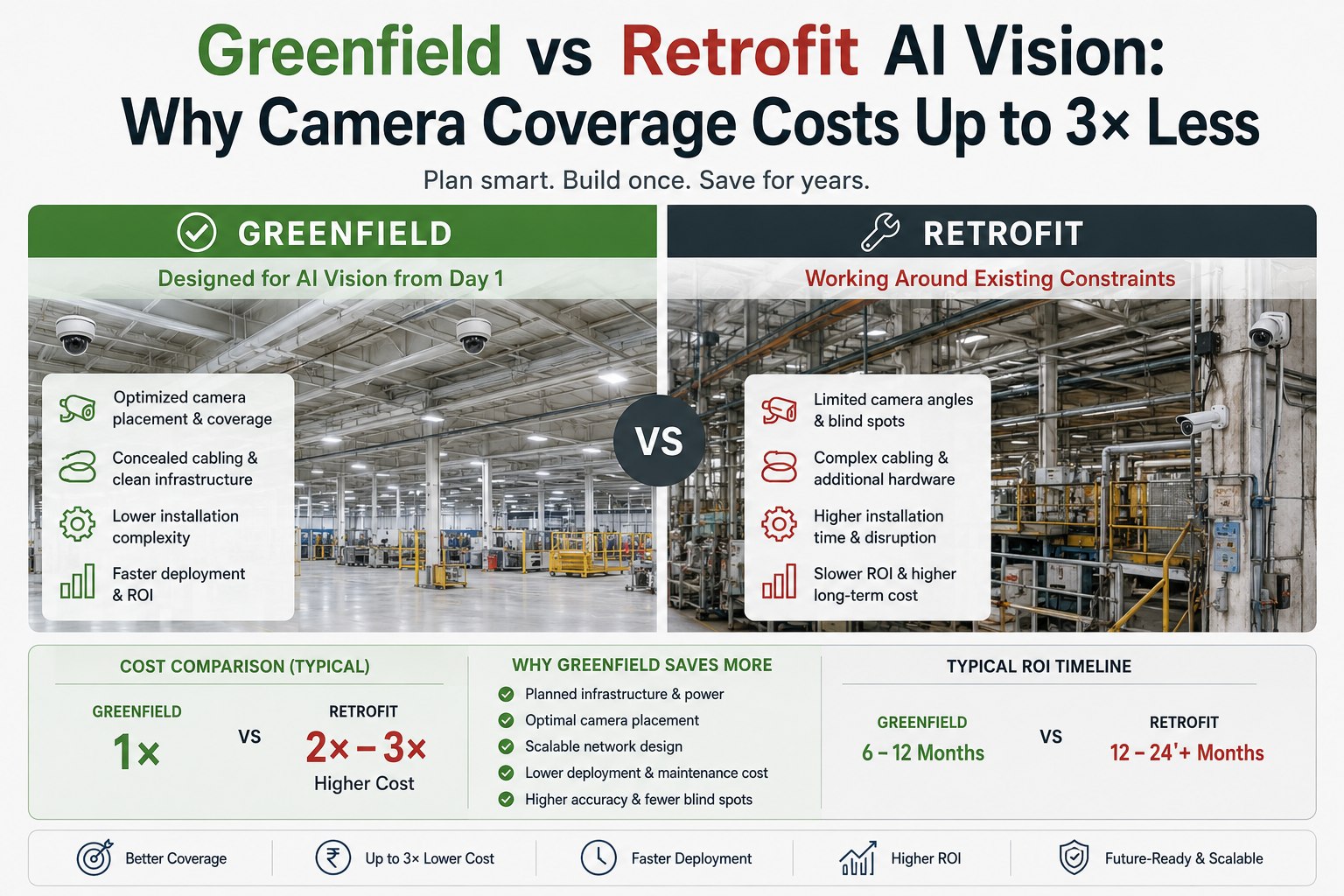
The cost difference between deploying AI vision in a greenfield plant and retrofitting it into an operating facility isn't 20% or 50% — it's 2 to 3× across the typical project, and as much as 10× on infrastructure line items alone. Cameras and edge servers cost the same either way. The gap comes from cabling, conduit, network drops, production shutdowns, and engineering re-work to integrate AI vision into spaces designed before it existed. Disciplined builders lock in the infrastructure during construction, when running 8 conduit drops costs $400 instead of $4,000. Book a greenfield AI vision consultation to model the gap against your project.
Built In During Construction
Bolted Onto Operating Facility
Where the 2–3× Cost Gap Actually Lives
Cameras and edge GPU servers cost the same in greenfield as retrofit — the gap is everything else. Four line-item categories absorb the entire cost differential. Understanding which categories drive the gap reveals where greenfield planning unlocks the biggest savings.
Open-wall cable pulls during construction cost $0.50–$2/ft. Retrofit pulls through finished walls with core drilling, fire-stopping, and asbestos checks run $5–$20/ft. The biggest single driver of the cost gap.
Greenfield deployments happen before production starts — zero opportunity cost. Retrofit work requires weekend shutdowns, planned downtime windows, or coordinated maintenance turnarounds that displace revenue.
Greenfield bakes camera mount locations, sightlines, and lighting into facility design. Retrofit demands custom brackets, structural reviews, and lighting upgrades adding 30–50% of total project labor cost.
AI-native plants pre-size electrical capacity at 2–3× traditional. Retrofit projects typically discover undersized switchgear, network closets, and UPS only after deployment — driving $12K–$40K in one-time infrastructure upgrades.
The Per-Camera Cost Breakdown: Greenfield vs Retrofit
Looking at any single AI vision camera position, the cost stack tells the story. Hardware lines stay constant — installation and infrastructure lines diverge dramatically. The all-in cost per camera position is what determines deployment ROI.
Want this cost stack modeled against your specific camera count and facility? Book a greenfield AI vision consultation — we will produce the full per-camera and project-level cost model before procurement.
How the Cost Gap Compounds Across 5 Years
The initial 2–3× cost gap is only the visible part. Greenfield AI vision pays back 12–18 months earlier than retrofit, and the compounding ROI difference reaches 150–200 percentage points over 5 years. Three drivers explain the gap.
Faster Payback
Greenfield AI vision starts generating ROI from production day 1. Retrofit deployments take 6–12 months longer to commission, deferring the entire ROI curve to the right.
Lower Baseline Cost
As a percentage of total facility CapEx, greenfield AI vision lands at 8–15%. Retrofit projects often reach 20–30% of facility CapEx when production downtime costs are included.
Compounding Returns
Earlier payback means more compounding cycles within the 5-year window. Each year of additional production data improves model accuracy and unlocks adjacent use cases at near-zero marginal cost.
When Retrofit Still Makes Sense — and When It Doesn't
Greenfield isn't always available. The honest answer for any operating facility is that the retrofit decision depends on the facility's remaining useful life, planned expansions, and shutdown tolerance. Four scenarios determine the right path.
Facility 10+ years from sunset
If the facility has 10+ years of remaining useful life, the 2–3× retrofit premium amortizes across enough production years to still deliver positive ROI within 36 months. Worth doing.
Planned major shutdown coming
If a major maintenance turnaround or expansion is already scheduled within 12 months, the retrofit work can piggyback on existing shutdown windows — eliminating the largest cost driver entirely.
New line in existing facility
Adding a greenfield production line inside an existing facility lets you achieve full greenfield AI vision economics on that line while the rest of the plant operates undisturbed.
Facility <5 years from sunset
If the facility is within 5 years of consolidation, closure, or major rebuild, the retrofit ROI window closes. Consider piloting AI vision on critical lines only, or defer to the replacement facility.
Expert Perspective: Why AI Vision Belongs in the Construction Schedule
The largest cost mistake we see in greenfield manufacturing projects is not over-budgeting AI vision. It is under-budgeting it during construction and then paying 2 to 3 times more to retrofit it 18 months after the ribbon-cutting. The cabling, conduit, edge server provisioning, and lighting design that costs almost nothing during construction becomes a major capital project once the plant is operating. We have seen plants spend $1.4M retrofitting AI vision into a facility that would have cost $450K to build in. The math is consistent across every greenfield project we audit. AI vision belongs in the construction schedule — not in a separate digitalization project two years later. Locking it in early also unlocks the compounding benefit: every year of additional production data improves model accuracy and the same infrastructure handles adjacent use cases like PPE compliance and predictive maintenance at near-zero marginal cost.
— iFactory Greenfield Consulting, AI Vision Cost Practice 2025 to 2026
Ready to lock in AI vision in the construction schedule before it becomes a retrofit project? Talk to our greenfield team — we will model the cost gap before construction documents close.