You are spending $200 million on a greenfield factory. The building will last 40 years. The production lines you install today will define your cost structure, throughput ceiling, and competitive position for the next decade. Yet most greenfield projects still treat robotics and automation as a procurement decision — something to bolt on after the floor plan is finalized. That approach locks in inefficiency from day one. The manufacturers gaining ground in 2026 are designing automation into the DNA of their greenfield plants: collaborative robots working alongside humans without safety cages, autonomous mobile robots replacing forklift fleets, AI-driven production cells that reconfigure themselves for new products in hours instead of weeks. The global collaborative robot market hit $3 billion in 2025 and is growing at 20%+ annually. The question is not whether to automate your greenfield plant — it is how to design it so every automation dollar delivers maximum throughput, flexibility, and ROI from the first day of production. iFactory helps manufacturers plan intelligent automation for greenfield plants — from layout simulation to cobot deployment to MES integration. Book a 30-minute consultation to start designing your future-ready factory.
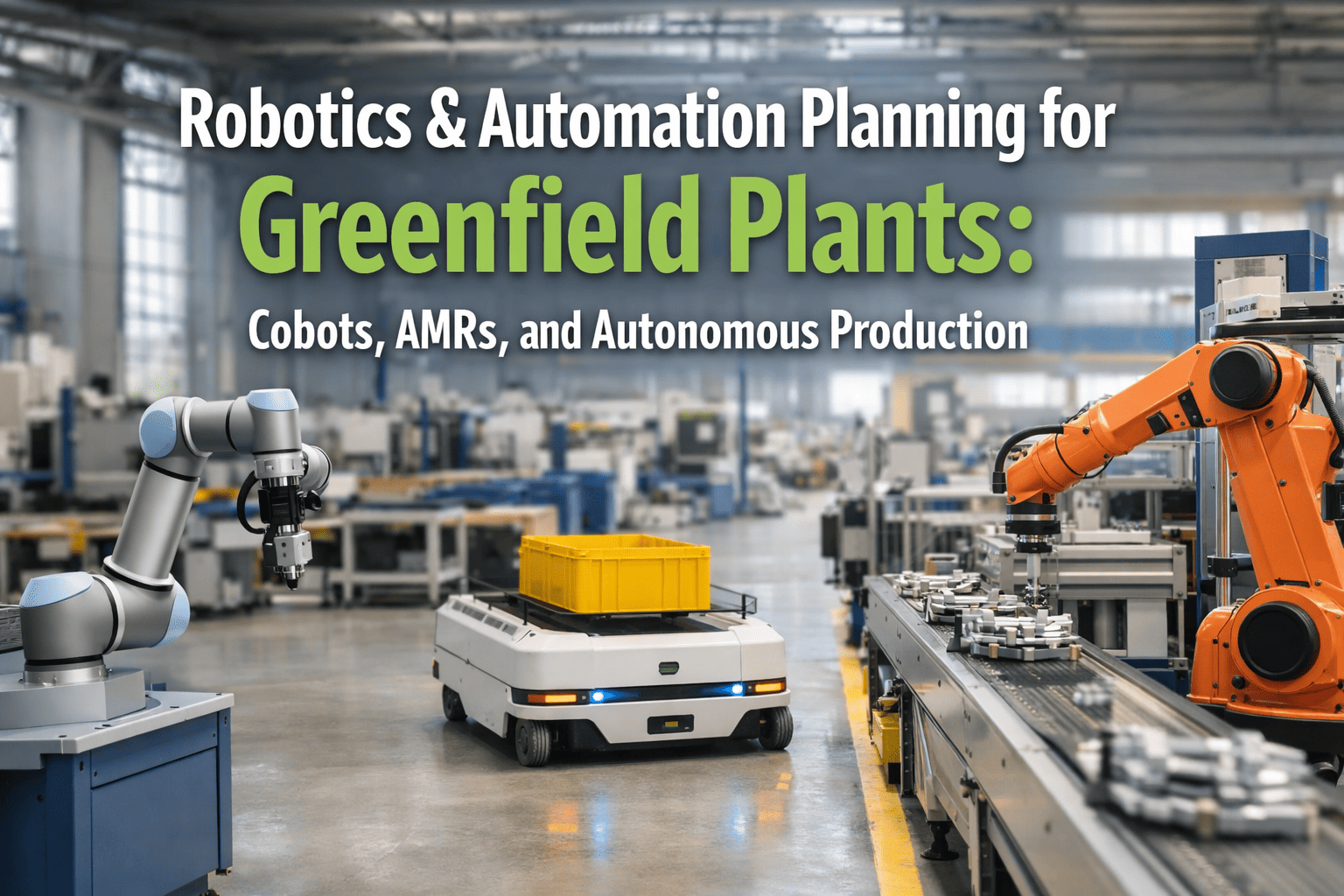
Robotics & Automation for Greenfield Plants
Cobots, AMRs, and Autonomous Production — Designed In from Day One
$3B+
Global Collaborative Robot Market Size (2025)
8–14 mo
Typical Cobot Payback Period in Manufacturing
73%
Of Manufacturers Cite Productivity as Top Automation Driver
Greenfield Advantage: Why Automation-First Design Changes Everything
Retrofitting automation into an existing plant means working around fixed column spacing, legacy power distribution, narrow aisles designed for forklifts, and production lines that were never meant to accommodate robots. A greenfield plant eliminates all of those constraints — but only if you design automation into the layout from the start.
Constraints You Inherit
✗ Fixed floor plans force robots into suboptimal positions
✗ Legacy power and network infrastructure limits sensor density
✗ Narrow aisles designed for manual operations block AMR navigation
✗ Production downtime during every integration phase
Typical Premium
✗ 30–50% higher integration cost vs. greenfield automation
Advantages You Design In
✓ Floor plans optimized for robot reach envelopes and AMR traffic flow
✓ Power, data, and compressed air pre-provisioned at every cell
✓ Wide aisles, charging stations, and staging zones built into layout
✓ Zero production disruption — automation is validated before launch
Typical Savings
✓ 35–50% lower total automation deployment cost
The Robotics Toolkit: Cobots, AMRs, AGVs, and When to Use Each
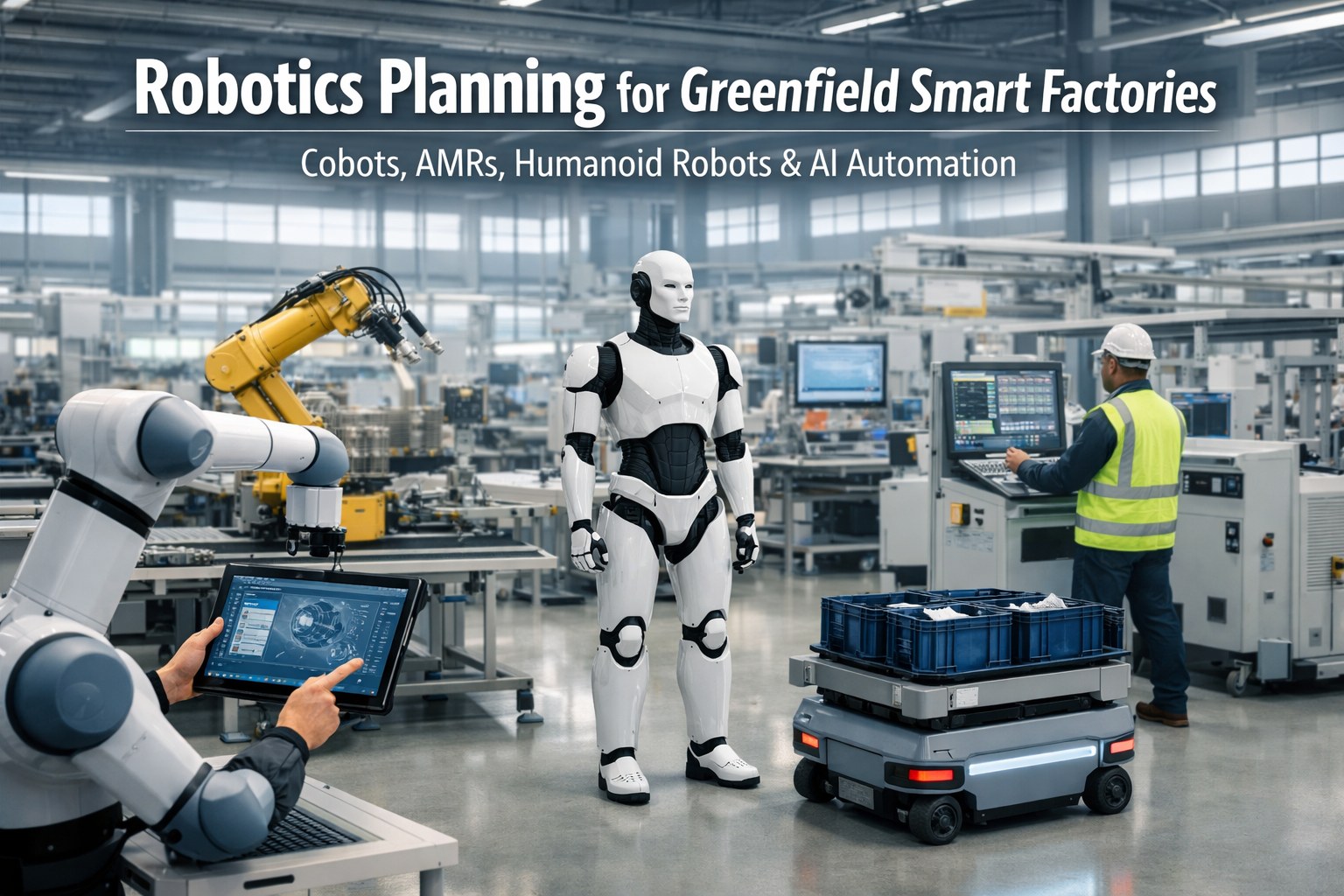
Not every task needs the same robot. The most effective greenfield automation strategies deploy the right technology for each workflow — blending collaborative robots for precision tasks, autonomous mobile robots for dynamic material movement, and traditional industrial robots for high-speed, high-payload operations.
Payload
Up to 35 kg
Precision
±0.02 mm
Payback
8–14 months
Work alongside humans without safety cages. Force-limiting joints, integrated sensors, and no-code programming make them ideal for assembly, inspection, machine tending, and packaging. SMEs now account for 42% of new cobot installations globally.
Best for: High-mix, low-volume production, quality inspection, precision assembly
Navigation
LiDAR + SLAM
Infrastructure
No floor markings
Scalability
Incremental fleet add
Self-navigating robots that use LiDAR, cameras, and AI to move materials dynamically. No guide wires, no magnetic tape — they navigate around obstacles in real time and reroute instantly when the environment changes.
Best for: Dynamic material handling, WIP transport, warehouse-to-line delivery
Payload
Up to 60+ tonnes
Navigation
Magnetic / Wire guided
Reliability
99.9%+ uptime
Follow fixed paths using floor-embedded guides or magnetic tape. Predictable, reliable, and capable of moving extremely heavy loads. Ideal for high-volume, repetitive transport routes where the path rarely changes.
Best for: Heavy-load transport, fixed production lines, high-volume repeating routes
Payload
100 kg+
Speed
High-cycle operations
AI Vision
Defect detection 95%+
Traditional 6-axis arms paired with AI-powered machine vision for welding, palletizing, material removal, and real-time quality inspection. Essential for high-speed, high-payload tasks where human proximity is not required.
Best for: Welding, palletizing, CNC loading, high-speed assembly lines
The most effective greenfield automation strategies combine all four technologies. Cobots handle flexible assembly cells, AMRs feed materials between stations, AGVs move heavy loads on fixed routes, and industrial robots power high-speed production lines. The art is in the integration — not choosing one technology, but orchestrating all of them into a seamless production workflow.
6-Phase Greenfield Automation Planning Framework
Building a factory from scratch gives you a once-in-a-decade opportunity to get automation right. This framework ensures every decision — from floor layout to robot selection to MES integration — is made in the right sequence.
Map every production workflow end-to-end. Classify each task by automation potential: fully automatable, human-robot collaborative, or human-only. Identify material flow patterns, cycle times, and bottleneck stations. This audit determines your automation mix before a single floor tile is placed.
Build a 3D digital twin of the entire plant. Simulate robot reach envelopes, AMR traffic patterns, human ergonomic zones, and material staging areas. Test multiple layout configurations virtually — validating throughput, cycle times, and safety clearances before construction begins. PepsiCo and other leaders are already using tools like Siemens Digital Twin Composer to optimize new facilities this way.
Match specific robot models to each task based on payload, reach, precision, and cycle time requirements. Design modular production cells that can be reconfigured as product lines change. Define cobot zones (no safety fencing), industrial robot zones (guarded), and shared AMR corridors with charging infrastructure.
Design the data backbone. Every robot, sensor, and conveyor must connect to MES for production tracking, ERP for order management, and an IoT platform for real-time monitoring. Use OPC-UA as the standard protocol layer. Define the edge-to-cloud data flow for predictive maintenance, quality analytics, and throughput optimization.
Test and debug every automation system in the digital twin before physical installation. Validate ISO 13849 machine safety, ISO/TS 15066 cobot collaboration safety, and IEC 62443 cybersecurity compliance. Virtual commissioning catches 60–80% of integration issues that would otherwise surface during physical startup — saving weeks of delays.
Install, calibrate, and commission the physical systems using validated digital twin configurations. Ramp production incrementally — cell by cell, line by line. Train operators on cobot programming, AMR fleet management, and exception handling. Achieve target throughput faster because every system was already proven virtually.
Plan Your Greenfield Automation with iFactory
From process mapping and digital twin simulation to cobot selection and MES integration — iFactory provides the end-to-end automation planning platform that ensures your greenfield plant launches on time, on budget, and at full capacity.
Human-Robot Collaboration: Safety-by-Design Architecture
In a greenfield plant, safety is not retrofitted — it is architected. Modern cobots eliminate the need for safety cages, but designing collaborative zones still requires careful planning around ISO standards, risk assessments, and ergonomic workflows.
Safety Standard
ISO/TS 15066
Fencing Required
None — force-limited
Human Access
Unrestricted during operation
Cobots with integrated force-limiting joints stop automatically on contact. Workers move freely alongside robots performing assembly, inspection, and packaging tasks. Modern cobots can be programmed through gesture-based teaching, drag-and-drop interfaces, and even natural language commands.
Safety Standard
ISO 3691-4
Fencing Required
None — dynamic avoidance
Human Access
Shared with pedestrians
AMRs navigate around people using LiDAR and camera-based SLAM. Wide aisles (3.5m+), floor markings, and designated charging stations are designed into the greenfield layout. Fleet management software prevents congestion at intersections and optimizes route scheduling.
Safety Standard
ISO 13849 / ANSI R15.06
Fencing Required
Perimeter guarding + light curtains
Human Access
Lockout/tagout entry only
Traditional industrial robots operating at high speeds with heavy payloads. Fully guarded cells with safety-rated monitored stop, interlocked gates, and area scanners. In a greenfield plant, these cells are positioned with service access corridors and overhead crane coverage designed in from the start.
ROI Model: What Greenfield Automation Actually Costs and Returns
Automation investment decisions require hard numbers, not vendor promises. Here is a realistic cost-benefit framework based on industry benchmarks for a mid-scale greenfield manufacturing plant.
Cobot Fleet (10–20 units)
$370K–$1M
20–200% productivity uplift
8–14 months
AMR Fleet (5–15 units)
$250K–$750K
Eliminates 4–8 forklift operators
12–18 months
AI Vision Inspection
$150K–$400K
95%+ defect detection accuracy
6–12 months
Digital Twin + Simulation
$200K–$500K
Catches 60–80% of integration bugs
Before Day 1 of production
MES + IoT Integration
$300K–$800K
Real-time visibility + 10–15% OEE gain
12–24 months
87% of companies already using cobots report double-digit productivity improvements. With cobot deployment costs running 35–50% lower than traditional industrial robots, the ROI math for greenfield plants is compelling — especially when integration costs are minimized by designing automation into the layout from the beginning.
Modularity & Future-Proofing: Building for the Next 10 Years
A greenfield plant designed in 2026 will still be running in 2036. The products, volumes, and technologies will change. Your automation architecture must be designed for expansion and reconfiguration — not locked into today's production mix.
Design standardized cell footprints with universal power, data, and compressed air connections. When a new product line launches, you reconfigure the cell — not the building. Cobots can be reprogrammed for new tasks in hours, not weeks.
Start with 5 AMRs on critical routes. Add more incrementally as production scales. AMRs require no fixed infrastructure — you can expand your fleet without rewiring the plant or relaying floor guides.
Build on OPC-UA, MQTT, and REST APIs — not proprietary vendor protocols. Open standards ensure your MES, ERP, and IoT platforms can integrate with any future robot, sensor, or analytics tool without vendor lock-in.
Subscription models for robotics are lowering entry barriers. Instead of $37K upfront per cobot, RaaS lets you pay monthly — scaling your robot fleet up or down with demand. Ideal for greenfield plants ramping production gradually.
Frequently Asked Questions
How much does it cost to automate a greenfield manufacturing plant?
Total automation investment varies by scale and industry, but typically ranges from 15–25% of the total greenfield CAPEX. For a $100M facility, that means $15–25M for robots, conveyors, vision systems, MES, and integration. However, greenfield automation costs 30–50% less per system than equivalent brownfield retrofits because you design the infrastructure to fit the automation — not the other way around.
What is the difference between a cobot and a traditional industrial robot?
Cobots are designed to work alongside humans without safety cages, using force-limiting joints and integrated sensors to stop on contact. They are easier to program — often through no-code interfaces or physical lead-through teaching — and cost 35–50% less to deploy. Traditional industrial robots operate at higher speeds and payloads but require safety fencing and specialized programming. Most greenfield plants use both: cobots for flexible assembly cells and industrial robots for high-speed production lines.
Should we use AMRs or AGVs for material handling?
It depends on your workflow. AMRs navigate dynamically using LiDAR and AI — no floor markings needed. They are ideal for changing environments, mixed traffic, and incremental scaling. AGVs follow fixed paths and are better for heavy-load, high-volume, repeating routes where predictability matters more than flexibility. Many greenfield plants deploy both: AGVs for trunk-line heavy transport and AMRs for flexible last-mile delivery to production cells.
How does a digital twin help with greenfield automation planning?
A digital twin creates a physics-accurate 3D simulation of your entire plant before construction. You can test robot placements, AMR traffic flows, production line throughput, and safety clearances virtually — iterating on the design in hours instead of months. Virtual commissioning catches 60–80% of integration problems that would otherwise surface during physical startup, saving weeks of delays and significant costs.
Design Your Greenfield Factory for the Future
iFactory provides end-to-end automation planning for greenfield manufacturers — from digital twin simulation and cobot selection to MES integration and production ramp-up. Build once, build right, and hit full capacity from day one.