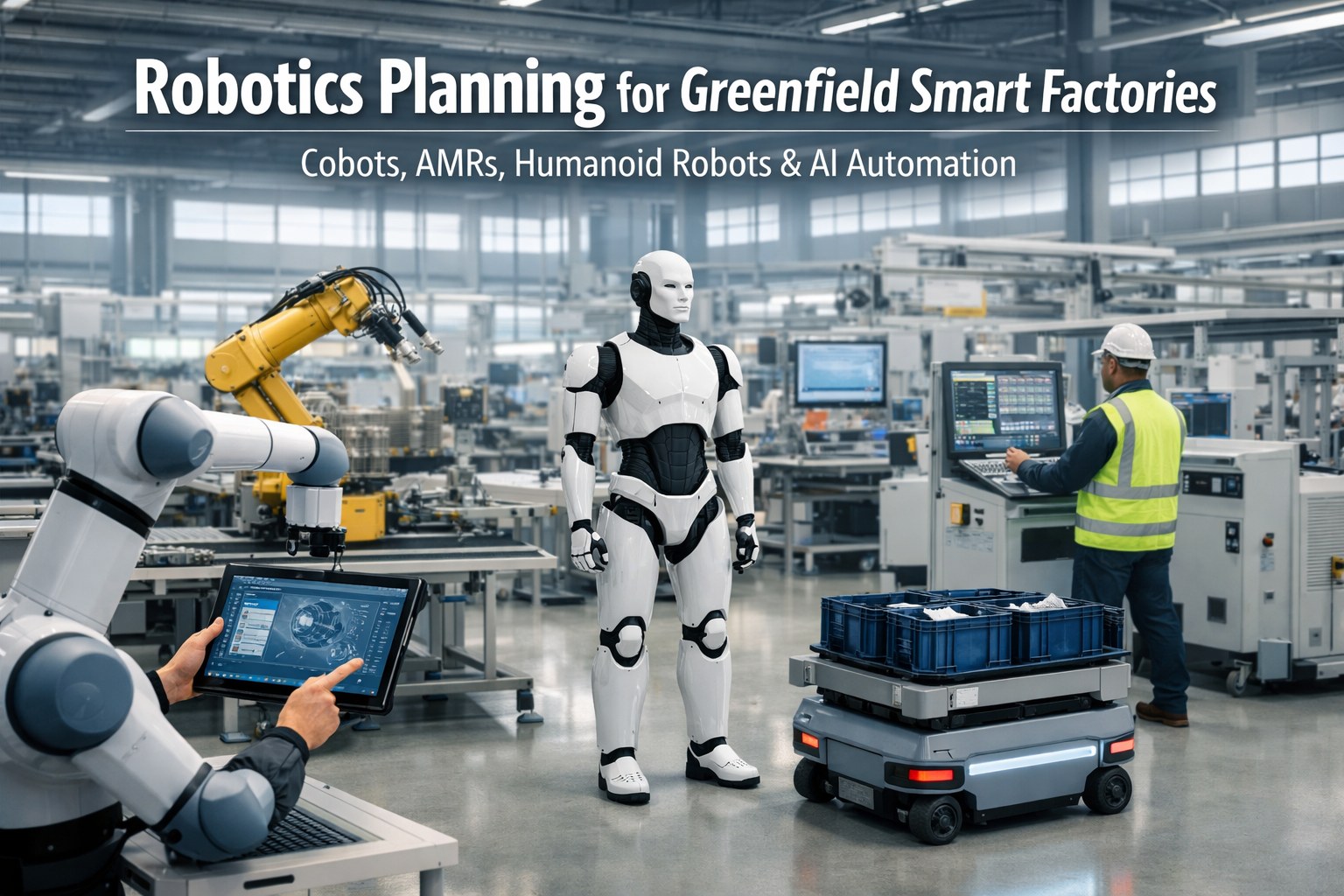
Greenfield Plant Storage & Warehouse Layout for AI Robots & AMRs
By Riley Quinn on June 19, 2026
Sixty-five percent of warehouses are planning to integrate AMRs by 2026 — but most are retrofitting robots into spaces designed for forklifts. Column grids that cannot accommodate AMR turning radii. Concrete slabs poured to FM3 flatness when AMR navigation requires FM2 or FM1. Aisle widths that create permanent bottlenecks at peak wave throughput. Wi-Fi coverage designed for handheld scanners, not 30-robot real-time orchestration. Getting warehouse layout right for AI robots and autonomous mobile robots is not a technology question — it is a construction specification question, and every wrong answer is locked in concrete before the first robot is commissioned. Book a greenfield warehouse design consultation to validate your layout, infrastructure specifications, and WMS integration architecture before structural drawings are finalized.
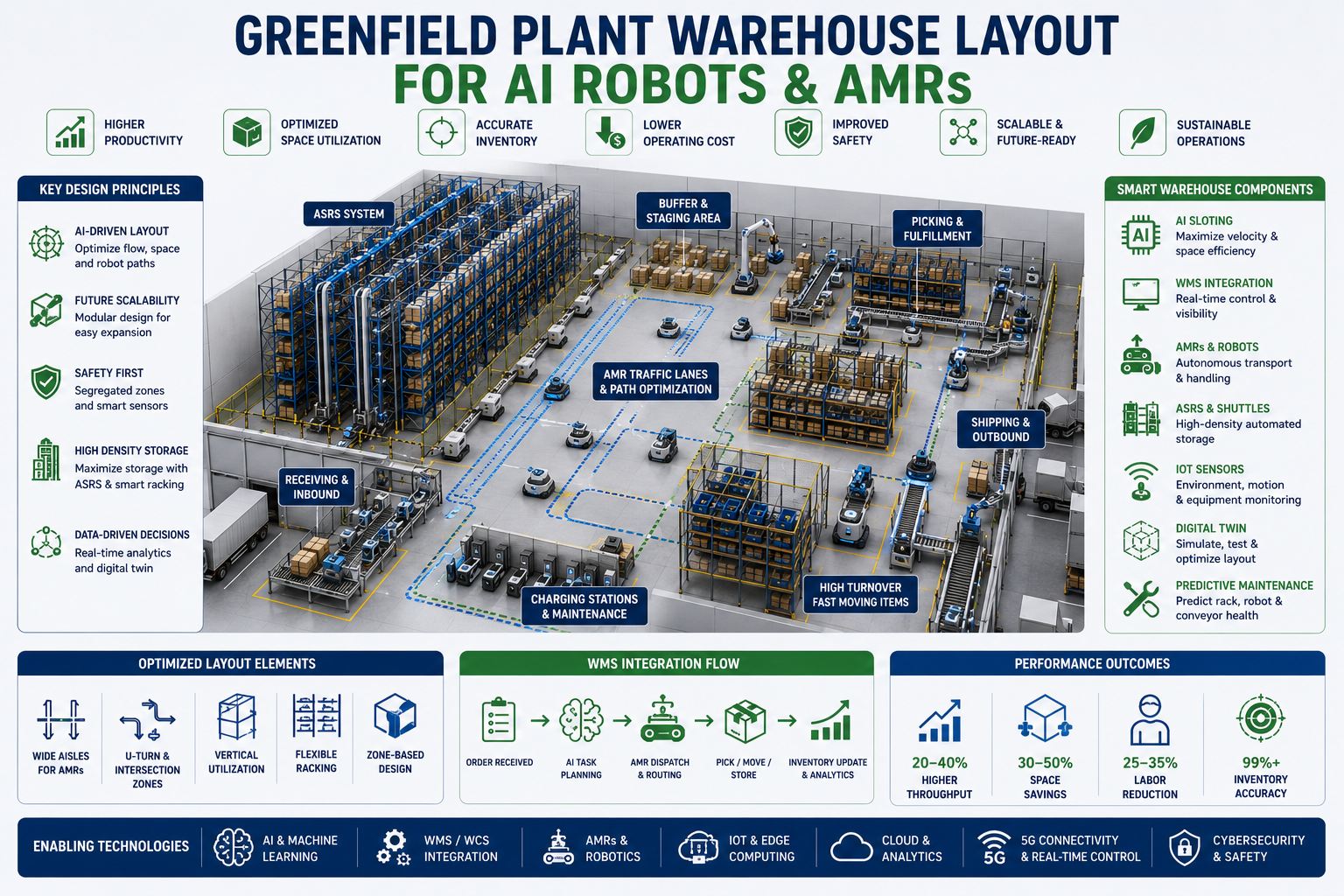
Greenfield Plant Warehouse Layout — AI Robots & AMRs 2026
The Eight-Zone Warehouse Architecture Designed for Robot-First Operations
Receiving
Dock doors, depal, inbound QC
Inbound Staging
AMR handoff buffer
Bulk Storage
ASRS / pallet rack / C-class
Forward Pick Zone
A/B-class, goods-to-person
AMR Charging Bay
Fleet-sized, fast-charge
WMS / AI Orchestration
Real-time task assignment to all robot types
Pack & Sort
Automated or hybrid
Quality Hold
Quarantine, sampling
Returns Processing
Inspection, restock, disposal
Outbound Staging
Lane allocation, manifesting
Dispatch Dock
Load, scan, depart
4x
Pick efficiency increase with AMRs vs. manual pick walking
50%
Cycle time reduction documented after AMR integration
30%
Operating expense reduction from warehouse automation (McKinsey)
12 to 24 mo
Typical WMS + AMR deployment ROI payback period
Physical Infrastructure: The Design Decisions That Robot Vendors Never Tell You About
AMR and robot vendors sell the hardware. Nobody sells you the physical infrastructure decisions that determine whether those robots operate at 85% utilization or 55% — because those decisions are made by architects and structural engineers who have never commissioned a robot fleet. In a greenfield plant, these infrastructure decisions are made once and lived with for decades. The concrete flatness specification, column grid spacing, ceiling height for ASRS integration, and charging station power provision are not adjustable after construction.
Physical Infrastructure Specifications for AMR and Robot-Ready Warehouses
Specification
Manual / Forklift Warehouse
AMR-Ready Specification
Why It Matters
Concrete Flatness
FM3 — ±7 mm over 3 m
FM2 or FM1 — ±5 mm or ±2 mm over 3 m
AMR LiDAR navigation errors compound on rough floors. FM3 causes navigation drift at speed — AMRs slow down or stop to recalibrate.
Column Grid
9 m x 9 m typical
12 m x 12 m or 12 m x 24 m
Columns inside AMR traffic zones force navigation detours. Wider grid allows straight AMR corridors — reduces travel time and collision risk.
Clear Height
8 to 10 m eave height
12 m minimum for ASRS; 16 m+ for unit-load ASRS with triple-deep storage
Clear height determines ASRS storage density. Every additional meter of height eliminates floor footprint requirements — wrong height cannot be corrected post-construction.
Aisle Width
3.5 m+ for counterbalance forklift
1.8 to 2.4 m for collaborative AMR; 1.2 to 1.5 m for AMR-only narrow aisle
Narrow aisles increase storage density by 20 to 40%. AMRs enable safe narrow-aisle operation without human driver risk — but only if rack systems are specified accordingly.
Charging Station Power
Not applicable
3-phase 32 A circuit per 2 to 4 robots; provision for 150% of initial fleet at design
Fleet expansion requires electrical capacity. Undersized subpanels force expensive electrical upgrades when fleet scales — must be provisioned at greenfield stage.
Wi-Fi Infrastructure
2.4 GHz handheld scanner coverage
Wi-Fi 6E (6 GHz) with access point density: 1 AP per 400 to 600 m², redundant mesh, <20 ms latency
AMR fleet orchestration requires real-time position updates and task assignments at sub-100 ms latency. Dense robot fleets experience 2.4 GHz congestion — 6 GHz avoids legacy device interference entirely.
Floor Load Rating
5 to 7.5 kN/m² typical
7.5 to 10 kN/m² for ASRS base loads; 12.5+ kN/m² beneath unit-load ASRS upright bases
ASRS rack concentrates load at upright base plates. Post-tension slab specification must account for point loads — standard warehouse slab specification will not support ASRS without reinforcement.
Not sure which infrastructure specifications apply to your automation plan? Book a greenfield warehouse design consultation — we will review your structural drawings against your robot fleet requirements and identify any specification gaps before construction.
Robot Type Selection: Which Automation Fits Which Warehouse Zone
The biggest layout error in robot-enabled warehouses is treating AMRs as a single category. AMRs, AGVs, goods-to-person ASRS, autonomous forklifts, and goods-to-person shuttle systems have different physical footprints, aisle width requirements, ceiling height demands, and WMS integration depths — and the right mix depends on your throughput profile, SKU count, order profile, and capital budget. Choosing the wrong robot type for a warehouse zone forces expensive reconfiguration after commissioning.
AMR (Autonomous Mobile Robot)
$25K to $80K per unit / RaaS from $1,500/month
Aisle width needed1.8 to 2.4 m (shared with humans); 1.2 m in AMR-only lanes
NavigationLiDAR + SLAM — no fixed infrastructure required
Best zonesForward pick, goods-to-person, cross-zone transport, cycle counting
Greenfield advantageMost flexible — layout can change without infrastructure modification. Start with 15 to 30 units, scale to 300+
Most deployable for greenfield plants
Unit-Load ASRS
$3M to $15M+ installed (system-level)
Ceiling height needed12 to 30 m — drives warehouse eave height specification
Storage density3 to 5x vs. conventional pallet rack for same footprint
Best zonesBulk storage, C-class deep storage, refrigerated high-density
Greenfield requirementConcrete slab point loads and eave height must be specified before foundation pour — no retrofit path
Must specify at greenfield design — no retrofit
Goods-to-Person Shuttle (AutoStore / Exotec)
$2M to $10M system (depends on totes and ports)
FootprintGrid occupies 80 to 95% of floor area — must be planned into warehouse footprint at design
Pick rate650 to 1,000+ tote deliveries per hour (AutoStore typical)
Best zonesHigh-velocity A-class SKUs with small unit pick profiles — e-commerce, pharma, cosmetics
Greenfield requirementGrid foundation, power supply for robot charging, and workstation port positions in architectural drawings
Floor plan must accommodate grid at design
Autonomous Forklift / AGV
$80K to $200K per unit
Aisle width needed2.5 to 3.5 m — similar to conventional counterbalance
NavigationMixed — laser reflector maps or natural feature LiDAR. Some require reflector installation.
Best zonesInbound/outbound dock operations, pallet movement from ASRS to staging, heavy-load transport
Greenfield requirementReflector mounting points (if required by chosen vendor) must be specified on building drawings
Standard aisle widths — plan reflectors if needed
WMS Integration Architecture: The Software Foundation That Makes Robots Intelligent
AMRs without WMS integration are expensive conveyor belts — they move things, but they do not know what to move, when to move it, or where it belongs in your inventory architecture. WMS integration transforms a robot fleet from a physical asset into an intelligent fulfillment system. In a greenfield warehouse, WMS integration architecture is specified alongside the physical layout — because WMS task assignment logic determines pick zone sizing, staging area dimensions, and how many AMR handoff points each zone needs.
WMS to AMR Orchestration Architecture — Greenfield Design Layer
AMRsASRS cranesAutonomous forkliftsShuttle systems
Orchestration-first design is the defining trend of 2026. Point solutions hit ceilings — merge starvation, congestion, manual resets — unless a higher orchestration layer manages shared capacity and task priorities across the full mixed fleet.
Designing your WMS and robot orchestration architecture? Book a greenfield warehouse WMS consultation — we will specify the integration architecture that connects your ERP, WMS, and robot fleet before software procurement begins.
Get Your Greenfield Warehouse Layout Validated for Robot-First Operations
iFactory's greenfield warehouse consultation covers zone layout design, robot type selection by zone, physical infrastructure specification (concrete, column grid, ceiling height, power, Wi-Fi), WMS and fleet orchestration architecture, and intelligent slotting strategy — all validated in a digital twin before structural drawings are finalized.
AI-Driven Intelligent Slotting: The WMS Capability That Pays Back Fastest
Slotting — the assignment of SKUs to storage locations — is the single highest-leverage optimization available in a warehouse operation. In a manually slotted warehouse, A-class items end up in inconvenient locations as product mixes change, operators build tribal knowledge about where things actually are versus where the system says they are, and pick routes gradually lengthen as slot assignments drift. AI slotting engines continuously optimize slot assignments based on velocity, pick affinity, cube, weight, and AMR travel time — and in a greenfield warehouse with no legacy slot assignments to unwind, day-one AI slotting produces maximum returns from commissioning.
A-Class SKUs
Top 20% of SKUs driving 80% of picks
Placement Strategy
Golden zone ergonomic height (knuckle to shoulder). Front of forward pick zone — shortest AMR travel path from storage to pick station. Group with pick-affinity partners (items frequently picked in same order).
Pick travel time reduction: 25 to 40%
B-Class SKUs
Next 30% of SKUs driving 15% of picks
Placement Strategy
Mid-zone positions — accessible but behind A-class. High or low ergonomic reach acceptable. Organized by physical cube and weight compatibility with A-class pick paths to minimize AMR repositioning between picks.
Combined A+B zone density optimized for wave throughput
C-Class SKUs
Bottom 50% of SKUs driving 5% of picks
Placement Strategy
Deep storage or ASRS — highest density, lowest accessibility acceptable. Top or floor-level positions. AMR retrieval tolerable given infrequent pick rate. AI monitors slow-movers for reclassification or obsolescence flagging.
ASRS density: 3 to 5x floor rack for same footprint
How AI Re-Slotting Works in a Greenfield WMS
1
WMS collects pick history, order affinity patterns, AMR travel telemetry, and velocity data for every SKU in real time
2
AI engine identifies slot assignment changes that would reduce total travel distance for next wave — re-ranks A, B, C classification continuously
3
System proposes re-slotting moves during low-volume windows — AMRs execute moves automatically without human intervention or production disruption
4
WMS verifies new slot performance against travel time baseline — documents improvement for operational reporting and continuous tuning
AMR Charging Station Design: The Infrastructure Decision That Determines Fleet Availability
Charging station design determines AMR fleet availability. An under-sized charging bay causes robots to queue for charging during peak operations — reducing effective fleet utilization from 85% to 55% or lower. Charging bay design is determined by battery chemistry (lithium-ion vs. lithium ferro phosphate), charge rate, shift pattern, fleet size, and whether you use opportunity charging (partial charges during task gaps) or scheduled charging (full charge during shift changeover). In a greenfield facility, charging bays are designed into the floor plan with dedicated power infrastructure. Retrofit charging bays are usually located in suboptimal positions because the optimal positions have already been committed to rack or dock equipment.
AMR Charging Station Design Requirements by Fleet Size
Parameter
Small Fleet (10 to 30 AMRs)
Medium Fleet (30 to 100 AMRs)
Large Fleet (100 to 300+ AMRs)
Charger positions at design
8 to 12
25 to 40
80 to 120+
Electrical provision (3-phase)
3x 32 A circuits
8 to 12x 32 A circuits
Dedicated sub-panel 200 to 400 A
Floor area for charging bay
40 to 60 m²
120 to 200 m²
400 to 800 m²
Opportunity charging points
2 to 4 (at pick stations)
8 to 15 (distributed)
30+ (zone-distributed)
Scale provision at design
150% of initial fleet capacity
150% of initial fleet capacity
130% of initial fleet capacity
Rule: Always provision charging infrastructure at 150% of initial fleet at greenfield design. Fleet expansion is predictable — electrical sub-panel upgrades in live facilities cost $40K to $120K and require production downtime.
Expert Perspective: Orchestration-First Is the Only Greenfield Warehouse Strategy That Works
The most successful greenfield warehouse deployments in 2026 share one common design decision: they build for orchestration from day one, not for individual robot types. Point solutions — a single AMR vendor's fleet, a standalone ASRS system, a WMS that cannot talk to the fleet manager — all hit operational ceilings within 12 to 18 months. Merge starvation at pick stations, congestion in shared aisles, robots queuing at chargers during peak waves, manual resets when task queues get out of sync. The facilities that avoid all of this design the orchestration layer first — they specify what the WMS must deliver to the fleet manager, what the fleet manager must deliver to each robot type, and what the physical layout must enable for those data flows — then they select the physical equipment that fits the architecture. That is orchestration-first design. It is harder to sell because it requires decisions before the vendor demos. It delivers 2 to 3 times better operational performance because everything is designed to work together from the start.
— iFactory Greenfield Consulting, Warehouse Automation Practice 2025 to 2026
65%
of warehouses planning AMR integration by 2026 — mostly brownfield retrofits
17.5%
Annual AMR market growth rate — projected $4.1B sector by 2028
99%+
Inventory accuracy achievable with WMS + RFID in properly designed greenfield warehouse
Ready to design your greenfield warehouse for orchestration-first robot operations? Talk to our warehouse automation team — we will review your throughput requirements, SKU profile, and layout constraints before recommending a robot architecture.
Design Your Greenfield Warehouse for Day-One Robot Operational Excellence
iFactory's greenfield warehouse consultation delivers zone layout design, robot type selection matrix, physical infrastructure specifications (concrete, column grid, ceiling height, power, Wi-Fi), WMS integration architecture, AI slotting strategy, and charging station design — all validated before structural drawings are issued for construction.
What concrete flatness specification do AMRs require and why does it matter?
AMRs require FM2 (±5 mm deviation over 3 m) or FM1 (±2 mm) per TR34 standards — not the FM3 (±7 mm) specification common in standard warehouse construction. AMR LiDAR navigation systems build a floor map during initial deployment and expect consistent height data across the operating area. FM3 floor variation causes AMR navigation drift at operating speeds — the robot either slows to recalibrate, takes corrective path deviations that reduce throughput, or triggers false obstacle detections. FM1 is required for high-density ASRS crane systems where any rail misalignment produces load accuracy errors. Specifying FM2 at greenfield adds approximately 8 to 12% to concrete slab cost — versus $50,000 to $150,000 per section for floor grinding remediation in a live facility.
How many AMRs should a 100,000 sq ft greenfield warehouse be designed for?
A typical 100,000 sq ft facility starts with 15 to 30 AMRs depending on throughput requirements, pick zone layout, and shift configuration. The key greenfield principle is not sizing for the initial fleet but designing physical and electrical infrastructure for 150% of the expected 5-year fleet size. Charging station capacity, Wi-Fi access point density, and sub-panel electrical provision should all be provisioned for fleet growth — the incremental greenfield cost is minimal, and the retrofit cost when you need to scale is $40,000 to $120,000 per upgrade event plus production downtime. Fleet orchestration software should be selected for 300+ robot scalability even if you start with 20 units.
When is ASRS the right choice over conventional rack in a greenfield warehouse?
ASRS is the right choice when storage density is the primary constraint and ceiling height is available to exploit. ASRS delivers 3 to 5 times the storage density of conventional pallet rack for the same floor footprint — which translates directly to reduced building footprint and land cost at greenfield. The breakeven analysis depends on your cubic storage requirement, local construction cost per square meter, and operating labor cost (ASRS eliminates forklift operators in the storage zone). Unit-load ASRS requires 12 to 30 m ceiling height — which must be specified before the building eave height is committed. This is why ASRS is a greenfield design decision that cannot be retrofitted without reconstructing the building envelope.
What Wi-Fi specification does a 50-robot AMR fleet actually need?
A 50-robot AMR fleet requires Wi-Fi 6E (6 GHz band) with access point density of one AP per 400 to 600 square meters, redundant mesh coverage with no single-AP zones, and sub-20 ms end-to-end latency for robot task assignment and position reporting. The 2.4 GHz band used for handheld scanners in legacy warehouses becomes congested with 20+ AMRs simultaneously transmitting position data, map updates, and task confirmations — causing navigation delays and task queue synchronization failures. 6 GHz is the correct specification because it avoids legacy device interference entirely, supports the higher bandwidth requirements of dense robot fleets, and provides the throughput needed for multi-robot orchestration at sub-100 ms response time.
How does iFactory's greenfield warehouse consultation work and what does it cover?
iFactory's greenfield warehouse consultation covers your throughput requirements and SKU profile analysis, zone layout design across all eight warehouse zones, robot type selection by zone with CapEx and RaaS comparison, physical infrastructure specification document (concrete flatness, column grid, ceiling height, floor load, power, Wi-Fi), WMS and fleet orchestration integration architecture, AI slotting strategy and ABC classification framework, charging station design and electrical provision, and construction-ready specification outputs that your architects and contractors build from directly. Book your greenfield warehouse design consultation here.