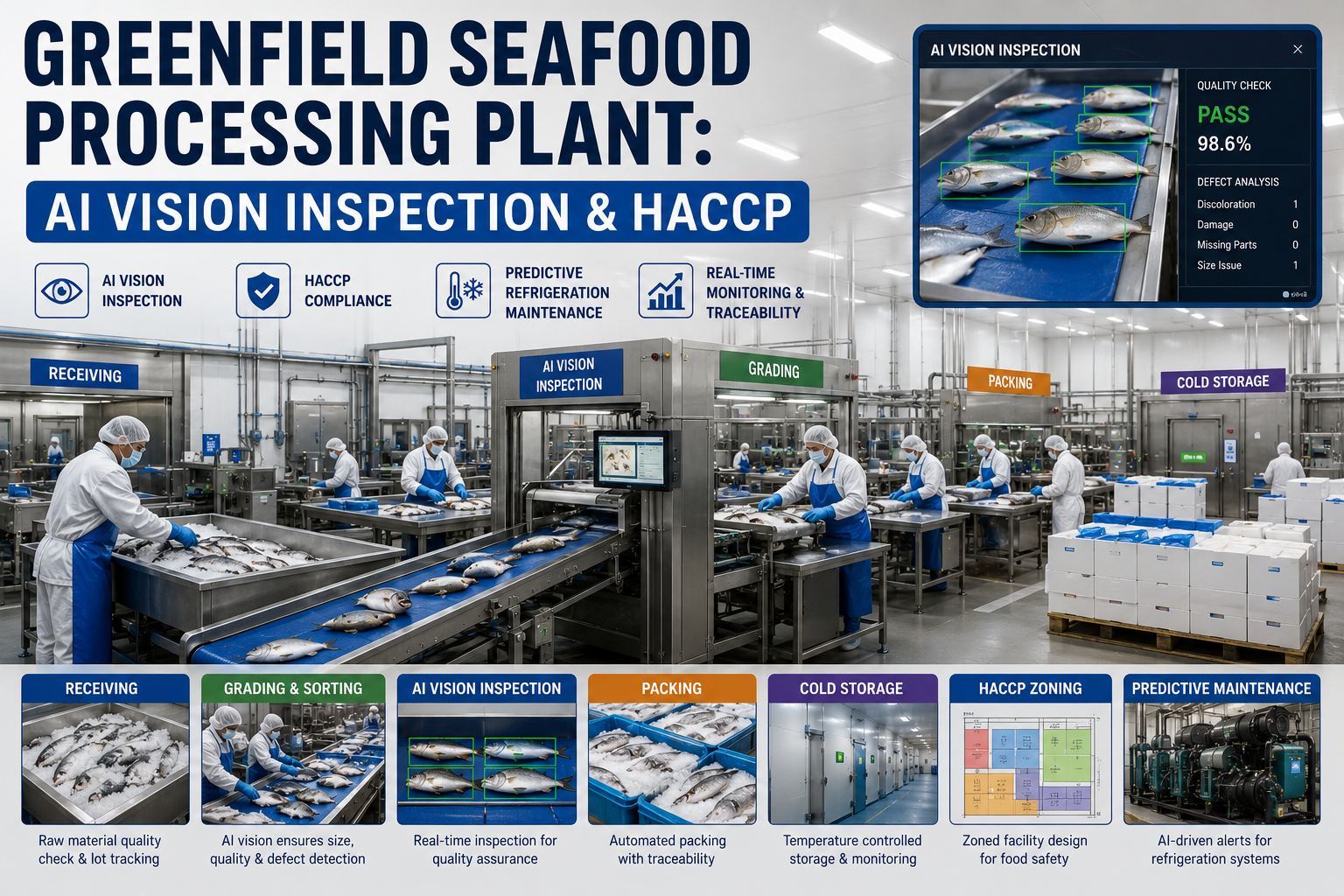
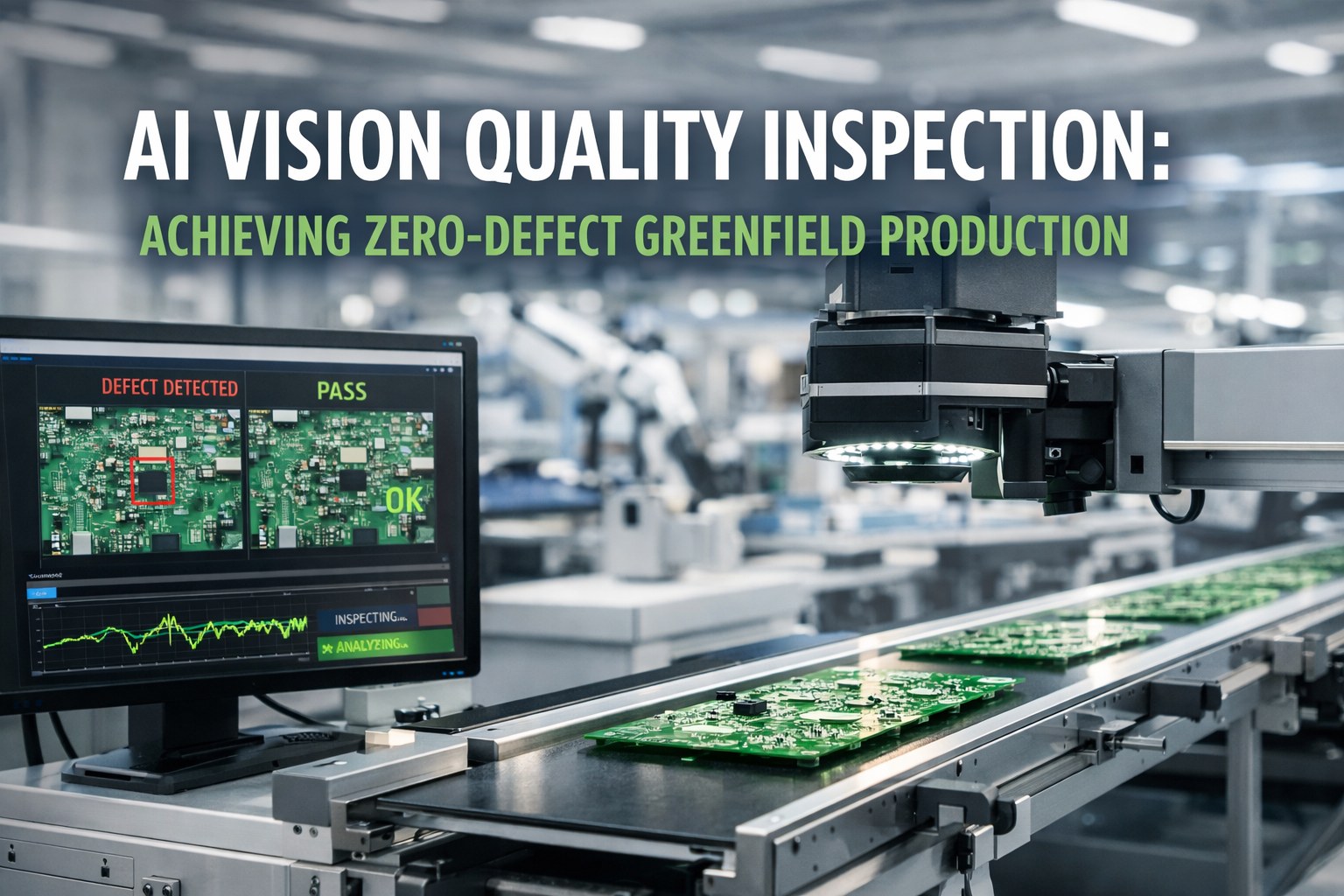
Seafood is the most perishable food category in commercial processing. Histamine forms in scombroid fish within hours of temperature abuse. Listeria monocytogenes grows at refrigerator temperatures. Allergen cross-contact between shellfish and finfish lines triggers FDA recall in any plant without zone separation engineered in at design. And FSMA 204 — fully enforced in 2026 — requires lot-level traceability on every Key Data Element from receiving through dispatch. Building a seafood processing plant without HACCP zoning, AI vision inspection, and cold chain monitoring designed in from day one is not a competitive disadvantage. It is a regulatory liability that becomes visible at the first FDA inspection. Book a greenfield seafood processing consultation to validate your HACCP zoning, AI inspection architecture, and cold chain monitoring specification before construction drawings are issued.
Greenfield Seafood Processing Plant Design — AI Vision & HACCP 2026
Process Flow With Temperature Discipline at Every Stage
Receiving & Inspection
Wet dock or refrigerated dock. Lot capture, supplier verification, time-temperature audit at intake.
CCP1 — Cold chain compliance at receipt
Grading & Sorting
Size, species, quality grading. AI vision identifies defects, parasites, foreign objects, freshness markers.
CCP2 — Parasite and foreign object detection
Processing & Portioning
Filleting, gutting, deheading, skinning, portioning. Process control prevents temperature dwell above limit.
CCP3 — Time-temperature exposure control
IQF / Blast Freezing
Individual Quick Freezing to core temperature ≤−18°C. Spiral or tunnel freezer with airflow validation.
CCP4 — Freezing rate and core temperature
Packing & Labelling
Vacuum, MAP, or block pack. AI vision verifies label accuracy, allergen statement, lot code, date code.
CCP5 — Label and allergen verification
Cold Storage & Dispatch
Frozen storage at −18°C or below. AI cold chain monitoring tracks integrity to truck handover.
CCP6 — Storage temperature continuity
≤4°CMaximum fresh seafood handling temperature — non-negotiable HACCP requirement
FSMA 204Lot-level traceability now required at every Key Data Element
60%Of food AI adoption now focused on real-time inspection and contamination detection
21 CFR 123FDA Seafood HACCP regulation governing every US processing plant
HACCP Zoning: The Physical Layout That Stops Cross-Contamination Before It Starts
Seafood HACCP is not a paperwork exercise — it is a physical design constraint. Raw and ready-to-eat zones must be separated by walls, dedicated personnel flow, separate utility services, and unidirectional product flow. Allergen species (crustacean, mollusc, fish) must not share production lines without engineered cleaning verification. Wet processing zones must drain independently from dry packaging zones. Every one of these requirements is a building design decision — locked in before the first concrete slab is poured.
Raw Zone
High-Risk Wet Processing
Receiving, gutting, filleting, washing, brining
Sloped epoxy floor with floor drains at 3 m centres
Wall to ceiling FRP cladding with coved corners
Air pressure: negative relative to RTE zones
Dedicated personnel entry with handwash + boot wash
Wall barrier + personnel changeover
RTE Zone
Ready-to-Eat Packing & Labelling
Smoking, curing, MAP packing, vacuum, labelling, secondary packaging
Sealed concrete or epoxy floor — no standing water
Smooth wall finishes, environmental swab program
Air pressure: positive relative to raw zones (HEPA-filtered)
Dedicated RTE personnel — no cross-zone movement
Allergen Zone Separation
Finfish
Crustacean (shrimp, crab, lobster)
Mollusc (oyster, scallop, clam)
Each allergen species requires dedicated processing equipment OR validated cleaning protocol with allergen-specific swab verification between species changeover. Shared lines without verification = mandatory FDA recall on detection.
Need HACCP zoning analysis for a seafood plant in early design? Book a greenfield seafood consultation — we will produce the zone separation drawing, allergen flow analysis, and air pressure cascade specification before architectural drawings are finalised.
AI Vision Inspection: Seven Detection Tasks Designed In, Not Added Later
Manual seafood inspection at line speed misses 15 to 30% of detectable defects — parasites in white-flesh fish, foreign objects from net debris, discoloration indicating spoilage, missing or incorrect labels. Operator fatigue compounds the problem on multi-shift production. AI vision systems trained on seafood-specific defect models achieve 99%+ detection accuracy across these tasks — but require camera mounting points, lighting fixtures, edge compute provision, and MES integration designed into the line at greenfield, not retrofitted into a finished facility.
01
Parasite Detection
UV transillumination + AI image analysis
Anisakis, copepods, and other parasites in white-flesh fish during candling stage
Accuracy: 98 to 99.5% vs. 70 to 85% manual
02
Foreign Object Detection
X-ray + AI image analysis
Bones, net fragments, hooks, plastic, metal, stones at processing stages
Detection limit: 1 mm bone fragments, 0.3 mm metal
03
Freshness Grading
RGB + hyperspectral imaging
Eye clarity, gill colour, flesh translucency — quality score 1 to 10 per piece
Correlation with sensory panel: 0.92 to 0.96
04
Size & Weight Estimation
3D stereo vision + AI volumetric model
Weight estimation within 2 to 4% accuracy without contact, for sorting and pricing
Throughput: up to 200 pieces per minute per camera
05
Species Verification
RGB + AI species classification
Detects species substitution fraud — economically motivated adulteration
Accuracy: 97 to 99% across 40+ commercial species
06
Label & Allergen Verification
RGB camera + OCR + AI verification
Label accuracy, allergen statement presence, lot code legibility, date code format
Critical for FSMA 204 and allergen labelling compliance
07
Package Seal Integrity
Vision + pressure differential analysis
Vacuum bag wrinkles, MAP seal contamination, tray heat-seal defects
Eliminates 95% of seal-related customer complaints
Get AI Vision Inspection Designed In — Not Bolted On After Commissioning
iFactory's greenfield seafood consultation covers HACCP zoning, AI vision inspection station specification, cold chain monitoring architecture, FSMA 204 traceability design, and predictive refrigeration maintenance — all delivered before architectural and process drawings are issued.
Cold Chain Monitoring & Predictive Refrigeration Maintenance
Refrigeration is the most critical and most expensive utility in a seafood plant. Compressor failure during production destroys product worth far more than the compressor itself. Cold storage temperature excursion beyond HACCP limits triggers regulatory holds on every product in the storage period. Predictive refrigeration maintenance and continuous AI cold chain monitoring are not premium upgrades — they are the only architecture that keeps a seafood plant operating without recall risk.
Cold Chain Monitoring
Receiving Dock
Wireless probe temperature at receipt, AI verifies against supplier data
Processing Rooms
Multiple zone sensors — alarms before product temp exceeds 4°C dwell
IQF / Blast Freezer
Core probe in each batch + freezer airflow validation
Cold Storage
Sensor grid with redundancy — fail-safe at single sensor failure
Dispatch & Trailer Loading
Door dwell tracking + truck reefer temp verification before release
Output: Continuous audit trail per lot — FSMA 204 ready, FDA inspection ready, customer audit ready
Predictive Refrigeration Maintenance
Compressor Vibration
Bearing wear and valve degradation detected 4 to 6 weeks before failure
Refrigerant Charge
Pressure differential identifies leaks before efficiency degrades — EPA reporting
Evaporator Frosting
Airflow and superheat monitoring schedules defrost cycles precisely — no over-frosting
Condenser Performance
Pressure and temperature differential detects fouling before COP collapses
Motor Current Analysis
Winding degradation detected weeks before insulation failure
Output: 70%+ reduction in unplanned refrigeration outages — most expensive failure mode eliminated
FSMA 204 Traceability: What Must Be Captured at Each Key Data Element
The FDA's Food Safety Modernization Act Rule 204 — fully enforced in 2026 — requires lot-level traceability data capture at every Key Data Element (KDE) for high-risk foods including seafood. The data must be retrievable within 24 hours of FDA request. Plants without automated capture rely on manual lot reconciliation — which fails recall response time tests and triggers expedited enforcement. In a greenfield plant, KDE capture is designed into the MES architecture from day one — every receipt scan, processing step, and dispatch transaction is captured automatically.
Process Step
Required KDE Data
Greenfield Capture Method
Receiving
Supplier lot, date/time, qty, traceability lot code (TLC)
Barcode scan + temperature probe + supplier EDI
Transformation
Input lots, output lot, process time, equipment ID
MES automated lot genealogy with PLC integration
Packing
Pack date, lot code on label, allergen statement, weight
AI label verification + checkweigher + serialization
Shipping
Recipient, ship date/time, qty, trailer temp verification
WMS dispatch + reefer telemetry + ASN/BOL integration
Expert Perspective: Why Seafood HACCP Demands a Greenfield-Native Approach
A seafood plant designed without HACCP zoning, AI vision, and cold chain monitoring in mind is not just an inefficient plant — it is a plant whose food safety capabilities are mechanically capped by its building shell. Air pressure cascades cannot be reversed after construction. Drainage routes cannot be re-graded once the slab is poured. Camera mounting positions for AI inspection cannot be added cleanly to finished ceiling structures. Cold storage envelope insulation cannot be upgraded without taking the room offline. Every one of these limitations becomes a HACCP exposure that the plant operations team must work around for the building's life. Greenfield is the only opportunity to build a plant where HACCP, AI inspection, and FSMA 204 capability all work together because they were designed together — not because they were retrofitted around each other after the fact.
— iFactory Greenfield Consulting, Food & Beverage Practice 2025 to 2026
98–99.5%
AI vision parasite detection accuracy vs. 70–85% manual candling
24 hr
FSMA 204 data retrieval requirement — automated capture is the only reliable path
70%+
Reduction in unplanned refrigeration failures with AI predictive maintenance
Ready to design a greenfield seafood plant where HACCP, AI vision, and FSMA 204 traceability are engineered together? Talk to our seafood plant team — we will produce the zoning brief, AI vision station spec, cold chain monitoring architecture, and traceability data model before architectural drawings are finalised.
Design Your Greenfield Seafood Plant for Compliance, Quality & Throughput From Day One
iFactory's greenfield seafood plant consultation covers HACCP zoning and allergen separation, AI vision inspection station design across all seven detection tasks, FSMA 204 traceability data architecture, cold chain monitoring sensor specification, predictive refrigeration maintenance brief, and MES integration — all delivered before architectural and process drawings are issued.
Frequently Asked Questions
What are the FDA HACCP requirements for a new seafood processing plant in the US?
All US seafood processors operate under 21 CFR Part 123 — the FDA's seafood HACCP regulation. The requirements include a written HACCP plan covering biological, chemical, and physical hazards for each species and process flow, identification of Critical Control Points with monitored limits, sanitation control procedures per 21 CFR 123.11 with written SSOPs and records, and FSMA 204 traceability for high-risk seafood including raw bivalve molluscs and certain finfish species. In a greenfield plant, all of these requirements translate to physical design constraints — zone separation walls, drainage routes, air pressure cascades, sensor positions for temperature monitoring, and MES architecture for traceability capture. Designing for HACCP at greenfield is significantly cheaper than retrofitting compliance into a completed building.
How does AI vision improve parasite detection in seafood compared to manual candling?
Manual candling — passing fish over backlit tables for visual inspection — detects 70 to 85% of parasites in white-flesh fish under ideal conditions. Detection drops sharply under operator fatigue, high line speed, or low-contrast presentations. AI vision systems using UV transillumination achieve 98 to 99.5% detection accuracy on parasites including Anisakis, copepods, and trematodes — and maintain that accuracy at line speed across multi-shift operations because they do not fatigue. The AI model is trained on species-specific parasite morphology and presents detection results to operators with annotated images for verification. The greenfield design requirement is camera mounting with UV illumination geometry specified at line layout — not retrofitted after commissioning.
What does FSMA 204 require for seafood traceability and when does it apply?
FSMA 204 — the FDA's Food Traceability Rule under the Food Safety Modernization Act — requires expanded traceability records for foods on the Food Traceability List, which includes raw bivalve molluscs (oysters, mussels, clams) and certain finfish. Records must capture Key Data Elements at each Critical Tracking Event including receiving, transformation, creation, and shipping. The compliance date is January 20, 2026. Plants must provide records to FDA within 24 hours of request. The required data — supplier lot, traceability lot code, dates, quantities, location identifiers — must be captured at the point of activity, not reconstructed afterwards. Automated capture via MES, WMS, and EDI is the only practical approach. Manual systems fail the 24-hour retrieval test in real recall scenarios.
Why does cold chain monitoring need to be designed in at greenfield rather than retrofitted?
Cold chain monitoring requires sensors at receiving docks, processing rooms, IQF and blast freezers, cold storage spaces, and dispatch areas — all with wireless network coverage that survives the refrigerated, condensation-heavy environment. Retrofitting wireless network infrastructure into operating cold storage rooms requires shutting down the room — and cold storage shutdown means moving the entire inventory, finding refrigerated alternate storage, and accepting the food safety risk of the move. In a greenfield plant, sensor mounting brackets, cable routes, and wireless access points are specified during electrical drawings — installed during construction with no shutdown impact. The sensors themselves are commodity; the access architecture is what must be designed in.
How does iFactory's greenfield seafood plant consultation work?
iFactory's consultation covers your processing scope and species mix, HACCP zoning brief with allergen separation drawing, AI vision inspection station specification across all relevant detection tasks (parasite, foreign object, freshness, size, species, label, seal), cold chain monitoring sensor schedule with redundancy and network architecture, predictive refrigeration maintenance brief, FSMA 204 traceability data architecture and MES integration design, and CIP automation specification. All outputs are specification-ready documents for your architectural team, equipment vendors, and MES integrators — delivered before drawings are finalised.
Book your greenfield seafood plant consultation here.