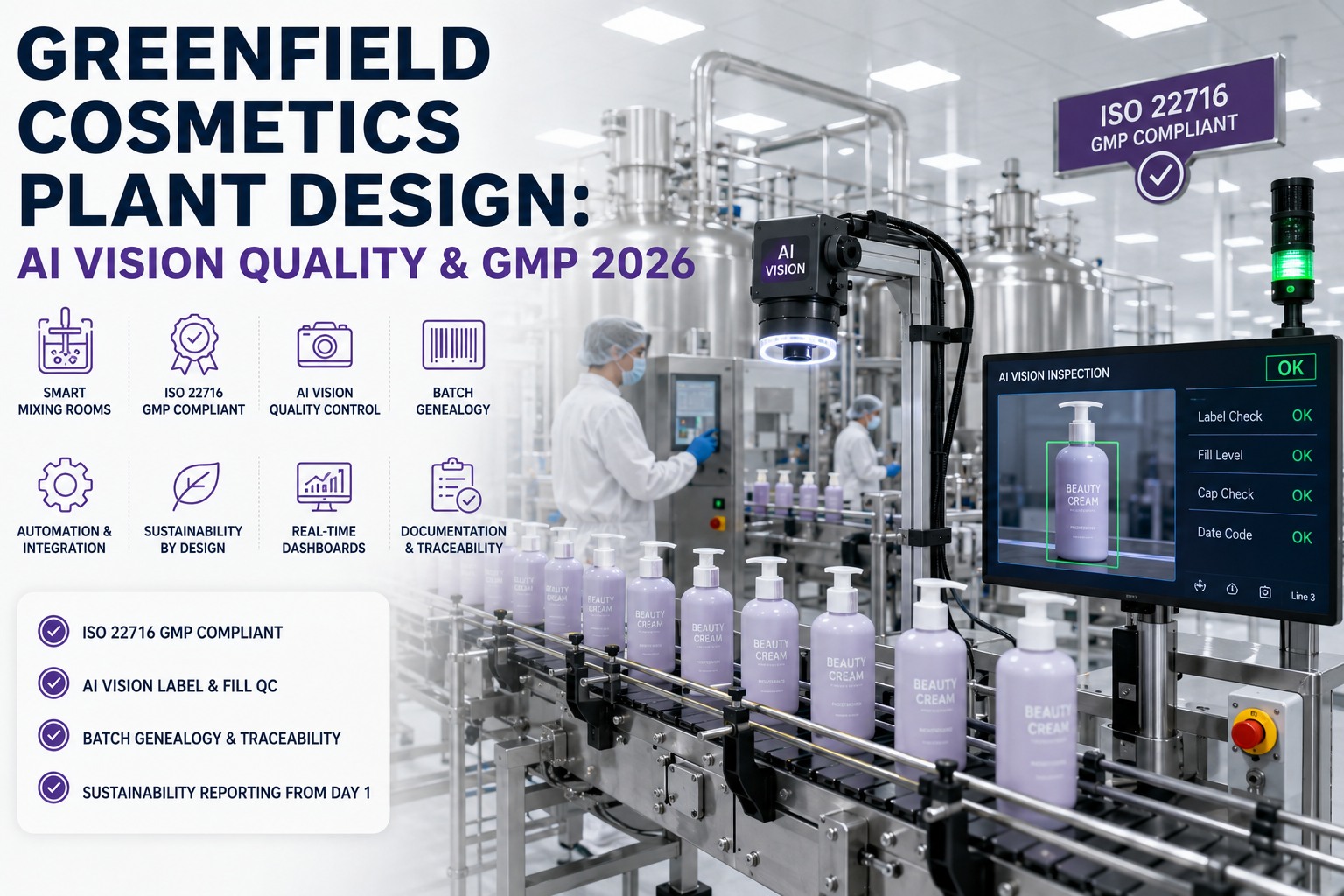
Beauty brands launch faster than ever, ingredient lists grow more complex by the quarter, and regulators across the U.S. and EU are tightening the GMP screws. Yet most cosmetics greenfield plants are still designed around process equipment first, with quality, traceability, and compliance bolted on after commissioning. The plants winning in 2026 invert that order — they engineer ISO 22716 GMP, AI vision QC, batch genealogy, and sustainability reporting into the building plan before the first wall goes up, then layer mixing rooms and filling lines on top of that foundation. The difference shows up the first day of production, and every day after.
Four Pillars That Define a Modern Greenfield Cosmetics Plant
ISO 22716 GMP, AI vision QC, batch genealogy, and sustainability reporting — designed in from day one, not retrofitted after launch.
Process Discipline
- Segregated mixing rooms by formulation type
- Closed-loop transfer between mixers and fillers
- Validated CIP/SIP and line-clearance protocols
AI Vision Quality
- Fill level, cap torque, and seal verification
- Label OCR/OCV and barcode validation
- Shade and color consistency in real time
Batch Genealogy
- Electronic batch records replace paper logs
- Lot-level recall scoping in minutes, not days
- MES, ERP, and CMMS share one identity
Sustainability Reporting
- Water, energy, and waste KPIs per batch
- Ingredient sourcing audit trail by lot
- Auto-generated Scope 1 & 2 emission reports
Why Cosmetics Greenfield Plants Need All Four Pillars
The cosmetics manufacturing landscape has changed faster than most plant designs have caught up. SKU complexity is exploding, ingredient sourcing is under consumer scrutiny, and ISO 22716 has become the global GMP benchmark referenced by the FDA, the EU Cosmetics Regulation, and most international cosmetics regulators. A greenfield plant built on conventional CPG logic — bulk mixing, manual QC sampling, paper batch records — hits compliance friction within the first audit cycle. Build the foundation right from day one — book a cosmetics plant design session to map your 4-pillar architecture against your formulation portfolio.
defect detection accuracy achievable with deep-learning vision on packaging lines
faster recall scoping with electronic batch records vs. paper-based genealogy
false reject rate of properly trained AI vision vs. 8–10% for legacy rule-based systems
of personal care recalls trace to labeling or packaging defects that vision QC prevents
Inside the Cosmetics Mixing Room: Design Essentials
The mixing room is the heart of any cosmetics plant — and the single largest source of contamination risk, batch variability, and regulatory exposure. A greenfield design that gets the mixing room right makes every downstream stage easier. Here are the design essentials U.S. cosmetics manufacturers should specify before construction.
Formulation-Segregated Mixing Rooms
Separate rooms for water-based, oil-based, and fragrance-loaded products eliminate cross-contamination risk and simplify changeover validation. Each room operates as an independent GMP zone with its own HVAC and pressure cascade.
HVAC Pressure Cascade
Positive pressure in clean zones, neutral in transfer corridors, negative in waste areas. The cascade keeps airborne particulates flowing one direction — out of the product, not into it.
Water-for-Cosmetics System
Purified water loops with continuous TOC monitoring, validated sanitization cycles, and dead-leg-free piping. Cosmetic water quality is the foundation of formulation stability and microbial control.
CIP/SIP-Ready Equipment
Vessels, transfer lines, and homogenizers specified for clean-in-place from day one. Spray balls, drainable geometry, and validated cycle programs cut changeover time by 50% or more.
Order-of-Addition Enforcement
PLC-controlled dosing tied to barcoded weigh-out enforces order, quantity, and mixing parameters. Operators cannot skip a step — the system blocks progression and alerts QA in real time.
Line Clearance & Verification
Digital line-clearance checklists with photo evidence and supervisor sign-off prevent the most common cross-contamination event in cosmetics: residue from the previous batch.
Designing a cosmetics plant with multi-formula lines? Book a mixing room design workshop with iFactory's greenfield consulting team.
AI Vision QC: What It Catches on a Cosmetics Line
Manual visual inspection on a 200-unit-per-minute filling line is a quality fiction. Operators catch obvious defects and miss the subtle ones that drive 50% or more of personal care recalls. AI vision systems running on every fill, cap, and label station catch every category of defect at line speed — and feed every result into the batch genealogy record.
Label OCR & OCV
Misaligned labels, wrong SKU, smeared print, missing regulatory symbols, incorrect ingredient list
Fill Level Verification
Underfill, overfill, foam-induced false reads, transparent and opaque container fills
Cap & Seal Integrity
Cross-threaded caps, missing induction seals, tamper-evidence breach, pump-actuator orientation
Color & Shade Consistency
Batch-to-batch shade drift, pigment separation, foundation undertone variance, color cosmetic uniformity
Code Verification
Lot codes, expiry dates, batch numbers, 2D data matrix, serialization for premium and prestige SKUs
Container Integrity
Glass micro-cracks, plastic deformation, pump dispenser alignment, decorative cap finish defects
Build a Cosmetics Plant That Passes Audit on Day One
iFactory's greenfield platform engineers ISO 22716 GMP, AI vision QC, batch genealogy, and sustainability reporting directly into your cosmetics plant design — so your facility hits production-ready and audit-ready at the same time.
Batch Genealogy: Raw Material to Retail Shelf
The single most powerful capability a greenfield cosmetics plant can build in from day one is end-to-end batch genealogy. When a regulator asks "which finished units used supplier lot X-2078?" the answer should take minutes, not days. This is the data chain that delivers it.
Raw Material Receipt
Supplier CoA scanned, lot ID linked to PO, quarantine status applied until QC release.
Dispensary & Weigh-Out
Barcoded weighing ties exact gram quantities of each raw lot to the production batch ID.
Mix & Process
PLC logs every process parameter — temperature, time, RPM, vacuum — against the batch record.
Fill, Cap & Label
AI vision QC results write back to the batch record at every station — every unit, every defect logged.
Pallet, Ship & Shelf
SSCC pallet labels and EPCIS events publish full lineage to retailers and regulators on request.
Want lot-to-unit genealogy designed into your plant before commissioning? Schedule a batch genealogy walkthrough with iFactory's cosmetics MES specialists.
ISO 22716 GMP Greenfield Checklist
The fastest way to fail an ISO 22716 audit is to treat GMP as paperwork instead of building it into the facility. The checklist below covers the items that must be specified during design — fixing them after commissioning ranges from costly to impossible.
Personnel hygiene & training zones
Gowning rooms, hand-wash stations, and access control specified per GMP zone classification.
Premises & equipment qualification
IQ/OQ/PQ documentation built into commissioning, not assembled post-hoc by quality teams.
Raw material & finished goods controls
Quarantine zones, sampling stations, and FEFO logic built into receiving and warehouse design.
Production controls & deviations
Digital deviation logs, change control workflows, and CAPA tracking integrated into the MES.
Laboratory & QC release
In-line QC lab adjacent to filling, with LIMS integration and certificate-of-analysis automation.
Documentation & data integrity
21 CFR Part 11 and EU Annex 11 audit trails, electronic signatures, and record retention from day one.
Internal audit & complaint handling
Self-inspection workflows and complaint-to-CAPA loops modeled in the QMS before go-live.
Sustainability & waste streams
Water, energy, and waste metering at the line level — not just plant-level aggregate reporting.
Want this checklist scored against your specific cosmetics product mix and regulatory geography? Book an ISO 22716 readiness review with iFactory's GMP design team.
Expert Perspective
Cosmetics manufacturers underestimate how quickly the regulatory floor is rising. Five years ago, an ISO 22716 GMP audit was a competitive advantage. Today it's table stakes, and the conversation has moved to lot-level traceability, AI-verified packaging, and ingredient-level sustainability disclosure. The greenfield plants designed against the 2026 standard — not the 2018 one — are the ones that will still be production-ready in 2030 without expensive retrofits.
— Greenfield Cosmetics Design Best Practice, iFactory Engineering Team
unit inspection rate with AI vision vs. 1–2% sampling rate of manual QC
changeover time reduction with CIP/SIP-ready vessel design specified during plant build
to scope a recall with electronic batch genealogy vs. days with paper batch records
Engineer Your Cosmetics Plant for the Next Decade
From mixing room layout and ISO 22716 GMP to AI vision QC and full batch genealogy — iFactory builds the 2026 cosmetics plant blueprint into your greenfield design, so your facility launches audit-ready, traceability-ready, and built for the next decade of regulatory change.
Frequently Asked Questions
What is ISO 22716 and why does it matter for a greenfield cosmetics plant?
ISO 22716 is the international Good Manufacturing Practice standard for cosmetics, covering production, control, storage, and shipment of finished products. It is referenced by the FDA in the U.S. and required under the EU Cosmetics Regulation. For greenfield plants it matters because GMP compliance is far cheaper to design in than to retrofit — gowning zones, pressure cascades, and electronic batch records must be specified during construction, not after.
How does AI vision QC differ from traditional rule-based vision systems on cosmetics lines?
Traditional rule-based vision systems rely on hard-coded thresholds and struggle with the visual variation typical in cosmetics — color cosmetics, decorative caps, transparent containers, premium finishes. AI vision uses deep learning trained on real defect images, achieving up to 99.97% accuracy and false reject rates below 3% versus 8 to 10% for legacy systems. The AI also adapts to new SKUs with brief reference image enrollment rather than full reprogramming.
What is batch genealogy and how is it different from basic lot tracking?
Basic lot tracking records which lot number was used in a batch. Batch genealogy connects every raw material lot, every process parameter, every AI vision result, and every finished unit into a single auditable chain. When a regulator or retailer asks which finished units used supplier lot X-2078, batch genealogy answers in minutes. Lot tracking alone forces a manual reconstruction that can take days.
How should mixing rooms be designed for a multi-formula cosmetics plant?
Separate mixing rooms for water-based, oil-based, and fragrance-loaded products eliminate cross-contamination and simplify validation. Each room operates as an independent GMP zone with its own HVAC pressure cascade, dedicated CIP/SIP systems, and validated cleaning protocols. Greenfield designs that share mixing rooms across formula families face significantly longer changeover times and higher cross-contamination risk over the plant lifecycle.
Can sustainability and ESG reporting really be designed into a greenfield cosmetics plant from day one?
Yes — and it is far easier than retrofitting later. Line-level metering for water, energy, and waste, ingredient-lot sourcing data tied to the MES, and Scope 1 and 2 emission feeds plugged into reporting tools can all be specified during plant design at minimal incremental cost. Book a greenfield cosmetics consultation with iFactory's design team to map an ESG-ready architecture against your sustainability commitments.