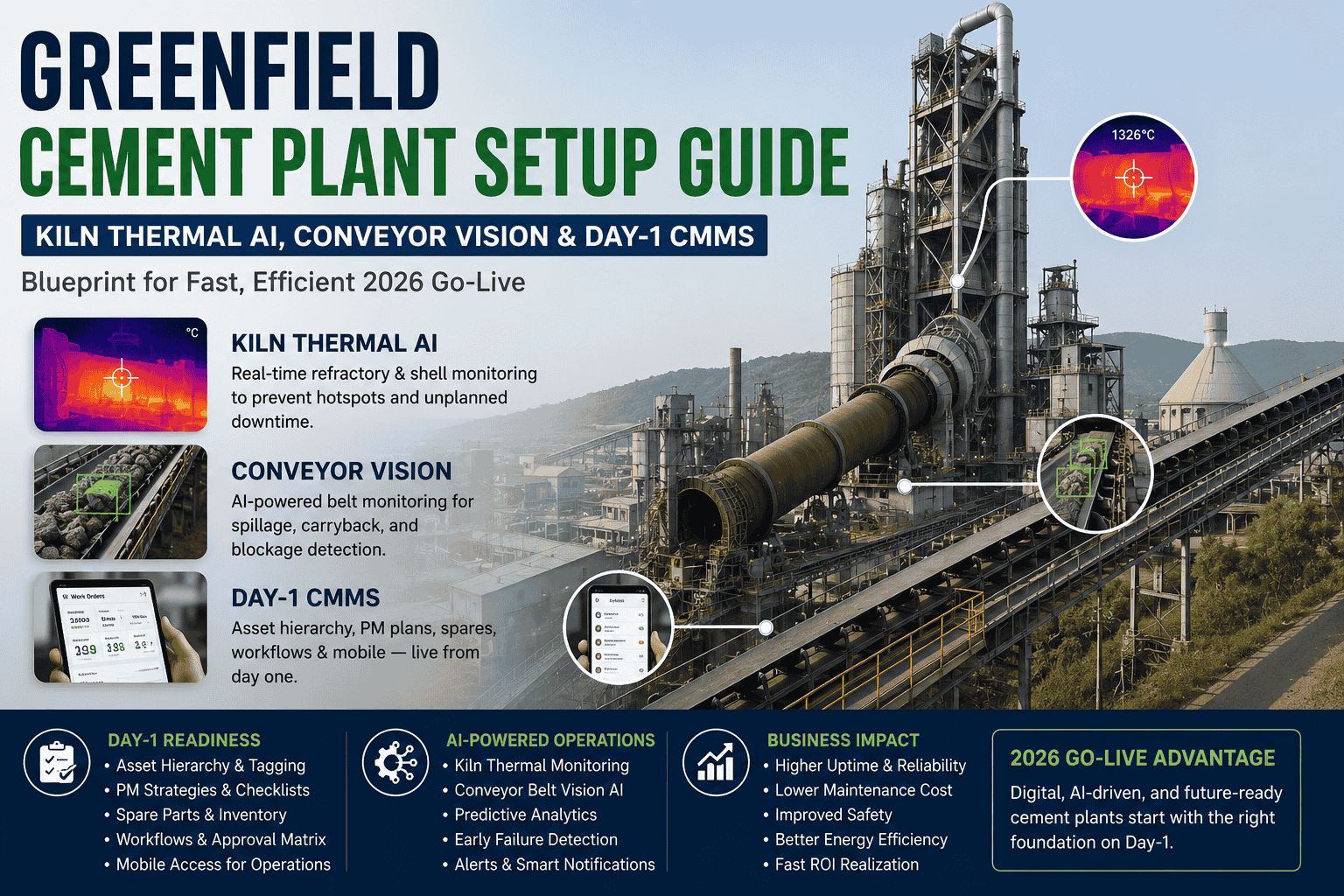
A cement greenfield plant commissions with more critical rotating equipment per square meter than almost any industrial facility type — kilns running at 1,400°C, conveyor networks spanning 5–15 kilometers, raw mills, preheater towers, and clinker coolers all starting up simultaneously. Every day of commissioning delay costs $50,000–$200,000 in lost clinker output, and the thermal, dust, and vibration conditions that define cement plant environments start degrading equipment from the moment first clinker flows. The plants that achieve fast, stable go-live in 2026 are the ones that design kiln thermal AI, conveyor vision, and CMMS into the facility before commissioning begins — not after the first unplanned stop makes the case.
Design your cement plant AI deployment blueprint with iFactory — kiln thermal monitoring, conveyor vision, and Day-1 CMMS integration, scoped before your EPC contractor finalizes the plant layout.
Day-1 Deployment Blueprint
Greenfield Cement Plant: From Construction to Live AI Monitoring
Three systems — kiln thermal AI, conveyor vision, and CMMS — must be commissioned before first clinker, not after the first shutdown
Design Integration
- CMMS asset hierarchy built from equipment lists
- Kiln camera mounting positions specified on drawing
- Conveyor vision camera locations on layout
- Edge server room sized and powered in facility design
- DCS / SCADA integration protocol confirmed (OPC-UA)
Infrastructure Installation
- Kiln thermal camera mounts welded to shell scanner frame
- Conveyor cameras and edge units installed and cabled
- Server room commissioned, OT network live
- CMMS populated: PM schedules, spare parts, BOMs
- AI models pre-loaded with cement-specific defect libraries
Live System Validation
- Kiln thermal baseline calibrated against known reference
- Conveyor detection thresholds validated (95%+ accuracy)
- CMMS → DCS alert routing tested end-to-end
- Maintenance team trained on mobile CMMS workflows
- OPC-UA DCS connection verified, data flowing live
First Clinker — AI Live
- Kiln thermal AI monitoring: live from first rotation
- Conveyor vision: detecting from first belt start
- CMMS: auto-generating work orders from AI alerts
- Maintenance team operating on condition-based PM
- Zero reactive maintenance from day one — only planned
Kiln Thermal AI: Protecting Your $50M+ Asset from Day One
A rotary kiln is the highest-value, highest-consequence asset in any cement plant. A refractory burn-through on a 5,000 tpd kiln costs $700,000–$1.4 million in lost production and emergency repair — and the thermal signature that precedes that event is visible in the data 48–72 hours before any physical symptom appears. AI thermal vision systems continuously scan the kiln shell, map every zone against historical thermal baselines, and generate maintenance work orders automatically when shell temperatures approach threshold — giving your maintenance team a planned intervention window instead of an emergency shutdown.
Continuous Thermal Shell Scanning
Infrared cameras mounted on the kiln shell scanner frame rotate continuously with the kiln, measuring surface temperature at every point from inlet to outlet. The AI baseline model distinguishes normal thermal variation from developing hotspots — flagging zones at 330°C (watch), 350°C (alert), and 380°C (critical) with automatic work order generation at each threshold.
- Coverage: 100% of kiln shell, all zones, continuous
- Accuracy: ±1°C at working temperature
- Camera rating: Rated for 200°C+ near-kiln ambient
Refractory Condition Trending
AI baseline models accumulate thermal history across every zone of the kiln lining. This trending data converts a snapshot temperature reading into a rate-of-change signal: a zone at 340°C that was 290°C three weeks ago is a different risk profile from a zone that has held steady at 340°C for six months. The trend determines urgency — and avoids both false alarms and missed early warnings.
- Historical depth: Full campaign from first firing
- Alert logic: Rate-of-change + absolute threshold
- CMMS output: Auto work order with zone location + trend chart
CMMS Work Order Auto-Generation
When a thermal threshold is breached, the system generates a structured CMMS work order containing the zone ID, current temperature, trend data, historical images for the same zone, and the suggested inspection action — routed automatically to the responsible maintenance supervisor's mobile device. Response time drops from 14 hours (manual monitoring) to 23 minutes on documented deployments.
- Integration: OPC-UA + REST API to CMMS
- Response time: Alert to CMMS work order in <2 minutes
- Documented result: 14h → 23min response time reduction
Reline Campaign Planning Integration
Thermal trend data across multiple refractory campaigns enables targeted reline planning: instead of whole-kiln reline on a fixed calendar interval, the AI system identifies which zones need replacement and which remain serviceable. Targeted zone repair versus wholesale reline accounts for 20–30% of the total ROI of kiln thermal AI, with plants reporting 25–35% longer refractory campaign life between major stoppages.
- Campaign life extension: 25–35% longer between major stoppages
- Reline waste reduction: 20–30% by targeting worn zones only
- Payback period: 6–9 months on documented deployments
saved per avoided burn-through on a 5,000 tpd kiln — production loss + emergency repair + expedited procurement
reduction in thermal anomaly response time — manual monitoring to automated CMMS work order dispatch
longer refractory campaign life with AI thermal trending vs. calendar-based inspection intervals
investment payback period for kiln thermal AI on a 5,000 tpd kiln — documented across 2024–2025 deployments
Designing your kiln monitoring system as part of greenfield construction? Book a kiln thermal AI design session with iFactory — we specify camera positions, alert thresholds, and CMMS integration in your plant drawings before the kiln shell scanner frame is fabricated.
Conveyor Vision AI: Protecting 5–15km of Critical Belt Infrastructure
A typical cement plant runs 5–15 kilometers of conveyor belt across dozens of systems, operating 24/7 through conditions that destroy equipment: abrasive clinker dust infiltrating every mechanical component, ambient temperatures exceeding 200°C near the kiln zone, and loads that never stop. A single undetected belt tear cascades to kiln shutdown in under 20 minutes — costing $50,000–$200,000 in lost production, emergency belt replacement, and material waste. AI vision systems detect belt tears, misalignment, hot clinker, and spillage in real time, frame by frame, routing alerts directly to CMMS before the damage reaches the point of no return.
Belt Tear & Edge Damage
Risk: Kiln shutdown within 20 min
AI vision detects longitudinal belt tears from the first frame of damage — before a 2cm tear becomes a 2-meter split. Edge damage from material overfill or misalignment is flagged as a developing condition, not a catastrophic failure. Alert routes directly to CMMS with belt ID, conveyor section, and image evidence.
Accuracy: 95%+ in dust and heat shimmer conditions
Belt Misalignment
Risk: Belt fire or structural damage
Misalignment tracking runs continuously, measuring belt position relative to nominal centerline at every camera position. Gradual drift that manual walkarounds miss between inspection rounds is detected in real time and flagged as a scheduled correction — preventing the idler friction that causes belt fires in cement dusty environments.
Detection: Frame-by-frame vs. belt centerline baseline
Hot Clinker Spillage
Risk: Belt fire, personnel hazard
Thermal AI cameras detect hot clinker spillage below or alongside the belt — the most common cause of conveyor belt fires in cement plants. Temperature above threshold triggers an immediate alert with camera image, GPS location on the conveyor map, and automatic CMMS emergency work order. Thermal cameras rated for 200°C+ ambient operate continuously near kiln zones.
Camera rating: Rated for 200°C+ near-kiln ambient
Material Spillage & Buildup
Risk: Idler seizure, belt wear
Material spillage at transfer chutes and skirting failures is detected by AI vision monitoring the floor area and belt edges at each transfer point. Accumulated buildup that seizes idlers or creates uneven loading is flagged as a maintenance condition before it causes equipment failure — reducing idler replacement frequency by 30–40% on monitored conveyors.
Idler failure reduction: 30–40% on monitored systems
Want conveyor camera positions specified on your plant layout? Talk to iFactory's cement conveyor vision team — we identify the highest-risk conveyor sections and specify camera coverage before your conveyor structures are erected.
Kiln Thermal AI + Conveyor Vision + CMMS — Live from First Clinker
iFactory's cement plant AI platform deploys kiln thermal monitoring, conveyor belt vision, and CMMS-integrated predictive maintenance as a single system designed into your greenfield plant during construction — so every critical asset is monitored from the moment it starts running, with no manual inspection gap during ramp-up.
Day-1 CMMS: Designing the Maintenance System Before Equipment Arrives
A CMMS deployed on Day 1 is built during construction — populated with the asset hierarchy from equipment lists, PM schedules from OEM documentation, spare parts from the critical spares analysis, and work order templates from the maintenance strategy. A CMMS deployed after first startup chases reactive failures for its first 12 months. The difference in maintenance cost between these two approaches is typically 15–25% of annual maintenance spend in the first three years.
Asset Hierarchy Build — From Equipment Lists
The CMMS asset hierarchy is populated from the mechanical equipment list and P&IDs during the detailed engineering phase — before any equipment arrives on site. Every kiln, conveyor, mill, crusher, fan, pump, and drive gets a CMMS asset record with parent-child relationships, technical specifications, criticality classification, and OEM maintenance requirements loaded from vendor documentation.
Deliverable: Complete asset registry for all ~2,000–5,000 plant equipment items
PM Schedule Generation — OEM + Industry Standards
Preventive maintenance schedules for every asset are loaded from OEM maintenance manuals and supplemented with cement industry maintenance standards. Kiln refractory inspection intervals, conveyor idler lubrication cycles, gear drive oil changes, and clinker cooler fan bearing inspections are all loaded and activated before the first equipment test run — so the maintenance team has a complete PM schedule from the moment operations begin.
Deliverable: Active PM schedule generating work orders from Day 1
Critical Spares Integration — Storeroom Linked to Assets
Critical spare parts — kiln refractory bricks, conveyor belt sections, drive gear sets, bearing kits — are loaded into the CMMS stores catalog and linked to the assets they support before commissioning begins. When an AI alert generates a work order for a developing kiln hotspot, the work order already contains the relevant spare part numbers, current stock levels, and reorder lead times — eliminating the procurement delay that turns a scheduled repair into an emergency shutdown.
Deliverable: Stores catalog linked to assets with min/max stock levels
AI Alert Integration — Thermal & Vision to Work Order
The final pre-commissioning step connects the kiln thermal AI and conveyor vision systems to the CMMS via OPC-UA and REST API. Alert thresholds are configured for each detection type, severity classifications are mapped to work order priorities, and the complete routing chain is tested end-to-end: thermal anomaly detected → threshold breached → work order generated → mobile alert dispatched to supervisor → technician dispatched → closure confirmed. This chain is validated before first clinker, not after first incident.
Deliverable: End-to-end AI → CMMS → mobile chain validated and live
Need a Day-1 CMMS build scoped for your cement plant? Book a CMMS implementation planning session — iFactory delivers the asset hierarchy, PM schedule, and AI integration readiness before your commissioning team arrives on site.
Expert Perspective
Cement plants that commission AI monitoring systems during construction rather than retrofitting them after startup consistently achieve two results their peers do not: they accumulate a thermal and condition baseline during ramp-up that makes their predictive models significantly more accurate within the first production quarter, and they never have the period of pure reactive maintenance that characterizes the first 12 months at plants where monitoring is installed after the first major incident makes the business case obvious. The greenfield window is a one-time opportunity to build monitoring capability that improves continuously from the moment clinker first flows.
reduction in unplanned stoppages in the first operating year — documented across cement plants with AI monitoring
average payback period for full AI monitoring stack (kiln thermal + conveyor vision + CMMS integration)
saved per prevented kiln catastrophic failure — covering relining, lost production, and expedited procurement
Launch Your Cement Plant with AI Protection From the First Clinker
iFactory's greenfield cement plant AI platform deploys kiln thermal AI, conveyor belt vision, and Day-1 CMMS as a single integrated system — designed into your plant during construction, live before first clinker, and generating condition-based maintenance intelligence from the moment your kiln starts rotating. Build the monitoring capability that improves continuously, not the reactive maintenance program that chases every unplanned stop.
Frequently Asked Questions
What is kiln thermal AI monitoring and how does it prevent burn-through events?
Kiln thermal AI monitoring uses infrared cameras mounted on the rotating kiln shell scanner frame to measure surface temperature continuously across every zone of the refractory lining — from inlet to outlet, 24 hours a day. The AI system builds a baseline thermal model for each kiln zone during the early weeks of operation and then monitors for deviation from that baseline: a zone warming faster than historical norm indicates developing refractory wear. Graduated alert thresholds (watch at 330°C, alert at 350°C, critical at 380°C) trigger automatically when zone temperatures approach danger levels, generating CMMS work orders with zone location, current temperature, rate-of-change trend, and historical thermal images attached. This early warning system gives maintenance teams a 48–72 hour intervention window before a developing hotspot reaches burn-through conditions — converting what would be a $700,000–$1.4 million emergency shutdown into a planned maintenance event scheduled during a convenient production window.
How many cameras does a cement plant conveyor vision system require?
A practical cement plant AI vision deployment starts with 3–5 cameras covering the highest-risk conveyor sections — typically one kiln thermal camera, two conveyor cameras on the main clinker transport system, and one at the most critical raw material transfer chute. From this starting point, expansion follows a risk-based sequence: all hot clinker conveyors (thermal fire risk), all raw meal conveyors serving the kiln, crusher discharge belts, and finally packing line and cement handling conveyors. For a 5,000 tpd plant with 10–20 major conveyor systems, a fully deployed network typically includes 15–30 cameras. The key design principle is that each camera can simultaneously monitor belt condition, material spillage, and hot spots in the same frame — so camera count does not scale linearly with the number of hazards monitored. iFactory's cement conveyor AI models are pre-trained on cement plant visual conditions including dust, heat shimmer, and vibration, achieving 95%+ detection accuracy from the first day of operation without a plant-specific training period.
How long does it take to implement a CMMS for a greenfield cement plant?
A Day-1 CMMS implementation for a greenfield cement plant requires 4–6 months of parallel work during the detailed engineering and construction phase. The timeline breaks into four stages: asset hierarchy build from mechanical equipment lists and P&IDs (months 1–2), PM schedule loading from OEM documentation and cement industry standards (months 2–3), spare parts and stores catalog population from the critical spares analysis (months 3–4), and AI system integration and end-to-end testing of the alert → work order → mobile routing chain (months 4–6). This timeline is only achievable when CMMS implementation is scoped as part of the project execution plan from the FEED stage — not as a systems commissioning task in the final six weeks before startup. Plants that start CMMS implementation late invariably commission with incomplete asset registers, missing PM schedules, and no AI integration — spending the first operating year in reactive maintenance mode.
How does AI thermal and vision monitoring integrate with the plant DCS and CMMS?
iFactory's cement plant AI platform integrates with the plant DCS via OPC-UA — the industry-standard industrial protocol supported natively by all major DCS platforms (ABB, Siemens, Yokogawa, Honeywell, Emerson). This connection allows the AI monitoring system to read process variables (kiln speed, inlet temperature, coal feed rate) that provide context for thermal anomaly interpretation, and to trigger DCS alarm acknowledgment when AI alerts are generated. CMMS integration uses REST API connections to automatically generate structured work orders in the CMMS platform when AI thresholds are breached — attaching thermal images, zone location data, temperature trend charts, and relevant spare part numbers to each work order. The integration chain is designed to be configurable to any CMMS platform (SAP PM, Maximo, iFactory CMMS, or equivalent). For greenfield plants, this integration is tested and validated during the commissioning phase — before first clinker — so the AI-to-CMMS chain is proven before it is needed in a real maintenance scenario.
What is the ROI of deploying kiln thermal AI and conveyor vision in a greenfield cement plant?
The primary ROI drivers for kiln thermal AI are avoided burn-through events ($700K–$1.4M each on a 5,000 tpd kiln), extended refractory campaign life (25–35% longer, reducing reline frequency and material cost), and targeted reline planning (refractory material savings of 20–30% by replacing worn zones rather than whole-kiln reline). Combined, these typically generate $1.5M–$3M in annual savings per kiln, with a documented investment payback period of 6–9 months. Conveyor vision ROI is driven by avoided belt replacement from catastrophic tears (emergency belt replacement costs $20,000–$80,000 plus 48–72 hours downtime), avoidance of kiln shutdown cascades from conveyor failures ($50,000–$200,000 each), and reduction in idler replacement frequency (30–40% on monitored systems). Plants with the full AI monitoring stack (kiln thermal + conveyor vision + CMMS integration) report 45–55% reduction in unplanned stoppages in the first operating year, with full investment payback averaging 14 months.