A bakery line is deceptively demanding. It runs fast, the product is judged on appearance the moment it leaves the oven, and a single mislabeled allergen or untraceable ingredient lot can trigger a recall that empties shelves nationwide. Doing all of that on spot checks and paper records is how defects ship and recalls drag on for days. A greenfield bakery can build the answer in from the start: AI vision that grades every unit at line speed, and traceability that captures every ingredient lot automatically, ready for FSMA 204. This guide covers how to set up quality inspection and compliance in a new bakery plant from day one.
Building a new bakery plant? Book a 30-minute bakery digital consultation to design AI vision and FSMA 204 traceability into the line from day one.
Every Unit Graded, Not Just a Sample
Why Bakeries Walk a Quality and Safety Tightrope
Bakery products are judged on appearance the instant they leave the oven, produced at high speed, and built from ingredients that carry most of the major allergens. Get the bake wrong and the defect is visible to the customer; get an allergen label or an ingredient lot wrong and you are looking at a recall and a public-health risk. With foodborne illness affecting one in six Americans every year and traceability rules tightening, the margin for manual checks has vanished. That combination of speed, appearance, and compliance is why a greenfield bakery should design quality and traceability in rather than bolt them on. If you want it scoped for your products, you can map it with a food manufacturing specialist.
Americans sickened by foodborne illness each year — one in six
FSMA 204 federal compliance date, extended from January 2026
major allergens a bakery must control and label without error
What AI Vision Inspects on the Bakery Line
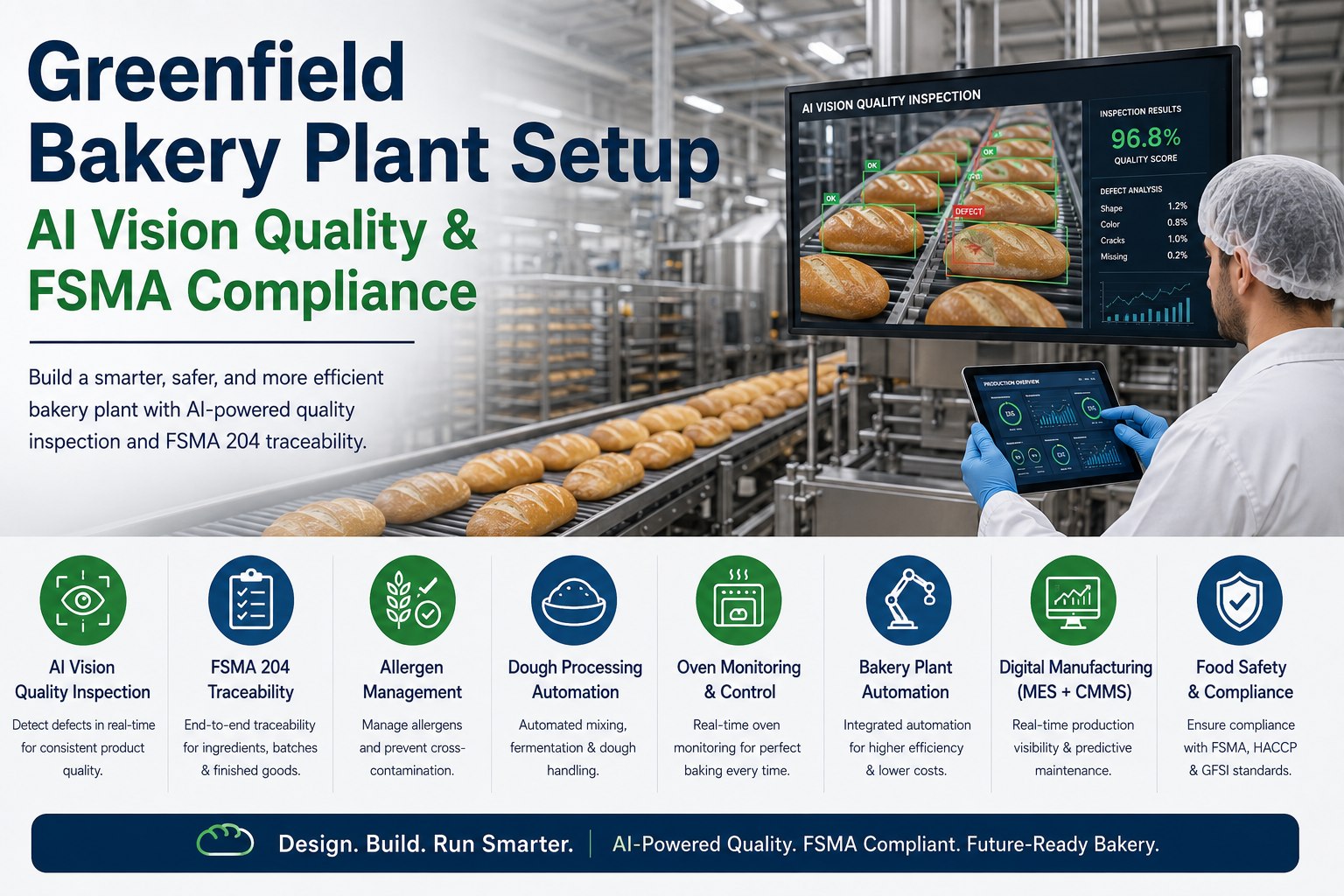
A trained inspector can spot-check a fraction of output; AI vision examines every single unit at full line speed, applying the same standard to the first piece and the millionth. These are the checks it runs.
Bake Color & Doneness
Detects underbaked and overbaked product from color uniformity across the surface.
Shape & Size
Flags misshapen, collapsed, or out-of-spec units before they reach packaging.
Fill & Topping
Verifies correct fill level, seeds, glaze, and inclusions on every piece.
Seal & Package Integrity
Checks seals, closures, and pack completeness to protect shelf life.
Foreign Material
Identifies contaminants and foreign objects that manual checks miss at speed.
Label & Allergen Verification
Confirms the correct label and allergen statement are on the right product.
Want inspection scoped for your products and line speed? Book an AI vision workshop and we will map the checks to every SKU you run.
FSMA 204 Traceability, Built In From Day One
The FDA's Food Traceability Rule requires you to capture Key Data Elements at every Critical Tracking Event and produce them in an electronic format within 24 hours of a request. The federal compliance date is now July 20, 2028 — but major retailers already require this data, so a greenfield plant should build it in now. In a bakery, the chain looks like this, with one traceability lot code linking every record.
Receiving
Supplier, lot, date, quantity
Transformation
Mixing & baking, new lot code, source lots
Packing
Lot code, product, quantity, date
Shipping
Lot code, recipient, ship date, quantity
Allergen control rides on the same data. Validated changeovers between allergen and allergen-free runs, plus AI vision confirming the correct allergen label on every pack, keep cross-contact and mislabeling out of the box.
The Greenfield Bakery Digital Roadmap
Build the quality and traceability layer alongside the process line, so inspection and compliance are live the day the first batch runs.
-
1
Automate dough and mixing
Control recipes and capture every ingredient lot at the mixer — the first traceability record in the chain.
-
2
Monitor proofing and ovens
Track time, temperature, and humidity through proofers and ovens with full thermal records for every batch.
-
3
Deploy AI vision inspection
Inspect color, shape, fill, seal, foreign material, and labels on every unit at line speed.
-
4
Build FSMA 204 traceability in
Capture KDEs and lot codes automatically at every critical tracking event, ready to produce within 24 hours.
-
5
Unify on one platform
Tie production, quality, traceability, and maintenance together in one MES and CMMS, live with the plant.
Ready to sequence this against your build? Book an implementation session and leave with a phased digital plan for your bakery project team.
Inspect Every Unit, Trace Every Lot
iFactory brings AI vision inspection and FSMA 204 traceability onto one platform — grading every unit at line speed and capturing lot codes at every critical tracking event, so quality and compliance are automatic from the first batch.
Expert Perspective
People hear the FSMA 204 deadline moved to 2028 and assume there is no rush. That is the wrong read. The big retailers already require this traceability data to ship to them at all, and the real cost of a weak system is not the federal fine — it is the recall you cannot scope, where you pull a week of product across three states because you cannot prove which lots were affected. A greenfield bakery has the rare chance to capture lot codes and inspection results as a by-product of normal operation, so the day you need to trace a problem, the answer is a query, not a fire drill.
— Food Manufacturing Practice, iFactory Engineering Team
to deliver traceability records to the FDA on request
of units AI vision inspects, versus a sampled few by hand
Americans affected by foodborne illness each year
The Bottom Line
A bakery wins or loses on two fronts at once: the quality a customer sees and the safety they trust. AI vision closes the first by grading every unit instead of a sample, catching bake, shape, fill, seal, and label faults before they ship. FSMA 204 traceability closes the second by capturing lot codes at every step, so a recall narrows to a query. A greenfield plant can build both in from day one — inspection on the line, traceability in the data, allergen control in the workflow — and start life producing food that is provably good and fully traceable.
Build a Bakery That's Provably Good and Fully Traceable
From AI vision quality inspection to FSMA 204 lot tracking, allergen control, and oven monitoring, iFactory helps greenfield bakery teams stand up quality and compliance on one platform — live with the plant, not retrofitted later.
Frequently Asked Questions
What is FSMA 204 and when is the compliance deadline?
FSMA 204, the FDA's Food Traceability Rule, requires enhanced recordkeeping for foods on the Food Traceability List, captured at critical tracking events and retrievable within 24 hours. The federal compliance date was extended from January 2026 to July 20, 2028, and that extension is now set in law. However, many major retailers already require traceability data to ship to them, so the practical deadline for suppliers is often sooner.
What can AI vision inspect on a bakery line?
AI vision can check bake color and doneness, shape and size, fill and topping, seal and package integrity, foreign material, and the correct label and allergen statement — on every unit at full line speed. Because it applies the same standard to every piece rather than a periodic sample, it catches defects that escape manual inspection under production pressure.
What are CTEs and KDEs in FSMA 204?
Critical Tracking Events are the points in the supply chain where traceability data must be recorded — for a bakery, receiving, transformation through mixing and baking, packing, and shipping. Key Data Elements are the specific details recorded at each event, such as lot codes, dates, quantities, and locations. A traceability lot code links all of these records so a food's movement can be reconstructed quickly.
How does a bakery manage allergens?
Through validated changeovers between allergen and allergen-free runs, careful sequencing, and verification that the correct label and allergen statement reach each pack. AI vision can confirm the right label is on the right product, and the same traceability data that supports FSMA 204 lets you isolate exactly which lots were affected if an allergen issue ever arises.
How does iFactory help set up a greenfield bakery plant?
iFactory helps automate dough and oven processes, deploy AI vision inspection, and capture FSMA 204 lot codes at every critical tracking event, all on one platform that ties production, quality, traceability, and maintenance together. Designed in from day one, it goes live with the plant. You can book a bakery consultation to plan it for your facility.