Walmart sent a letter to 5,000 suppliers in 2024 demanding FSMA 204 traceability readiness — two years before the FDA deadline. Kroger followed. Costco followed. The message was clear: retailers won't wait for the government timeline. If your new food plant can't produce an electronic sortable spreadsheet of every lot, every critical tracking event, and every key data element within 24 hours of a request, you're not retailer-ready — regardless of what the FDA's compliance calendar says. The plants being built right now with AI quality inspection, automated CIP, and end-to-end traceability designed into the architecture won't just be compliant. They'll be first in line for shelf space.
FSMA 204 Deadline: July 2028 — But Retailers Are Demanding Compliance Now
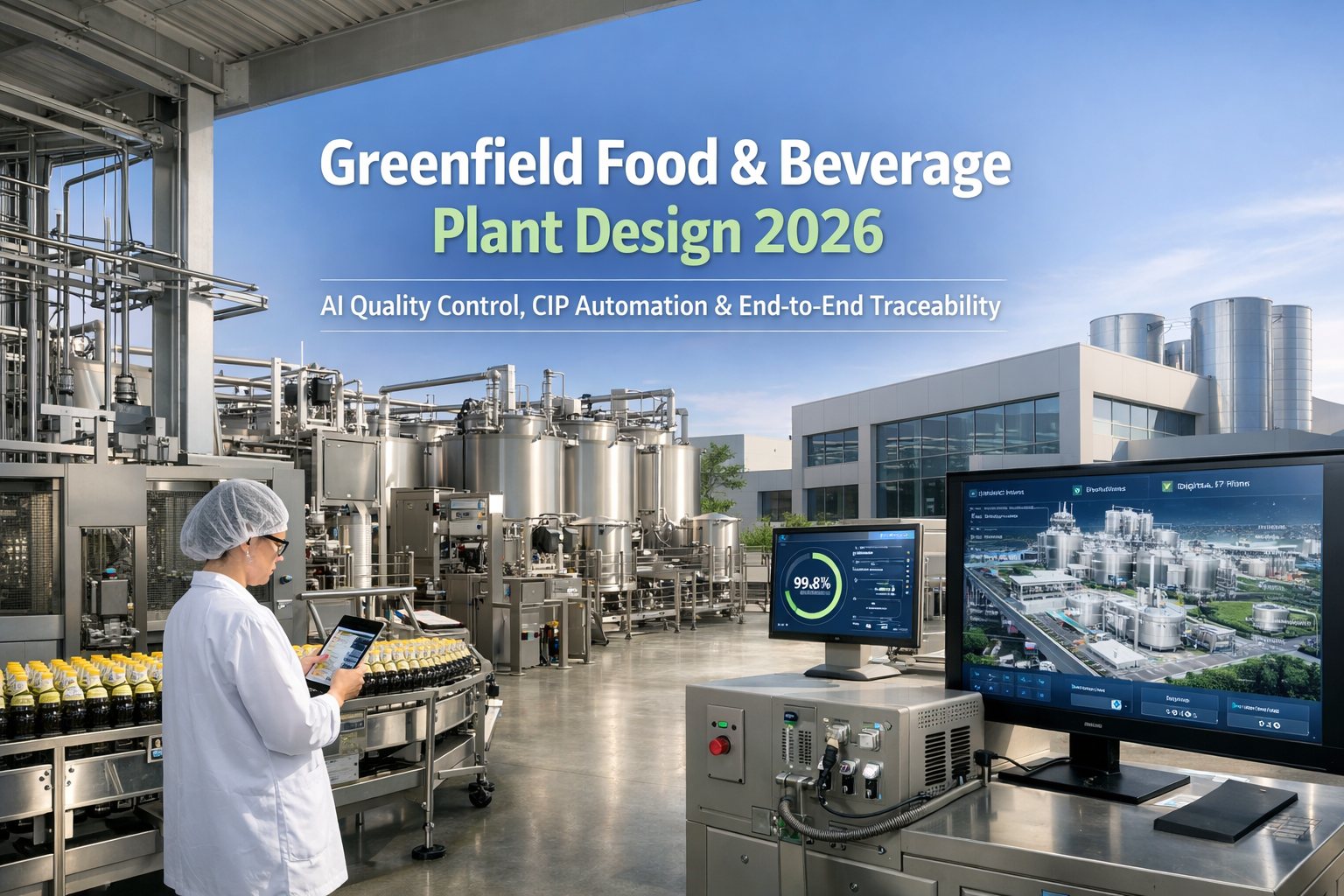
Greenfield Food Plant Design 2026
AI Quality Control, CIP Automation & FSMA 204 Traceability
Design your food plant with every inspection, sanitation cycle, and traceability record automated before your first production run.
Sources: BCC Research · FDA FSMA Final Rule · Overview.ai · Food Logistics 2026
The Three Pillars of a Modern Food Plant
A greenfield food facility built in 2026 without these three systems embedded from day one is already outdated. Retrofitting any of them after construction costs 3-5x more and introduces compliance gaps that auditors and retailers will find. Here's what each pillar delivers and why it must be designed into the blueprint — not bolted on later.
Pillar 1
AI Vision Quality Inspection
The Problem
Human inspectors miss 20% of defects. Their accuracy drops 20-30% after just 30 minutes of continuous inspection. Two inspectors grading the same product disagree 15-25% of the time. On 8-hour shifts inspecting 200+ units per minute, subtle defects slip through.
The Day-1 Solution
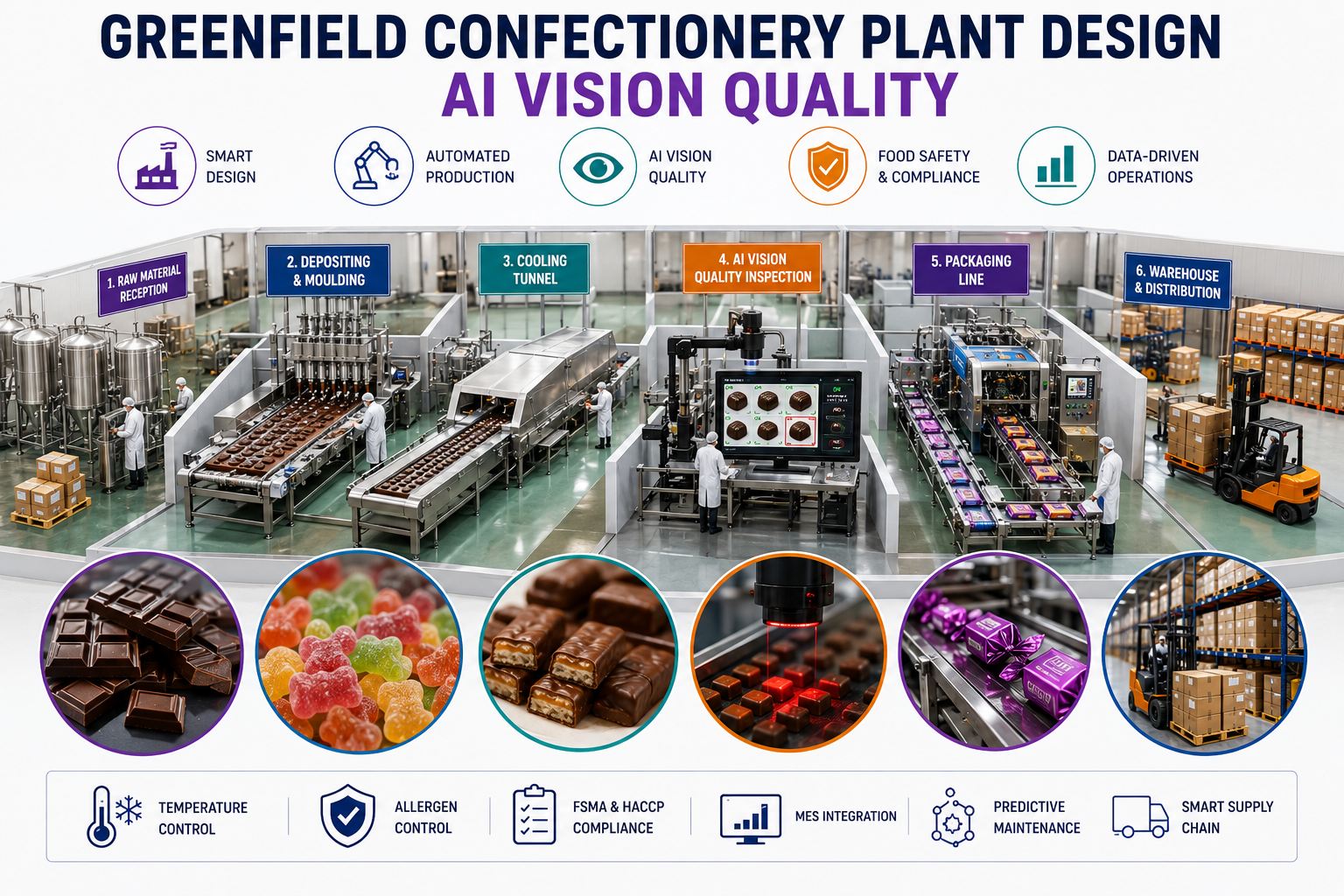
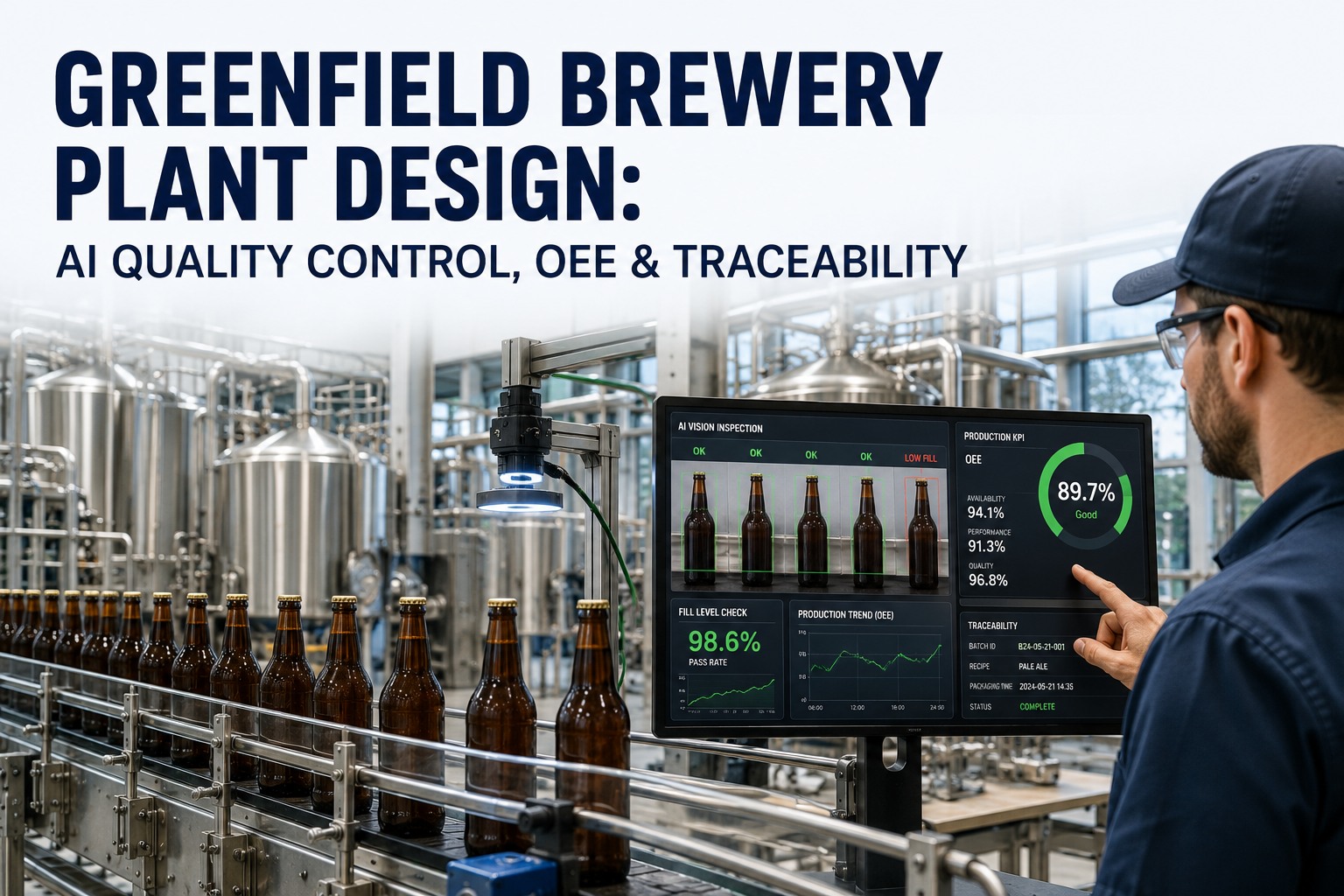
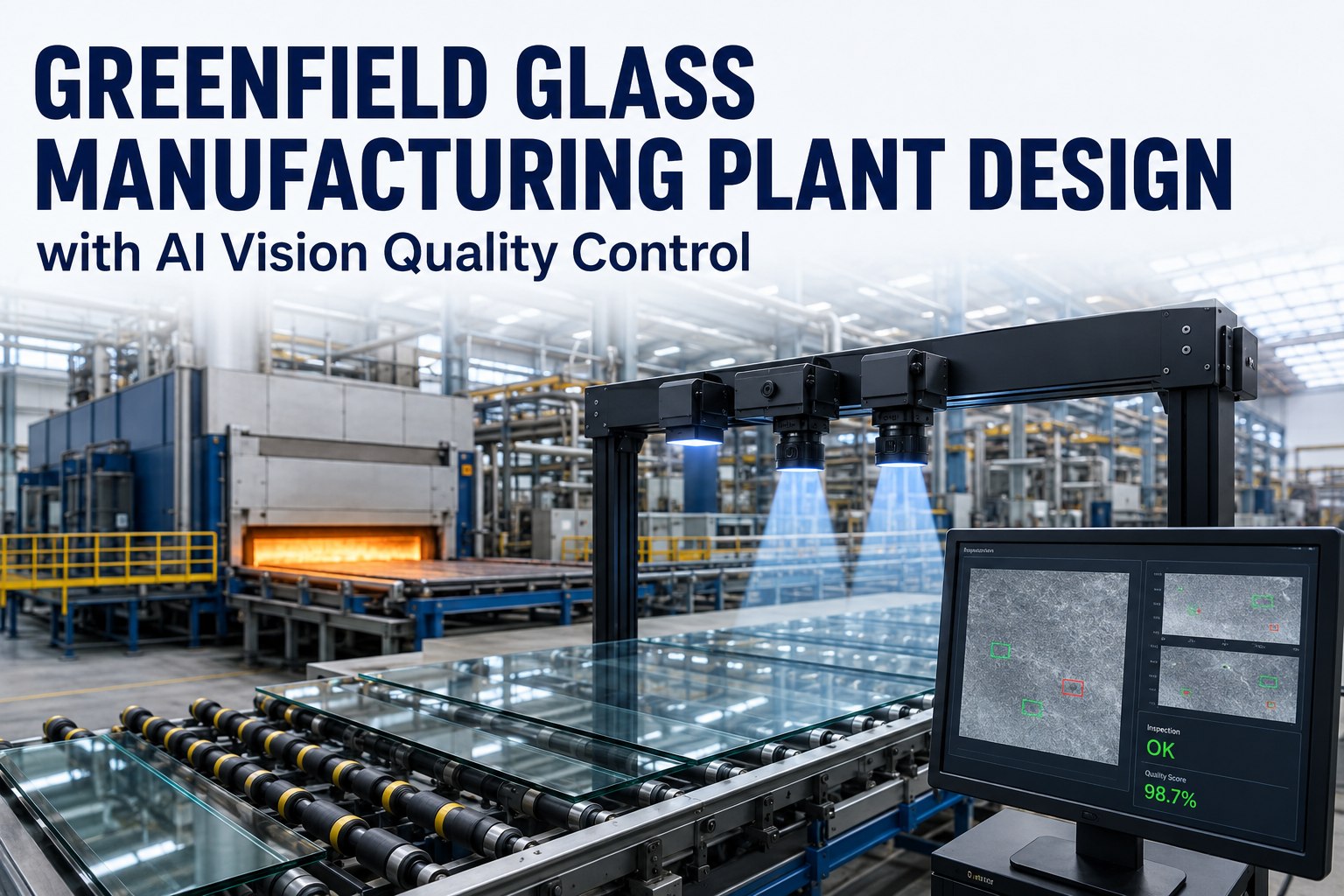
AI cameras on every production line — 99%+ detection rate with zero fatigue, identical performance shift 1 and shift 3
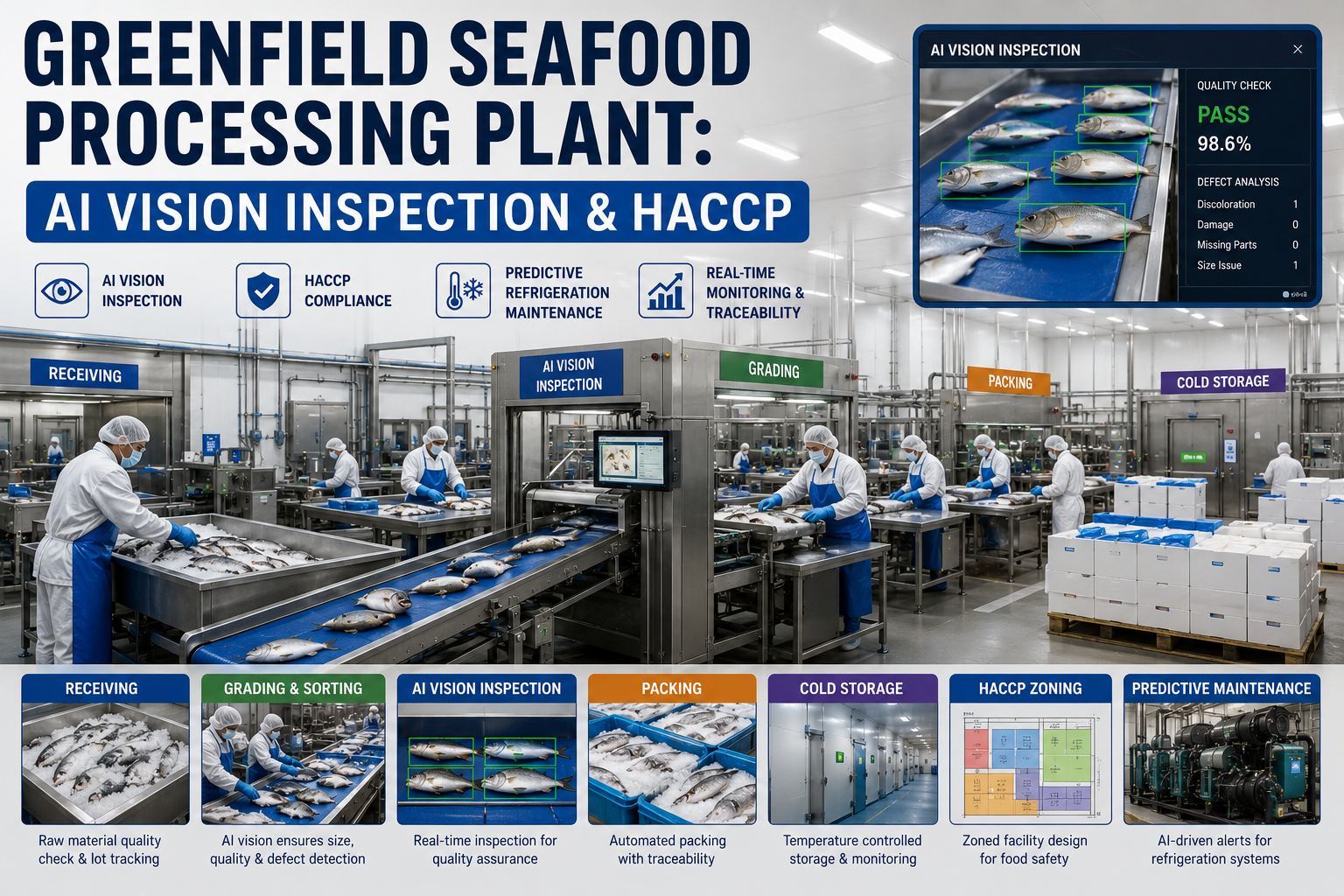
Foreign object detection — metal fragments, plastic shards, glass, bone splinters, insect matter at sub-millimeter precision
Real-time color, texture, and packaging integrity grading — every unit inspected, every anomaly captured, every decision traceable
Why greenfield matters: Camera positions, lighting angles, and compute hardware designed into the line — not retrofitted around existing equipment with compromised viewing angles.
Clean-in-place cycles consume 15-20% of available production time in food plants. Manual scheduling leads to either over-cleaning (lost production) or under-cleaning (contamination risk). Paper-based CIP records fail audits because they can't prove cycle completeness.
The Day-1 Solution
CMMS-integrated CIP scheduling — automated work orders trigger based on production runs, allergen changeovers, and time-based intervals
Digital CIP validation records — temperature, flow rate, chemical concentration, and cycle duration logged automatically for every clean
AI-optimized scheduling — minimize cleaning time without compromising food safety, recovering hours of production capacity per week
Why greenfield matters: Piping, valve placement, and sensor locations designed for full CIP automation — no dead legs, no manual bypass points, no sanitation blind spots.
FSMA 204 requires tracking Key Data Elements at every Critical Tracking Event — receiving, transformation, shipping — with records deliverable to the FDA in 24 hours as an electronic sortable spreadsheet. Most food companies need 6-14 months just to upgrade existing systems for compliance.
The Day-1 Solution
Traceability lot codes (TLCs) assigned automatically at every critical tracking event — receiving, processing, packing, shipping
All KDEs captured digitally — lot codes, quantities, dates, locations, and supply chain partner data linked in a single system
24-hour FDA response capability from day one — electronic sortable records exportable on demand, not assembled from paper files under pressure
Why greenfield matters: Data architecture designed for traceability from the blueprint stage — no retrofitting barcode systems, no middleware connecting incompatible databases.
Your First Production Run Should Be FDA-Compliant and Retailer-Ready
iFactory integrates AI vision quality control, automated CIP scheduling, and FSMA 204 traceability into a single platform — deployed during construction so your food plant is audit-proof from the first shift, not the first year.
Expert Perspective: Why Retailers Aren't Waiting for the FDA
While the FDA extended the FSMA 204 compliance deadline to July 2028, the agency made clear it remains fully committed to implementation and has no plans to alter the rule's requirements. The extension was granted because industry-wide coordination across thousands of entities wasn't achievable under the original timeline — not because the requirements changed. Meanwhile, major retailers are already requiring traceability capabilities from suppliers regardless of the federal timeline. For greenfield plants, there is no excuse not to build it right from the start.
— FDA Federal Register · Food Logistics Analysis · Food Safety Magazine, 2026
82%
Of food safety directors said AI visual inspection was their top planned investment for 2025
48M
Americans suffer foodborne illness annually — FSMA 204 aims to cut response time from weeks to hours
6-14mo
Lead time for existing plants to upgrade systems for FSMA 204 — greenfield plants start compliant
15-20%
Of production time consumed by CIP cleaning — AI scheduling recovers hours per week
iFactory gives food and beverage manufacturers a single AI platform for quality inspection, CIP automation, CMMS, predictive maintenance, and FSMA 204 traceability — designed into your greenfield plant during construction. Your first production run is your first compliant production run.
What is FSMA 204 and when is the compliance deadline?
FSMA 204 (the Food Traceability Final Rule) requires companies that manufacture, process, pack, or hold foods on the FDA's Food Traceability List to maintain detailed records of Key Data Elements at every Critical Tracking Event in the supply chain. The original compliance deadline was January 20, 2026. The FDA extended it by 30 months to July 20, 2028. However, major retailers including Walmart and Kroger are already requiring traceability capabilities from suppliers regardless of the federal timeline. Records must be deliverable to the FDA in electronic sortable format within 24 hours of request.
How does AI vision quality inspection work in food manufacturing?
AI vision systems use high-resolution cameras and deep learning algorithms to inspect every unit on the production line in real time. They detect foreign objects (metal, plastic, glass, bone, insects) at sub-millimeter precision, grade color and texture consistency, verify packaging integrity, and identify process deviations. AI achieves 99%+ detection rates compared to roughly 80% for human inspectors, with zero fatigue degradation across shifts. In greenfield plants, camera positions, lighting, and edge computing hardware are designed into the line for optimal accuracy.
Why should CIP automation be designed into a greenfield food plant?
Clean-in-place cycles consume 15-20% of available production time in food plants. When CIP is designed into the greenfield blueprint, piping eliminates dead legs, valve placement supports full automation, and sensors are positioned to verify cycle completeness at every stage. Automated CIP scheduling through a CMMS triggers cleaning based on production runs, allergen changeovers, and time intervals — with digital validation records (temperature, flow rate, chemical concentration, cycle duration) generated automatically for audit readiness.
How much does it cost to build a greenfield food manufacturing plant?
Greenfield food processing plants typically cost $50M-$500M depending on scale, product type, and regulatory requirements. Conventional construction runs $120-$250 per square foot, while metal building alternatives can reduce shell costs to $35-$85 per square foot. Cold storage and refrigeration add a 40-60% premium. FDA and USDA compliance requirements (cleanrooms, sanitation infrastructure, traceability systems) add significant cost but are dramatically cheaper when designed in during construction rather than retrofitted later.
Can iFactory handle both food safety compliance and predictive maintenance?
Yes. iFactory's platform integrates AI vision quality control, automated CIP scheduling, FSMA 204 traceability, CMMS, and predictive maintenance into a single system. For greenfield food plants, this means one platform manages quality inspection, sanitation automation, traceability records, equipment maintenance, and spare parts inventory — all deployed during construction and fully operational from the first production shift. No separate systems, no middleware, no integration gaps that auditors or retailers can exploit.