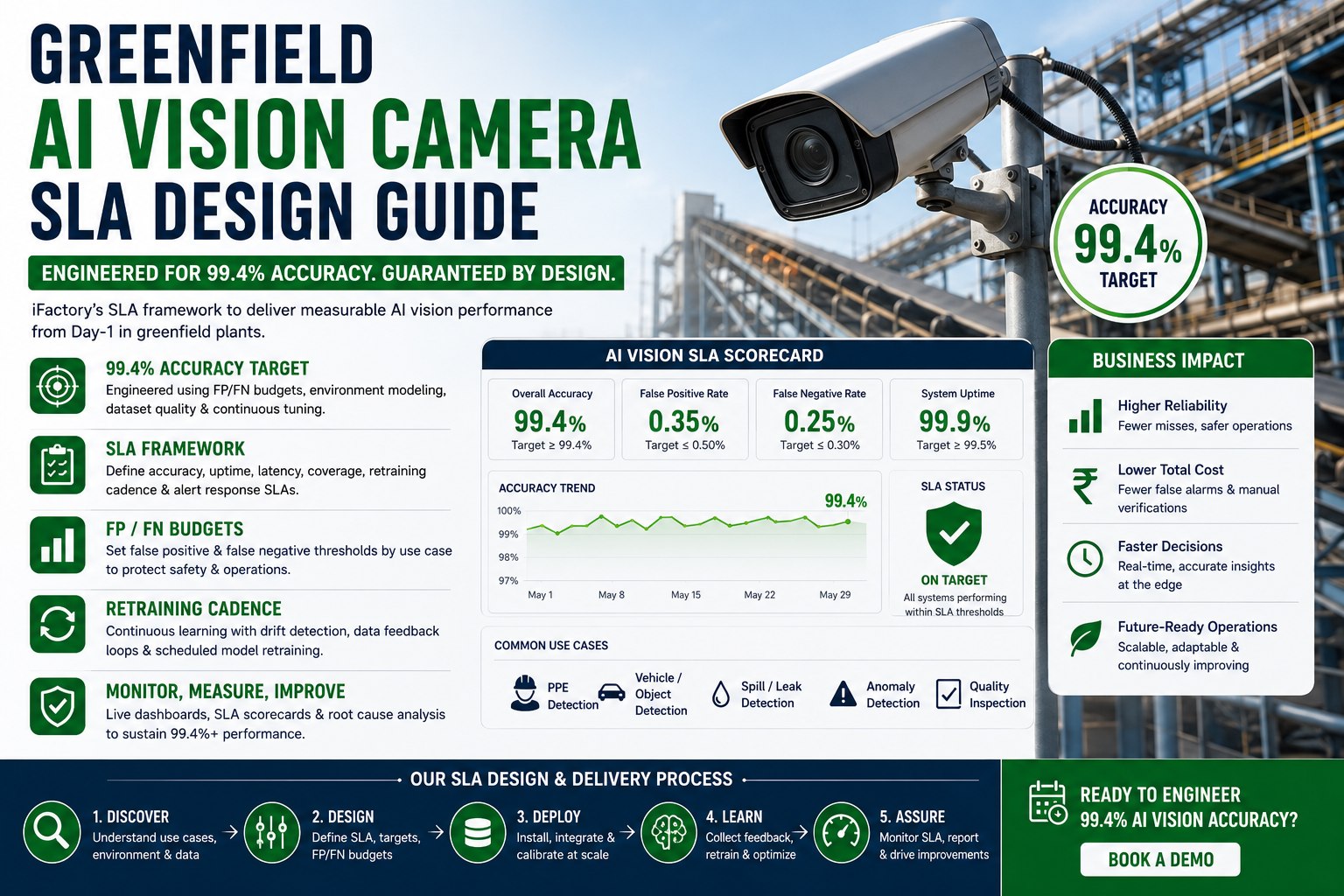
A vendor quoting "99% accuracy" is quoting a lab benchmark — measured under controlled lighting on a curated image set. When that system reaches your factory floor, accuracy emerges from camera placement, lighting geometry, training quality, FP/FN budget, and the retraining cadence written into the contract. The 99.4% target is an engineered outcome, achievable when the SLA specifies the right metrics, measurement methodology, and remediation obligations before the first camera ships.
See how iFactory engineers 99.4% accuracy into your vision SLA — FP/FN budgets, retraining cadence, and measurement protocol designed for your production line before contract signature.
True Positives ÷ (TP + False Negatives)
Six defects escape per 1,000. That escape rate determines your warranty exposure and recall probability — not the headline number.
False Positives ÷ (TN + False Positives)
At 2% FP on a 1,000 parts/hr line: 20 false rejects per hour. Operators start overriding the system. Quality protection disappears.
Worst-case 1% of decisions, not average
At 60 parts/min, 500ms latency misfires the gate onto the wrong part. P99 — not mean — is what causes production errors.
Inspection minutes ÷ Production minutes × 100
Every uninspected minute is either a quality escape or a throughput hold. The SLA must define the fallback protocol.
The FP/FN Budget: Right Trade-Off for Your Production Context
Every AI vision SLA involves a trade-off: higher sensitivity catches more defects but increases false rejects. The correct balance depends on the cost consequence in your specific production context — and that profile is different for an automotive safety part, food packaging, and a consumer electronics enclosure.
Not sure which FP/FN budget fits your line? Book an SLA design session with iFactory — we calculate cost-per-FP and cost-per-FN for your production context and specify the accuracy budget that minimizes total quality cost.
How 99.4% Is Engineered — The Five Layers
Accuracy is not a model property. It is the output of five engineering layers working together. Lab benchmarks of 99.9% routinely drop to 92–95% in the first weeks of production because one of these layers was not specified in the deployment contract.
Camera & Lighting Specification
Resolution, working distance, and lighting geometry must be calculated to achieve minimum pixel size per defect class. A 0.2mm scratch on a 200mm part requires ≤0.1mm/px — constraining lens focal length and sensor size before a camera brand is chosen. Lighting type (dark-field, coaxial, dome) determines whether the defect is even visible to the model.
Training Data Volume & Quality
Production-grade models require 200–2,000 labeled images per defect class covering the full range of production variation. Data augmentation multiplies effective training set. Models trained on under 100 images per class routinely fail to generalize to real production variance — lighting shifts, different material lots, tool wear.
Shadow Running & Go-Live Validation
Before the system controls the reject gate, it must run in shadow mode alongside existing inspection for a defined period — typically 1–2 weeks across 10,000+ real parts. Shadow mode produces the only real measure of production accuracy. The go-live decision must be gated on shadow performance, not lab benchmark.
Retraining Cadence & Trigger Criteria
Models degrade when conditions change: new material lots, tooling changes, lighting drift, seasonal temperature shifts. The SLA must specify scheduled retraining (monthly in Year 1, quarterly thereafter) and trigger-based retraining when accuracy drops below a defined floor between cycles.
Continuous Measurement & Remediation
An SLA is only enforceable if accuracy is measured independently in production — not self-reported by the vendor. Weekly statistical sampling of AI decisions against gold-standard inspection is the only valid methodology. Remediation obligations must specify maximum response time and consequence when the threshold is missed.
Need all five layers specified for your line? Talk to iFactory's SLA design team — we write the accuracy specification, retraining cadence, and measurement protocol into your vision contract before a camera ships.
99.4% Accuracy Engineered In — With the SLA to Prove It
iFactory's AI vision SLA specifies detection rate, FP budget, inference latency, system uptime, shadow validation protocol, retraining cadence, and remediation obligations — all before deployment. The accuracy you contract is measured weekly, in production, on your parts.
SLA Vendor Scorecard: 10 Requirements Before You Sign
The gap between an accuracy claim and an accuracy commitment is a contract clause. Use this checklist to evaluate any AI vision proposal. Reject vendors that cannot commit to all ten.
Want this scorecard applied to a vendor proposal? Book an SLA review with iFactory — we evaluate any AI vision vendor proposal against these ten requirements and identify gaps before you sign.
Expert Perspective
The most dangerous deployment is not the one that fails at launch — it is the one that hits 97% at go-live, never gets retrained, and silently drifts to 91% over eight months. By then, operators have normalized the false rejects, override rates are part of the job description, and the defect escape rate has doubled. The SLA that prevents this is not the one specifying 99.4% at go-live. It is the one specifying 99.4% continuously, measured weekly, with a retraining trigger and a consequence clause for breach.
more critical defects caught by AI vs. expert human inspectors under optimal conditions
to cross 99%+ accuracy via active learning after shadow validation go-live
ROI at major steel plant — accuracy 70%→99.8%, $2M+ saved annually
Your Vision SLA Engineered Before the First Camera Ships
iFactory writes the SLA before deployment — specifying detection rate, FP budget, P99 latency, uptime floor, shadow validation, retraining cadence, and remediation obligations. The accuracy you contract is measured weekly in production on your actual parts — not on a benchmark dataset that never sees your factory floor.
Frequently Asked Questions
What is a realistic AI vision accuracy target for greenfield factories?
Production-grade AI vision achieves 99–99.8% detection with 0.1–0.5% FP rate when camera placement, lighting, and training data are correctly specified. Lab benchmarks of 99.9%+ routinely drop 2–5 points on the production floor before tuning — shadow mode comparison on 10,000+ real parts is the only valid accuracy measurement before handover.
What is the difference between false positive and false negative in vision inspection?
A false negative is a defective part passed as good — it escapes to the customer and drives warranty, recall, and liability cost. A false positive is a good part incorrectly rejected — it is scrapped or reworked. Which matters more depends on your consequence profile: safety-critical parts tolerate high FP rates to drive FN toward zero; high-value cosmetic parts require the opposite trade-off. Both must be contractually specified.
How often does an AI vision model need retraining?
Monthly in Year 1 as the model encounters the full production variation range; quarterly thereafter once a stable baseline is established. Trigger-based retraining fires when weekly measured accuracy drops below the contracted floor — typically 48–72 hours to retrained model deployment. Active learning accelerates this: every human correction enters the pipeline immediately, so models improve continuously between scheduled cycles.
What should a greenfield plant require in an AI vision RFP?
Require vendors to contractually commit to: detection rate as a minimum number per defect class; FP rate maximum; P99 latency ceiling; monthly uptime floor; shadow validation protocol with minimum sample size; minimum training images per defect class; scheduled and trigger-based retraining obligations; independent weekly accuracy measurement; and a remediation consequence clause. Any vendor declining to commit to any of these ten is declining accountability for the SLA they are marketing.
How does active learning improve AI vision accuracy after go-live?
Every human correction — false reject or missed defect — is automatically captured and added to the retraining dataset. Models typically improve from 90–92% at initial deployment to 99%+ within 3–4 weeks as they learn the full range of real production variation. A realistic SLA specifies a ramp: 95%+ at go-live, 97%+ within 2 weeks, 99.4%+ from week 6 onward — then holds that floor continuously with weekly measurement.