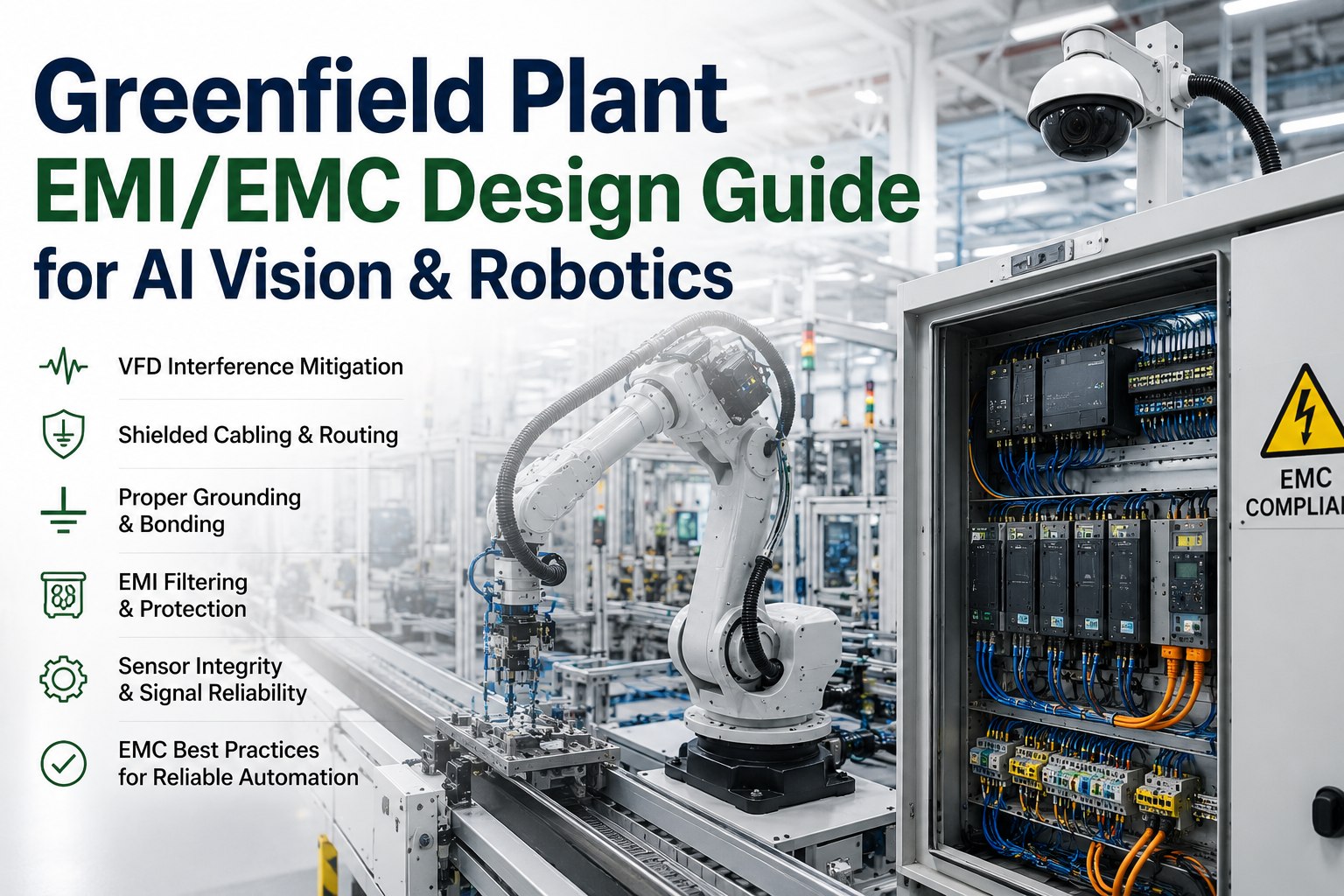
The plant is brand new. The robots are calibrated, the vision cameras are sharp, the PLC code is clean. Then the line starts throwing faults nobody can reproduce: a camera drops frames, a robot halts for no reason, a sensor reads a value the process never reached. Nothing is broken. The culprit is invisible — electromagnetic noise from the drives and motors nearby, coupling into the very signals your automation depends on. The good news is that a greenfield plant can design this problem out before it ever appears. This guide explains how to build EMI/EMC into a plant made for AI vision and robotics.
Designing a new automated plant? Book a 30-minute EMC design consultation to engineer interference out before the first robot powers on.
Every EMI Problem Has Three Links — Break One
A disturbance needs all three to cause a fault. Cut the source, interrupt the path, or harden the victim — and the noise never lands.
Why EMI Is the Invisible Threat to Smart Factories
AI vision and robotics run on exactly the signals EMI corrupts: high-speed camera data, precise analog sensor readings, encoder feedback, and industrial Ethernet. The drive that tolerates its own switching noise sits beside a camera link that does not. The result is intermittent, hard-to-diagnose faults that masquerade as software or hardware bugs. These ghost faults are the most expensive kind, because teams chase code and components for weeks before anyone suspects the wiring. Designing EMC in from the start avoids the entire hunt. If you want it scoped for your layout, you can map it with an automation design specialist.
Ghost faults no inspection finds — intermittent comms drops, false vision rejects, random robot stops.
Variable-frequency drives switch like radio transmitters — the dominant noise source on an automated line.
EMC built at the design stage costs a fraction of re-routing and re-grounding a running plant.
How EMI Travels: Source, Path, Victim
To design noise out, it helps to see the whole chain at once — who makes it, how it moves, and what it ruins. Each column is a place you can intervene.
- VFDs & servo drives
- Switch-mode power supplies
- Contactors & relays
- Welders & large motors
- Conducted — through cables & ground
- Radiated — through the air
- Capacitive & inductive pickup
- Unshielded cable as an antenna
- AI vision cameras & GigE links
- Encoders & 4–20 mA sensors
- PLCs & robot controllers
- Industrial Ethernet & fieldbus
Five Defenses That Design EMC In
These five disciplines, layered together, are how a plant stays quiet. None is optional — EMC is a system, not a single fix — and all five are far cheaper to build than to retrofit.
Zone & Separate
Route power and signal in separate ducts, never parallel, crossing at right angles where they must meet.
Protects routingShield & Terminate
Use shielded twisted-pair and terminate the shield 360°. Termination quality matters more than the cable itself.
Protects cablingGround & Bond
Give noise a short, low-impedance drain with flat-braid straps, equipotential bonding, and bonded cable trays.
Protects referenceFilter & Choke
Add EMI line filters, ferrites and common-mode chokes, snubbers, and VFD line reactors or dV/dt filters.
Protects signalsEnclose
House electronics in bonded, conductive enclosures — a Faraday cage with proper gland and earthing plates.
Protects equipmentWant these five defenses turned into a wiring and grounding spec for your build? Book an EMC design workshop and we will map them to your plant layout.
Taming VFDs: The Biggest Noise Source
One source dominates the noise budget of a modern automated plant: the variable-frequency drive. Its fast switching radiates and conducts across a wide spectrum. Stack these five fixes on every drive and you remove most of the plant's interference at its origin.
Tame the source
Fit a line reactor or dV/dt filter on the drive to soften the switching edges before they radiate.
Contain the motor cable
Use shielded motor cable, terminated 360° at both ends, to trap load-side noise inside the shield.
Drain to earth
Provide a short, low-impedance PE with a flat-braid strap so high-frequency noise has a clean path to ground.
Separate the runs
Keep VFD power and motor cables away from all signal cabling — no parallel routes, ever.
Protect the feedback
Shield the encoder and feedback cabling, where low-voltage analog signals are easiest to corrupt.
Running drives next to vision and robotics? Book a VFD mitigation review and protect every signal those drives sit beside.
Build Automation on Clean Signals
iFactory's greenfield advisory helps design AI vision and robotics into a plant engineered for electromagnetic compatibility — and once you're live, surfaces the intermittent faults that signal interference before they cost you uptime.
Expert Perspective
The hardest faults we get called in for are never the dramatic ones — they are the intermittent ones. A robot cell that stops twice a shift, a vision system that false-rejects only when the big conveyor ramps up, a sensor that drifts at random. Teams replace the camera, reflash the controller, rewrite the logic, and the fault comes back, because the real cause is a coupling path that was never broken. On a greenfield plant you get to design that path out before it exists — separate the routes, shield and terminate properly, ground for high frequency, and tame the drives. Do it at the design stage and you simply never have the mystery to solve.
— Industrial Automation Practice, iFactory Engineering Team
break any one link — source, path, or victim
noise travels conducted and radiated
EMC built in beats EMC bolted on
The Bottom Line
AI vision and robotics deliver only as much as their signals stay clean, and a plant full of drives and motors is a noisy place to keep them clean by accident. The discipline that makes it deliberate is EMC: understand the source-path-victim chain, layer the five defenses, and tame the drives that dominate the noise budget — all aligned to standards like IEC 61000 and IEC 61800-3. A greenfield plant is the one moment you can route, ground, shield, and filter for compatibility before anything is energized. Build it in, and the ghost faults that haunt retrofitted plants simply never appear.
Design the Noise Out Before You Build
From zoning and shielded-cabling specs to grounding and VFD mitigation, iFactory helps greenfield teams design an interference-free foundation for AI vision and robotics — and catches the intermittent faults that signal trouble once you're running.
Frequently Asked Questions
What is the difference between EMI and EMC?
EMI, electromagnetic interference, is the unwanted electrical noise one device emits that disrupts another. EMC, electromagnetic compatibility, is the design goal: equipment that neither emits enough noise to disturb its neighbors nor is disturbed by them. In short, EMI is the problem and EMC is the engineered state where everything coexists cleanly — achieved through separation, shielding, grounding, and filtering.
Why are AI vision and robots so sensitive to EMI?
They depend on exactly the signals noise corrupts: high-speed camera data, low-voltage analog sensor readings, encoder feedback, and industrial Ethernet. A few millivolts of induced noise can drop a frame, shift a measurement, or break a communication packet. The drive causing the noise tolerates it fine, but the camera link and the encoder beside it do not — which is why interference shows up as vision and robot faults first.
What is the single biggest source of EMI in a plant?
Variable-frequency drives. Their power transistors switch thousands of times a second with very fast edges, which both conduct noise back through the wiring and radiate it through the air across a wide frequency range. Servo drives and switch-mode power supplies add to it, but VFDs typically dominate the noise budget, which is why most mitigation effort focuses on them first.
Should cable shields be grounded at one end or both?
It depends on frequency. For low-frequency analog signals, grounding the shield at one end avoids ground loops. For high-frequency and digital signals, which dominate vision and robotics, the shield is generally terminated at both ends with a low-impedance 360° connection, supported by good equipotential bonding so the two ground points sit at the same potential. The termination quality matters more than the choice itself.
How does iFactory help design an EMC-ready plant?
iFactory's greenfield advisory helps design AI vision and robotics into an architecture planned for electromagnetic compatibility — zoning, shielded-cabling and grounding specs, and VFD mitigation — and its platform then surfaces the intermittent comms and sensor faults that reveal interference once the plant is live. You can book a consultation to plan it for your facility.