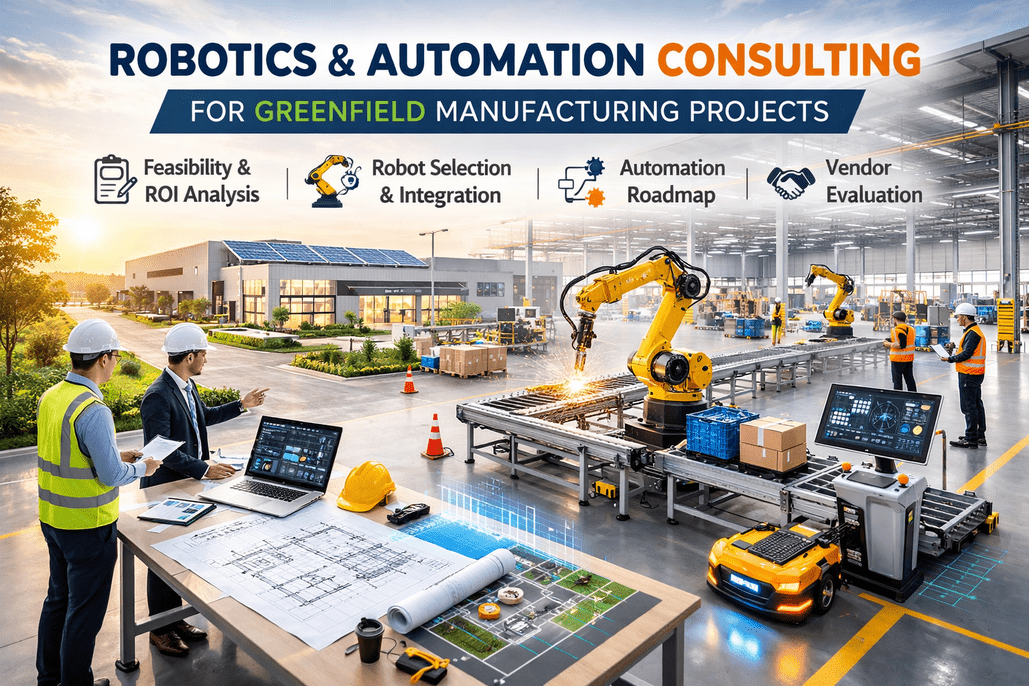
Building a greenfield manufacturing facility is a once-in-a-generation capital decision. The automation and robotics choices made during planning lock in production capacity, labor requirements, quality levels, and operating costs for decades. Yet 60% of industrial automation projects fail to meet their projected ROI — not because the technology was wrong, but because the strategy was. With the global robotics market reaching $50 billion in 2025 (14% CAGR to $111B by 2030), 84% of businesses planning to introduce or expand robotic automation, and cobot investments paying back in as little as 6-12 months, the opportunity is massive — but only if the automation architecture is designed correctly from the start. That's what our greenfield robotics and automation consulting delivers: vendor-neutral strategy, data-driven feasibility, and ROI-validated automation roadmaps that ensure your new facility launches at peak efficiency from day one.
Why Greenfield Projects Need Dedicated Automation Consulting
Brownfield retrofits work around existing constraints. Greenfield projects have the luxury — and the risk — of designing automation from scratch. The decisions made at this stage have 10-20× the impact of post-commissioning changes:
Automation Architecture Defines Everything
Layout, workflow, utility requirements, safety zones, material flow, and staffing models all cascade from the automation strategy. Get it wrong and you're locked into suboptimal operations for the life of the facility.
Vendor Selection Is High-Stakes
Robot OEMs (FANUC, ABB, KUKA, Universal Robots, Yaskawa) have overlapping but distinct strengths. The wrong selection — or worse, no selection process — results in capability gaps, integration headaches, and inflated TCO.
ROI Models Must Be Honest
60% of industrial automation projects fail to meet projected ROI. Most failures trace to unrealistic cycle time assumptions, underestimated integration costs, or mismatched automation levels for actual production volumes.
Future-Proofing Is Non-Negotiable
The robotics landscape is shifting fast — AI integration, physical AI, cobots, AMRs, digital twins. A greenfield strategy must accommodate technologies that don't yet exist, not just today's catalog.
Robot Types at a Glance: Greenfield Selection Guide
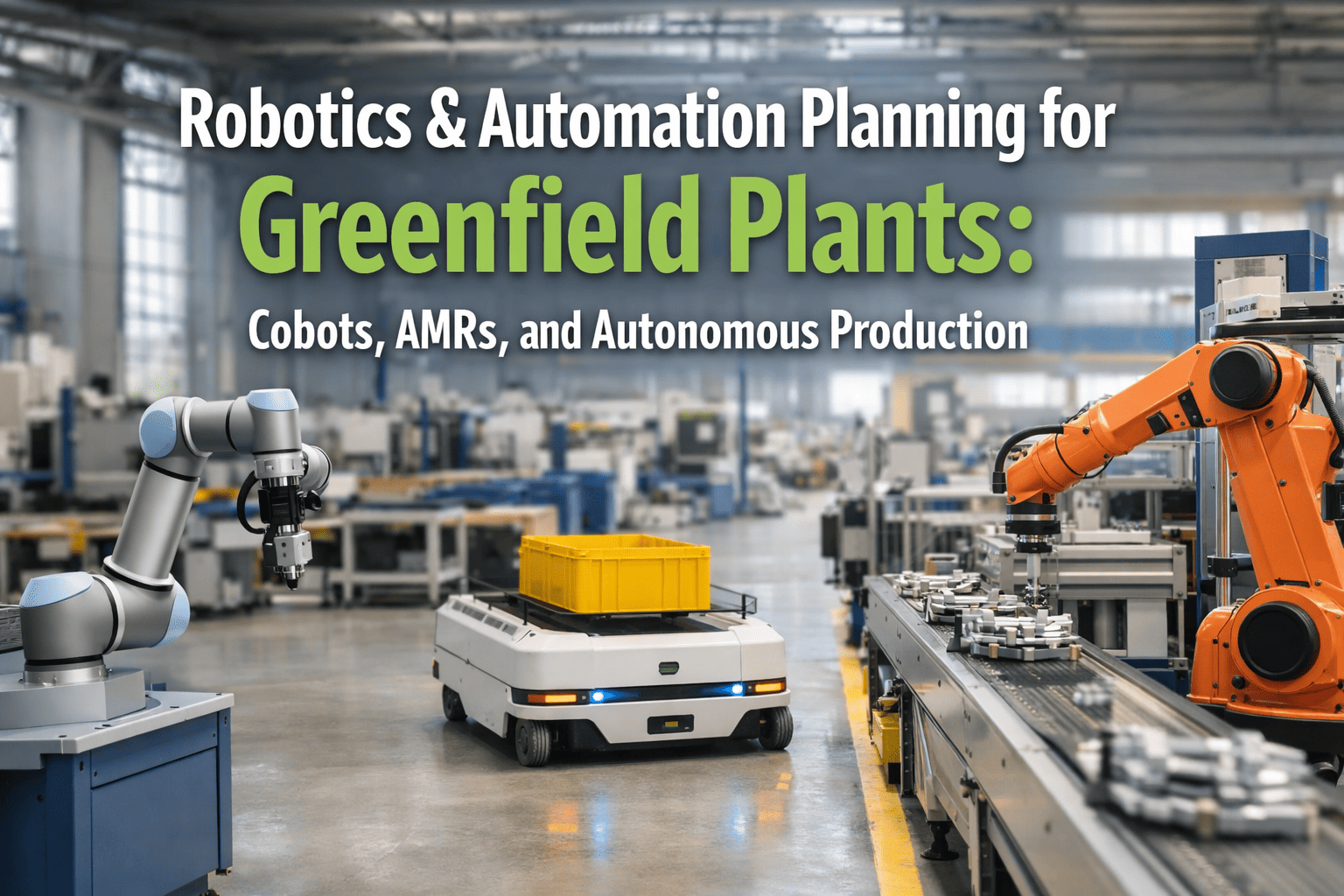
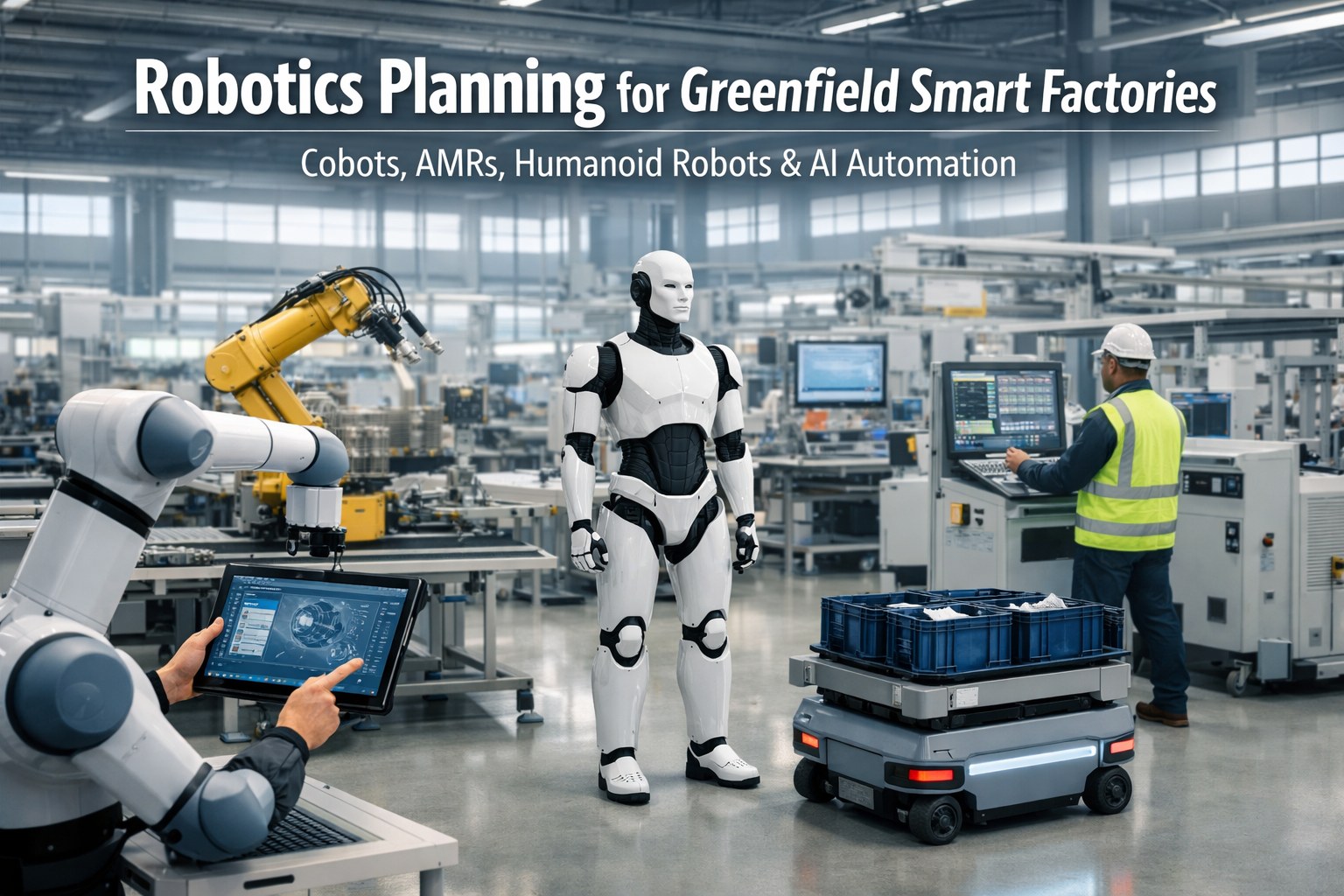
Choosing the right robot class for each station is the foundation of greenfield automation. Here's how the four primary categories compare across the metrics that matter most for new facility design:
| Parameter | Industrial Robots | Collaborative Robots (Cobots) | AMRs / AGVs | Vision-Guided Systems |
|---|---|---|---|---|
| Typical Payload | 5–2,300 kg | 0.5–25 kg | 50–1,500 kg | N/A (inspection/guidance) |
| Speed | Very High | Moderate (safety-limited) | 1–2 m/s typical | Line speed (1,000+ ppm) |
| Safety Infrastructure | Fenced cells, light curtains | None required (force-limited) | LiDAR, obstacle avoidance | Integrated with line controls |
| Programming Complexity | High (specialist required) | Low (hand-guided teaching) | Medium (fleet management) | Medium-High (AI training) |
| Redeployment Flexibility | Low (fixed installation) | High (move in hours) | Very High (route changes) | Medium (camera relocation) |
| Typical Payback | 18–36 months | 6–12 months | 12–24 months | 6–18 months |
| Best For (Greenfield) | High-volume, fixed-task cells | Human-adjacent, flexible tasks | Material transport, logistics | Quality inspection, sorting |
| Market Trajectory | $17B → $19.6B (2% CAGR) | $2.9B → $7B by 2030 (27.5%) | Dominates 50-60% of revenue | Growing with AI integration |
Not sure which robot types fit your production processes? Schedule a free feasibility call — we'll map your process flow to the optimal automation mix.
Our 6 Consulting Modules
Each module can be engaged independently or as part of a comprehensive greenfield automation program. All work is vendor-neutral and data-driven.
Automation Feasibility Assessment
Before specifying a single robot, we assess whether automation is the right answer — and where. We map every process in your planned production flow, score each for automation suitability (repeatability, precision requirements, volume, hazard level), and identify the 20% of processes that will deliver 80% of the automation value.
Deliverables
Robot Capability & Specification Advisory
Matching the right robot to the right task requires deep understanding of payload capacities, reach envelopes, repeatability specs, speed profiles, and end-effector compatibility. We develop detailed technical specifications for each automation cell — industrial robots for high-speed/high-payload operations, cobots for human-adjacent tasks, AMRs for material transport, and vision-guided systems for inspection and quality.
Deliverables
Human-Machine Collaboration Strategy
Modern factories don't replace humans with robots — they design optimal collaboration between them. Cobots working alongside operators (without safety cages) eliminate ergonomic injuries, handle repetitive tasks, and free skilled workers for higher-value roles. We design the collaboration model: which tasks are human-only, which are robot-only, and which benefit from shared operation. The cobot market is projected to reach $7 billion by 2030 (27.5% CAGR) — this is the fastest-growing segment in robotics.
Deliverables
Cobots are the fastest-growing segment in robotics (27.5% CAGR). Book a consultation to see how human-machine collaboration design can reduce your greenfield staffing requirements by 30-50%.
Throughput & Cycle Time Modeling
Automation ROI lives or dies on cycle time accuracy. We build detailed simulation models of your proposed production lines — including robot motion profiles, material handling times, changeover durations, maintenance windows, and buffer strategies. The model identifies bottlenecks before they're built into concrete and steel, and validates that the proposed automation architecture can actually deliver the target throughput at the specified OEE.
Deliverables
Automation ROI & Payback Analysis
We build honest, detailed financial models that capture the full picture — not just robot purchase price, but integration, programming, safety infrastructure, maintenance, spare parts, training, energy, and opportunity costs. Our models include scenario planning (best/expected/worst case), payback period calculations, NPV analysis, and comparison against manual and semi-automated alternatives. The goal: every automation dollar invested delivers documented, defensible returns.
Deliverables
Vendor Evaluation & Risk Assessment
Robot OEMs and system integrators vary widely in capability, reliability, service support, and total cost. We manage the vendor evaluation process from RFI through final selection — scoring each candidate on technical fit, commercial terms, integration support, spare parts availability, training programs, and long-term viability. We also assess integration risks, supply chain dependencies, and technology obsolescence to protect your investment over the facility's lifetime.
Deliverables
Need a vendor-neutral evaluation of robot OEMs for your project? Schedule a 30-minute vendor strategy call — we'll outline the evaluation framework and scoring criteria for your specific requirements.
Automation ROI by Application: What Greenfield Projects Are Achieving
These benchmarks are based on documented results from greenfield and major expansion projects across manufacturing sectors. Your actual ROI depends on production volume, product mix, and automation scope — our Module 05 builds a custom model for your facility.
| Application Area | Typical Investment Range | Payback Period | Labor Offset | Quality Impact | OEE Impact |
|---|---|---|---|---|---|
| Assembly (Cobot) | $50K–$150K per cell | 6–12 months | 1–2 FTEs per cell | Defects reduced 40-60% | +8–12 pts |
| Welding (Industrial) | $150K–$500K per cell | 12–24 months | 1–3 FTEs per cell | Rework down 50-70% | +10–15 pts |
| Palletizing (Cobot/Industrial) | $75K–$250K per cell | 8–18 months | 2–4 FTEs per shift | Damage reduced 30-50% | +5–10 pts |
| Machine Tending | $40K–$120K per cell | 6–12 months | 1–2 FTEs per cell | Consistency +40% | +10–18 pts |
| Material Transport (AMR) | $80K–$300K per fleet | 12–24 months | 3–6 FTEs per shift | Handling errors -60% | +5–8 pts |
| Visual Inspection (AI) | $60K–$200K per line | 6–18 months | 1–3 inspectors per line | Detection 99.5%+ | +3–6 pts |
| Pick & Place | $45K–$180K per cell | 8–14 months | 1–2 FTEs per cell | Accuracy 99.9%+ | +8–12 pts |
Want a custom ROI model built for your greenfield facility? Book a 30-minute demo to see our TCO analysis framework with scenario planning for your specific automation scope.
Start Your Greenfield Automation Strategy
Book a 30-minute consultation to discuss your greenfield project scope, timeline, and automation objectives — and see how our consulting modules map to your specific needs.
How We Work: Engagement Model
Discovery & Scoping
We review your greenfield project brief, production targets, product mix, and capital budget. We identify which consulting modules are relevant and develop a tailored scope of work with clear deliverables and timelines.
1–2 weeksAnalysis & Modeling
Deep technical work: process mapping, automation scoring, robot specifications, cycle time simulations, ROI modeling, and vendor evaluation. Regular checkpoints ensure alignment with your project team.
4–8 weeksDelivery & Support
Comprehensive deliverables package with presentation to stakeholders. Implementation support during vendor selection, integration planning, and commissioning. We stay engaged through factory acceptance testing (FAT).
Ongoing through commissioningReady to start? Book a free 30-minute discovery call — we'll review your greenfield project brief and recommend which consulting modules will deliver the highest impact for your timeline and budget.
Industries We Serve
Frequently Asked Questions
Don't Build Your Facility Around the Wrong Automation
60% of automation projects miss their ROI targets. Our consulting ensures yours doesn't. Book a 30-minute call to discuss your greenfield project.