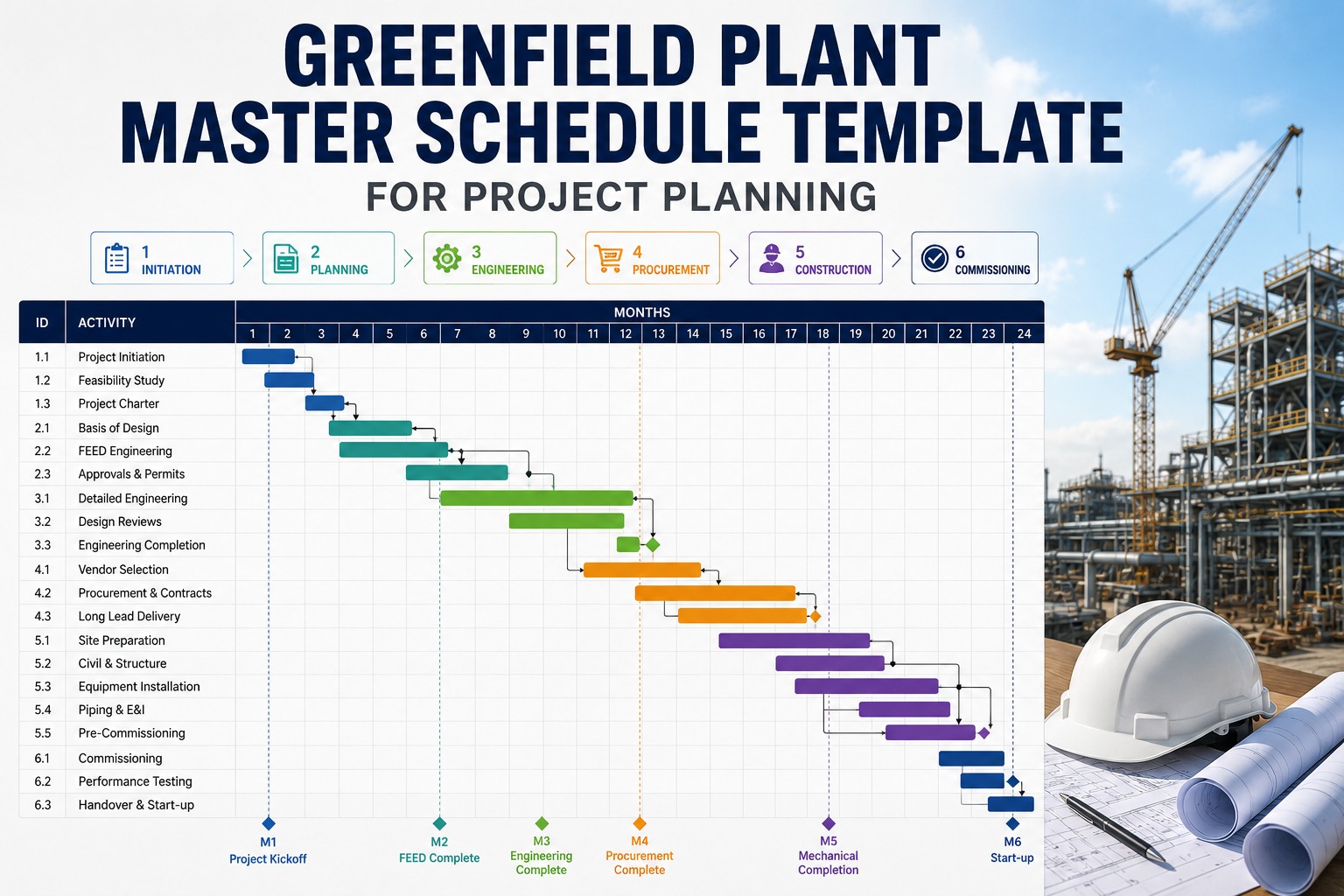
Greenfield Plant Master Schedule Template for Project Planning | iFactory
By Riley Quinn on June 20, 2026
A greenfield plant master schedule is not a Gantt chart. It is the central control document that aligns FEED engineering, long-lead procurement, multi-trade construction, commissioning sequencing, and production ramp-up across 3 to 5 years of work — with a defined critical path running through every phase. Most greenfield projects either start without a master schedule (catastrophic) or start with one that lacks dependency mapping, gate criteria, or critical path visibility (almost as bad). McKinsey's data shows 60% of capital projects overrun schedule by an average of 60% — and almost every one of those overruns traces back to a master schedule that did not properly capture the dependencies that ended up driving the delays. The template structure below covers the seven phases, eight milestone categories, and twelve dependency types every greenfield plant master schedule must capture. Book a greenfield project schedule consultation to build your master schedule with critical path, gate criteria, and AI dependency modeling before construction starts.
Greenfield Plant Master Schedule Template — 2026
The 7-Phase Timeline With Critical Path Highlighted
Critical Path
Standard Path
Phase Gate
3–5 yrTypical greenfield plant timeline — strategy to steady state production
60%Average schedule overrun for capital projects (McKinsey research)
12–18 moLong-lead procurement on the critical path of nearly every greenfield
6 gatesPhase gates that separate 20–30% CapEx savings from 70% budget overrun
The 7 Phases of a Greenfield Plant Master Schedule
Every greenfield plant master schedule organises around the same 7 phases — but the durations, dependencies, and gate criteria vary dramatically by industry and project complexity. The phase breakdown below is the canonical reference structure. The Strategy and Feasibility phases set the foundation. FEED is where the plant's economics and engineering get locked. Procurement runs in parallel with FEED for long-lead items. Construction and Commissioning execute the FEED. Ramp-up validates everything.
Phase 1
Strategy & Feasibility
2 to 4 months
Capacity targets, business case, technology selection, capital framework
Gate 1 deliverables: Six-factor site model · capacity scenarios · budget envelope · executive approval to proceed
Phase 2
Site Selection & Permitting
4 to 8 months
Land acquisition, utility connection studies, environmental clearances, incentive negotiation
Gate 2 deliverables: Site contract · utility commitment letters · permit pathway · incentive package signed
Phase 3
FEED Engineering
6 to 12 months
Process design, equipment specification, utility loads, MES/CMMS architecture, integrated spec
Systems testing, safety validation, operational qualification, virtual commissioning verification
Gate 6 deliverables: All systems handed over · punch list closed · PdM models trained · dashboards live
Phase 7
Ramp-Up to Steady State
6 to 12 months
Production trials, workforce training, sensor baseline collection, AI model tuning, 30/60/90 day targets
Gate 7 deliverables: Design capacity achieved · OEE target met · stable production · project handover to operations
The 12 Dependency Types Every Master Schedule Must Capture
Most greenfield schedule failures originate in unmapped dependencies — activities that look independent on paper but cannot start until a prior activity completes. Each dependency type below appears across virtually every greenfield project. A master schedule that does not explicitly model all 12 produces optimistic timelines that collapse during execution.
01
Permit → Construction
Building permit required before slab pour. Environmental clearance required before excavation.
Equipment specifications stable enough to order — transformers, switchgear, vessels, custom drives.
04
Civil Complete → MEP Rough-In
Building shell and slab must be complete before mechanical, electrical, and plumbing rough-in can begin.
05
MEP Rough-In → Equipment Delivery
Equipment foundations, utility tie-ins, and access paths required before major equipment delivery.
06
Equipment Install → Controls Integration
PLCs, sensors, and HMI cannot be commissioned until equipment is mechanically installed.
07
Network Live → MES/CMMS Deployment
OT and IT networks operational before MES and CMMS connectivity testing can begin.
08
Utilities Commissioned → Equipment Commissioning
Power, water, compressed air, HVAC must be commissioned and stable before production equipment commissioning.
09
Safety Systems → Personnel Access
Fire detection, suppression, life safety must be operational before workforce arrives for training.
10
Operator Training → Production Trials
Operators trained and certified before any production trial run on critical equipment.
11
Sensor Baseline → AI Model Activation
90 days of clean sensor data required before PdM models can be activated with statistical confidence.
12
Regulatory Sign-Off → Commercial Production
FDA / EPA / regulatory approvals required before any commercial product can be released to market.
Want all 12 dependencies mapped into your project schedule with AI critical-path modeling? Book a greenfield schedule consultation — we will build the dependency map before your next gate review.
The Critical Path: Why Long-Lead Procurement Owns Your Timeline
On nearly every greenfield manufacturing project, the critical path runs through the same chain: FEED specification → long-lead procurement → equipment delivery → installation → commissioning. Long-lead items (transformers 18-24 months, custom vessels 12-18 months, specialised switchgear 14-16 months) determine when commissioning can start. Compressing FEED only shifts the bottleneck to procurement. The only way to compress the critical path is to release long-lead items at 70% FEED completion rather than 100% — and that requires FEED discipline tight enough to make those specifications stable enough to commit.
A
FEED Specification
Process design, equipment spec, utility loads stabilised
6 to 12 months
→
B
Long-Lead Procurement
Transformers, switchgear, vessels in vendor production
12 to 24 months
→
C
Equipment Delivery & Install
Setting on foundations, utility tie-ins, mechanical complete
3 to 8 months
→
D
Commissioning & Ramp
Systems testing, validation, trial production, design capacity
10 to 21 months
Get the 7-Phase Master Schedule, Dependency Map & Critical Path for Your Project
iFactory's greenfield schedule consultation builds your master schedule with all 7 phases, all 12 dependency types mapped, critical path identified with AI modeling, 6 phase gates with criteria per gate, and Gantt visualisation — delivered as a working document before your next gate review.
The 8 Milestone Categories That Must Appear on Every Master Schedule
Milestones are the visible markers on the master schedule that signal progress to stakeholders. The 8 categories below appear on every greenfield project — but the most common scheduling failure is mixing milestone categories together, so a board-level "FEED Complete" milestone becomes invisible inside hundreds of granular engineering milestones. Each category has its own audience, cadence, and use.
First Production Run · 30-Day Target · 60-Day Target · 90-Day Target · Design Capacity Achieved
Expert Perspective: The Master Schedule That Survives First Contact With Reality
The master schedule you produce at FEED is a hypothesis. Every project we audit at 12 months in has discovered at least 3 dependencies that were not captured at FEED. Every project at 24 months has discovered 5 to 10. The question is never whether the master schedule will need to absorb discoveries — it is whether the schedule was built to make those discoveries visible early, or whether they will only surface as schedule slip during execution. The single most important property of a working master schedule is dependency completeness: every activity has its predecessors and successors explicitly mapped, the critical path is identifiable in 30 seconds, gate criteria are documented for each phase transition, and any new dependency discovered during execution can be added without breaking the model. Excel-based "schedules" that are really lists of activities with start dates almost always fail this test. The reason AI dependency modeling matters at greenfield is that it forces every activity to declare its predecessors — and then identifies the dependencies that the project team did not capture explicitly. That discipline alone is worth more than any specific software tool.
— iFactory Greenfield Consulting, Capital Projects Practice 2025 to 2026
60%
Average schedule overrun for capital projects (McKinsey)
3 to 10
Hidden dependencies typically discovered in first 12 to 24 months of execution
70%
Long-lead release point of FEED that breaks the procurement bottleneck
Ready to build a master schedule that survives execution? Talk to our project planning team — we will produce the 7-phase schedule with full dependency mapping and critical path before your next gate.
Build Your Greenfield Master Schedule With Critical Path, Dependencies & Gate Discipline
iFactory's greenfield schedule consultation produces your 7-phase master schedule with all 12 dependency types mapped, critical path identified through AI modeling, 6 phase gates with documented criteria, 8 milestone categories aligned to stakeholder audiences, Gantt visualisation, and a working planning document — delivered before your next gate review.
What is the typical timeline for a greenfield manufacturing plant from strategy to steady-state production?
A greenfield manufacturing plant typically takes 3 to 5 years from initial strategic evaluation to full production capacity. The breakdown is usually: Strategy and Feasibility (2 to 4 months), Site Selection and Permitting (4 to 8 months), FEED Engineering (6 to 12 months), Procurement running parallel for 12 to 24 months, Construction (12 to 30 months), Commissioning (4 to 9 months), and Ramp-Up (6 to 12 months). Total elapsed time varies based on project complexity, regulatory environment, industry, and whether the facility incorporates Industry 4.0 technologies from the start. Simple facilities can complete in 2 to 3 years; complex chemical, semiconductor, or pharmaceutical greenfields routinely run 4 to 6 years. The most common schedule failure is treating these phases as sequential when several must run in parallel — particularly FEED and long-lead procurement.
What does "critical path" mean in greenfield plant scheduling, and how is it identified?
The critical path is the longest sequence of dependent activities through the project — the chain of activities that determines the minimum possible project duration. Any delay on a critical path activity delays the entire project; any acceleration on a non-critical activity does not. On greenfield manufacturing projects, the critical path almost always runs through FEED specification → long-lead procurement → equipment installation → commissioning, because long-lead items (transformers, switchgear, custom vessels) have 12 to 24 month lead times that compound through every later phase. Identification requires explicit dependency mapping — every activity has documented predecessors and successors, durations are estimated, and AI critical-path modeling identifies the longest chain. The critical path can change during execution: a delay on a previously non-critical activity can promote it onto the critical path. Continuous critical-path monitoring is the discipline that prevents this from becoming a surprise.
When should long-lead procurement be released against the master schedule?
Long-lead items (transformers 18 to 24 months, custom vessels 12 to 18 months, specialised switchgear 14 to 16 months) should be released at approximately 70% FEED completion. Releasing earlier risks specification changes after PO that trigger expensive vendor variation orders. Releasing later puts long-lead delivery on the critical path and ends up compressing commissioning to recover schedule. AI lead-time modeling against the project's actual critical path identifies which specific items must be released at 50%, 70%, or 90% FEED — the percentages are not arbitrary but driven by each item's specific lead time and dependency relationships. Long-lead procurement timing is consistently identified as the single largest schedule lever on greenfield manufacturing projects. Plants that hit production targets on time almost always released long-lead items at the right point in FEED; plants that miss almost always released them too late.
What is the difference between a Gantt chart and a master schedule?
A Gantt chart is a visualisation format — horizontal bars showing activities over time. A master schedule is the underlying planning document — a structured collection of activities, durations, predecessors, successors, gate criteria, milestones, and critical-path calculations. A Gantt chart can be a useful presentation of a master schedule but is not a substitute for one. Many greenfield projects fail because they have a Gantt chart but not a master schedule — the visual is impressive but the dependencies are not modeled, the critical path is not identified, and any schedule change requires manual re-drawing rather than dependency-driven recalculation. The master schedule lives in scheduling tools (Primavera P6, MS Project, modern alternatives) and the Gantt is one of several outputs from it — alongside critical-path reports, milestone trackers, resource allocation views, and gate review packages.
How does iFactory's greenfield master schedule consultation work?
iFactory's greenfield schedule consultation produces your master schedule across all 7 phases (Strategy through Ramp-Up), with explicit dependency mapping for all 12 dependency categories documented above, critical path identified using AI modeling against your specific equipment lead times and project specifications, 6 phase gates with documented entry criteria and deliverable lists, 8 milestone categories aligned to stakeholder audiences (board, regulatory, procurement, construction, utilities, equipment, workforce, ramp-up), Gantt visualisation for executive presentation, working planning document compatible with your project management platform (Primavera P6, MS Project, or modern equivalents), and ongoing critical-path monitoring through execution. All outputs are delivered as a working planning system before your next gate review. Book your greenfield master schedule consultation here.