McKinsey's research across thousands of capital projects shows that 85% of greenfield manufacturing projects overrun budget — by an average of 28%, and 60% over schedule. The average cost overrun for a large project reaches $1.3 billion. Yet almost every one of these overruns traces back to a small set of decision errors made during the planning and FEED (Front-End Engineering Design) phases — when correcting them would have cost a fraction of what they cost during construction or commissioning. A design issue caught at conceptual design costs $1 to fix; the same issue caught at construction costs $10 to $200; caught at commissioning, it can cost the entire margin of the project. The 12 mistakes below are not edge cases — they appear repeatedly across F&B, automotive, semiconductor, chemical, and battery greenfield builds. Each one is preventable. Book a greenfield project risk consultation to map your current plan against the 12 mistake patterns before construction starts.
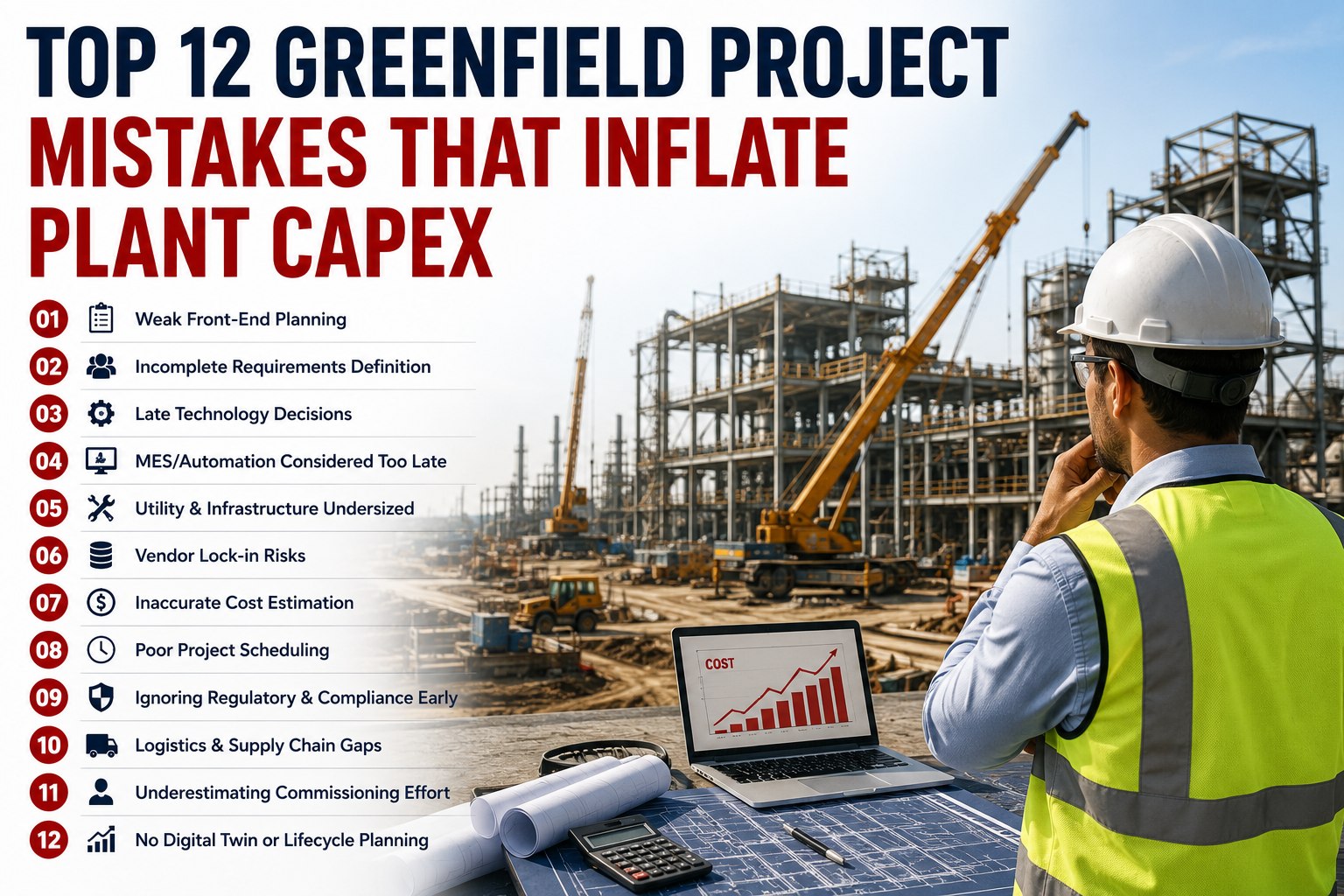
Top 12 Greenfield Project Mistakes That Inflate Plant CapEx — 2026
The Same Mistake Costs 1× at Design, 10× at Construction, 200× at Commissioning
FEED & Design
1×
Mistake caught on paper. A redline, a redesign, a re-spec. Hours of engineering time.
Procurement
3–5×
Mistake caught at PO stage. Vendor variation, lead time impact, re-quote cycle.
Construction
10–20×
Mistake caught on site. Rework, structural modification, RFI, contractor change orders.
Commissioning
50–100×
Mistake caught at startup. Equipment swap, line shutdown, recommissioning, schedule slip.
Production
100–200×
Mistake caught after launch. Lost production, retrofit cost, competitive position erosion.
85%Of capital projects exceed budget — across all industries (McKinsey)
28%Average cost overrun on greenfield manufacturing projects
60% / 70%Average schedule and budget overrun for large capital projects
15–35%CapEx reduction achievable through AI-driven design review at FEED
Planning Phase Mistakes — Made in Months 1 to 12, Discovered in Year 3
The most expensive mistakes in any greenfield project are made before construction begins — typically in the first 12 months of planning. They cost almost nothing to make. They cost millions to undo. Each one of the four below is documented as a recurring pattern across global capital projects.
01
Site Selection Without Modeling the Full Six Factors
Picking land based primarily on cost or geographic preference, without modeling energy availability, workforce depth, incentives, supply chain proximity, permitting speed, and digital infrastructure.
Hardest mistake to fix post-commitment. Energy availability is now the #1 site factor for advanced manufacturing — a low-cost site without grid capacity becomes the most expensive site after delays.
Fix: Six-factor scoring model applied before land option is taken — not after.
02
Building Too Large or Too Small for Demand
Plant capacity set against an internal forecast without scenario-testing market demand, phased expansion options, or competitive response.
Too large = stranded capital + ongoing OpEx waste for 15+ years. Too small = lost market share + Phase 2 expansion at 2 to 3× greenfield cost per unit capacity.
Fix: AI-driven demand scenario modeling with phased capacity options before structural design begins.
03
Weak or Compressed FEED
FEED rushed under pressure to start construction. Engineering deliverables incomplete. Equipment specifications, utility loads, and controls integration left as "Phase 2 detail."
Late discovery during construction: utilities undersized, controls cabinets too small, MES gateways missing. Average late-discovery cost is 10 to 200× the cost of fixing at FEED.
Fix: Gate discipline — construction cannot start until FEED gate is cleared with complete specifications.
04
Under-Budgeting IT/OT Infrastructure
Allocating 5 to 8% of CapEx to IT/OT — the historical norm — for what is now an AI-ready facility requiring 10 to 18%.
Edge compute, private 5G, unified data architecture, CMMS/MES, cybersecurity, and 2 to 3× electrical capacity all under-funded. Retrofitting these later costs 4 to 6× the greenfield specification.
Fix: IT/OT budget set at 10 to 18% of total CapEx for AI-ready facilities at FEED.
Design & Procurement Mistakes — Made During FEED, Detonated at Construction
Design and procurement mistakes are the costliest category because they appear "controllable" at the time but become irreversible once equipment is on order. Vendor lock-in, late MES decisions, and procurement timing errors compound across the entire project — and they are the most preventable with disciplined planning.
05
Equipment Vendor Lock-In Through Bespoke Specifications
Specifications written so tightly to one vendor's catalogue that only one supplier can bid. No alternative pricing, no protocol flexibility, no spare parts competition.
15 to 30% premium on equipment CapEx. Ongoing spares and service captive. Future AI integration constrained to vendor's roadmap.
Fix: Open-protocol specifications (OPC-UA, MQTT) and minimum 3-vendor commercial review before any PO >$500K.
06
Long-Lead Procurement Started Too Late
12 to 18 month lead-time items (transformers, custom drives, specialised vessels) ordered after FEED is complete instead of in parallel with FEED.
Long-lead procurement is consistently the single biggest schedule delay driver on greenfield projects. Every week of delay cascades into commissioning compression.
Fix: AI lead-time modeling against FEED critical path — long-lead items go on order at 70% FEED completion, not 100%.
07
MES & CMMS Decisions Deferred to "Phase 2"
MES, CMMS, and unified data architecture treated as software decisions to be made after the plant is built — not as design constraints that drive sensor placement, network topology, and cable routes.
Sensor brackets retrofitted post-construction. Network coverage holes in zones nobody planned for. CMMS asset hierarchies reconstructed from spreadsheets. Eliminates 25 to 40% of the digital ROI a greenfield plant could have delivered.
Fix: MES, CMMS, and data architecture decisions made during FEED, with sensor schedule and network coverage in construction drawings.
08
Incomplete Estimates That Don't Tie Disciplines Together
Equipment vendors price machines in isolation. Engineering firms work in siloed scopes. No shared specification tying square footage, utilities, equipment, controls, and labor together.
When conflicts surface during construction, the project is already committed and reality replaces guesswork at full cost. This is the single most cited root cause of greenfield overruns in industry analysis.
Fix: Integrated specification owner (greenfield consultant or EPC PMO) responsible for reconciliation across all disciplines from FEED through construction.
Need an independent FEED quality review against the 12 mistake patterns? Book a greenfield project risk consultation — we will produce a mistake-pattern audit before construction starts.
Construction & Commissioning Mistakes — Where Schedule Pressure Wins and Quality Loses
By the time construction begins, the worst mistakes have already been made. But the construction and commissioning phases have their own characteristic errors — typically driven by schedule pressure or by failing to coordinate scopes that were never integrated at design. Each compounds the budget impact of any earlier mistake.
09
Utility Sizing Discovered Mid-Construction
Power, water, gas, compressed air, and HVAC capacities sized to baseline equipment list — then process design adds loads that exceed the utility capacity.
Utility retrofits during construction: transformer upgrade, additional compressors, HVAC unit replacement. Each retrofit costs 4 to 8× the greenfield specification of correctly-sized utilities.
Fix: Utility load schedule maintained as a live document through FEED, with 20% headroom built into all utility sizing for design growth.
10
Multi-Contractor Coordination Failure
Civil, mechanical, electrical, and controls contractors each working to their own drawings without integrated coordination model. Conflicts surface as RFIs during construction.
Every RFI adds 3 to 14 days of schedule. RFI rate on poorly coordinated projects can exceed 50 per month — adding months of cumulative delay.
Fix: BIM coordination model with clash detection before construction sequence is finalised. Weekly BIM review with all trades.
11
Commissioning Compressed Under Schedule Pressure
Project running behind, commissioning is the last phase, schedule recovery comes from "running parallel commissioning" or "compressing the testing phase."
Commissioning errors propagate into production. Plant ramp-up extended by months. OEE start-up trajectory delayed by 12 to 24 months. The largest single contributor to "the plant that never ramps."
Fix: Virtual commissioning during construction (digital twin) so physical commissioning becomes verification rather than discovery.
12
No Maintenance Strategy at Launch
CMMS not configured, asset hierarchies not built, sensor architecture not mapped, predictive models not trained. Plant launches with reactive maintenance from day one.
Reactive firefighting from day one adds 20 to 30% to maintenance costs and delays ramp-up by months. Compounds every other mistake on this list.
Fix: CMMS configured during construction, predictive maintenance models trained during commissioning, dashboards live from day one of production.
Map Your Greenfield Plan Against the 12 Mistake Patterns Before Construction Starts
iFactory's greenfield risk consultation reviews your FEED documents, procurement strategy, IT/OT budget allocation, utility load schedule, and commissioning plan against the 12 mistake patterns. The output is a prioritised risk register with specific fixes per item — delivered before the next gate review.
Phase-Gate Discipline: The Framework That Catches All 12 Mistakes Before They Cost Money
The single most effective intervention against greenfield CapEx overrun is phase-gate discipline. Each phase has a defined gate review. No phase begins until the prior gate is cleared. This single practice separates 20-30% CapEx savings from 70% budget overruns — but it requires the organisational discipline to actually hold the gates when schedule pressure builds.
Gate 1
Strategy → Feasibility
Catches: Site selection error (#1), demand sizing error (#2)
Required: Six-factor site model, demand scenarios, phased capacity options
Gate 2
Feasibility → FEED
Catches: IT/OT under-budget (#4), MES deferral (#7)
Required: Complete CapEx breakdown including 10–18% IT/OT, MES/CMMS architecture decided
Gate 3
FEED → Construction
Catches: Weak FEED (#3), vendor lock-in (#5), utility sizing (#9), incomplete estimates (#8)
Required: Complete utility schedule with headroom, integrated specification, vendor competition for all majors
Gate 4
Procurement Sequencing
Catches: Late long-lead procurement (#6)
Required: Long-lead items on PO at 70% FEED with lead-time modeling against critical path
Gate 5
Construction → Commissioning
Catches: Coordination failure (#10), commissioning compression (#11)
Required: BIM clash-detection clean, virtual commissioning complete, CMMS configured, sensor architecture live
Gate 6
Commissioning → Production
Catches: No maintenance strategy at launch (#12)
Required: PdM models trained, CMMS work order workflow live, dashboards operational on day one
Expert Perspective: The Mistake That Funds Every Other Mistake
If we had to identify the single root cause behind 80% of greenfield overruns, it would be the absence of one role: an integrated specification owner. Equipment vendors price machines in isolation. Civil engineers design the building. Electrical engineers size the switchgear. Controls integrators write the PLC code. IT teams design the network. Each discipline produces a correct deliverable in their own scope — and nobody owns the integration. When the integration breaks during construction, every discipline points at the next one. The project absorbs the rework cost because nobody owned the conflict in advance. The single most cost-effective intervention on any greenfield project is naming the integrated specification owner — and giving them gate authority. With that role in place, all 12 mistakes become tractable. Without it, even the best individual disciplines produce projects that overrun by 28% on average and 70%+ in the long tail. The technology to prevent every mistake on this list exists in 2026. The organisational discipline to use it is the actual scarce resource.
— iFactory Greenfield Consulting, Capital Projects Practice 2025 to 2026
10–200×
Cost multiplier — same mistake at commissioning vs. at FEED
15–35%
CapEx reduction from AI-driven FEED review and equipment benchmarking
20–30%
Maintenance cost premium from launching with reactive maintenance only
Ready to add gate discipline and an integrated specification owner to your greenfield project? Talk to our greenfield risk team — we will produce a gate review framework before your next phase begins.
Stop CapEx Overrun Before It Starts — At FEED, Not At Commissioning
iFactory's greenfield risk consultation covers FEED quality review, IT/OT budget benchmarking, vendor competition discipline, utility load reconciliation, long-lead procurement scheduling, BIM coordination, virtual commissioning planning, and CMMS / PdM launch readiness — coordinated through phase-gate discipline before each gate review.
Frequently Asked Questions
What is the single most common cause of greenfield project CapEx overrun?
The most cited root cause across capital project research is incomplete estimates that fail to integrate disciplines — equipment vendors price machines in isolation, engineering firms work in siloed scopes, and no single specification ties square footage, utilities, equipment, controls, and labor together. When conflicts surface during construction, the project is already committed and reality replaces guesswork at full cost. Late discovery (problems present in design data but not identified until construction or commissioning) accounts for the majority of overruns — at correction costs 10 to 200 times higher than the same fix at conceptual design. The fix is naming an integrated specification owner accountable for reconciliation across all disciplines from FEED through commissioning, with explicit gate authority to hold construction until prior phases are complete.
How much IT/OT infrastructure budget should a greenfield manufacturing plant allocate?
AI-ready manufacturing facilities require 10 to 18% of total CapEx for IT/OT infrastructure — significantly above the 5 to 8% allocated in traditional greenfield builds. This higher allocation covers edge computing infrastructure, private 5G or Wi-Fi 6E networks, unified data architectures, MES and CMMS platforms, cybersecurity, and the 2 to 3 times higher electrical capacity that AI-powered operations require. Plants budgeted at traditional IT/OT percentages systematically discover they cannot run AI vision inspection, predictive maintenance, or unified MES at the production capacity their physical infrastructure supports — leading to either compromised AI deployments or expensive post-launch retrofits at 4 to 6 times the greenfield cost. Setting the IT/OT budget at 10 to 18% at FEED is one of the highest-ROI single decisions in greenfield planning.
When should long-lead procurement items be placed on order?
Long-lead items (transformers, custom drives, specialised process vessels, switchgear, certain HVAC equipment) typically have 12 to 18 month lead times. Waiting until FEED is 100% complete to order them puts them on the critical path. Best practice is to release long-lead procurement at approximately 70% FEED completion — when the specifications are stable enough for procurement but FEED has time to absorb any specification adjustments. AI lead-time modeling against the critical path identifies which items must be ordered at 50%, 70%, or 90% FEED to avoid becoming the schedule bottleneck. Long-lead procurement is consistently identified as the single biggest schedule delay driver on greenfield manufacturing projects — and every week of delay cascades into commissioning compression at the end of the project.
What is virtual commissioning and how does it prevent CapEx overrun?
Virtual commissioning is the practice of running the plant in a digital twin during construction — simulating every PLC interaction, every utility load, every quality measurement, every control loop, before physical commissioning begins. Errors discovered in virtual commissioning are fixed in software at FEED-equivalent cost. The same errors discovered at physical commissioning cost 50 to 100 times more because they require equipment swap, line shutdown, recommissioning, and schedule slip. Virtual commissioning typically covers PLC code validation, controls integration verification, utility load reconciliation, and MES-to-process connectivity testing. By the time physical commissioning starts, it becomes verification rather than discovery — making the most schedule-sensitive phase of the project predictable. Plants using virtual commissioning routinely cut commissioning duration by 30 to 50% and eliminate the post-launch ramp problems that derail OEE.
How does iFactory's greenfield project risk consultation work?
iFactory's greenfield risk consultation reviews your current project documents — FEED package, CapEx breakdown, procurement schedule, utility load schedule, BIM coordination model if available, MES/CMMS architecture, commissioning plan — against the 12 mistake patterns documented in this guide. The output is a prioritised risk register with specific fixes per item, IT/OT budget benchmark vs. the 10 to 18% target for AI-ready facilities, long-lead procurement schedule with AI lead-time modeling, gate review framework with criteria per gate, virtual commissioning roadmap, and CMMS / predictive maintenance launch plan. All outputs are delivered before your next gate review — so the risks are addressable in the next phase rather than after the project is committed.
Book your greenfield project risk consultation here.