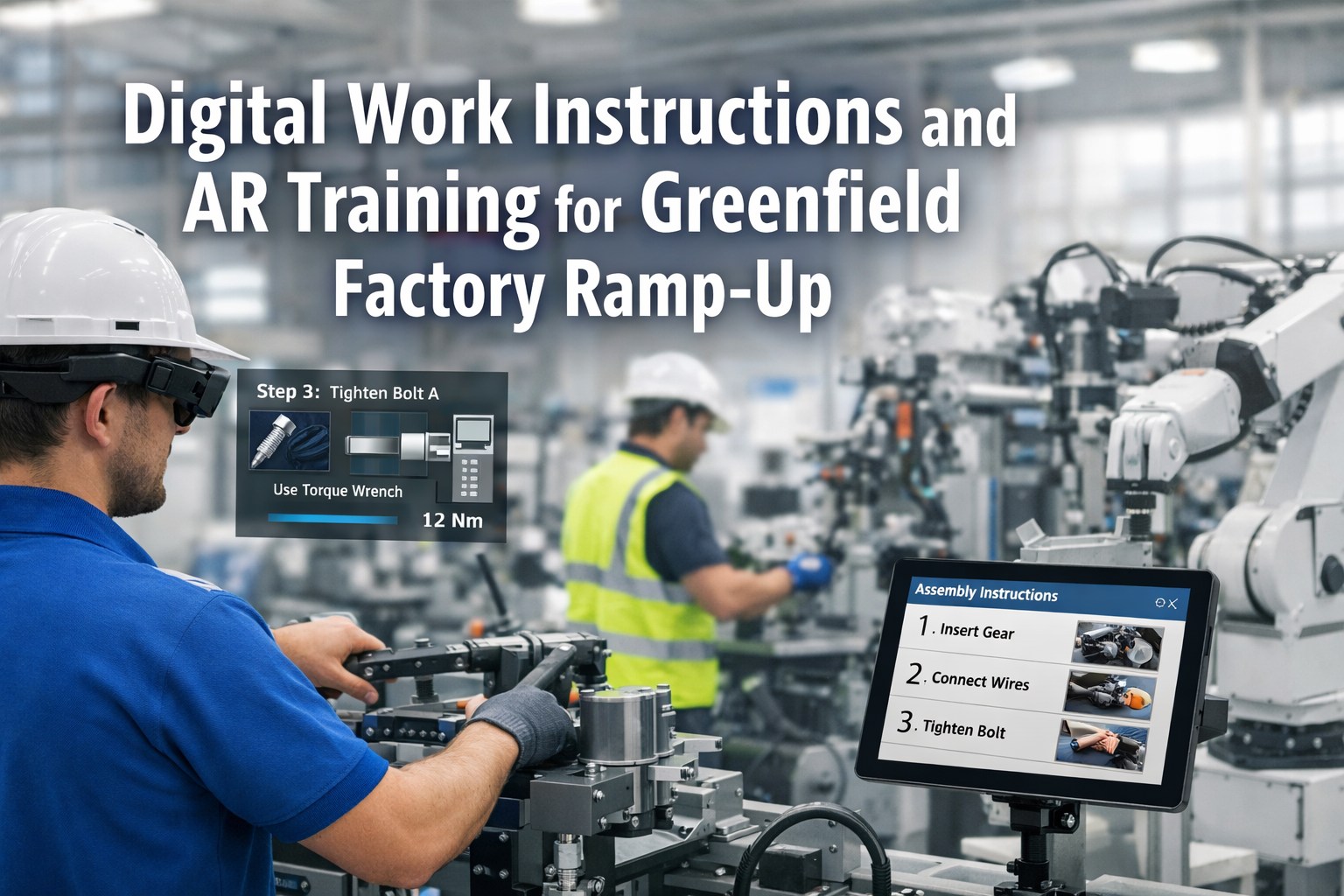
Digital Work Instructions and AR Training for Greenfield Factory Ramp-Up
By David Cook on March 6, 2026
The average manufacturer loses 3 weeks training each new operator using paper manuals and shadowing. With 45% of the skilled manufacturing workforce retiring by 2030, that timeline is unsustainable — especially when you're ramping up an entire greenfield factory with a workforce that has zero institutional memory. Digital work instructions and AR-guided training compress onboarding from weeks to days, cut assembly errors by up to 25%, and ensure every operator follows the same optimized procedure from day one. Here's how to build it into your greenfield ramp-up plan.
DIGITAL WORK INSTRUCTIONS & AR TRAINING
$1.5BDigital Work Instructions Market (2024)
50%Training Time Reduction With AR
25%Fewer Assembly Errors Reported
90%Operator Confidence Post-AR Training
GUIDE
TRAIN
VERIFY
Why greenfield ramp-up is the hardest training challenge in manufacturing: Every operator is new. No one has institutional knowledge. No veteran on the floor to shadow. Every process, every machine, every quality checkpoint is being learned simultaneously — while production targets are already ticking. Digital work instructions and AR training turn your engineering documentation into interactive, step-by-step guidance that any operator can follow on day one, with zero reliance on tribal knowledge.
The Ramp-Up Problem: Why Traditional Training Fails Greenfield
The Old Way
Paper binders with 200+ page SOPs that no one reads completely
Classroom training disconnected from the actual production floor
Shadowing veterans who each do tasks slightly differently
3-week average onboarding before an operator runs independently
Knowledge locked in experts' heads — lost when they leave or retire
The Digital Way
Interactive step-by-step instructions on tablets or AR headsets at each station
Learn on the actual machine with 3D overlays showing exactly what to do
Every operator follows the same standardized, optimized procedure
Onboarding compressed to 3 days with AR-guided training programs
Knowledge captured digitally — reusable, updatable, scalable across shifts
The skills gap in manufacturing is real and accelerating. As experienced workers retire, factories face a choice: spend weeks training every new hire through outdated methods, or equip them with digital tools that deliver expert-level guidance in context, at the point of work. Companies like Boeing report that AR-based work instructions reduced production time by 25% and drove error rates to near zero on complex wiring tasks. Toyota cut training time by 50% using AR headsets with step-by-step holographic guidance. These aren't pilot projects — they're production-scale deployments proving that digital work instructions and AR training are the fastest path from new hire to full productivity.
What Are Digital Work Instructions and AR Training?
The Digital Training Stack for Greenfield Factories
Digital Work Instructions (DWI)
Interactive, visual SOPs delivered on tablets, touchscreens, or monitors at each workstation. Include photos, videos, annotated diagrams, and step-by-step task flows that guide operators through every procedure — from machine setup to quality checks. Automatically updated across all stations when engineering changes occur.
Step-by-step visual task guidance
Embedded photos, video, and 3D models
Version-controlled with instant updates
Completion tracking and sign-off
AR-Guided Training & Assistance
Augmented reality overlays digital guidance onto the real physical environment via smart glasses, headsets, or tablet cameras. Operators see holographic arrows pointing to the right bolt, torque values floating next to components, and animated sequences showing the exact procedure — all while looking at the actual machine.
3D holographic overlays on real equipment
Hands-free guidance via smart glasses
Remote expert assist with live video
Spatial anchoring to specific machines
How It Transforms the Greenfield Ramp-Up Timeline
Traditional Ramp-Up
Week 1-2Classroom + Paper SOPs
Week 3-4Shadow a Veteran
Week 5-8Supervised Production
Week 9+Independent (with errors)
DWI + AR Ramp-Up
Day 1-2AR-Guided Orientation
Day 3-5Guided Production + DWI
Week 2-3Independent + On-Demand AR
Week 4+Full Speed (with verification)
The greenfield multiplier: In a brownfield retrofit, you're retraining existing staff on new tools. In a greenfield ramp-up, you're training an entire workforce from scratch — on every process, every machine, every quality check simultaneously. Digital work instructions turn months of tribal knowledge transfer into days of structured, repeatable onboarding.
Ramp Up Faster With iFactory
iFactory's digital work instruction platform integrates with MES, quality tracking, and operator dashboards — so your workforce has standardized guidance, real-time feedback, and performance tracking from day one.
5 Use Cases: Where DWI and AR Deliver the Most Impact
01
Complex Assembly Guidance
AR overlays show operators exactly which component to pick, where to place it, and what torque to apply — step by step. Boeing used this for aircraft wiring and drove error rates to near zero. Critical for any greenfield line with multi-step, multi-component assembly processes.
02
Machine Setup & Changeover
Digital instructions walk operators through machine setup, tooling changes, and parameter configuration with visual confirmation at each step. Reduces changeover time and eliminates the risk of missed steps that cause scrap on the first batch after a changeover.
03
Quality Inspection & Verification
Embed quality checkpoints directly into work instructions — operators can't skip ahead without confirming the check. AR can highlight measurement points and acceptable ranges. Inspection data flows directly into MES for real-time quality tracking and traceability.
04
Maintenance & Troubleshooting
When equipment faults occur, technicians scan the machine with AR and see step-by-step repair procedures overlaid on the actual components. Remote expert assist lets a senior engineer guide a junior technician through complex repairs via live AR video — no travel required.
05
Safety & Compliance Training
AR highlights hazard zones, PPE requirements, and lockout/tagout procedures in the operator's real field of view. Digital checklists ensure every safety step is completed and documented — creating an audit-ready compliance trail automatically.
The ROI Numbers That Matter
50%
faster onboarding — Toyota reduced training time by half using AR headsets with holographic work instructions
25%
reduction in production time — Boeing achieved this on complex wiring tasks using AR-guided procedures
70%
drop in employee errors — Ford reported this after implementing AR for assembly line worker training
3x
trainer efficiency — BMW AR goggles let one trainer supervise three trainees simultaneously during engine assembly
The compounding ROI most teams miss: Digital work instructions don't just speed up onboarding — they capture expert knowledge permanently. Every time a veteran operator refines a procedure, that improvement is instantly available to every operator on every shift. When staff turns over, the knowledge stays. When you open a second shift or a second facility, the same instructions deploy instantly. That's not a training tool — it's an institutional knowledge engine that compounds value over time.
Building Your Digital Training Stack: What You Need
Tablet-Based DWI
Smart Glasses AR
Hybrid (DWI + AR)
Best For
Standard SOPs, quality checklists, setup procedures
Hands-free assembly, maintenance, complex tasks
Full greenfield ramp-up covering all use cases
Hardware
Industrial tablets ($300-$800 each)
Smart glasses ($2K-$3.5K each)
Tablets + glasses where needed
Training Impact
30-40% onboarding reduction
40-60% onboarding reduction
50%+ onboarding reduction
Hands-Free
No — requires holding device
Yes — fully hands-free
Yes at AR stations
MES Integration
API-based, straightforward
Requires middleware
Unified platform approach
Deployment Speed
2-4 weeks
4-8 weeks
4-8 weeks
Common Mistakes When Deploying DWI & AR in Greenfield
Mistake
Digitizing paper SOPs word-for-word instead of redesigning instructions for the digital medium — operators get walls of text on a screen instead of clear visual steps.
Solution
Design instructions for the screen: short steps, one action per screen, photos or 3D models at every step, and embedded video for complex procedures.
Mistake
Rolling out AR glasses plant-wide before validating on a single line — creating support headaches and operator resistance before proving value.
Solution
Start with tablet-based DWI across all stations and deploy AR glasses only at high-complexity or high-error workstations. Expand based on measured results.
Mistake
Keeping work instructions disconnected from MES — so completion data, cycle times, and quality results live in separate silos with no visibility.
Solution
Integrate DWI directly with your MES platform so work instruction completion feeds production tracking, quality records, and operator performance dashboards.
Mistake
Creating instructions once and never updating them — procedures drift from reality as operators find better methods that never get captured.
Solution
Build a feedback loop: let operators flag improvements, route suggestions through engineering for approval, and push updates to all stations instantly.
Frequently Asked Questions
Tablet-based digital work instruction platforms typically cost $5K-$50K annually depending on the number of users and stations, plus $300-$800 per industrial tablet. AR smart glasses add $2K-$3.5K per device. Cloud-native platforms like iFactory bundle digital work instructions into the MES subscription, reducing standalone software costs. Most factories see ROI within 6 months through reduced training time, fewer errors, and lower scrap rates.
For a greenfield factory, DWI creation runs in parallel with equipment installation. A typical production line with 15-25 work stations can have full digital instructions authored in 2-4 weeks. Modern platforms use templates, drag-and-drop editors, and media capture via smartphones — so process engineers can create instructions without coding or design skills. AR content takes slightly longer due to spatial anchoring and 3D model alignment.
Adoption depends on comfort, use case, and proven value. Current smart glasses weigh 300-500g and are designed for 2-4 hour sessions. The most successful deployments use AR for training and complex tasks (changeovers, new product introductions, maintenance), not for routine operations. Once operators experience the reduced cognitive load and error elimination, resistance drops quickly. Companies report that new hires — especially younger workers — adopt AR faster than veterans.
Yes — and this integration is what separates effective DWI from fancy PDF viewers. When DWI integrates with MES, work instruction completion automatically updates production tracking. Quality checkpoints embedded in instructions feed data directly into quality management systems. Operator performance metrics flow into analytics dashboards. iFactory's platform provides this integration natively.
iFactory's cloud-native MES platform includes digital work instruction capabilities integrated with production scheduling, quality tracking, and operator performance analytics. Visual SOPs are delivered at each workstation, completion data feeds real-time production dashboards, and quality checkpoints are embedded directly into operator workflows. For greenfield factories, instructions are authored during the construction phase and deployed at commissioning — so operators have guided procedures from their first shift.
Ramp Up Your Greenfield Workforce in Days, Not Months
iFactory integrates digital work instructions, quality verification, and operator performance tracking into one MES platform — giving greenfield factories standardized, visual guidance from day one.
Planning operator training for your greenfield factory? Book your free iFactory demo and see how digital work instructions integrate with MES, quality tracking, and operator analytics — configured during construction, operational from first shift.