Greenfield vs Brownfield Manufacturing: 2026 ROI & Cost Guide
By Riley Quinn on April 8, 2026
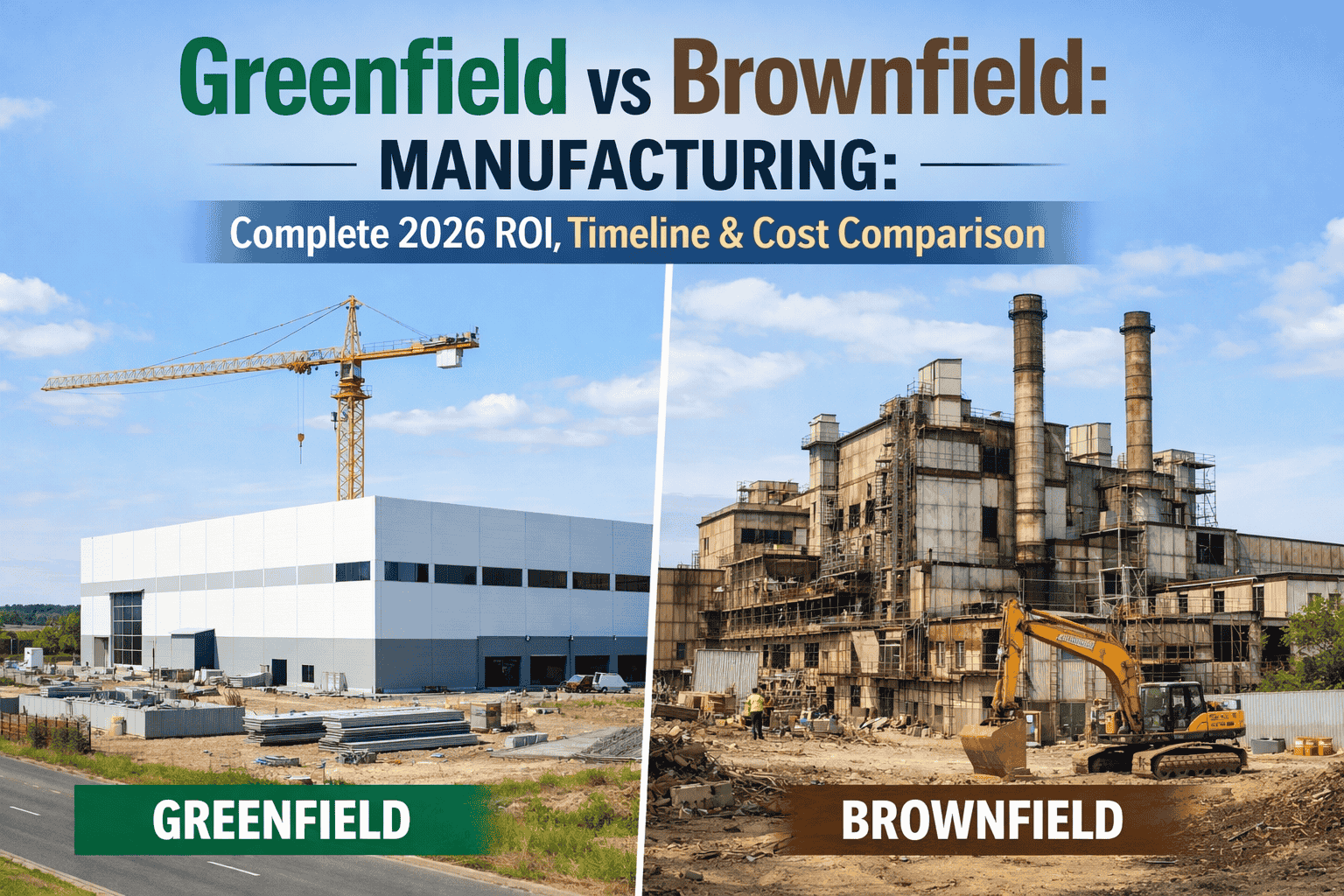
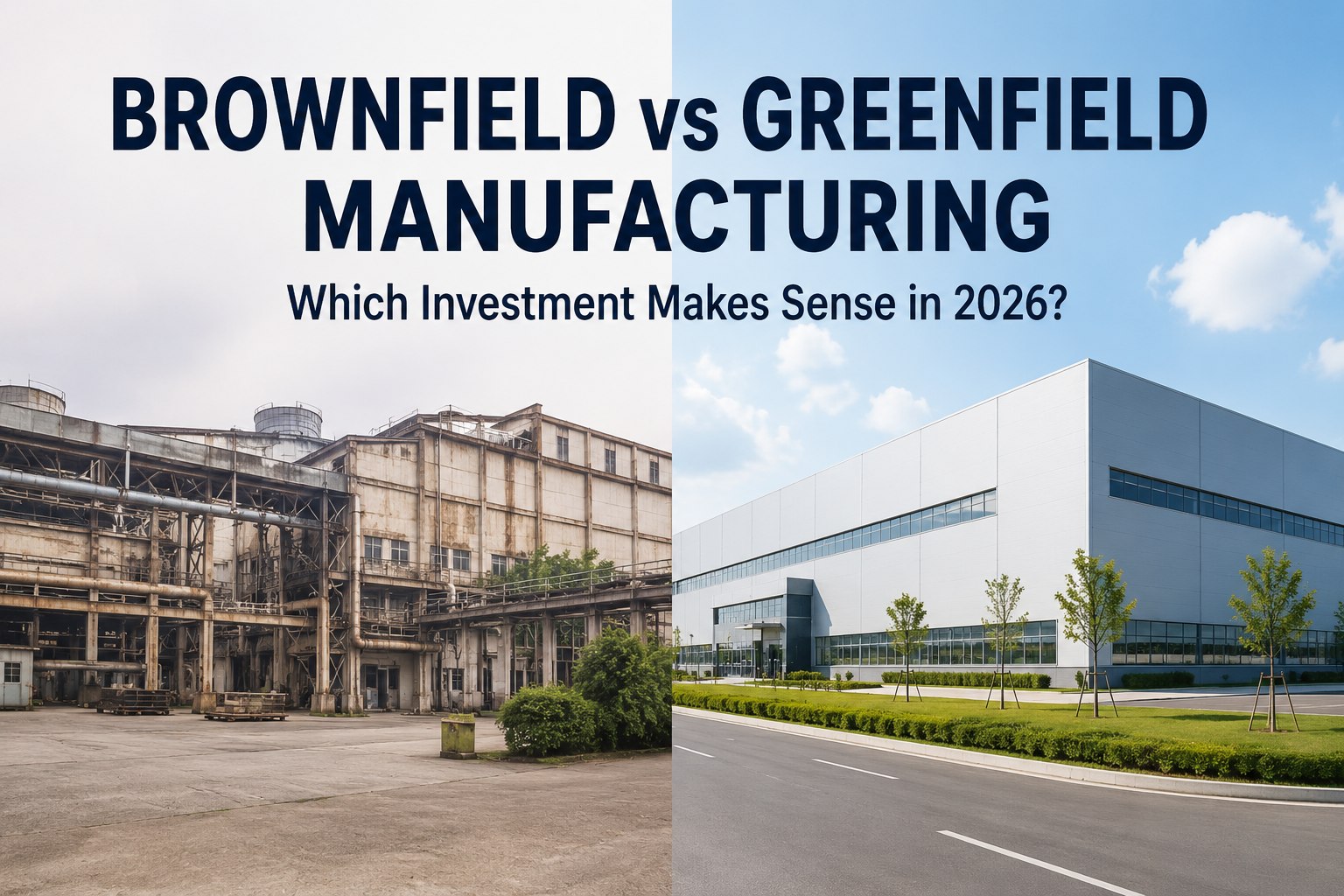
Only 14% of manufacturers choose pure greenfield construction. The other 86% face the same question you're facing right now: should we build new or renovate what we have? The answer isn't about which approach is "better"—it's about which approach delivers better ROI for your specific situation. Greenfield projects cost 40-60% more upfront but achieve 45% faster technology adoption. Brownfield retrofits deploy 6-12 months faster but often hit performance ceilings at 60-80% of potential. This guide breaks down the real numbers so you can make the decision that shapes your next decade.
The 2026 Manufacturing Investment Decision
Build new or renovate? Here's what the data actually shows.
Greenfield
Build from scratch
$12M – $55M
Typical project range
3–5 yearsTotal timeline
VS
Brownfield
Renovate existing
$6M – $22M
Typical project range
6–18 monthsTotal timeline
14%
Choose pure greenfield
70%
Of projects run over budget
60%
Run over schedule
10:1
AI maintenance ROI potential
What "Greenfield" and "Brownfield" Actually Mean
These terms come from construction, but in manufacturing they represent fundamentally different investment philosophies. Understanding the distinction is the first step toward making the right choice.
Greenfield Manufacturing
Building a new facility from the ground up on previously undeveloped land. You start with an empty field and design everything to your exact specifications.
Examples in 2026:
TSMC's $100B Arizona fab complex, Samsung's $37B Texas semiconductor plant, Rivian's $5B Georgia EV campus
Brownfield Manufacturing
Renovating, upgrading, or repurposing an existing facility. You work within the constraints of current infrastructure while modernizing operations.
Examples in 2026:
GM's $900M Michigan plant refurbishment, Stellantis reopening Illinois facility for Jeep production, legacy auto plants converting to EV lines
Not sure which approach fits your situation?Get a free ROI assessment with our manufacturing consultants.
The Complete Cost Comparison
Initial investment is just the beginning. The real comparison includes hidden costs, timeline risks, and long-term operational efficiency. Here's what the 2026 data shows.
Swipe to compare all factors
Cost Factor
Greenfield
Brownfield
Initial Investment
$12M – $55M (40-60% higher)
$6M – $22M (baseline)
IT/OT Infrastructure
10–18% of CAPEX
5–8% of CAPEX
Hidden Retrofit Costs
None
+20–35% for integration
Schedule Overrun Risk
68% exceed 12+ days
68% exceed 12+ days
5-Year Maintenance Cost
25–40% lower (new equipment)
Baseline + legacy upkeep
5-Year Total Cost of Ownership
Often lower despite higher upfront
Often higher due to hidden costs
The Hidden Cost Reality
McKinsey research shows the average capital project runs 60% over schedule and more than 70% over budget. For large projects, cost overruns average $1.3 billion. Both greenfield and brownfield face these risks—but brownfield adds integration complexity that's notoriously hard to estimate.
Timeline Reality Check
Time-to-production is often the deciding factor. Brownfield delivers faster, but greenfield catches up in long-term efficiency. Here's how the timelines actually break down.
Project Timeline Comparison
Greenfield (3–5 years)
Planning6–12 mo
Construction12–36 mo
Commissioning6–12 mo
Brownfield (6–18 months)
Assessment1–3 mo
Retrofit3–12 mo
Integration2–3 mo
Environmental permits alone can add 3–6 months to greenfield timelines depending on jurisdiction
The investment decision ultimately comes down to returns. Here's where the greenfield vs brownfield math gets interesting—and where AI-powered maintenance changes the equation.
Greenfield ROI Profile
45%
Faster tech adoption
100%
Data accessibility
15%+
Target net returns
J-curve: 3–5 years before positive cash flow
Brownfield ROI Profile
6–12 mo
Faster time-to-value
60–80%
Performance ceiling
20–40%
Lower startup costs
Faster ROI but often hits limits due to legacy constraints
Whether you're building new or upgrading existing infrastructure, iFactory's AI platform delivers predictive maintenance, real-time OEE tracking, and automated work orders—so your investment pays off faster.
Decision Framework: Which Approach Fits Your Situation?
There's no universal "right answer"—but there is a right answer for your specific circumstances. Use this framework to clarify your decision.
Choose Greenfield When:
You're planning major capacity expansion anyway
Current facility has significant physical limitations
You need maximum flexibility for future technology
Competitive strategy depends on operational excellence
5–10 year growth projections justify higher upfront cost
Choose Brownfield When:
You need faster time-to-value (6–12 months)
Current facility has remaining useful life
Budget constraints are the primary consideration
Location is strategically valuable and irreplaceable
Government incentives favor redevelopment
Still weighing the options?Book a strategy session to walk through your specific situation with our team.
Expert Perspective
"The choice between Greenfield and Brownfield is not always black and white. It's a budget balancing act—weighing immediate savings against long-term scalability, operational risk, and future vision. Brownfield projects can yield faster ROI, but only with careful planning. Greenfield enables innovation, but requires patient capital and stakeholder alignment."
— Industry analysis, Gray Construction & Salfati Group 2025
95%
Predictive maintenance adopters report positive ROI
27%
Achieve payback in under 1 year
70%
Breakdown reduction with smart maintenance
Want to see how smart maintenance changes ROI?Connect with our team for a custom projection based on your facility.
Your Investment Deserves AI-Powered Maintenance
Whether greenfield or brownfield, iFactory integrates predictive maintenance, real-time OEE, and automated work orders into your facility from Day 1—so your ROI timeline accelerates regardless of which path you choose.
What is the cost difference between greenfield and brownfield manufacturing projects?
Greenfield manufacturing projects typically cost $12 million to $55 million, while brownfield renovations range from $6 million to $22 million—making greenfield 40-60% more expensive upfront. However, brownfield projects often incur hidden integration costs of 20-35% above base estimates, and 68% of retrofits exceed their original schedules. When you factor in 5-year total cost of ownership, greenfield often becomes more cost-effective due to lower ongoing maintenance and higher operational efficiency.
How long does it take to complete a greenfield vs brownfield factory project?
Greenfield manufacturing projects require 3-5 years from planning to full production: 6-12 months for planning and design, 12-36 months for construction and equipment installation, and 6-12 months for commissioning and ramp-up. Brownfield retrofits complete in 6-18 months: 1-3 months for assessment, 3-12 months for renovation, and 2-3 months for integration. Environmental permits can add 3-6 months to greenfield timelines.
What ROI can I expect from each approach?
Greenfield projects target 15%+ net returns but have a J-curve of 3-5 years before positive cash flow. They achieve 45% faster technology adoption and 100% data accessibility. Brownfield delivers faster time-to-value (6-12 months) and 20-40% lower startup costs, but typically hits a performance ceiling at 60-80% of potential due to legacy constraints. With AI-powered maintenance, both approaches can achieve 10:1 ROI—95% of predictive maintenance adopters report positive returns, with 27% achieving payback in under one year.
What are the main risks of each approach?
Greenfield risks include: permitting delays (3-6 months added), cost overruns (70% of projects exceed budget), long lead-time equipment procurement, and skilled labor shortages. Brownfield risks include: undocumented infrastructure (68% of retrofits exceed schedule by 12+ days), legacy system incompatibilities, structural limitations preventing optimal equipment placement, and technical debt from integrating old and new systems. Both approaches benefit from thorough pre-project assessment.
Can brownfield facilities achieve smart factory capabilities?
Yes. Modern IoT sensors and AI platforms can connect to legacy PLCs and even equipment from the 1960s-1980s using standard industrial protocols. A brownfield smart factory pilot typically costs $50K-$500K for 10-20 assets, with ROI often visible within 45-90 days of sensor deployment. Digital twins, cobots, and predictive maintenance can all be retrofitted into existing facilities. The key is accepting that brownfield may achieve 50-75% OEE versus 75-85% for AI-native greenfield—but that's still significantly above the 55-65% industry average.