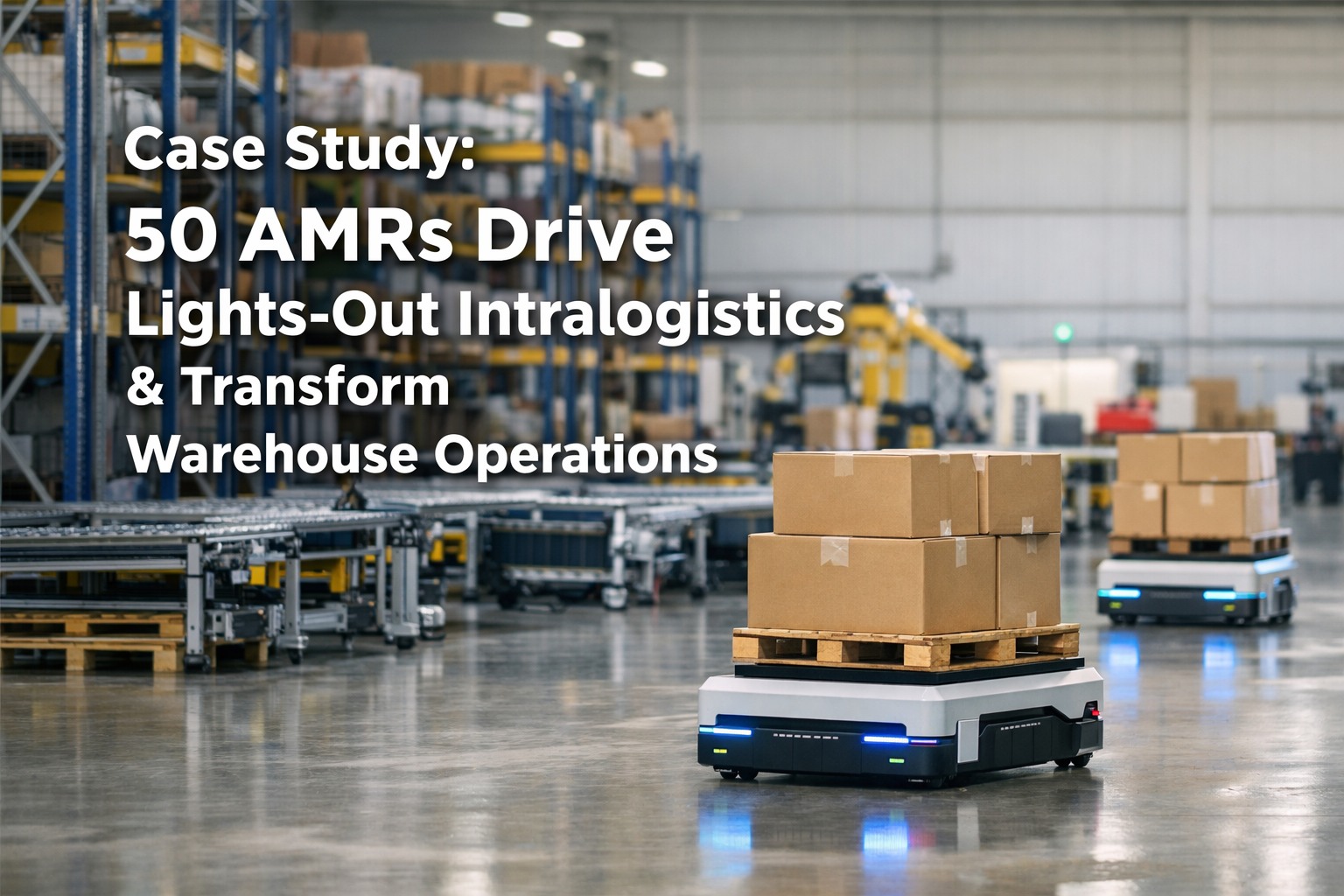
The global AMR market is projected to grow from $2.01 billion in 2024 to $4.56 billion by 2030. Yet most factories still move materials the same way they did 20 years ago — with forklifts, manual carts, and radio calls. This case study documents how a greenfield consumer goods factory deployed 50 autonomous mobile robots to achieve fully lights-out intralogistics — eliminating manual material handling across three shifts while boosting throughput, accuracy, and operator safety from day one.
CASE STUDY: LIGHTS-OUT INTRALOGISTICS
50
AMRs Deployed Across the Facility
91%
Reduction in Manual Material Handling
24/7
Lights-Out Autonomous Operation
14 Mo
Full ROI Payback Period
Why this case study matters: Most AMR deployments stop at 5-10 units in a single zone. This deployment scaled to 50 AMRs operating autonomously across raw material intake, WIP transfer, finished goods staging, and shipping dock loading — achieving true lights-out intralogistics across the entire value chain. The results provide a blueprint for any manufacturer planning large-scale AMR adoption.
The Challenge: Why Manual Intralogistics Was Failing
01
Labor Dependency
The facility required 36 forklift operators across three shifts — and still couldn't fill all positions. Average warehouse turnover rates exceed 37% annually, creating a constant cycle of hiring and retraining that bled operational consistency.
02
Throughput Bottlenecks
Manual material transport created unpredictable wait times at production cells. Line-side inventory was either overstocked (tying up capital) or starved (causing line stoppages), with no real-time visibility into material flow.
03
Accuracy Gaps
Manual picking and delivery errors were running at 2.4% — translating to thousands of misrouted pallets per month, rework delays, and missed shipping windows that eroded customer confidence.
04
Safety Incidents
Forklift-pedestrian near-misses averaged 6 per month in high-traffic zones. One recordable incident every 11 weeks was driving up insurance premiums and exposing leadership to regulatory scrutiny.
The Solution: 50-AMR Fleet Architecture
Raw Material Intake
12 AMRs
Fleet Orchestration Layer
AI-powered central brain coordinating all 50 AMRs in real-time — dynamic path planning, traffic management, battery rotation, and priority-based task assignment integrated with WMS and MES.
Each AMR uses LiDAR, depth cameras, and SLAM (Simultaneous Localization and Mapping) to navigate autonomously through dynamic factory environments — no magnetic strips, no fixed paths, no infrastructure changes. The fleet orchestration software assigns tasks based on real-time demand signals from the MES, optimizes traffic flow to prevent congestion, and automatically rotates units to charging stations without human intervention.
Navigation
LiDAR + SLAM mapping with real-time obstacle avoidance. No floor modifications needed — deployed in 48 hours per zone.
Fleet Intelligence
AI orchestration engine managing task queues, traffic lanes, and charging cycles. Dynamic rerouting in under 200ms.
Integration
Bi-directional API links to WMS, MES, and ERP — triggering material movements from production orders automatically.
The Results: Before vs. After Deployment
Before
185
pallets/shift
After
253
pallets/shift
+37% Increase
Before
97.6%
accuracy rate
After
99.8%
accuracy rate
Near-Zero Misroutes
Before
36
forklift operators
After
4
fleet supervisors
32 Workers Redeployed to Value-Add Roles
Before
6/mo
near-misses
After
0
in 12 months
Zero Recordable Incidents
Want Results Like These in Your Facility?
iFactory's AI-powered platform integrates with AMR fleets, MES, and CMMS to give you real-time visibility into every material movement — from commissioning day one.
ROI Breakdown: The Financial Impact
Insurance & Safety Savings
Total Annual Savings
$4.8M
Total Deployment Cost
$5.6M
Payback Period
14 Months
Implementation Timeline: From Zero to Lights-Out
Phase 1: Facility Mapping & Integration
AMRs mapped the entire 280,000 sq ft facility using onboard LiDAR. Fleet orchestration software integrated with the existing WMS and MES via bi-directional APIs. No floor modifications required.
Phase 2: Pilot Zone — Raw Material Intake
12 AMRs deployed in the receiving zone. Validated navigation accuracy, load handling, and WMS handoff protocols. Achieved 99.6% delivery accuracy within the first two weeks of live operation.
Phase 3: Full Production Floor Rollout
Scaled to 50 AMRs across all four zones. Traffic management algorithms optimized for peak throughput. Charging station rotation automated to maintain 95%+ fleet availability at all times.
Phase 4: Lights-Out Certification
Full autonomous operation validated across all three shifts including overnight. Human supervisors moved from active driving to fleet monitoring dashboards. Zero manual interventions required during off-shift operations.
Key lesson from the deployment: The fastest path to lights-out isn't deploying all robots at once — it's proving the concept in one zone, validating the data integrations, then scaling with confidence. Factories that skip the pilot phase consistently encounter integration failures that could have been caught in week two.
Why iFactory is the Intelligence Layer Behind AMR Operations
Real-Time Visibility
iFactory dashboards display live AMR fleet status, material flow rates, and zone-level throughput — giving operations leaders a single pane of glass for the entire intralogistics operation.
Predictive Maintenance
AI monitors AMR health metrics — battery degradation, motor vibration, wheel wear — and triggers maintenance work orders before failures cause fleet downtime.
KPI Auto-Calculation
OEE, MTBF, throughput per zone, and energy consumption are calculated in real-time from connected equipment data — no manual spreadsheets, no delayed reporting.
Seamless Integration
iFactory connects to AMR fleet software, WMS, MES, and ERP systems through standard APIs — creating a unified data layer that turns raw sensor data into executive-level intelligence.
Frequently Asked Questions
Ready to Build Your Lights-Out Intralogistics Operation?
iFactory gives greenfield executives real-time visibility into AMR fleet performance, material flow KPIs, and predictive maintenance — configured during construction, not after launch.
Planning an AMR deployment or building a greenfield factory with autonomous intralogistics? Book your free iFactory demo and see how AI-powered dashboards turn raw fleet data into executive-level plant intelligence — from commissioning day one.