Essential KPIs for Greenfield Factory Executives: OEE, MTBF, FPY, and More

By James C on February 27, 2026

essential-kpis-greenfield-factory-executives

Redzone's 2025 Benchmark Report analyzed 1,500 factories and found the average baseline OEE is just 47%. That means most manufacturers are capturing less than half of their production potential every single day. For greenfield factory executives, the stakes are even higher — you're building from scratch with no historical data, no baselines, and investors watching every ramp-up milestone. These are the KPIs that separate plants that hit full production on schedule from those that burn through contingency budgets firefighting problems they never saw coming.

THE EXECUTIVE KPI STACK
47% Avg. Baseline OEE Across 1,500 Factories
85%+ World-Class OEE Target
95%+ Best-in-Class First Pass Yield
3x Faster KPI Improvement With Performance Culture
OEE THE GOLD STANDARD

Why greenfield KPIs are different: Unlike brownfield operations with years of baseline data, greenfield factories start at zero. Every KPI must be configured during commissioning, and AI-powered predictive models need clean data from day one to learn equipment behavior. The metrics below are sequenced in the order a greenfield executive needs them — from ramp-up through steady-state optimization.

The 8 KPIs Every Greenfield Executive Must Track

01
Mission Critical

Overall Equipment Effectiveness (OEE)

OEE is the single most important manufacturing productivity metric — it combines three dimensions into one number that tells you exactly how much of your production potential you're actually capturing. An OEE of 100% means you're manufacturing only good parts, as fast as possible, with zero downtime.

Formula
OEE = Availability x Performance x Quality
Availability Actual production time as a percentage of scheduled time. Captures losses from breakdowns, changeovers, and material shortages.
Performance Actual throughput versus maximum possible speed. Exposes slow cycles, minor stoppages, and speed losses.
Quality Good units produced as a percentage of total units started. Reveals scrap, rework, and yield losses.
47% Average
65% Typical
85%+ World-Class
Greenfield Tip: Configure OEE tracking during commissioning, not after production starts. iFactory auto-calculates OEE from connected equipment, giving your team real-time visibility from the first shift.
02
Mission Critical

Mean Time Between Failures (MTBF)

MTBF measures the average operating time between equipment failures — it's the definitive indicator of equipment reliability. In a greenfield factory, MTBF baselines are especially critical because you're establishing the performance profile of brand-new equipment. Early failures during ramp-up often reveal installation defects, not manufacturing defects.

Formula
MTBF = Total Operating Time / Number of Failures
Low MTBF Signals
Frequent breakdowns, poor installation quality, wrong equipment sizing, or missing preventive maintenance schedules. Ramp-up timeline extends.
High MTBF Signals
Reliable equipment, effective maintenance strategy, proper commissioning. AI predictive models have stable baselines to learn from.
Greenfield Tip: iFactory tracks MTBF from commissioning day — establishing equipment reliability baselines that feed predictive maintenance AI models. Early MTBF data is gold for preventing failures during the critical ramp-up phase.
03
Mission Critical

Mean Time to Repair (MTTR)

MTTR measures how fast your maintenance team can get a failed machine back into production. Combined with MTBF, these two metrics tell the complete reliability story: how often equipment fails and how quickly you recover. For greenfield teams with new maintenance crews, MTTR exposes training gaps and spare parts readiness faster than any other metric.

Formula
MTTR = Total Repair Downtime / Number of Failures
Greenfield Tip: High MTTR in the first 90 days usually means spare parts aren't staged, technicians aren't trained on the new equipment, or work order processes are still being figured out. iFactory's guided work orders and pre-loaded asset data eliminate this learning curve.

See These KPIs Live in iFactory

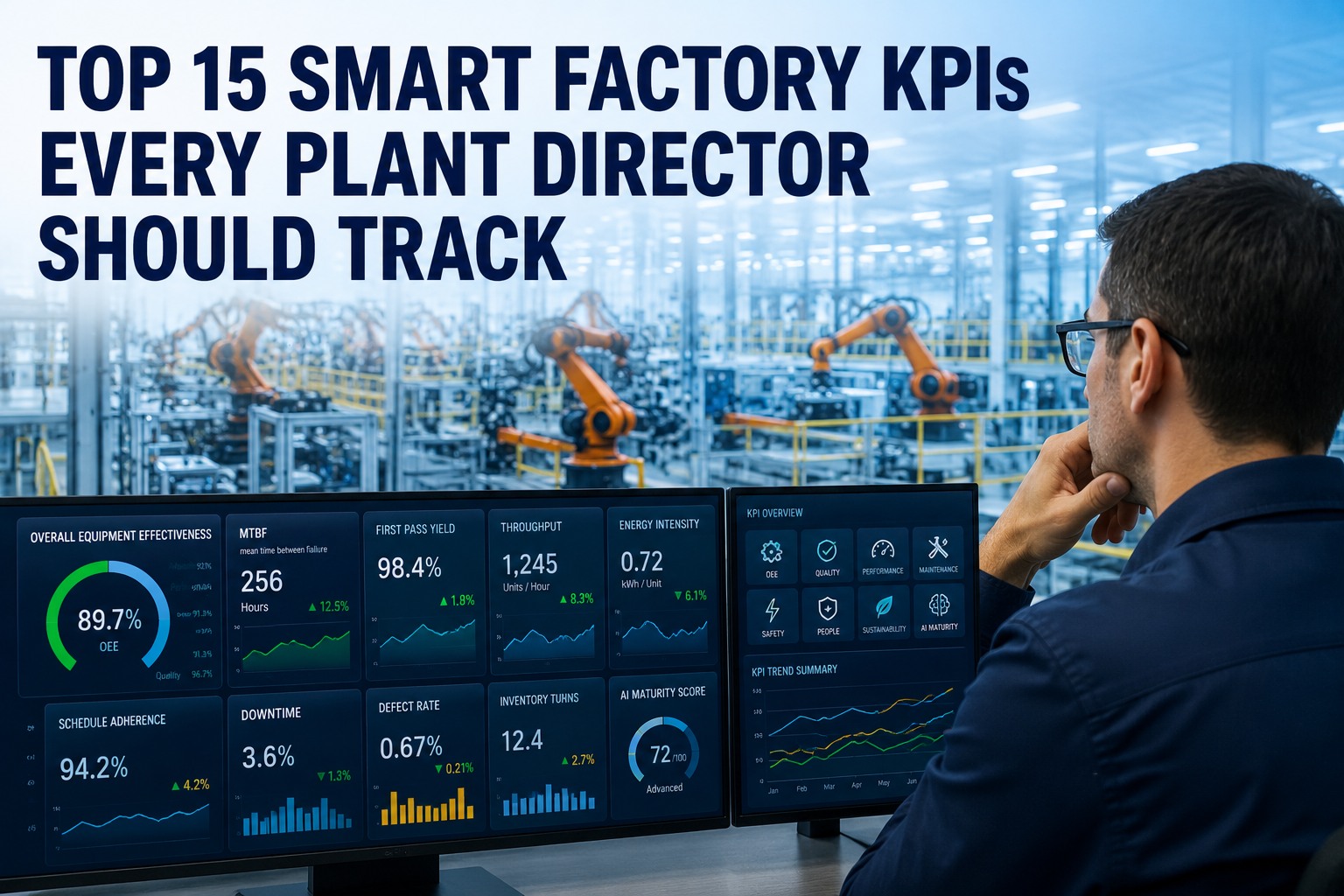
iFactory dashboards calculate OEE, MTBF, MTTR, and more in real-time — giving greenfield executives instant visibility from commissioning day one.

04
High Priority

First Pass Yield (FPY)

FPY measures the percentage of products manufactured correctly on the first attempt — no rework, no scrap, no quality holds. It is the purest measure of process stability and operator proficiency. During greenfield ramp-up, FPY is the canary in the coal mine: if it's dropping, something upstream is wrong.

Formula
FPY = (Units Passing First Time / Total Units Started) x 100%
<90% Needs Work
90-95% Good
95%+ Best-in-Class
Greenfield Tip: Track FPY by production line and shift from day one. iFactory's quality analytics pinpoint exactly where defects originate — equipment, material, or operator — so you can fix root causes instead of chasing symptoms.
05
High Priority

Energy Cost Per Unit

This KPI measures how much energy is consumed to produce each unit — and it's becoming one of the most scrutinized metrics in manufacturing as energy costs rise and ESG reporting requirements tighten. In a greenfield factory with edge computing, robotics, and AI inference running alongside production, energy costs can surprise teams that didn't plan for high-density compute loads.

Formula
Energy Cost Per Unit = Total Energy Cost / Number of Units Produced
Greenfield Tip: iFactory monitors energy consumption at the asset level, correlating power draw with production output. This reveals which equipment is energy-hungry relative to its throughput — data that drives both cost savings and sustainability reporting.
06
High Priority

Ramp-Up Velocity

Ramp-up velocity measures how quickly your greenfield factory progresses from first article production to target output levels. This is the KPI that boards and investors watch most closely — it directly determines time-to-revenue and payback period. Deloitte's greenfield research confirms that dashboards tracking WIP status, equipment performance, and line yield during ramp-up make the difference between hitting targets and missing them.

Formula
Ramp-Up Velocity = (Current Output / Target Output) x 100% over time
Slow Ramp-Up
Revenue delayed by months. Contingency budgets exhausted. Investor confidence erodes. Equipment warranty periods burn while output lags.
Fast Ramp-Up
Revenue starts on schedule. Team confidence builds. Lessons learned feed back into production immediately. Warranty periods used productively.
Greenfield Tip: iFactory's production dashboards track ramp-up progress against milestones in real-time — so leadership sees exactly where output stands relative to targets, with drill-down into the bottlenecks causing shortfalls.
07
Optimization

Planned Maintenance Percentage (PMP)

PMP reveals the maturity of your maintenance strategy by measuring how much of your total maintenance activity is planned versus reactive. A greenfield factory should target high PMP from the start — because every hour spent on unplanned firefighting is an hour stolen from the ramp-up timeline.

Formula
PMP = (Planned Maintenance Hours / Total Maintenance Hours) x 100%
<60% Reactive
60-80% Developing
80%+ Proactive
Greenfield Tip: iFactory pre-loads preventive maintenance schedules during construction — so your team starts with structured PM workflows from day one, instead of scrambling to build them after the first breakdown.
08
Optimization

Capacity Utilization Rate

Capacity utilization measures how much of your factory's total production potential is actually being used. For greenfield executives, this metric is the bridge between ramp-up and steady-state — it tells you when you've unlocked the capacity you built and when it's time to plan the next phase of expansion.

Formula
Capacity Utilization = (Actual Output / Maximum Possible Output) x 100%
Greenfield Tip: iFactory tracks utilization across every asset, giving executives data-driven signals for when and where to expand — not guesses. This prevents both over-investing in idle capacity and under-building that forces costly early expansion.
KPI Priority Matrix: Greenfield Phase Mapping

Commissioning
Ramp-Up
Steady-State
OEE
Configure
Critical
Critical
MTBF
Critical
Critical
Monitor
MTTR
Critical
Critical
Monitor
FPY
Configure
Critical
Critical
Energy/Unit
Configure
Monitor
Critical
Ramp-Up Velocity
N/A
Critical
N/A
PMP
Configure
Critical
Critical
Capacity Util.
N/A
Monitor
Critical

The pattern that separates leaders from laggards: Organizations with strong performance cultures achieve 3x better KPI improvement rates than those relying solely on technology and measurement systems. The factories that win aren't just tracking KPIs — they're acting on them in real-time, with cross-functional teams that share targets and collaborate on solutions rather than pointing fingers when performance drops.

Frequently Asked Questions

During ramp-up, an OEE of 40–55% is common and expected. The target should be to reach 65% within the first 6 months and push toward 85%+ (world-class) within 12–18 months of production start. The key is having real-time OEE tracking from day one so you can identify and eliminate losses systematically rather than guessing at problems.
MTBF measures equipment reliability (how long between failures), while MTTR measures maintenance responsiveness (how quickly you fix failures). Together, they paint the complete picture: a high MTBF with low MTTR means reliable equipment backed by an effective maintenance team. In greenfield factories, MTBF baselines established during commissioning feed directly into predictive maintenance AI models.
Greenfield factories with AI, edge computing, and robotics consume 2–3x more energy than traditional plants. Energy cost per unit reveals which assets and processes are energy-hungry relative to their output, driving both cost optimization and ESG compliance. This KPI becomes increasingly critical as energy prices rise and sustainability reporting becomes mandatory.
During commissioning — before production starts. Configure your CMMS and dashboard infrastructure while equipment is being installed so that sensors, data pipelines, and KPI calculations are validated and ready when the first shift begins. iFactory deploys alongside your construction timeline to ensure complete KPI visibility from day one of operations.
iFactory provides real-time executive dashboards that auto-calculate OEE, MTBF, MTTR, FPY, energy metrics, and capacity utilization from connected equipment. Dashboards are configured during the construction phase, so leadership has full plant intelligence from commissioning. AI-powered alerts flag anomalies before they become production-stopping events.

Get Real-Time Plant Intelligence From Day One

iFactory's AI-powered dashboards give greenfield executives instant visibility into OEE, MTBF, FPY, energy costs, and ramp-up velocity — configured during construction, not after launch.

Ready to track the KPIs that matter from commissioning day one? Book your free iFactory demo and see how AI-powered dashboards turn raw equipment data into executive-level plant intelligence.
Share This Story, Choose Your Platform!