Factory AI Server Room Planning: How Much Compute Do You Actually Need?
By Riley Quinn on March 20, 2026
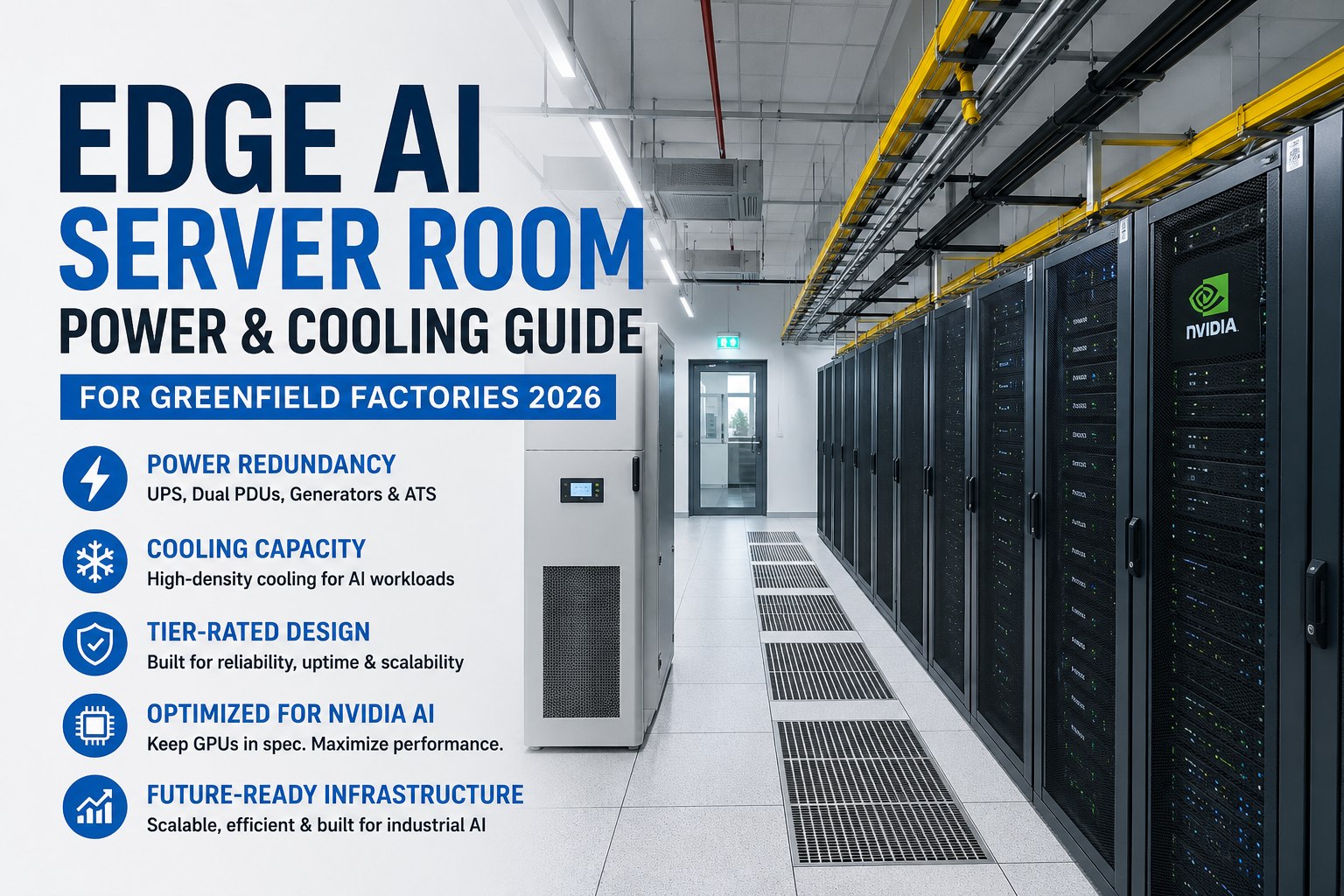
A food manufacturer in Wisconsin installed a $90,000 AI vision system for quality inspection. It worked brilliantly in the vendor demo. Six months later, inference times had tripled — not because the model degraded, but because the "server room" was a repurposed closet running at 42°C with no dedicated cooling. The GPUs were thermal-throttling 14 hours a day. The fix cost $180,000 — twice the original system. If you're building a new facility, your AI server room is either the smartest investment you'll make or the most expensive afterthought you'll regret.
The Temperature Gap That Kills Factory AI
Your factory floor and your servers live in two different worlds. Bridging that gap is the single most critical infrastructure decision.
Not every AI workload needs a GPU rack. And not every workload can survive cloud latency. The right answer depends on speed, data volume, and sensitivity.
Edge AI
<5ms latency
Power
15-70W
Cost
$500-3K
Cooling
Passive
Jetson AGX Orin · Intel Arc · Edge TPU
Safety detectionSimple visionVibration alerts
Most Factories Need This
On-Premise GPU
<10ms latency
Power
5-15kW
Cost
$50-500K
Cooling
Dedicated HVAC
NVIDIA T4 · A100 · H100 · AMD MI300X
Multi-cam visionPredictive maint.Digital twinsQuality AI
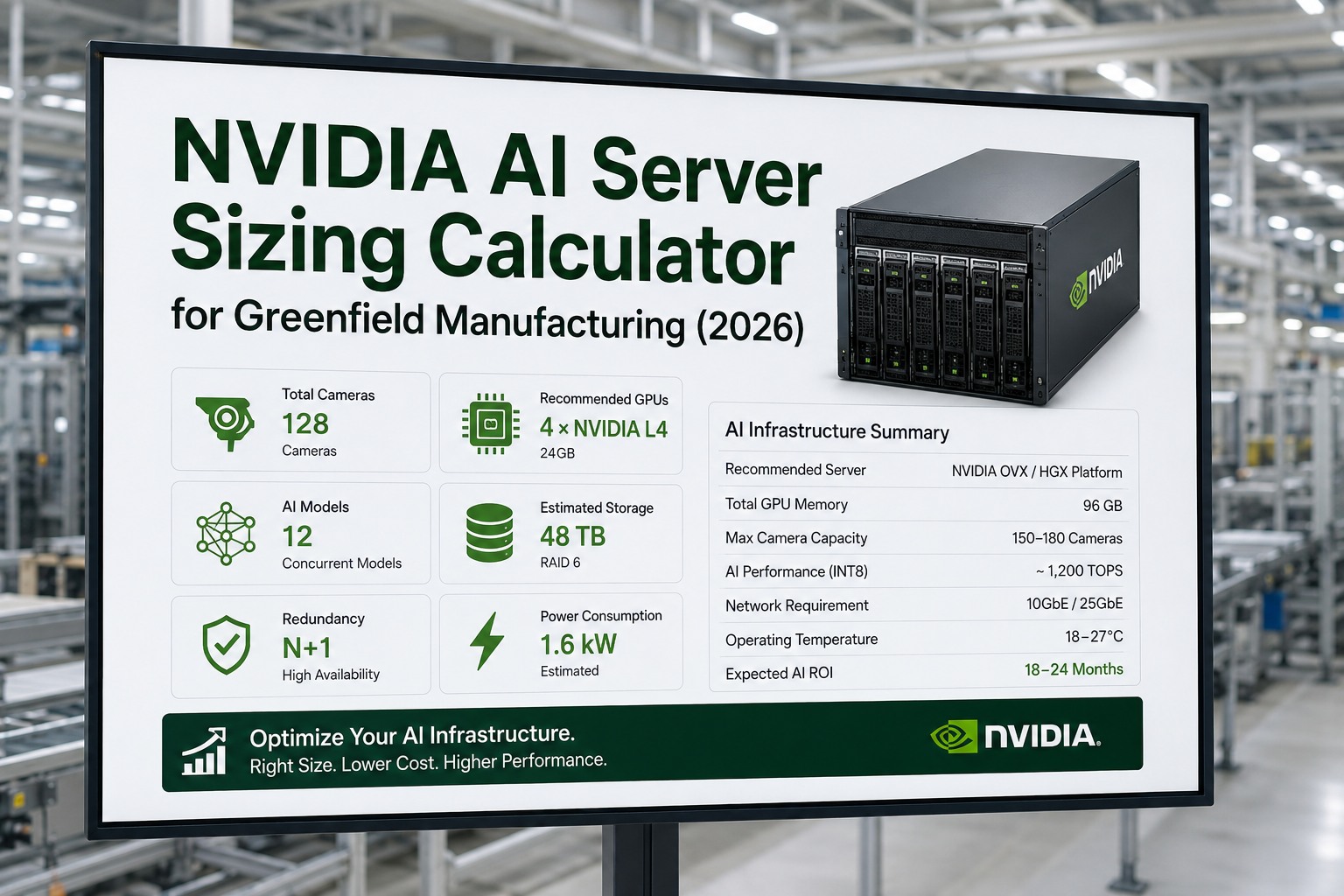
Every factory AI workload has a calculable compute footprint. This table maps use cases to exact hardware.
Swipe to see full table
AI Workload
Tier
Hardware
Power
Latency
Visual Inspection (1-4 cams)
Edge
Jetson Orin × 1-2
30-120W
<5ms
Visual Inspection (10+ cams)
On-Prem GPU
NVIDIA T4 × 2-4
280-600W
<10ms
Predictive Maintenance
On-Prem GPU
T4 or A100 × 1
70-300W
<1 sec
Digital Twin (real-time)
On-Prem GPU
A100 × 2-4
600W-1.2kW
<50ms
Model Training
Cloud
Cloud A100/H100
None on-site
Hours
OEE / Reporting
Cloud/CPU
Xeon/EPYC
200-400W
Seconds
140%
Size Everything to This
The Golden Rule of Factory Compute
Size compute, power, cooling, and UPS at 140% of projected workload. Factory AI grows faster than anyone plans. Under-sizing today means a six-figure retrofit in 24 months.
"Every single data center in the future is going to be power-limited. And your revenue is limited if your power is limited. The smallest instance of a true AI factory can start at 120 kilowatts — it's an industrial model, replicable and being built at volume."
— NVIDIA Data Center World 2025 / Wade Vinson, Chief DC Distinguished Engineer
75% of new data centers designed with AI workloads in mind
Edge AI achieves under 1ms — cloud starts at 50ms minimum
AI inference demand projected to reach 400% of training by 2027
iFactory deploys on edge, on-premise GPU, and cloud — adapting to your compute reality. From predictive maintenance to quality vision, we right-size software to your hardware.
Technically yes, but you'll regret it. Office servers are rated for 20-25°C with clean air. Factory environments hit 35-45°C with dust, vibration, and power surges. Use industrial-grade hardware rated ASHRAE Class A3/A4 (up to 45°C), or build an isolated server room with dedicated cooling.
How much does a factory AI server room cost?
For 2-4 GPU racks: $150K-$400K for the room (HVAC, UPS, fire suppression, monitoring). Compute hardware: $50K-$500K+ additional. Building into a greenfield adds ~10-15% vs. retrofitting, which costs 2-3x more.
Should I do all AI on-premise or use cloud?
Most factories benefit from hybrid. Real-time workloads (vision, safety, robots) need on-premise for sub-10ms latency. Model training and analytics run cheaper in the cloud. Key factors: latency, data volume, sensitivity, internet reliability.
How do I calculate cooling requirements?
Formula: Total cooling (BTU/h) = (Room sq ft × 20) + (IT watts × 3.41) + (people × 400). Add 30% overcapacity. A 10kW GPU rack = ~34,100 BTU/h. Use CRAC units, not building HVAC. Maintain 18-27°C and 45-50% humidity.
What UPS size do I need?
Total IT load at peak × 1.25. Example: 2 GPU racks (10kW each) + 5kW networking = 25kW — size at 30-32kW. N+1 redundancy. Battery: 10-15 min. Online double-conversion UPS recommended for factory power quality.