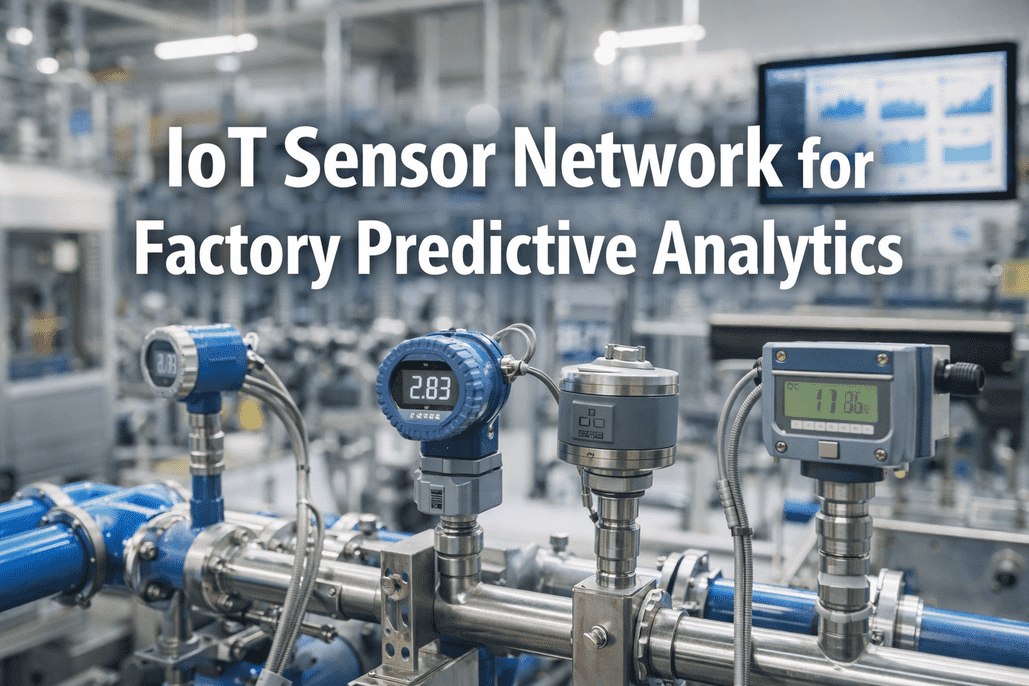
Every machine tells a story through data — vibration spectra that reveal bearing wear months before failure, temperature gradients that signal insulation breakdown, current signatures that fingerprint motor health, and pressure traces that detect valve degradation in real-time. But capturing this data reliably at factory scale requires more than bolting sensors onto machines. It requires an end-to-end IoT sensor network designed from the ground up: the right sensor types matched to each failure mode, the right connectivity protocol for each environment, edge gateways that process data locally, time-series databases that handle millions of data points per second, and AI pipelines that convert raw signals into maintenance predictions. Sensors bolted on as an afterthought create data gaps, unreliable connections, and analytics that don't trust the source data. Greenfield design solves this permanently. Plan Your IoT Sensor Network — we design sensor placement, connectivity, gateways, and data pipelines as construction-ready documentation.
The Afterthought Problem: Why Retrofit Sensor Networks Fail
Data Gaps
Retrofit installations skip hard-to-reach assets because cable routing is too expensive or disruptive. The machines you can't monitor are usually the ones that fail catastrophically. In greenfield, every critical asset has sensor provisions designed into the mechanical and electrical drawings before construction.
Unreliable Wireless
Metal structures, EMI from VFDs, and RF-congested environments create dead zones and packet loss. Retrofit wireless sensors are placed where it's convenient — not where coverage is optimal. Greenfield design maps RF propagation before walls go up and positions access points for guaranteed coverage.
Untrusted Data
Sensors mounted on vibrating surfaces without isolation, cables sharing trays with power lines, and uncalibrated instruments produce data that AI models can't trust. Garbage in, garbage out. Greenfield specifies isolated mounting pads, dedicated signal conduit, and commissioning-time calibration procedures.
Scalability Dead Ends
Retrofit networks grow organically — different protocols, different vendors, different gateways. By the time you reach 500 sensors, you have 5 incompatible ecosystems. Greenfield designs a unified architecture from the start that scales from 100 to 10,000+ sensors on one platform.
Building a new factory and want sensors that work from day one? Plan Your IoT Sensor Network — we deliver sensor maps, protocol selection, gateway architecture, and data pipeline specs as construction-ready documents.
Connectivity Protocol Selection
No single wireless protocol covers every factory IoT requirement. The right network design uses a hybrid of protocols matched to each use case — high-bandwidth wired for critical assets, mesh wireless for dense indoor monitoring, and LPWAN for campus-wide coverage.
| Protocol | Range | Data Rate | Power | Latency | Best Factory Use Case | Greenfield Design Note |
|---|---|---|---|---|---|---|
| Wired (4-20mA / HART) | 1,500m | Continuous analog | Loop-powered | <1ms | Critical process instruments (T, P, flow, level) | Conduit and junction boxes designed into equipment foundations |
| Industrial Ethernet | 100m (copper); km (fiber) | 100 Mbps-10 Gbps | PoE available | <1ms | High-speed vibration, vision, PLC integration | Dedicated sensor Ethernet VLAN; fiber backbone pre-installed |
| WiFi 6/6E | 30-50m indoor | Up to 9.6 Gbps | Medium-High | 1-10ms | Mobile instruments, tablets, high-bandwidth edge devices | Industrial AP locations planned for coverage; metal interference mitigated |
| Bluetooth 5.0/BLE | 10-30m | 2 Mbps | Very low | 10-100ms | Sensor configuration, short-range data collection, asset tracking | BLE gateways positioned at machine clusters for reliable pairing |
| Zigbee / Thread | 10-100m (mesh extends) | 250 kbps | Low | 15-30ms | Dense indoor sensor mesh; environmental monitoring | Mesh topology self-heals; plan initial node density for redundancy |
| LoRaWAN | 2-5 km (indoor: 200-500m) | 0.3-50 kbps | Ultra-low (5-10 yr battery) | 1-10 sec | Campus-wide: utility meters, tank levels, environmental, non-critical assets | Gateway on rooftop or elevated position; 1 gateway covers entire plant |
| Private 5G / LTE-M | Plant-wide | 10-100 Mbps | Medium | 1-10ms | Mobile robots, AGVs, high-reliability wireless for critical monitoring | Small cell locations designed into facility; licensed spectrum if available |
Sensor-to-Machine Mapping
| Machine Type | Total Sensor Points | Wired | Wireless | Key Parameters Monitored | Est. Cost/Machine (Greenfield) |
|---|---|---|---|---|---|
| Large Motor (>100 HP) | 6-8 | 4 (vibration, current) | 2-4 (temp, environment) | Vibration (DE/NDE), current signature, winding temp, bearing temp | $800-$1,500 |
| Centrifugal Pump | 5-7 | 3 (vibration, pressure) | 2-4 (temp, flow) | Vibration, suction/discharge pressure, flow, seal temp, motor current | $700-$1,200 |
| Gearbox/Reducer | 5-8 | 4 (vibration, oil) | 1-4 (temp, acoustic) | Vibration (I/O bearings), oil particle count, oil temp, acoustic emission | $1,000-$2,000 |
| Air Compressor | 8-12 | 6 (vib, P, T, current) | 2-6 (ambient, leak) | Vibration, discharge P/T, oil pressure, current, air leak ultrasonic | $1,200-$2,500 |
| Conveyor System | 4-10 (per drive) | 2 (motor vib, current) | 2-8 (roller vib, belt) | Drive motor health, roller bearings (sampled), belt tension, tracking | $500-$1,500/drive |
| HVAC/AHU | 4-6 | 1-2 (power) | 3-4 (temp, humidity, vib) | Fan vibration, filter dP, discharge temp, power consumption | $400-$800 |
| Utility (Boiler/Chiller) | 10-15 | 8-10 (process instruments) | 2-5 (supplemental) | Pressure, temperature, flow, combustion O2, vibration, level | $2,000-$4,000 |
Gateway & Edge Processing Architecture
Sensor-to-Network Translation
Converts sensor protocols (4-20mA, Modbus RTU, BLE, LoRaWAN) to IP-based data streams (MQTT, OPC UA). One gateway per machine cluster or zone (typically 10-50 sensors per gateway). Greenfield: gateway mounting locations and power/network drops designed into equipment layout.
Local Analytics & Anomaly Detection
Runs threshold detection, spectral analysis, and basic ML models on-premise. Reduces data volume by 90-95% before cloud transmission (send features, not raw waveforms). NVIDIA Jetson or industrial PC with GPU. Greenfield: edge compute rack space, power, and cooling included in server room design.
Message Routing & Buffering
MQTT broker (Mosquitto, HiveMQ, EMQX) or OPC UA server aggregates all sensor data into unified topic structure. Handles message queuing during network disruptions (store-and-forward). Provides pub/sub architecture for multiple analytics consumers. Greenfield: broker runs on edge server with redundancy.
High-Performance Data Storage
InfluxDB, TimescaleDB, or QuestDB for storing sensor data at million-point-per-second ingest rates. 30-90 day high-frequency data retention locally; downsampled data archived to cloud/object storage. Greenfield: storage capacity and IOPS requirements factored into server room design.
Need help selecting the right gateway and edge architecture for your sensor count? Plan Your IoT Sensor Network — we'll specify gateway counts, edge compute requirements, and TSDB sizing based on your asset inventory.
Scaling: 100 to 10,000+ Sensors
| Scale | Sensor Count | Gateways | Edge Compute | TSDB Ingest Rate | Network Backbone | Typical Plant Size |
|---|---|---|---|---|---|---|
| Pilot | 50-100 | 2-5 | 1 industrial PC | ~10K points/sec | Existing Ethernet + 1 LoRaWAN GW | Single line or critical asset cluster |
| Department | 100-500 | 5-20 | 1-2 edge servers (GPU optional) | ~50K points/sec | Dedicated VLAN + 2-3 LoRaWAN GW | Production department or building |
| Plant-Wide | 500-2,000 | 20-50 | 2-4 edge servers with GPU | ~200K points/sec | Fiber backbone + campus wireless | Full manufacturing facility |
| Enterprise | 2,000-10,000+ | 50-200 | Edge cluster (4-8 servers) | 1M+ points/sec | Redundant fiber + private 5G + cloud sync | Multi-building campus or multi-site |
Data Pipeline: Sensor to AI to Action
Physical measurement converted to digital signal. Protocol translation (Modbus, BLE, LoRaWAN → MQTT/OPC UA). Data validated, timestamped, and tagged with asset ID. Latency: 1-100ms depending on protocol.
MQTT pub/sub distributes data to multiple consumers. Store-and-forward handles network disruptions. Topic structure: plant/area/asset/sensor/parameter. QoS levels configured per criticality.
High-speed ingest into InfluxDB/TimescaleDB. Continuous queries calculate rolling averages, RMS, peak values. Retention policies: raw data 30-90 days local, downsampled indefinitely in cloud/archive.
ML models consume feature-engineered data. Anomaly detection, RUL estimation, failure classification. Edge inference for real-time alerts; cloud training for model improvement. Results written back to TSDB for dashboarding.
Predictions trigger auto work orders in iFactory CMMS. Dashboards (Grafana, Power BI) show asset health, trends, and alerts. Mobile app notifies technicians. Closed-loop: repair outcomes feed back to improve models.
Key Benefits & ROI
Every Sensor Placement Decision Made Now Saves $1,000 in Retrofit Later
iFactory designs complete IoT sensor networks for greenfield factories — sensor types, connectivity protocols, gateway architecture, data pipelines, and CMMS integration — delivered as construction-ready documentation.
Frequently Asked Questions
Bad Data In = Bad Predictions Out — Start with the Sensor Network
AI analytics are only as good as the data they consume. Design the sensor network, connectivity, gateways, and data pipeline right — and every prediction your AI makes will be trustworthy from day one.