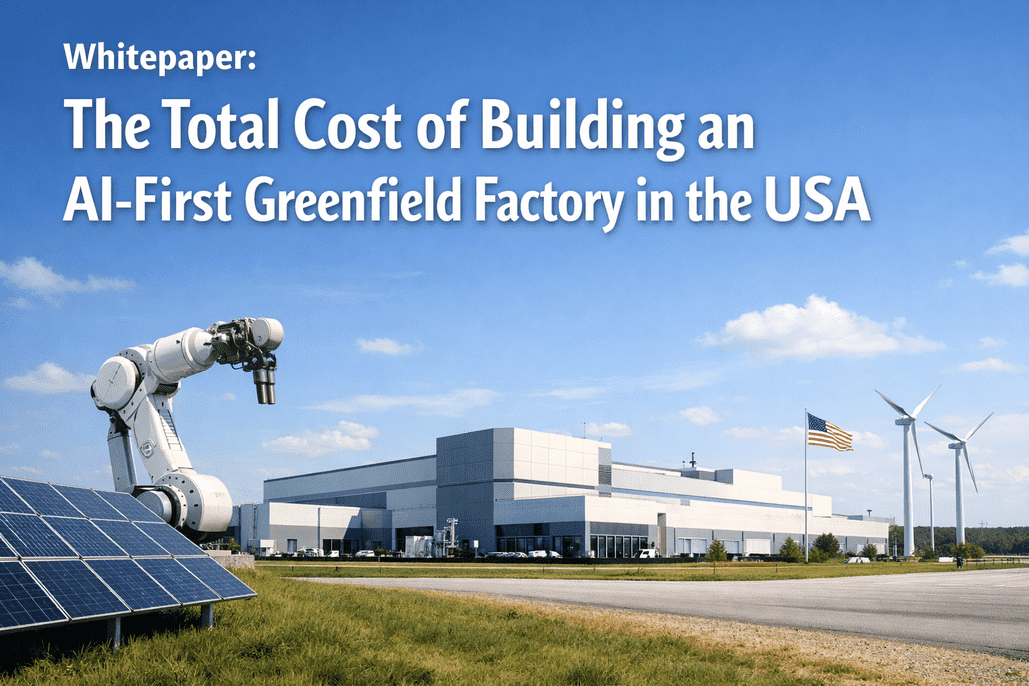
Building an AI-first greenfield factory in the United States is a $50M–$500M+ capital decision — and the single highest-leverage investment a manufacturer will make this decade. U.S. manufacturing construction spending hit $202.4 billion in December 2025. TSMC committed $100 billion, Micron announced $200 billion, and Rockwell Automation broke ground on its largest-ever factory in Wisconsin. Yet 60% of industrial automation projects fail to meet projected ROI — not because the technology was wrong, but because the cost modeling was incomplete. This whitepaper provides a detailed, data-backed framework covering every cost category: land, construction, production equipment, automation, AI/ML infrastructure, OT/IT convergence, digital twins, workforce, and ongoing operations — with a full 5-year TCO model that proves why the AI premium pays for itself by Year 3. Book a free strategy call to get this model customized for your project.
Executive Summary
Building an AI-first greenfield factory in the United States in 2026 is a $50M–$500M+ capital investment depending on industry, scale, and automation level. But the cost of not building AI-first is higher — manufacturers who retrofit legacy facilities face 12-18 months longer timelines, 40-60% higher integration costs, and structural limitations that cap performance below what purpose-built smart factories achieve from day one.
This whitepaper provides a detailed, data-backed cost framework for planning an AI-first greenfield facility in the USA. We break down every major cost category — land, construction, production equipment, automation, AI/ML infrastructure, OT/IT convergence, digital twins, workforce, and ongoing operations — with ranges calibrated to three factory scales (small, mid-size, and large). The 5-year TCO model captures both the investment arc and the compounding returns that justify the premium of building smart from the start.
Want the full cost model customized for your industry and scale? Book a 30-minute consultation — we'll walk through the TCO framework with your specific parameters.
The 2026 Greenfield Landscape
U.S. manufacturing construction spending reached $202.4 billion (seasonally adjusted annual rate) in December 2025 — driven by CHIPS Act funding, reshoring incentives, and the One Big Beautiful Bill Act tax provisions. TSMC committed $100 billion, Micron announced $200 billion across Idaho, New York, and Virginia, and Rockwell Automation broke ground on its largest-ever factory (1M+ sq ft) in Wisconsin. Samsung is investing $37 billion in Texas semiconductor expansion.
Yet the 2026 landscape is challenging. Manufacturing PMI remained below 50 for much of 2025, signaling contraction. Over three-quarters of manufacturers cited trade uncertainty as their top concern. Construction capacity for new factories is constrained, especially by skilled labor shortages. McKinsey notes that in many organizations, factory-building skills have atrophied as leaders relied more on acquisitions than greenfield development.
This creates a paradox: more factories are being planned than at any time in decades, but fewer organizations have the internal expertise to build them well. The companies that pair greenfield investment with rigorous cost modeling and AI-first architecture will outperform those that treat smart factory technology as a bolt-on.
CAPEX Breakdown: Building the Physical Factory
The table below provides CAPEX ranges for three greenfield factory scales — a 50,000 sq ft specialized facility, a 200,000 sq ft mid-size plant, and a 500,000+ sq ft large-scale operation. All figures are in USD and reflect 2025-2026 U.S. market conditions.
| CAPEX Category | Small (50K sq ft) | Mid-Size (200K sq ft) | Large (500K+ sq ft) | % of Total CAPEX |
|---|---|---|---|---|
| Land Acquisition & Site Development | $2M–$5M | $5M–$15M | $15M–$50M | 5–10% |
| Building Construction (shell, MEP, cleanroom) | $8M–$15M | $25M–$60M | $80M–$200M | 30–40% |
| Production Equipment & Machinery | $5M–$12M | $20M–$50M | $60M–$150M | 25–35% |
| Automation & Robotics (cobots, industrial, AMRs) | $2M–$6M | $8M–$25M | $25M–$80M | 10–18% |
| AI & Digital Infrastructure | $1.5M–$4M | $5M–$18M | $15M–$50M | 8–15% |
| Utilities & Energy Systems | $1M–$3M | $3M–$10M | $10M–$30M | 4–8% |
| Commissioning, Testing & Validation | $0.5M–$1.5M | $2M–$5M | $5M–$15M | 3–5% |
| Total CAPEX Range | $20M–$46M | $68M–$183M | $210M–$575M | 100% |
Note: Semiconductor and pharmaceutical facilities can exceed these ranges significantly due to cleanroom, environmental, and regulatory requirements. TSMC's Arizona fab investment alone exceeds $100B. These figures represent general discrete and process manufacturing.
AI & Digital Infrastructure Costs
The "AI premium" — the incremental investment required to make a factory AI-first rather than traditionally automated — typically represents 8-15% of total CAPEX. But this is the investment with the highest long-term ROI, because it drives compounding operational savings that accelerate over time as AI models improve with more data.
| AI/Digital Component | What It Covers | Cost Range (Mid-Size) | Greenfield Advantage |
|---|---|---|---|
| IoT Sensor Mesh | Vibration, temperature, pressure, acoustic, vision sensors across all production equipment | $800K–$3M | Designed into machine specs; no retrofit cost |
| Edge Computing Infrastructure | Edge servers, GPU nodes for real-time inference, 5G/WiFi 6E networking | $500K–$2M | Power, cooling, rack space spec'd into building design |
| Unified Namespace (UNS) | MQTT/Kafka event bus connecting PLCs, SCADA, MES, ERP, CMMS, AI agents | $200K–$800K | No legacy protocol translation; native IT/OT convergence |
| Digital Twin Platform | Physics-based simulation, real-time synchronization, scenario modeling | $500K–$2M | Full sensor coverage = complete twin fidelity from day one |
| AI/ML Platform & Models | Predictive maintenance, quality analytics, scheduling optimization, agentic AI agents | $800K–$3M | Clean data from UNS; no data remediation required |
| Cybersecurity (OT/IT) | Zero Trust architecture, data diodes, SIEM, endpoint protection, compliance | $300K–$1.5M | Security by design; no legacy vulnerability patching |
| MES / ERP Integration | Manufacturing execution system, enterprise planning, quality management | $500K–$2M | Single-vendor or purpose-built stack; no integration debt |
| CMMS & Maintenance Platform | Work order management, spare parts, compliance logging, mobile access | $150K–$600K | Connected to digital twin and AI from launch |
| Total AI/Digital Infrastructure | $3.75M–$14.9M |
Need a detailed AI infrastructure cost model for your specific facility? Schedule a free consultation — we'll size the digital stack to your production requirements and automation level.
OPEX: Annual Operating Cost Model
Annual operating costs determine long-term factory economics. The AI-first advantage shows up most clearly in OPEX — predictive maintenance reduces unplanned downtime 40-60%, AI scheduling optimizes energy consumption 20-35%, and vision-based quality systems cut defect rates and rework. The table below models Year 1 and steady-state (Year 3+) OPEX for a mid-size AI-first facility.
| OPEX Category | Year 1 (Ramp-Up) | Year 3+ (Steady State) | AI-Driven Savings vs. Traditional |
|---|---|---|---|
| Direct Labor | $8M–$15M | $7M–$13M | 15-30% lower headcount through automation |
| Energy & Utilities | $2M–$5M | $1.5M–$4M | 20-35% reduction via AI energy optimization |
| Maintenance & Spare Parts | $1.5M–$4M | $1M–$2.5M | 30-50% savings from predictive maintenance |
| Raw Materials & Consumables | $10M–$30M | $9M–$27M | 5-10% waste reduction via AI quality control |
| Quality & Compliance | $1M–$2.5M | $0.8M–$2M | 25-40% fewer defects; automated compliance logging |
| IT/OT Operations & Licensing | $1M–$3M | $1.2M–$3.5M | Higher initially; offsets labor/downtime savings |
| Insurance, Tax & Regulatory | $0.5M–$2M | $0.5M–$2M | Lower risk profile reduces premiums over time |
| Total Annual OPEX | $24M–$61.5M | $21M–$54M | 20-35% lower vs. traditional factory |
5-Year Total Cost of Ownership (TCO)
The 5-year TCO captures both the upfront CAPEX premium of building AI-first and the compounding OPEX savings that justify it. For a mid-size facility, the AI premium adds $5M-$15M in CAPEX — but generates $3M-$8M in annual OPEX savings by Year 3, achieving full payback on the premium within 3-5 years and delivering a significant competitive advantage for the remaining 15-25 year facility life.
| Category | Year 0 | Year 1 | Year 2 | Year 3 | Year 4 | Year 5 |
|---|---|---|---|---|---|---|
| CAPEX Investment | $68M–$183M | — | — | — | — | — |
| Annual OPEX | — | $24M–$61M | $22M–$56M | $21M–$54M | $21M–$53M | $20M–$52M |
| AI-Driven Savings (cumulative) | — | $1M–$3M | $4M–$10M | $9M–$20M | $15M–$32M | $22M–$46M |
| OEE Improvement | — | +5–8 pts | +8–12 pts | +10–15 pts | +12–18 pts | +15–20 pts |
| Net TCO Advantage vs. Traditional | -$5M to -$15M | -$3M to -$10M | +$1M to +$5M | +$6M to +$15M | +$12M to +$27M | +$19M to +$41M |
Negative values indicate the AI premium has not yet been recouped. Breakeven typically occurs between Year 2 and Year 4 depending on automation scope and industry. By Year 5, the cumulative advantage ranges from $19M to $41M for a mid-size facility.
Want this TCO model built with your specific production targets, labor costs, and automation scope? Book a free strategy call to walk through the financial framework with our greenfield advisory team.
Cost Comparison: AI-First vs. Traditional Greenfield
The common misconception is that AI-first factories cost significantly more. In reality, the AI infrastructure premium is 8-15% of CAPEX — while the operational returns are 20-35% annually. The comparison below makes the economics clear.
| Dimension | Traditional Greenfield | AI-First Greenfield | Difference |
|---|---|---|---|
| CAPEX (mid-size) | $60M–$165M | $68M–$183M | +8-15% AI premium |
| Design-to-Commission | 18–30 months | 18–30 months | Same (digital twin accelerates validation) |
| Year 1 OEE | 55–65% | 65–75% | +10 pts from day one |
| Unplanned Downtime | 15–25% of production time | 5–10% of production time | 40-60% reduction |
| Annual Maintenance Cost | $2M–$5M | $1M–$2.5M | 30-50% lower |
| Energy Cost | $2.5M–$6M | $1.5M–$4M | 20-35% lower |
| Quality Defect Rate | 2–5% | 0.5–1.5% | 60-80% fewer defects |
| Labor Requirement | Baseline | 15-30% fewer FTEs | Higher-value roles, lower headcount |
| Retrofit Cost (add AI later) | $5M–$20M (3-5 years post-build) | $0 (built-in) | Avoided entirely |
| 5-Year Cumulative OPEX Savings | Baseline | $22M–$46M | Net positive by Year 2-4 |
| 5-Year TCO Advantage | Baseline | $19M–$41M lower | ROI proven by Year 3-5 |
Get the Full Cost Model for Your Greenfield Project
Our greenfield advisory team builds custom CAPEX, OPEX, and 5-year TCO models calibrated to your industry, production volume, automation scope, and U.S. site location.
Funding & Incentives for U.S. Greenfield Factories
The U.S. federal and state incentive landscape for manufacturing construction is the most favorable in decades. Manufacturers planning greenfield facilities should factor these into their cost models:
CHIPS & Science Act
Direct subsidies and tax credits for semiconductor and advanced manufacturing. Samsung received $4.7B, Amkor $7B in phased support. Investment tax credits apply to qualifying manufacturing equipment.
One Big Beautiful Bill Act (2025)
Major tax and spending provisions to lower manufacturing costs and encourage investment. Includes enhanced depreciation, R&D credits, and domestic production incentives that directly reduce greenfield CAPEX burden.
State & Local Incentives
Property tax abatements, workforce training grants, infrastructure subsidies, and job creation credits. Rockwell Automation's Wisconsin facility leverages state and local support. Many states compete aggressively for manufacturing investment.
Advanced Manufacturing Investment Tax Credit
25% investment tax credit for qualifying manufacturing facility construction and equipment. Applies to semiconductor packaging, advanced electronics, and critical technology manufacturing — increasingly interpreted broadly.
How iFactory Helps
iFactory provides vendor-neutral greenfield consulting across the entire factory lifecycle — from concept design through commissioning. Our six consulting modules map directly to the cost categories in this whitepaper:
Ready to Build Your AI-First Factory?
The cost of waiting is higher than the cost of building smart. Book a strategy call to discuss your greenfield project — we'll share the full TCO model framework and customize it for your facility.