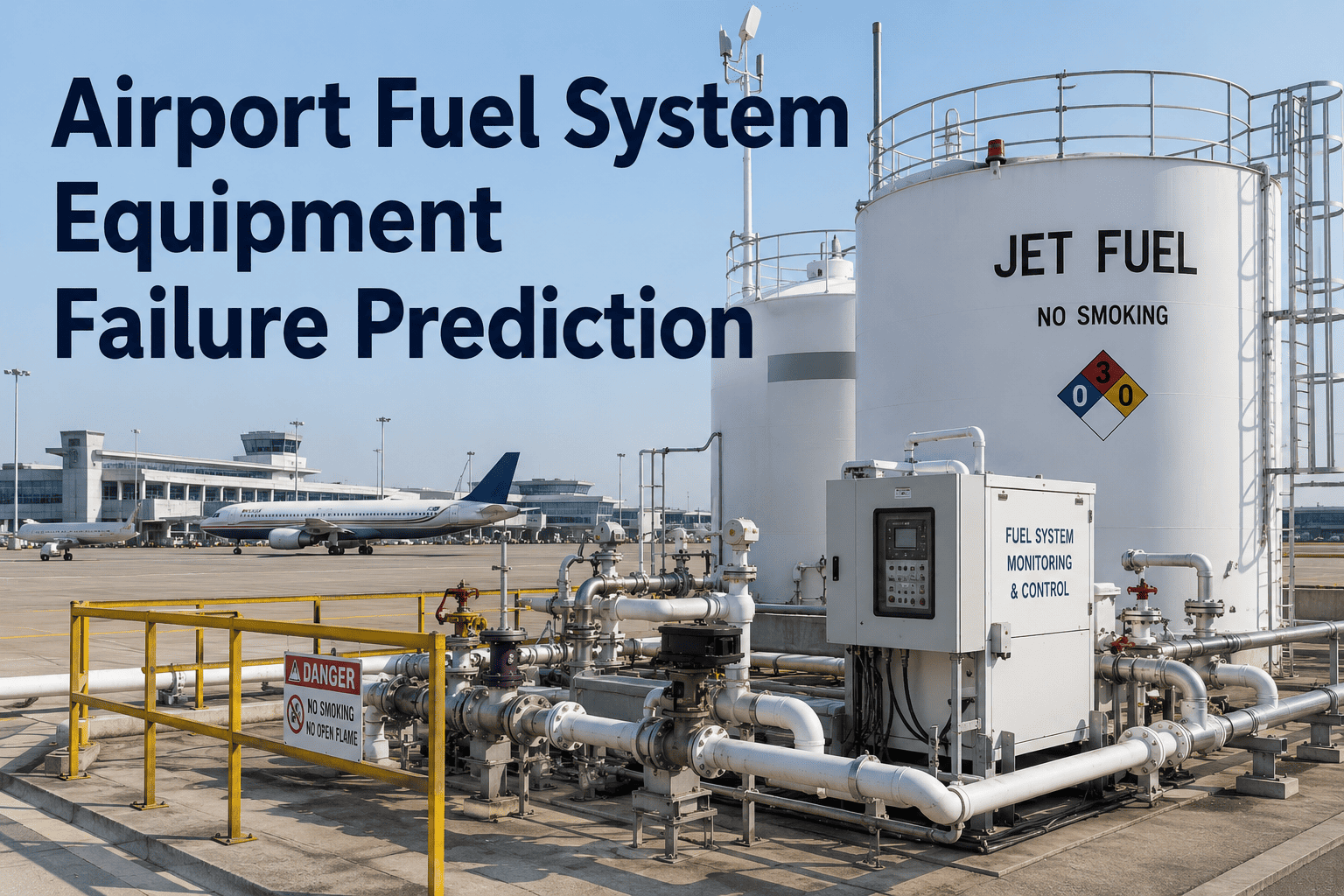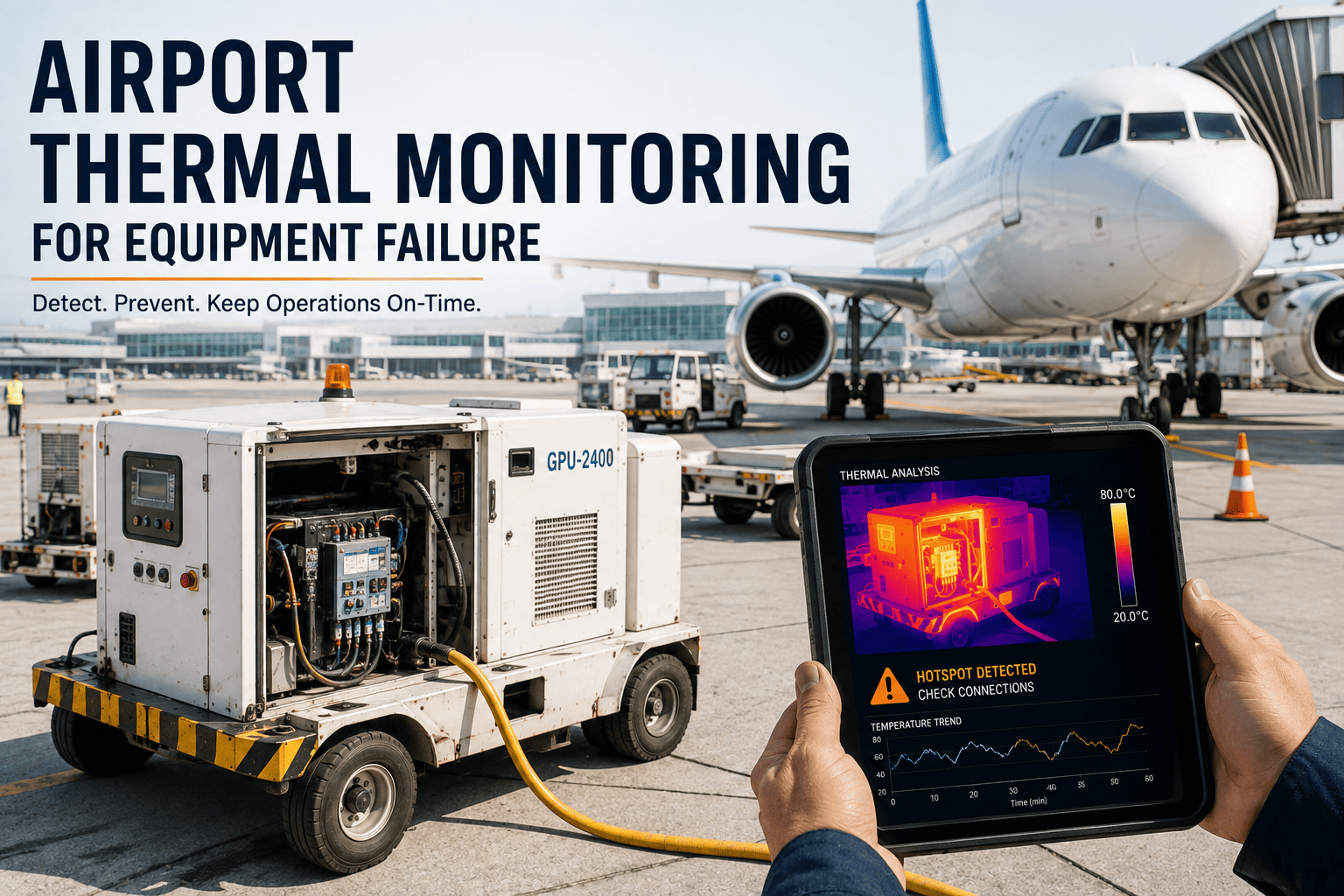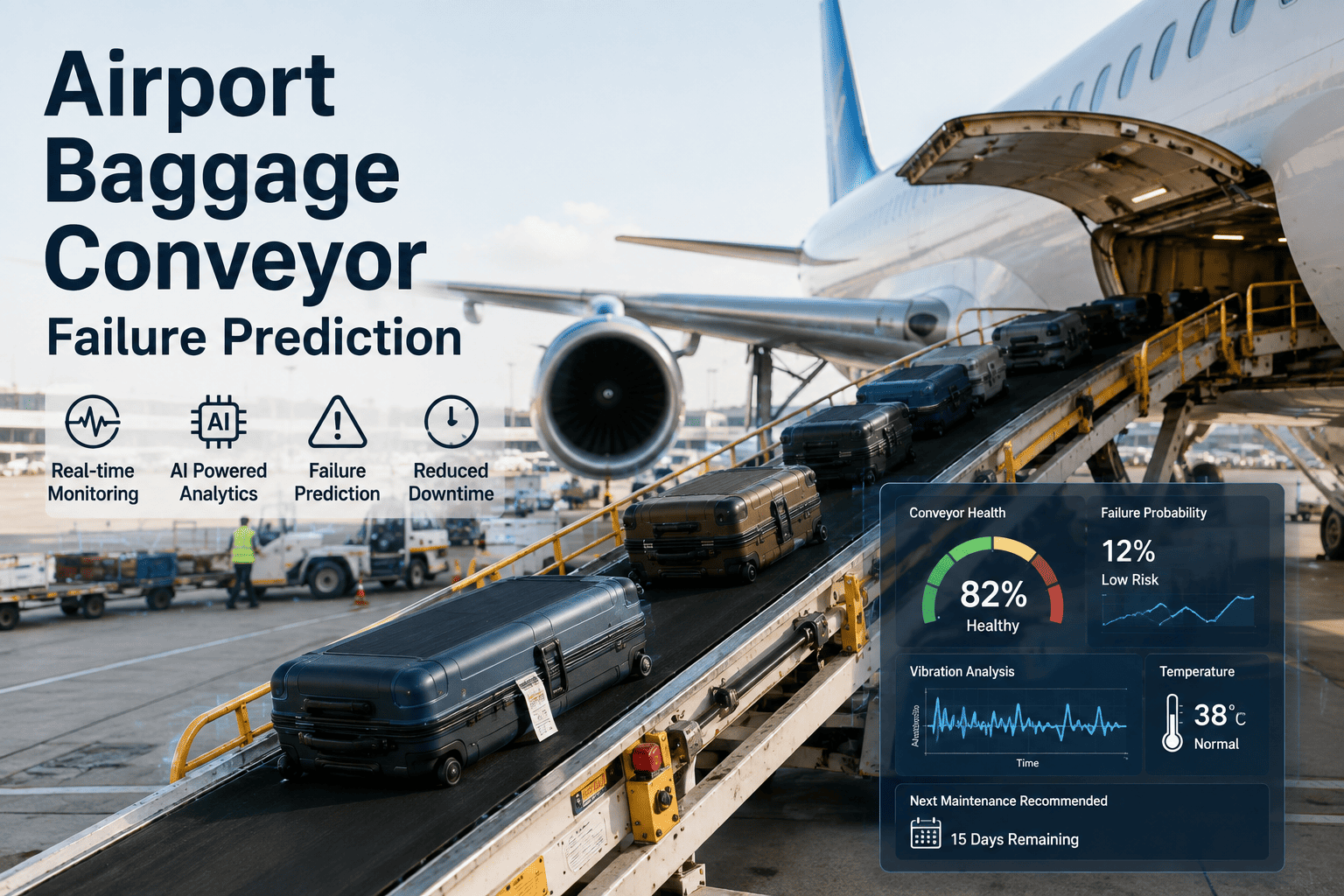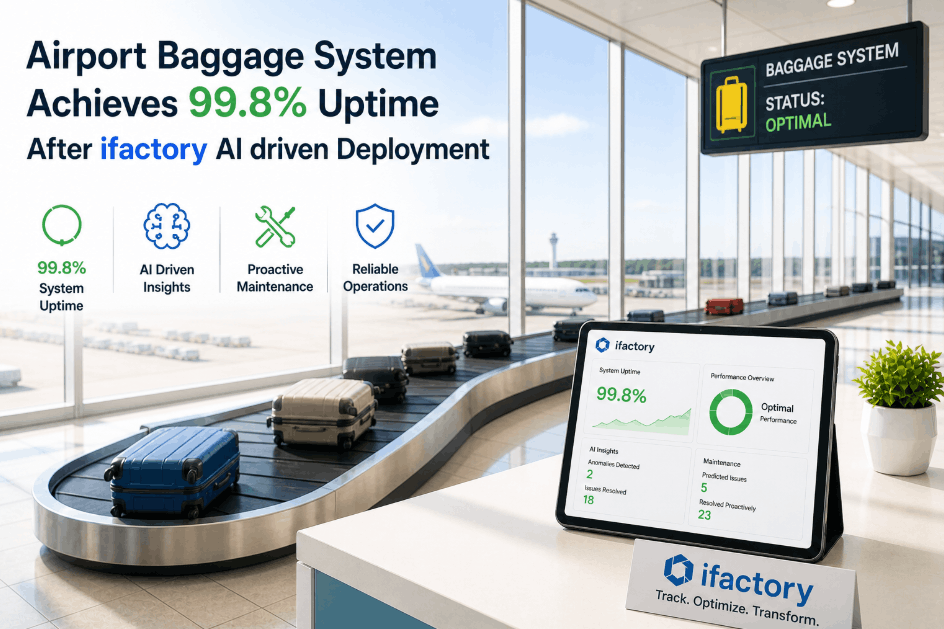
Airport operations run on razor-thin margins — a single hour of unplanned downtime on a baggage conveyor system costs an average of $90,000 in delays, diversions, and operational penalties. In 2026, leading airports are deploying AI-powered predictive analytics that detect equipment degradation signals 30 to 90 days before a failure grounds operations. iFactory's platform monitors thousands of airport assets — from baggage handling systems and runway lighting circuits to HVAC, jet bridges, and ground support equipment — using IoT sensor data, machine learning, and digital twin modeling to predict failures before they happen. Book a demo and see how AI predictive analytics transforms airport reliability from reactive chaos into engineered certainty.
Stop Reacting. Start Predicting. Prevent Airport Equipment Failures Before They Happen.
iFactory’s AI platform monitors every critical airport asset — baggage systems, runway lighting, HVAC, jet bridges, and power infrastructure — predicting failures 30–90 days in advance so your team fixes problems before they ground operations.
Why Airports Can No Longer Afford Reactive Maintenance in 2026
Modern airports operate as interconnected ecosystems where a single equipment failure cascades into flight delays, passenger safety risks, and regulatory scrutiny. Traditional time-based preventive maintenance — servicing assets on fixed schedules regardless of actual condition — wastes budget on healthy equipment while missing real failures that develop between inspection cycles. Reactive maintenance is even more costly: emergency procurement, unplanned labor deployment, and the operational losses from sudden downtime compound quickly into seven-figure annual expenses.
The critical shift is from time-based to condition-based predictive analytics. AI-powered airport analytics continuously evaluate the real-time health of every monitored asset, using machine learning models trained on historical failure data to recognize early degradation signatures — vibration anomalies, current spikes, temperature drift, bearing wear patterns — long before human inspectors could detect them visually. This is the foundation of aviation predictive analytics: engineering reliability into operations, not inspecting it in after the fact.
How AI Predictive Analytics Works Across Airport Asset Classes
iFactory's airport AI-driven analytics platform applies layered intelligence across six major airport asset classes — each with distinct failure modes, sensor requirements, and maintenance implications. Here is how predictive analytics operates across each one.
The 5-Layer Architecture of Airport AI Predictive Analytics
Effective machine learning airport analytics is not a single algorithm applied to a sensor stream. iFactory's platform operates across five integrated intelligence layers that convert raw IoT signals into actionable maintenance decisions — autonomously, continuously, and at scale.
See 30-Day Failure Predictions Across Your Entire Airport in One Dashboard
iFactory deploys in 12–16 weeks and integrates with your existing CMMS, IoT infrastructure, and flight scheduling systems — with zero disruption to live operations.
Predictive Analytics vs. Preventive Maintenance: The Critical Difference
Many airport operations teams confuse predictive analytics with enhanced preventive maintenance schedules. They are fundamentally different approaches — and the performance gap is measurable in hundreds of thousands of dollars annually per airport.
| Dimension | Preventive Maintenance | AI Predictive Analytics |
|---|---|---|
| Maintenance Trigger | Fixed calendar interval (e.g., every 90 days) | Real-time asset condition crossing risk threshold |
| Failure Detection | Misses failures developing between service intervals | Detects 60–85% of failures 30–90 days in advance |
| Labor Efficiency | Scheduled work on healthy assets wastes 40% of PM hours | Work performed only when condition data indicates need |
| Parts Procurement | Emergency orders at 2–4× standard cost | 30–90 day advance warning enables planned procurement |
| Runway / Terminal Impact | Unplanned closures, flight diversions | Repairs scheduled in planned maintenance windows |
| Compliance Documentation | Manual logs assembled before audits | Automated ICAO/FAA/EASA audit-ready reports |
| Cost Benchmark | Industry baseline (100%) | 35–55% reduction in total maintenance spend |
Real-World Impact: What Airports Achieve with AI-Driven Predictive Analytics
The business case for smart airport analytics is no longer theoretical. Airports deploying condition-based AI platforms are reporting measurable outcomes across safety, cost, and compliance within the first 12 months of full deployment.
Airport Downtime Prevention: The Financial Case for AI Analytics
For airport CFOs and heads of infrastructure, airport downtime prevention through AI analytics is a risk management decision with a calculable ROI. A single unplanned baggage system outage during peak hours generates direct costs of $120,000–$280,000 from flight delays, rebooking, passenger compensation, and ground handler overtime. A runway lighting failure requiring emergency closure costs $18,000 per incident in direct airport costs, plus the cascade of flight diversions and ATC coordination.
At a mid-size hub, five or six such events annually represent $1.5M+ in preventable losses. The book a demo consistently returns 4–7× ROI within the first 18 months — making the financial case for AI investment straightforward at virtually any airport scale.
IoT Airport Sensors: Building the Data Foundation for AI Prediction
The quality of AI predictions is entirely determined by the quality and density of sensor data feeding the models. IoT airport sensors must capture the specific physical signals that precede each asset class's known failure modes. iFactory's Discovery phase conducts a gap analysis of your existing sensor infrastructure, identifying assets with zero monitoring coverage and those missing critical signal types.
The platform then recommends only the additional sensors needed — wireless vibration sensors, clamp-on current transformers, non-contact thermal imagers, and photometric monitoring heads — integrating into existing data infrastructure without system shutdowns or airside access restrictions. This is why iFactory deployments achieve full predictive coverage within 12–16 weeks. Speak with our team about your airport's current sensor landscape.
Aviation Analytics Automation: Eliminating Manual Workflows
Aviation analytics automation transforms the entire maintenance execution workflow from a manual process into a continuous autonomous decision loop. When iFactory's AI detects a degradation signature crossing a configured risk threshold, the following sequence executes without any human initiation.
If your airport is still relying on manual patrol rounds and technician-reported failures as the primary detection mechanism, book a demo to see what automated detection looks like in a live iFactory deployment.
Compliance & Regulatory Reporting: The Hidden Advantage of Predictive Analytics
ICAO, FAA, EASA, and national civil aviation authorities are intensifying documentation requirements for airport equipment maintenance. The expectation in 2026 is that airports demonstrate proactive, evidence-based maintenance through continuous monitoring data and traceable compliance records. Airports that cannot produce this documentation face audit failures, operational restrictions, and operating certificate jeopardies.
iFactory stores every sensor reading, anomaly alert, maintenance action, and inspection outcome in an immutable, timestamped audit trail. Compliance reports covering any asset, date range, and regulatory standard — ICAO Annex 14, FAA AC 150/5340, EASA CS-ADR-DSN — are generated automatically. Pre-audit preparation, previously a multi-week manual exercise, reduces to a single click. Book a demo to see a sample compliance report generated from live airport data.
Frequently Asked Questions: AI Predictive Analytics for Airports
AI predictive analytics uses IoT sensors, machine learning, and digital twin simulation to monitor airport equipment health continuously — predicting failures 30–90 days before they occur. This enables planned repairs that eliminate unplanned downtime, runway closures, and costly operational disruptions.
iFactory's ML models achieve 85%+ accuracy at the 30-day horizon and 95%+ at 72-hour windows. Accuracy improves continuously as models learn each airport's specific equipment patterns, operational cycles, and failure history over time.
iFactory monitors baggage systems, runway lighting, HVAC, jet bridges, ground support equipment, power distribution, UPS infrastructure, escalators, elevators, and airside access systems. The platform supports 200+ sensor types and all major industrial protocols for complete airport coverage.
A standard mid-size airport deployment runs 12–16 weeks from infrastructure audit to full autonomous predictive operations. Larger hub airports may require 16–24 weeks. Book a consultation for a timeline scoped to your airport.
Yes. iFactory connects with SAP PM, IBM Maximo, eMaint, and Infor EAM via pre-built API connectors. When a failure is predicted, work orders auto-generate in your CMMS with asset location, failure mode, required parts, and optimal repair window — zero manual entry required.
Airports consistently see 4–7× ROI within 18 months — driven by 55% less unplanned downtime, 35–55% lower maintenance spend, and 70% fewer emergency parts orders. Combined savings average $2.4M annually for a mid-size hub airport.
Every Equipment Failure Is Predictable. Make Downtime a Choice, Not a Surprise.
Predict failures up to 90 days ahead, automate work orders, and pass every compliance audit — without disrupting live operations.