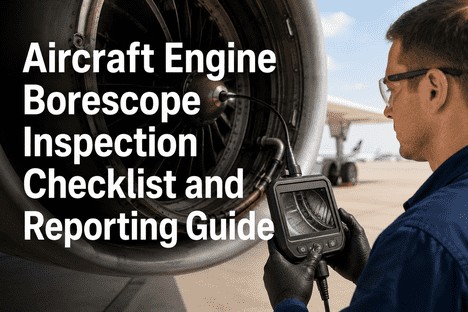
Aircraft Engine Borescope Inspection Checklist and Reporting Guide

By Grace on June 4, 2026

aircraft-engine-borescope-inspection-checklist-reporting

Aircraft engine borescope inspection is one of aviation's most critical non-destructive testing methods — allowing MRO teams to examine turbine blades, compressor stages, and combustion chambers without costly disassembly. Yet most inspection programmes fail not because of poor equipment, but because of missing process rigour: incomplete pre-inspection setup, inconsistent defect classification, and reports that don't hold up to FAA or EASA audit. This guide and checklist covers every stage from equipment readiness to final reporting — so your borescope findings translate directly into airworthy decisions. Book a Demo to see how iFactory's Borescope Inspection Module digitises this entire workflow.

iFactory Borescope Inspection Module
Stop Losing Findings in Paper Reports
iFactory digitises borescope inspection from probe selection to regulatory submission — with AI-assisted defect classification, structured reporting, and audit-ready records built in.
$1.79B
Aviation borescope market in 2025, growing to $4.39B by 2034
9.44%
CAGR driving investment in advanced inspection and analytics
44.5%
Market share held by engine inspection — the largest application segment
30%
Reduction in inspection time achieved with structured digital borescope workflows

Why Most Borescope Programmes Miss Defects

A borescope is only as effective as the process around it. The most common failure modes are not equipment failures — they are process gaps: wrong probe angle for the inspection zone, no standardised defect severity scale, findings recorded in free-text that no analytics tool can parse, and reports filed without cross-reference to the engine's maintenance history. The checklist below closes every one of those gaps.

01
Probe not matched to access port
Wrong diameter or length for the specific engine model creates blind zones in HPC and HPT sections.
02
No standardised defect taxonomy
Technicians describe the same crack differently — "nick", "notch", "surface break" — making trend analysis impossible.
03
Image not linked to engine location
Photos captured without blade number, stage, and port reference cannot be relocated at next inspection interval.
04
Severity assessed without OEM limits
Defects called "acceptable" without referencing the Engine Manual allowable limits invalidates the airworthiness decision.
5 Inspection Phases — Complete All Before Releasing the Aircraft
Phase 1 · Pre-Inspection Setup

Phase 2 · Equipment & Probe Readiness

Phase 3 · In-Engine Inspection Sequence

Phase 4 · Defect Classification & Measurement

Phase 5 · Reporting & Regulatory Submission
Phase 1 Pre-Inspection Setup & Documentation
Complete before the borescope touches the engine
Engine & Work Order Verification
Safety & Access Preparation
Phase 2 Equipment & Probe Readiness Verification
Equipment failure mid-inspection contaminates findings
Borescope Selection & Calibration
Recording & Storage Setup
Phase 3 In-Engine Inspection Sequence by Module
Each module must be inspected in sequence — do not skip stages
Fan & Low-Pressure Compressor (LPC)
High-Pressure Compressor (HPC)
Combustion Chamber (Burner Can / Annular Combustor)
High-Pressure Turbine (HPT) — Highest Criticality Zone
Low-Pressure Turbine (LPT) & Exhaust
Phase 4 Defect Classification & Severity Assessment
Every finding must be classified before the report is written
Defect Severity Classification Framework
Category A
Unserviceable — Immediate Action Required
Defect exceeds OEM allowable limits. Aircraft must not be released to service. Engine requires removal, repair, or shop-visit disposition before next flight.
Broken blade, through-crack, burn-through, blocked cooling passage, missing metal exceeding limits
Category B
Serviceable with Monitoring — Repeat Inspection Required
Defect within allowable limits but approaching threshold. Engine may operate under defined monitoring interval before next borescope.
Crack within limits, TBC spallation within percentage allowance, erosion within dimensional tolerance
Category C
Serviceable — No Restriction, Document Only
Defect noted and documented for trend purposes. Engine released to service on normal inspection schedule.
Minor erosion, light surface oxidation, cosmetic scoring within serviceable limits
Classification Verification Checklist
Phase 5 Reporting, Close-Out & Regulatory Submission
A technically perfect inspection is worthless without a compliant report
Report Content Requirements
Close-Out & Compliance

What a Compliant Borescope Report Must Contain

FAA and EASA regulators increasingly scrutinise borescope inspection records following incidents where deferred defects were inadequately documented. A compliant report is not just good practice — it is the evidence base for every airworthiness decision the report supports.

01
Engine Identity Block
Serial number, ESN, position, aircraft tail, total hours, total cycles, time since overhaul — all required for the record to be traceable at any future regulatory investigation.
02
Trigger & Scope Statement
Why the inspection was performed (scheduled, event-driven, or on-condition) and which modules and stages were within the inspection scope.
03
Findings Table with OEM Reference
Every finding with defect type, location, measured dimension, OEM allowable limit and limit source, and disposition code. Unmeasured findings do not meet reporting standards.
04
Image Evidence Package
Still images for all Category A and B findings, with scale reference where dimensional measurement was performed. Video file reference for full inspection replay.
05
Clear Serviceability Statement
Unambiguous release statement from a licensed certifying staff member. No vague language — the report must state whether the engine is cleared for return to service.
06
Trend & Monitoring Flag
Cross-reference to prior inspection findings for the same engine. Any defect being monitored must show the progression rate and the action threshold that triggers Category A escalation.
iFactory Borescope Inspection Module
From Probe to Report in One Structured Workflow
iFactory replaces paper-based borescope inspection with a structured digital workflow: pre-inspection setup forms, in-engine finding capture with blade-position tagging, AI-assisted defect classification against OEM limits, and one-click report generation that meets FAA and EASA audit standards. No findings lost in free-text notes. No reports rebuilt manually from video files.
Structured finding capture with defect taxonomy built in
Blade-position and stage tagging — every image is locationally referenced
OEM manual limits integrated — real-time compliance check at point of classification
Auto-generated EASA/FAA-ready inspection report with image package
Fleet trend analytics — monitor defect progression across your entire engine population

Common Questions

How often should aircraft engine borescope inspections be performed?
Inspection intervals are defined by the OEM Engine Manual and applicable Airworthiness Directives — there is no universal interval. Most turbofan engines have scheduled borescope checks tied to flight hour or cycle thresholds (typically every 3,000–6,000 hours for HPT sections), with additional event-driven inspections triggered by bird strikes, FOD ingestion, EGT exceedances, high vibration events, or abnormal oil consumption. Operators should also inspect following any Airworthiness Directive that references on-condition borescope requirements.
What is the difference between a Category A and Category B borescope finding?
A Category A finding is one where the measured defect exceeds the OEM's allowable limit — the engine is unserviceable and cannot be returned to flight without repair or engineering disposition. A Category B finding is within limits but requires a shortened monitoring interval and repeat borescope before the normal next scheduled inspection. The classification must always reference the specific Engine Manual limit, not general industry experience, because allowable damage tolerances vary significantly between engine models and even between engine variants within the same family.
Which regulatory standards apply to borescope inspection reporting?
In Europe, EASA Part 145 defines the certification and documentation requirements for MRO organisations performing borescope inspections, with records required to be retained for at least two years after the aircraft leaves the register. In the United States, FAA AC 120-17A and the applicable Engine Type Certificate Data Sheets govern maintenance record requirements. ICAO Annex 6 sets the baseline international standard for engine maintenance record-keeping. Reports must be traceable, immutable, and accessible for regulatory audit — paper records that cannot be reproduced are non-compliant in most jurisdictions.
Can AI-assisted tools replace a licensed engineer's judgment in borescope defect classification?
No current regulatory framework permits fully autonomous AI classification for airworthiness decisions. AI tools including iFactory's module function as decision-support systems — they flag potential defects, cross-reference OEM limits, and surface trend data — but the final airworthiness determination must be made by a certifying technician holding the appropriate licence and type authorisation. The practical benefit of AI-assisted classification is consistency: it eliminates the free-text terminology problem that makes fleet-wide trend analysis unreliable, and it ensures every finding is automatically checked against the correct OEM limit rather than relying on manual cross-reference.
How does iFactory integrate borescope inspection data with existing MRO systems?
iFactory connects with major MRO CMMS platforms via REST API — findings logged in the borescope module automatically generate or update work orders in the maintenance management system, with defect severity driving work order priority. For operators using engine health monitoring systems, iFactory can ingest EGT trend and vibration data to contextualise borescope findings within the broader engine condition picture. Integration is configured without replacing existing systems — iFactory adds the structured digital inspection layer that most legacy CMMS platforms lack natively.
iFactory Borescope Inspection Module
Every Stage. Every Finding. Every Report — Audit-Ready.
iFactory's Borescope Inspection Module gives MRO teams and airline engineering departments a structured digital workflow from pre-inspection setup through to regulatory-compliant report submission — with AI-assisted defect classification, OEM limit integration, and fleet trend analytics built in from day one.
Used by airlines, MROs, and OEMs across the UK, EU, Middle East, and Asia-Pacific.

Share This Story, Choose Your Platform!