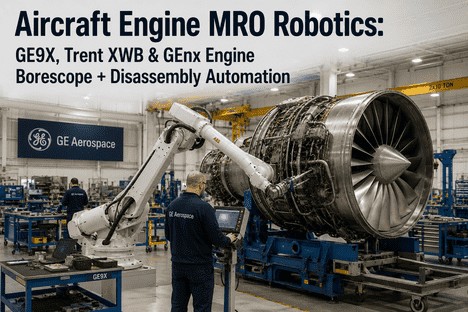
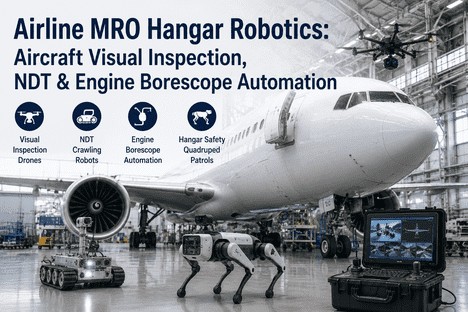
An aircraft engine is not repaired. It is disassembled, inspected, measured, and rebuilt from the inside out. Every major shop visit involves removing the fan module, splitting the core, extracting the high-pressure compressor and turbine rotors, inspecting each blade with a borescope or white light scanner, measuring every disk and seal against OEM limits, and reassembling the entire module stack within tolerances measured in thousandths of an inch. The process takes weeks. It costs between $2 million and $12 million depending on the engine model and workscope. And it is the subsegment of aviation MRO where robotics adoption delivers the highest return per automated minute — because an engine on the shop floor is an engine not earning revenue, and every day saved on a shop visit is a day added to an airline's fleet utilization. The largest engine OEMs — GE Aerospace, Rolls-Royce, and Pratt & Whitney — are not experimenting with robotics in their MRO networks. They are industrializing them.
Robotic borescope inspection, AI-guided white light scanning, automated HPC rotor assembly, collaborative receive-in-check systems, and the facility investments reshaping the $50B engine MRO market across the five most widely deployed large turbofan platforms.
GE9X
Trent XWB
GEnx
PW1100G
LEAP
CFM56
$50B+
Global aircraft engine MRO market in 2026, growing at 6.4% CAGR toward $62B by 2031 across all commercial turbofan platforms.
39,000+
Projected shop visit events for LEAP, PW1100G, and GEnx engines over the next decade — each requiring borescope inspection, module disassembly, and robotic-assisted rebuild.
87.5%
Man-hour reduction achieved by Pratt & Whitney's Alfred robot for HPC rotor assembly at Eagle Services Asia — from 8 hours to 1 hour per assembly.
Five Engines, One Robotics Imperative: The Platform Comparison
The five most commercially significant large turbofan engines in service today each operate under different MRO economics, but the robotics technologies being deployed across their shop floors are converging on a shared set of capabilities: AI-assisted borescope inspection for hot-section blades, robotic white light scanning for disk and seal measurement, automated rotor stacking for HPC and HPT modules, and collaborative systems for receive-in-check documentation. The engines differ in architecture and workscope frequency, but the automation toolchain serving them is increasingly common.
Engine
Model
GE9X
Aircraft
Boeing 777X
Thrust
105,000-134,000 lb
Fan Diameter
134 in / 3.4 m
Robotic Tech
AI BIT, White Light Robot
Status
Entering service 2026
Engine
Model
Trent XWB
Aircraft
Airbus A350
Thrust
74,000-97,000 lb
Fan Diameter
118 in / 3.0 m
Robotic Tech
Intelligent Borescope, MDI 3D
Status
3,000+ on order, 60+ customers
Engine
Model
GEnx
Aircraft
Boeing 787, 747-8
Thrust
53,000-75,000 lb
Fan Diameter
111 in / 2.8 m
Robotic Tech
AI BIT, MDI Templates, AI HPC
Status
3,600+ built, 62M flight hours
Engine
Model
LEAP
Aircraft
A320neo, 737 MAX
Thrust
23,000-35,000 lb
Fleet
3,700+ aircraft, 60M flight hours
Robotic Tech
AI BIT deployed 12+ facilities
Status
$20B MRO demand by 2034
Every Engine on the Shop Floor Is a Tracked Asset. Every Robotic Inspection System Should Be Too.
iFactory registers every borescope robot, white light scanner, HPC assembly cobot, and test cell measurement system as a managed asset with PM scheduling, calibration tracking, software version control, and inspection audit trails.
Borescope Robotics: AI-Assisted and Automated Inspection Across the Engine Core
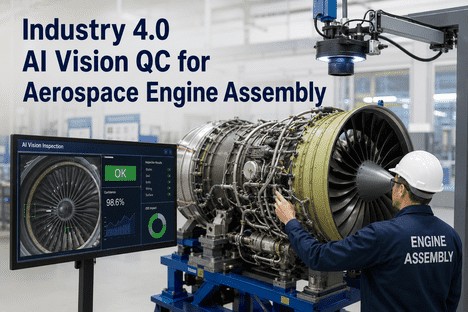
Borescope inspection is the most frequently performed and most labor-intensive MRO task on every engine model. Each shop visit requires visual inspection of HPC rotor blades, HPT stage 1 and stage 2 blades, combustor liners, and turbine vanes — accessed through inspection ports using flexible or rigid borescope probes. The inspection generates thousands of images per engine that must be reviewed, compared against OEM limits, and documented. Three parallel technology tracks are automating this workflow across the major engine platforms.
AI-Assisted Blade Inspection
GE Aerospace BIT
AI-guided Blade Inspection Tool deployed on GEnx (3 years), LEAP (12+ facilities since Feb 2025), and GE9X (ready at entry to service). Cuts inspection time 50% — from 3 hours to 1.5 hours on GEnx. Technician captures images; AI selects which to review for defects.
50% time reduction
AI Borescope ADR
GE + Waygate HPC Inspect
Joint Technology Development Agreement produced AI-based Automated Defect Recognition for HPC inspections on GEnx and LEAP. Results: 33.6% increase in defect detection True Positive Rate, 13%+ reduction in False Positive Rate. Uses Waygate Mentor Visual iQ+ platform.
33.6% higher defect detection
Intelligent Borescope Method
Rolls-Royce + Waygate MDI
Menu Directed Inspection for Trent XWB HPT stage 1 and 2 blades. Mentor Visual iQ+ video borescope with facial-recognition-style AI and 3D color scanning. Semi-transparent image overlay templates ensure consistent data collection across every inspection. Automated reporting integrated.
3D scanning overlay templating
Disassembly and Assembly Robotics: The Shop Floor Automation That Cuts Weeks from Engine Throughput
The most significant productivity gains from engine MRO robotics are not in inspection. They are in the physical disassembly and assembly of engine modules — the tasks that historically required skilled mechanics to lift, align, torque, and measure components weighing hundreds of kilograms. The deployments across Pratt & Whitney, GE Aerospace, and ST Engineering demonstrate that the highest return automation targets are the repetitive, precision-critical assembly steps that occupy the most labor hours per shop visit.
Deployment Spotlight
Pratt & Whitney Alfred Robot — HPC Rotor Assembly, Eagle Services Asia
Named Alfred by the technician who conceived it, this six-axis robot at Pratt & Whitney's Eagle Services Asia facility in Singapore assembles high-pressure compressor rotors for the PW1100G-JM GTF engine. The concept originated in 2021 from a technician's observation that the 14-hour HPC module assembly process could be automated. Design review completed in 2022, and the fully operational automated cell was running by 2023. Alfred works double shifts: prepares rotors, places them in an industrial oven for thermal expansion, cools them, and transfers them to the hydraulic stacking system. The result: assembly time cut by 50%, man-hours reduced by 87.5% from 8 hours to approximately 1 hour per rotor. Three operators were freed for higher-value tasks such as rotor balancing. Alfred is now being scaled across Pratt & Whitney's 17 active GTF MRO network sites.
50%
Assembly time cut
87.5%
Man-hour reduction
8 to 1
Hours per rotor assembly
17
GTF network sites scaling
Receive-in-Check Cobot
Eagle Services Asia
Camera-equipped cooperative robot that automatically photographs every engine arriving for processing before disassembly. Collects data using a standardized process with high accuracy. Reduced man-hours by 90%. A follow-on phase using AI to analyze the captured images is under study.
White Light Robot Inspection
GE Aerospace STAC Cincinnati
Two articulated industrial robots with white light optical scanners at GE's Services Technology Acceleration Center. First generation captured images and stitched them digitally. Second generation uses line-scan cameras for video-like stream quality. Mount a part, hit go, let the system run while you do another job.
Robotic HPC Bearing Sleeve
Pratt & Whitney ESA
Dedicated robotic arm for installing and removing HPC bearing sleeves — a task that requires precise alignment and consistent force application. Part of the broader automation ecosystem at Eagle Services Asia that increased overall MRO output by 40% in a single year.
Automated Fan Frame & Sealant
ST Engineering Singapore
Automated fan frame abradable machine delivered 500% productivity improvement. Automated sealant application increased productivity by 150%. ST Engineering doubled LEAP MRO capacity to 300+ engines annually by 2027, using AI-enabled hardware sorters and automated cleaning systems.
The Robots That Inspect and Rebuild Your Engines Need PM Schedules and Calibration Logs Too.
iFactory manages every engine MRO robot — from Alfred HPC assemblers and white light scanners to bore inspection cobots and automated sealant applicators — as a registered asset with PM scheduling, calibration tracking, and software version control.
The Productivity Impact: How Automation Compresses Engine MRO Cycle Time
The measurable productivity gains from deployed engine MRO robotics are not theoretical. They are documented across multiple OEM facilities and published as operational results. The cumulative effect on engine throughput is significant enough that the three largest engine OEMs have collectively committed over $1.5 billion in MRO facility investments with automation and robotics as a stated investment priority.
50%
Blade inspection time reduction — GE AI BIT across GEnx, LEAP, GE9X
87.5%
Man-hour reduction — Pratt Alfred HPC rotor assembly, Eagle Services Asia
90%
Man-hour reduction — Pratt receive-in-check cobot for incoming engine documentation
500%
Productivity increase — ST Engineering automated fan frame abradable machine
Frequently Asked Questions
Three deployments stand out for their documented and published productivity gains. First, Pratt & Whitney's Alfred six-axis robot at Eagle Services Asia in Singapore reduced HPC rotor assembly man-hours by 87.5%, from 8 hours to approximately 1 hour per rotor, and cut total assembly time by 50%. Second, GE Aerospace's AI-enabled Blade Inspection Tool deployed on GEnx, LEAP, and incoming GE9X reduced blade borescope inspection time by 50% from 3 hours to 1.5 hours on GEnx, and is now deployed across 12+ GE MRO facilities and customer sites. Third, ST Engineering's automated fan frame abradable machine delivered a 500% productivity increase at its Singapore LEAP MRO facility, which is doubling capacity to 300+ engines annually by 2027. The common factor across all three deployments is that the automation targets the highest-labor-intensity tasks in each engine's shop visit cycle. Book a Demo to see how iFactory supports the asset management infrastructure behind these robotic systems.
Traditional borescope inspection requires a trained technician to manually guide a flexible or rigid borescope probe through each inspection port, capture images of each blade, and visually compare each image against OEM limits stored in paper or digital manuals. The technician's skill level directly determines inspection quality and consistency. For a GEnx HPC with 18 stages, the process takes approximately 3 hours per engine. AI-assisted borescope inspection, as deployed by GE Aerospace with Waygate Technologies and by Rolls-Royce with the Intelligent Borescope Method, uses three key technologies: Menu Directed Inspection with semi-transparent image overlay templates that guide the technician to capture each blade image at the correct angle and distance; AI-based Automated Defect Recognition that analyzes captured images and flags potential defects with 33.6% higher True Positive Rate than manual review; and automated 3D measurement tools that quantify defect geometry without requiring the technician to switch tools. The result is a 50% reduction in inspection time and more consistent documentation across different inspectors and facilities. Get In Touch to discuss how iFactory tracks borescope robot calibration and AI model versioning for your MRO facility.
The Services Technology Acceleration Center, opened near Cincinnati, Ohio in late 2024, is GE Aerospace's dedicated facility for developing and proving MRO robotics and automation technologies before deploying them across the company's global MRO network. It is the result of a five-year joint effort between GE Aerospace Research in Niskayuna, New York and the Global Automation and Robotics Center in Bromont, Quebec. The first production technology deployed from STAC is the AI-guided white light robot inspection system, which uses two articulated industrial robots with white light optical scanners to inspect high-precision parts such as turbine disks. The second-generation system uses line-scan cameras that produce a video-like stream for real-time analysis. The system assigns numerical values to anomalies including dents, cracks, corrosion, and fretting, and creates a digital record accessible in the cloud. The goal, as stated by GE's Services Technology Leader, is to mount a part, hit go, and let the system run while the technician performs other tasks. STAC is part of GE Aerospace's $1 billion MRO investment programme announced in 2024, with $250 million allocated in the first year alone across facilities in the United States, South America, Europe, Middle East, and Asia Pacific. Book a Demo to see how iFactory manages robotic inspection assets across multi-facility MRO networks.
iFactory registers every robot, cobot, and automated inspection system in an engine MRO facility as a managed asset with a complete lifecycle record. For each system — whether it is a Pratt & Whitney Alfred HPC assembly robot, a GE Aerospace white light scanner, a Waygate Mentor Visual iQ+ borescope with AI defect recognition, or an ST Engineering automated sealant applicator — iFactory maintains the manufacturer PM schedule, calibration interval, software version history, sensor validation records, and operational uptime log. When a borescope AI model is updated, the software version is logged and the update deployment is tracked. When a white light scanner requires calibration, the PM work order is generated automatically and the calibration certificate is attached to the asset record. For MRO facilities operating under EASA Part 145, FAA, or AS9100 quality systems, iFactory provides the documented audit trail that every robotic inspection system is maintained to the same standard as the engine components it inspects. Get In Touch to see how iFactory manages engine MRO robotics assets alongside your test cell equipment and tooling portfolio.
Conclusion
The engine MRO industry is not preparing for a future with robotics. It is operating in that future today. GE Aerospace has cut blade inspection time by 50% across the GEnx, LEAP, and incoming GE9X fleets using AI-guided inspection tools deployed at 12 MRO facilities and customer sites. Pratt & Whitney's Alfred robot reduced HPC rotor assembly from 8 hours to 1 hour and is scaling across the 17-site GTF MRO network. Rolls-Royce's Intelligent Borescope Method with Waygate Technologies brings 3D scanning and facial-recognition-style AI to Trent XWB HPT blade inspections. ST Engineering's automated fan frame machine delivers 500% productivity improvement at its Singapore LEAP facility. These are not pilot projects. They are production systems with documented results measured in hours saved, throughput increased, and quality improved.
The facility management infrastructure that keeps these robotic systems calibrated, maintained, and audit-ready is not optional. iFactory provides that infrastructure: asset registration for every MRO robot and automated inspection system, PM scheduling aligned with manufacturer specifications and regulatory requirements, software version and AI model tracking, calibration documentation, and compliance audit trails — built for the engine MRO facilities deploying robotics today and planning the shop floor transformations of tomorrow. Book a Demo to see how iFactory manages engine MRO robotics assets alongside your shop floor equipment, or Get In Touch to begin registering your automated inspection and assembly systems.
Every Engine That Enters Your Shop Is Tracked. Every Robot That Inspects and Rebuilds It Should Be Too.
iFactory registers every borescope robot, white light scanner, HPC assembly cobot, and sealant applicator as a managed asset — with PM scheduling, calibration tracking, software version control, and compliance audit trails.