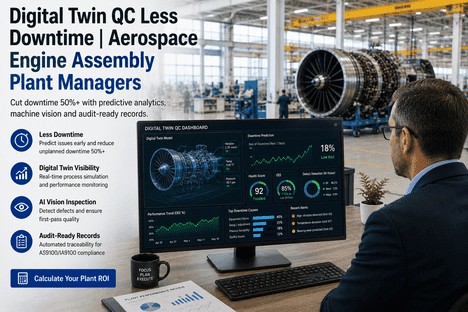
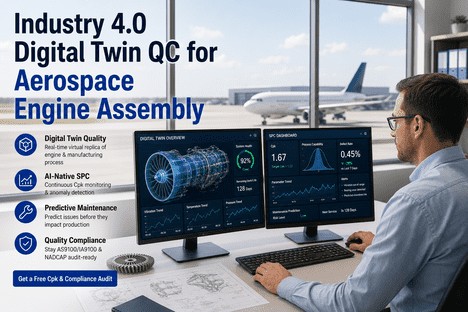
Digital Twin QC Less Downtime | Aerospace Engine Assembly Plant Managers
By Grace on June 13, 2026
Unplanned downtime in aerospace engine assembly is the most expensive operational metric a plant manager manages — not because the maintenance cost is high, but because the production loss compounds across every downstream cell, every committed delivery date, and every engine programme that depends on that machine's output. A single spindle bearing failure on a 5-axis CNC machining a titanium fan blade can stop a production cell for 6 to 18 hours, delay an engine set delivery by 72 hours, and trigger contractual penalties that exceed the repair cost by 40 times. The root cause is almost never a single event. It is a pattern — vibration trending upward for days, coolant temperature drifting outside normal range, spindle load increasing incrementally with every part — that the plant's existing systems did not connect into a single predictive signal. Digital twin quality closes this detection gap by creating a live virtual replica of every machine, tool, and process parameter — continuously comparing actual behaviour against expected behaviour and forecasting the failure timeline before any physical threshold is crossed. This is the plant manager's guide to deploying digital twin quality for downtime reduction in aerospace engine assembly.
Live Digital Twin · Predictive Failure Detection · Quality Mirror · AS9100 Audit Trail
Plant Managers Who Cut Unplanned Downtime by 50% in Aerospace Engine Assembly Do Not React to Failures — They See Them Building in the Digital Twin Before Any Physical Symptom Appears.
iFactory's digital twin quality platform gives aerospace plant managers a live virtual replica of every production cell — synchronised in real time with machine sensors, quality inspection data, and maintenance history — that continuously compares actual performance against the expected model and forecasts failure events 7-14 days before they materialise.
Unplanned downtime reduction achieved when digital twin quality platforms detect failure patterns 7-14 days in advance — converting emergency repairs into scheduled interventions
87%
Faster root cause identification when the digital twin compares real-time machine behaviour against the expected model — isolating the specific parameter deviation within seconds
6x
ROI documented within 12 months when digital twin quality prevents a single major spindle or bearing failure in high-value aerospace machining cells
94%
Failure prediction accuracy when the digital twin model integrates vibration, thermal, acoustic, and load data streams across multiple sensor types simultaneously
The Plant Manager's Problem: Why Unplanned Downtime Keeps Happening Despite Maintenance Schedules, Alarms, and Corrective Actions
Unplanned downtime in aerospace engine assembly follows a deceptive pattern. It looks like a sudden, unpredictable event — a spindle bearing that seizes without warning, a coolant pump that fails mid-shift, a vibration spike that triggers an emergency stop. But when the post-event analysis reconstructs the data, the pattern was always there: a 3-micron vibration increase per day for 12 days, a coolant temperature drift of 2 degrees per shift for 36 hours, a spindle load creep of 0.5% per part for 80 parts. The data existed in the machine controller, the PLC historian, and the vibration monitoring system. But these systems operated independently — each generating its own alarms against its own static thresholds, none connecting the cross-sensor pattern that would have revealed the failure trajectory. The digital twin closes this gap by fusing every data stream into a single virtual model of the machine's expected behaviour and raising a predictive alert when the real machine diverges from its digital counterpart — not when it violates a static threshold that was set when the machine was commissioned.
Machine Layer
What the Physical Asset Generates
Every CNC machine, assembly station, and test cell in the plant continuously generates sensor data — spindle vibration and load, coolant temperature and flow, feed motor current, axis position error, torque curves, and cycle timing. These signals are captured by PLCs and machine controllers at millisecond resolution but are typically monitored independently against static thresholds calibrated at installation. The machine does not know it is failing until a threshold is breached.
VibrationThermalLoadCycle
Twin Layer
What the Digital Twin Does
The digital twin ingests every data stream and builds a live mathematical model of the machine's expected behaviour under current operating conditions — accounting for the specific material being machined, the tool configuration, the spindle speed, and the production programme. It continuously compares actual sensor readings against the expected model output. When actual vibration exceeds expected vibration by a configurable margin, the deviation is flagged not as an alarm but as a pattern requiring observation.
Expected vs ActualDeviation TrendFailure Forecast
Action Layer
What the Plant Manager Receives
The plant manager does not receive raw sensor data or digital twin model outputs. The platform translates the deviation pattern into a specific, actionable prediction: "CNC Cell #4 spindle bearing has a 92% probability of failure within 11 days at current vibration trend. Recommended intervention: replace bearing during scheduled changeover on Day 9. Estimated downtime: 4 hours. Cost of unplanned failure: 14 hours + 18-hour production backlog." The prediction includes the confidence level, the recommended action, and the cost comparison.
Every Unplanned Downtime Event Leaves a Digital Signature in the Machine Data. The Digital Twin Reads It 7-14 Days Before the Physical Failure. Most Plants Never Connect the Signals.
iFactory's digital twin quality platform fuses every sensor stream, quality inspection, and maintenance record into a single live model — so plant managers see the failure trajectory before it crosses the threshold from pattern to breakdown.
The Digital Twin Quality Architecture: Five Detection Layers That Eliminate Unplanned Downtime
The iFactory digital twin quality platform does not replace existing machine monitoring systems — it fuses them into a single detection architecture that generates predictions no individual system can produce alone. Five detection layers operate simultaneously, each covering a failure mode that traditional monitoring misses when signals are analysed in isolation.
Layer 01 Vibration Twin
Builds a baseline vibration signature for every machine at every spindle speed and material combination. When actual vibration deviates from the expected signature — even within the static alarm threshold — the twin flags the deviation trend and forecasts the time to the threshold crossing. Spalling bearings, shaft misalignment, and coolant-induced imbalance are detected 10-14 days before conventional vibration monitoring would alarm.
10-14 day advance notice
Layer 02 Thermal Twin
Models the expected thermal profile of every spindle, motor, bearing housing, and coolant system under current load conditions. A coolant temperature drift of 1.5 degrees per shift that would never trigger a static alarm is identified by the twin as a developing coolant pump or heat exchanger fault. The thermal twin also detects spindle bearing overheating patterns that precede catastrophic seizure by 5-8 days.
5-8 day advance notice
Layer 03 Load Twin
Continuously maps spindle load, feed motor current, and axis torque against expected values for the specific material, tool, and programme combination. A spindle load increase of 0.3% per part that goes unnoticed by the operator is flagged by the twin as a developing tool wear or material hardness deviation pattern. The load twin is the earliest indicator of machining process drift that will eventually produce non-conforming parts.
7-12 day advance notice
Layer 04 Quality Twin
Links every CMM inspection result and surface finish measurement back to the machine parameter state at the time the part was produced. When the quality twin detects a correlation between a specific parameter combination and a Cpk decline trend — even while every individual measurement remains within specification — it alerts the plant manager before the defect escapes to final inspection. The quality twin effectively predicts non-conformances 4-8 hours before the CMM confirms them.
4-8 hour advance notice
Layer 05 Maintenance Twin
Integrates the failure predictions from all four upstream twins with the plant's CMMS data — work order history, spare parts inventory, technician skill availability, and scheduled production windows. The maintenance twin outputs a ranked list of predicted failure events with recommended intervention timing that intersects with the production schedule, minimising the downtime impact. It automatically generates work orders with the specific part numbers, tools, and skills required.
Auto-scheduled intervention
What the Digital Twin Quality Dashboard Shows the Plant Manager
The plant manager's digital twin dashboard is not a sensor monitoring interface or a 3D visualisation of machine geometry. It is a failure prediction and intervention management tool designed around one question: which machine is going to fail next, when, and what should I do about it right now?
Twin View 01
Live Asset Health — Ranked by Failure Probability
Every production asset is ranked by current failure probability within the next 14 days, calculated from the combined output of the vibration, thermal, load, and quality twins. The plant manager sees at a glance which machines are predicted to fail, the lead time, the confidence level, and the specific parameter driving the prediction. A CNC cell with a 92% spindle failure probability at 11 days is clearly distinguished from a cell with a 15% general degradation probability at 13 days.
Action: Assets above 70% probability receive immediate maintenance planning for the next scheduled changeover window.
Twin View 02
Deviation Trend — Actual vs Expected by Parameter
For every asset, the plant manager can view the deviation trend for any monitored parameter — spindle vibration, coolant temperature, load current, cycle time — plotted as actual value against the digital twin's expected value. The deviation trend line shows whether the gap is widening, stable, or closing. A widening deviation trend on spindle vibration over 8 days is a stronger predictor of bearing failure than a static threshold crossing on a single shift.
Action: Widening deviation trend triggers automated work order generation with spare part reservation and technician dispatch.
Twin View 03
Failure Forecast Timeline — 14-Day Look-Ahead
A Gantt-style timeline shows every predicted failure event across the plant for the next 14 days, colour-coded by confidence level and overlaid with the scheduled production plan and planned maintenance windows. The plant manager sees exactly where the predicted failures intersect with production commitments and can make informed decisions about intervention timing — scheduling a bearing replacement during a programme changeover rather than during a critical production run.
Action: Drag predicted events into scheduled maintenance windows for zero-downtime intervention planning.
Twin View 04
Unplanned Downtime Pareto — Predicted vs Historical
The downtime Pareto view overlays predicted failure categories (spindle, coolant, tooling, electrical, quality) against historical downtime events. When the digital twin's predicted Pareto shows a rising trend in coolant-related failures while the historical Pareto shows spindle failures as the dominant category, the plant manager has a direct signal that the failure profile is shifting — and can proactively stock coolant pump spares and assign technician training before the first coolant-related unplanned event occurs.
Action: Shifting Pareto categories trigger proactive spares and training allocation before the new failure type materialises.
Twin View 05
Quality Mirror — Cpk Forecast by Machine and Programme
The quality twin segment of the digital twin mirrors the expected quality output for every active engine programme against actual Cpk measurements. When the quality twin detects that a specific machine's process parameter combination — even with every individual parameter within specification — matches a pattern historically associated with a Cpk decline, it alerts the plant manager before the next CMM inspection confirms the drop. The quality mirror effectively gives the plant manager a 4-8 hour lead time on quality degradation that would otherwise be discovered at final inspection.
Intervention Effectiveness — Actual vs Predicted Downtime
Every intervention triggered by a digital twin prediction is logged with the predicted failure event, the actual intervention timing and duration, and the downtime that was avoided. This creates a continuous improvement record that validates the twin's prediction accuracy and quantifies the downtime savings. Plant managers use this record to demonstrate ROI to plant leadership, justify digital twin investment for additional production cells, and refine intervention protocols based on actual outcomes.
Action: Intervention effectiveness data feeds continuous model improvement and quantifies plant-level ROI.
Unplanned Downtime That Keeps Happening Has a Predictable Digital Signature. The Digital Twin Reads It Before the Machine Stops. Get a Free Downtime Risk Assessment.
iFactory's digital twin quality platform for aerospace engine assembly plant managers — live virtual replicas of every production cell that forecast failure events 7-14 days before they materialise, with automated intervention scheduling and AS9100-compliant documentation generated automatically from your machine data.
Failure detected by digital twin deviation trend — 7-14 day advance notice for intervention planning
Root cause identified by digital twin deviation analysis — within seconds, not hours
Spindle bearings replaced on schedule — planned intervention during changeover, zero production loss
Quality deviations predicted by quality twin — 4-8 hours before CMM confirmation
Maintenance triggered by failure forecast — every intervention scheduled at the optimal production-maintenance intersection
We had a vibration monitoring system, a coolant temperature monitoring system, a spindle load monitoring system, and a CMM data system — four separate platforms generating alarms against four separate sets of static thresholds. A bearing would fail, and the post-event analysis would show that the vibration had been trending upward for 9 days, the load had increased by 4%, and the coolant temperature had drifted by 3 degrees. But none of those signals individually crossed a threshold that would have triggered an alarm. The digital twin changed this by fusing all four signals into a single expected-behaviour model. When the actual vibration exceeded the expected vibration by 0.5 microns, the twin flagged it — not as an alarm, but as a pattern. By Day 5, the pattern had a 70% confidence prediction. By Day 9, it was 94%. We replaced the bearing on Day 10 during a scheduled changeover. The repair took 3.5 hours instead of the 14 hours an unplanned failure would have cost. The digital twin paid for itself in that single intervention.
14 CNC Machining Cells — Titanium and Inconel Blades, Discs, and Casings — 3 Shifts, 6-Day Operation
How Digital Twin Quality Integrates with AS9100 and the IA9100 Predictive Compliance Standard
The incoming IA9100 standard explicitly requires aerospace manufacturers to shift from reactive quality management to predictive process control — real-time monitoring, automated documentation, and proactive intervention. Digital twin quality directly satisfies this requirement by building a continuous record of expected-versus-actual machine behaviour, failure prediction and intervention documentation, and quality deviation forecast and corrective action linkage. Every prediction, intervention, and outcome is logged automatically with full production context — machine ID, engine programme, material lot, operator ID, and the specific parameter deviation that triggered the prediction. The audit record demonstrates that the plant did not wait for failures to occur before acting — it predicted them, intervened before they materialised, and documented the entire sequence. This is the compliance standard that IA9100 is designed to enforce, and digital twin quality delivers it as a byproduct of normal operation, not as a separate documentation exercise.
Conclusion
Unplanned downtime in aerospace engine assembly is not a maintenance problem — it is a detection integration problem. The data that predicts every bearing failure, every coolant system fault, and every quality deviation already exists in the machine controllers, PLC historians, and inspection systems. It is not being connected into a single predictive signal because the detection architecture treats each data stream as an independent monitoring channel with its own static thresholds. Digital twin quality closes this integration gap by fusing every data stream into a single live model of expected machine behaviour — and raising a predictive alert when the real machine diverges from its digital counterpart, regardless of whether any individual sensor has crossed its threshold.
The evidence from aerospace manufacturing in 2025 and 2026 is clear: plants deploying digital twin quality platforms achieve 48-60% reduction in unplanned downtime, 87% faster root cause identification, and 94% failure prediction accuracy within 90 days of deployment. The 6x ROI documented within 12 months is driven by a single prevented spindle or bearing failure in a high-value machining cell — and the compounding effect of every prevented failure on production schedule reliability, delivery performance, and customer confidence. The IA9100 standard shift toward predictive quality management makes digital twin quality not just an operational advantage but a compliance requirement in the making. Plant managers who deploy digital twin quality ahead of the standard transition will enter their next AS9100 or IA9100 audit with a system that demonstrates predictive failure detection, proactive intervention, and complete documentation — not one that tracks events after they have already cost the plant production time.
iFactory's digital twin quality platform is designed for aerospace engine assembly plant managers who need to eliminate unplanned downtime and shift from reactive to predictive quality management. Book a Demo to see the digital twin quality system configured for your production cell layout and engine programme portfolio, or talk to an expert about a free downtime risk and IA9100 readiness assessment for your engine assembly operation.
Frequently Asked Questions
Traditional predictive maintenance systems monitor individual machine parameters against static or adaptive thresholds — vibration above X, temperature above Y, load above Z. Each parameter is evaluated independently against its own alarm limit. Digital twin quality creates a holistic, multi-parameter model of expected machine behaviour that accounts for the current operating context — material being machined, tool configuration, spindle speed, engine programme, and production phase. Instead of asking "is spindle vibration above the alarm threshold?", the digital twin asks "is spindle vibration higher than expected for a machine machining titanium at 12,000 RPM with Tool Set #47 on its 80th part?" The expected value changes with the context. This means the digital twin detects deviation patterns that individual parameter monitoring misses entirely — because no single parameter crossed a threshold, but the combination of parameters deviated from the expected behavioural model. Book a Demo to see the difference demonstrated with your machine data.
The digital twin platform connects to existing machine and sensor infrastructure — no new sensors or controllers are required for most aerospace production cells. iFactory's platform supports OPC-UA, MTConnect, Modbus, Siemens S7, and Fanuc FOCAS protocols, covering the vast majority of CNC machines, PLCs, and industrial controllers in aerospace engine assembly plants. For each machine, the digital twin ingests the data streams that already exist — spindle vibration, load current, coolant temperature, axis position error, cycle time, and alarm history from the machine controller. For machines without native digital outputs, iFactory provides IoT edge gateways with non-invasive vibration, temperature, and current sensors that capture the required data without modifying the machine. The platform runs on an on-premise GPU server that processes all data streams in real time with <50ms latency. A typical 14-machine production cell requires one edge gateway and connects to the plant's existing network infrastructure. Talk to an expert about a connectivity and data readiness assessment for your production cells.
The digital twin model for each machine is built using historical data from the machine controller and PLC historian — typically 3-6 months of production data is sufficient to establish the baseline expected behaviour model for vibration, thermal, load, and cycle time signatures under different operating conditions. Machines with longer production histories (12-18 months) achieve higher model accuracy across a wider range of material lots, tool configurations, and engine programmes. The model is generated automatically using iFactory's ML pipeline — no manual model building or machine learning expertise is required from the plant team. The model deploys in observation mode for the first 2 weeks, learning the machine's normal operating patterns without generating predictions. After the observation period, the model transitions to active prediction mode with initial accuracy of 80-85%. Accuracy improves to 90-94% as the model accumulates more operating data over the following 4-8 weeks. The model is retrained continuously as new data streams in, adapting to machine wear, process changes, and new engine programmes without requiring manual recalibration. Book a Demo to see model accuracy validation data from comparable aerospace engine component manufacturing deployments.
Yes. iFactory's digital twin quality platform integrates with all major CMMS and ERP platforms used in aerospace manufacturing — SAP PM, SAP EAM, Oracle EAM, IBM Maximo, Infor EAM, and standard CMMS APIs. When the digital twin generates a failure prediction with confidence above the configurable threshold, it automatically creates a work order in the connected CMMS with the machine ID, predicted failure mode, recommended intervention, required spare parts (pulled from the CMMS parts database), estimated repair duration, and technician skill level required. The work order is scheduled at the optimal intersection of the production schedule and the predicted failure timeline — maximising the chance that the intervention occurs during a planned changeover or off-production window. The integration works in both directions: the CMMS feeds maintenance history, spare parts availability, and technician schedules back to the digital twin, which uses this data to refine its predictions and intervention recommendations. Talk to an expert about configuring CMMS integration for your specific platform and work order workflows.
Unplanned Downtime Has a Digital Signature. The Twin Reads It Before the Machine Stops. Get a Free Downtime Risk and Digital Twin Readiness Assessment.
iFactory's digital twin quality platform for aerospace engine assembly plant managers — live virtual replicas of every production cell that compare actual behaviour against expected models and forecast failure events 7-14 days before they materialise, with automated intervention scheduling and AS9100 / IA9100-compliant audit documentation generated automatically.