In aerospace engine assembly, the cost of a non-conforming part is never just the part. A turbine disk bore that drifts two microns over three production shifts — each shift individually within static SPC limits — reaches final assembly as confirmed scrap after weeks of added value: machining hours, coating, NDT, operator time, and inspection overhead. The real damage is not the material. It is everything that was done to the material after the drift began and before anyone knew it was happening. Adaptive control limits change that math. They move detection upstream — from the inspection confirmation to the process signal — and they do it continuously, across every material lot, every tool change, every shift transition, without requiring a quality engineer to manually recalibrate limits that stopped tracking actual process behavior months ago.
Why Static SPC Is the Wrong Tool for Engine Assembly
Engine assembly does not behave like the environment static SPC was designed for. A turbine disk passes through rough machining, heat treatment, finish grinding, EDM, coating, and final inspection — each stage generating process data that is individually within limits and collectively predictive of a quality outcome that no single control chart would catch. Static SPC requires one chart per variable. Engine assembly generates dozens of correlated variables per operation. The control chart that passes every individual characteristic can still miss the combination that predicts a surface integrity failure at NDT, three weeks downstream.
There is a second structural problem: static limits are calibrated on historical data from a process that changes constantly. A new Inconel 718 melt lot behaves differently under the same cutting parameters — different work-hardening rate, different surface finish response. The limits were set for the previous lot. The new lot generates a pattern that looks like process drift on one chart, normal variation on another, and a confirmed scrap event at CMM. The limits were not wrong when they were set. They became wrong the moment the process changed, and no one recalibrated them.
What Adaptive Control Limits Actually Do
Adaptive control limits are not a different kind of control chart — they are a different kind of intelligence layer on top of the same statistical foundation. The core principle of SPC does not change: process data is measured, compared against a baseline, and evaluated against control limits. What changes is how the baseline is defined and how the limits are maintained. In a static system, the baseline is a snapshot — a capability study run once, perhaps quarterly, and applied until the next study. In an adaptive system, the baseline is a rolling model that updates continuously with incoming process data, material lot changes, recipe transitions, and tool replacement events.
The result is a control chart where the UCL and LCL are always calibrated to the process as it actually runs right now — not the process as it ran during the last scheduled capability study. When the material lot changes, the adaptive engine detects the regime shift and recalibrates without generating false alarms during the window where the process is legitimately resettling. When a new tool batch is qualified, the limits adjust to the new tool's behavior profile. Every alarm that fires is a real alarm, because the limits are tracking the real process.
The Cpk Picture Quality Engineers Should Be Looking At
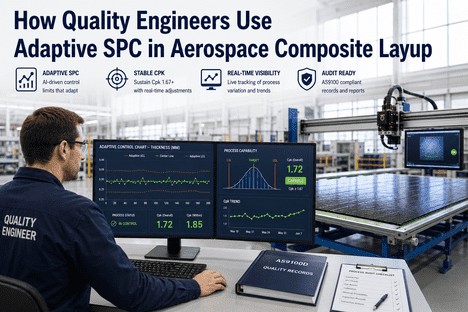
Process capability is not a number you calculate once per quarter and file in the quality management system. It is a live measure of how much margin exists between the current process performance and the tolerance boundary of the feature being produced. In engine assembly, that margin changes continuously — with tool wear, material lot transitions, environmental conditions, and operator variation. A Cpk of 1.72 at 6 AM can be 1.49 by 2 PM if a tool batch is behaving differently than its predecessor. A static Cpk study would not show that. A live Cpk trend does.
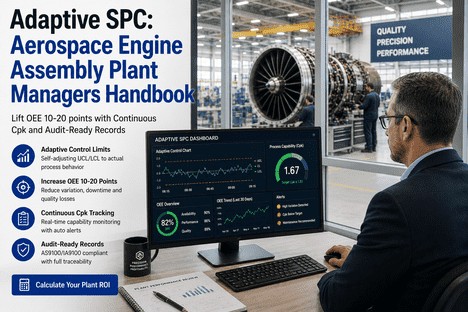
The difference matters most on flight-critical features. AS9100 programmes targeting Cpk 1.67 for engine-critical characteristics need continuous visibility into whether that floor is being maintained — not a quarterly confirmation that it was being maintained three months ago. When a live Cpk trend on a turbine blade root geometry begins falling toward 1.67, the intervention window is the time between the falling trend and the threshold crossing. Adaptive SPC creates and preserves that window. Static SPC creates the threshold-crossing event and calls it an audit finding.
Where Quality Engineers See the Difference
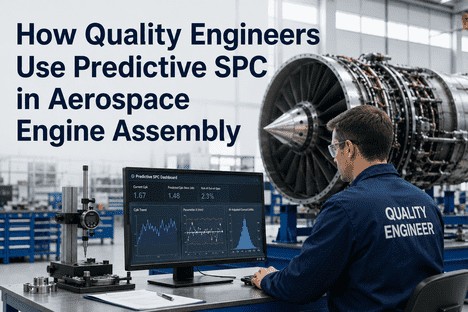
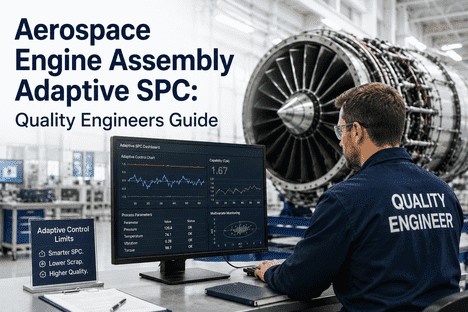
The dashboard a quality engineer works from in an adaptive SPC deployment is not a monitoring interface — it is a risk management tool. Every view is built around a question that engine assembly quality engineers need to answer continuously: where is the scrap risk right now, which parameter combination is driving it, and when the AS9100 auditor arrives, what does the record show about what the quality programme knew before the nonconformance was confirmed?
The AS9100 Compliance Case for Adaptive Limits
AS9100 Clause 8.5.1 requires that controlled production processes use monitoring, measuring, and control methods. What the clause does not specify is whether those methods must be static. The strongest compliance position is a quality system that demonstrates active risk management before the nonconformance was confirmed — not a system that documents what happened after it was confirmed. Adaptive SPC creates that documentation structure automatically. Every limit change is logged with its statistical rationale. Every predictive alert is recorded against the part and operation it flagged. Every CAPA includes the Cpk trend that validates or fails to validate its effectiveness.
The approaching IA9100 transition — expected to introduce expanded product safety requirements and closer alignment with APQP processes — makes this documentation structure more important, not less. Quality engineers who deploy adaptive SPC now are building the evidence base the next standard revision will require, ahead of the transition deadline rather than during it. The limit change log alone — showing every adaptive recalculation, its trigger, and its statistical basis — is the kind of process control evidence that audit teams from OEM customers and certification bodies increasingly expect to see alongside static capability studies.
We had a surface integrity problem on a turbine disk bore recurring in corrective action for eleven months. The event numbers were different. The material lot was sometimes different. But the root cause column in every CAPA said essentially the same thing. When we moved to predictive SPC and built the scrap Pareto across all eleven events, the pattern was obvious in about forty minutes: every occurrence followed a specific combination of spindle load and coolant temperature that only appeared when we were in the last 15% of tool life on a particular insert grade. No single event was severe enough to escalate as a systemic issue. The aggregate was unmistakable. We changed the tool replacement protocol. The event has not recurred in seven months.
— Quality Engineer, Turbine Engine Component Manufacturing Programme, Commercial and Defense ApplicationsShort-Run, High-Mix Engine Programmes
Short-run SPC is one of the persistent gaps of traditional statistical control in aerospace. When a part number runs 20 or 30 units before transitioning to the next programme, standard control charts never accumulate enough data to establish a statistically reliable baseline. The chart remains in a perpetual state of insufficient data, and the quality engineer makes judgement calls where statistical control should be doing the work.
Adaptive SPC addresses this through feature family modelling. Dimensional bore features in Inconel 718 share a capability model that accumulates data across part numbers with similar geometry and material classification, building a statistically robust baseline even when individual part number volumes are low. A new part number entering production inherits a starting limit profile from its closest historical analogue, with the adaptive engine tuning those limits as actual production data accumulates. Quality engineers see defensible control limits from the first production run — not a warning that says "insufficient data."
Conclusion
Scrap reduction in aerospace engine assembly is not achieved by running more control charts. It is achieved by making the control charts smarter — limits that track the process as it actually runs across material lot transitions, tool changes, and regime shifts; detection that operates across the full multi-variable process pattern rather than one characteristic at a time; and prediction that surfaces defect risk before the inspection result confirms it. The difference between a quality system that watches the process and one that understands it is visible in the numbers: 30 to 50% scrap reduction, 60 to 70% inter-batch variance reduction, 2 to 5 times earlier drift detection.
The quality engineer who deploys adaptive SPC is not replacing their quality judgement — they are giving it better inputs. The scrap Pareto that surfaces a systemic tool life protocol issue after eleven months of corrective actions is a tool for quality engineering, not a substitute for it. iFactory's predictive SPC platform is built to give aerospace engine assembly quality engineers that level of visibility, with the AS9100-aligned documentation structure that makes every finding defensible in an audit and every corrective action traceable to a verified outcome.
Book a Demo to see adaptive SPC configured for your engine assembly part family and material profile, or Talk to an Expert about a free Cpk and compliance audit for your current quality programme.