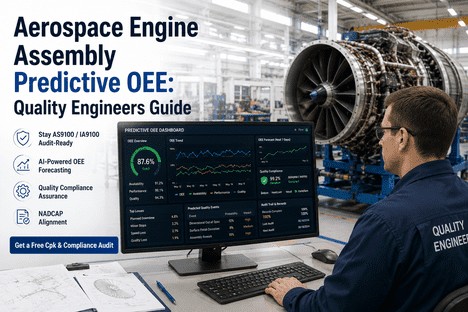
Aerospace Engine Assembly Predictive OEE: Quality Engineers Guide

By Grace on June 13, 2026

aerospace-engine-assembly-predictive-oee-quality-engineers-guide

A turbine disk arrives at final assembly on schedule, fully machined, coated, and NDT-cleared. Then a torque value during stacking comes back outside spec — not by much, but enough to stop the build. The quality engineer pulls the OEE data for that operation and finds the answer was sitting there for two shifts: a slow availability drift on the torque cell, masked by a performance metric that looked fine in isolation. Nobody flagged it because nobody was looking at OEE as a quality signal. They were looking at it as a productivity number. Predictive OEE changes that relationship. In engine assembly, where AS9100 already demands traceable process control and the upcoming IA9100 revision pushes quality systems toward proactive hazard detection rather than after-the-fact documentation, OEE stops being a throughput metric and becomes one of the earliest quality signals available on the floor.

Predictive OEE · AS9100 · Engine Assembly · Quality Engineering
OEE Was Never Just a Productivity Number. In Engine Assembly, It's a Quality Warning System.
iFactory connects predictive OEE analytics directly to your quality compliance programme — turning availability, performance, and quality losses into early signals for AS9100 and audit readiness.
55-70%
Typical OEE range for engine assembly operations under standard AS9100 QC time and validation steps
5-8 pts
Documented OEE improvement when digital SPC replaces paper-based inspection workflows
40-60%
Reduction in first-article inspection time when OEE and quality data are integrated
2026
The year IA9100 revisions push QMS programmes from reactive to predictive hazard detection

Why Quality Engineers Should Care About OEE at All

OEE has historically lived on the production side of the house — a measure of availability, performance, and quality rate used to track throughput and justify capital spend. Quality engineers tend to encounter it secondhand, as a chart someone else owns. But the quality component of OEE is, by definition, a defect rate. And the availability and performance components are leading indicators of the conditions that produce defects: a machine running with unplanned micro-stops, a spindle running below rated speed, a fixture cycling slower than its baseline. None of these show up on a control chart until they affect a dimensional or surface characteristic. By the time they do, the part has already absorbed every downstream operation between that point and inspection.

In high-mix, low-volume engine assembly programmes, this gap is wider than in repetitive manufacturing. Each part number runs in small batches, OEE baselines reset with every changeover, and the connection between an equipment performance anomaly and a quality outcome three operations later is almost impossible to see manually. Predictive OEE closes that gap by treating equipment behaviour and quality outcomes as one dataset, not two separate reporting streams owned by two separate departments.

The Three OEE Components — and What Each One Tells a Quality Engineer
1
Availability Loss
Unplanned stops on a 5-axis machining centre often precede a tool-wear-related surface finish issue. The stoppage pattern is the early warning. The surface finish failure at NDT is the confirmation, weeks later.
2
Performance Loss
A spindle or torque cell running below its rated cycle speed for a sustained period frequently correlates with a dimensional or torque-conformance shift in the parts produced during that window — even when each individual part still passes inspection.
3
Quality Loss
The traditional OEE quality factor is a lagging output — scrap and rework counted after the fact. Predictive OEE uses it differently: as a labelled outcome that trains the model to recognise the availability and performance patterns that preceded it.

How Predictive OEE Actually Works in Engine Assembly

Predictive OEE starts with the same data most facilities already collect — equipment run states, cycle times, downtime codes, and quality results from CMM, DCC, and LIMS systems. What changes is how that data is connected. Instead of OEE living in one dashboard and SPC living in another, the platform builds a single model where equipment behaviour patterns are mapped against quality outcomes for the specific operation, part family, and material lot involved. The model learns which combinations of availability and performance signatures have historically preceded a non-conformance, and which have not.

When a live signature starts matching a historical pre-defect pattern, the system raises a flag before the part reaches inspection — not as a vague anomaly alert, but as a specific prediction tied to the operation, the part number, and the characteristic at risk. For a quality engineer, this means the difference between reacting to a CMM failure at 2 PM and reviewing a flagged operation at 9 AM, while the part is still in the cell and the corrective options are still open.

Capability 01
OEE-Linked Defect Prediction
Equipment availability and performance signatures mapped against quality outcomes by operation and part family

The model continuously compares live OEE signatures — micro-stop frequency, cycle time variance, spindle load trends — against historical signatures associated with confirmed non-conformances. When a match is detected, a predictive alert is generated and tied to the specific part serial number, operation, and characteristic most likely to be affected, giving quality engineers an intervention window before the part reaches CMM or NDT.

Availability pattern matching Performance signature analysis Operation-level alerts
Capability 02
Unified OEE and SPC Dashboard
A single view connecting equipment performance to control limits, Cpk, and predictive quality alerts

Quality engineers no longer need to cross-reference an OEE report from operations with a separate SPC review. iFactory presents both in one dashboard, by operation and part number — so a falling performance trend on a critical cell and a tightening Cpk on the feature it produces are visible side by side, not discovered as a coincidence weeks apart.

Cross-functional visibility Live Cpk by operation Single source of truth
Capability 03
AS9100 and IA9100-Aligned Records
Automatic documentation linking equipment data to predictive alerts and corrective action outcomes

As IA9100 moves quality programmes toward proactive hazard detection, predictive OEE creates the record that supports it: equipment signature, predictive alert, action taken, and the resulting Cpk trend — all logged automatically by operation, part number, and material lot, ready for AS9100 Clause 8.5.2 traceability and CAPA effectiveness review under Clause 10.2.

Predictive alert log CAPA effectiveness trace IA9100 readiness

What This Looks Like on the Quality Engineer's Dashboard

The value of predictive OEE for a quality engineer is not in the OEE number itself — it's in what that number is now connected to. Every view answers a question that matters for compliance and for the floor: which operations are showing equipment behaviour that has historically led to a quality problem, and is that connected to a feature that matters for airworthiness.

OEE-to-Quality Risk Map
Equipment Signatures Linked to Quality Risk, by Operation
A single map shows every active operation, its current OEE breakdown, and whether its current availability or performance signature matches a historical pre-defect pattern. Operations showing a match are ranked by the criticality of the feature they produce, so a quality engineer's attention goes to the highest-consequence risk first.
Equipment risk and feature criticality, in one view.
Predictive Alert Timeline
From Equipment Signal to Quality Outcome, Tracked Over Time
Every predictive alert is logged with the equipment signature that triggered it, the part and operation affected, and the eventual inspection outcome. Over time, this timeline shows the prediction model's accuracy improving as more confirmed outcomes feed back into it — a direct, auditable measure of how well predictive OEE is performing for this programme.
A growing, auditable record of prediction accuracy.
First-Article Inspection Time
Reduced Inspection Load on High-Mix Programmes
For programmes running 5 to 20 times more part variants than typical manufacturing, first-article inspection is a major time cost. When OEE signatures for a new part number's setup closely match a part family with a strong predictive track record, inspection priority can shift toward the variants where the equipment signature is unfamiliar — not toward every new part number equally.
Inspection effort follows risk, not routine.
CAPA-to-OEE Loop
Corrective Actions Tracked Against the Equipment Signal That Triggered Them
When a corrective action follows a predictive alert, the system continues watching the equipment signature that triggered it. If the same signature reappears within the monitoring window after the CAPA is closed, the record is automatically flagged for review — closing the loop between equipment behaviour, quality action, and verified outcome.
CAPA effectiveness verified against the original signal.
Predictive · Connected · Audit-Ready
Your Equipment Data Is Already Telling You Where the Next Quality Issue Will Come From. Predictive OEE Just Reads It Sooner.
Get a free Cpk and compliance audit to see how your current OEE data connects to your quality outcomes.

Getting Ready for IA9100: Why the Timing Matters

The IA9100 revision underway during 2026 is expected to push quality management systems further toward proactive hazard detection and product safety integration throughout the QMS, rather than treating safety as a downstream check. For engine assembly programmes, this means the documentation expectation is shifting from "show me the nonconformance was caught and corrected" toward "show me the risk was identified before it became a nonconformance, and show me how."

Predictive OEE is a practical way to build that evidence base ahead of the transition. Every predictive alert, every equipment signature that preceded it, and every corrective action taken in response becomes part of a record that demonstrates exactly the kind of proactive risk management the revised standard is expected to require. Programmes that start connecting OEE and quality data now will not be retrofitting a new documentation structure when the revision lands — they will already have one.

"

For years our OEE dashboard and our SPC charts told two different stories about the same shift. Operations would report a perfectly normal OEE day, and quality would report a tightening Cpk on a bore feature with no obvious cause. When we connected the two data sets, we found a recurring pattern: a specific machining cell would run a series of short, sub-minute micro-stops that never registered as a real availability event, but always preceded a measurable shift in that bore's dimensional trend two to three parts later. Once we saw it lined up side by side, the fix was straightforward. The pattern had been in our data the whole time. We just weren't looking at it as one dataset.

— Quality Engineer, Engine Component Assembly Programme, Commercial Aerospace

Conclusion

For quality engineers in aerospace engine assembly, OEE and quality compliance have always described the same factory floor from two different angles. Predictive OEE removes the separation. Availability and performance data — collected continuously, by operation and part family — becomes a leading indicator for the same Cpk trends and nonconformance risks that SPC and inspection have always tracked, just weeks earlier and with a documented trail behind it.

As IA9100 pushes the industry toward proactive hazard detection, the programmes best positioned for the transition will be the ones already treating equipment performance data as quality data. iFactory's predictive OEE platform connects these two worlds into a single dashboard, with the AS9100-aligned documentation that makes every predictive alert, every corrective action, and every verified outcome part of one traceable record.

Book a Demo to see predictive OEE configured for your engine assembly part family, or Talk to an Expert about a free Cpk and compliance audit for your current quality programme.


Frequently Asked Questions

Most operations dashboards report OEE as a standalone productivity metric, separated from quality data by department and by system. iFactory's predictive OEE links the same availability, performance, and quality data to historical inspection outcomes for each part family and operation, so equipment signatures that have previously preceded a non-conformance generate a predictive quality alert — not just a productivity flag. Book a Demo to see how this connects with your current OEE setup.

iFactory ingests equipment run-state and downtime data from existing OEE systems or PLC/DCC feeds, alongside quality results from CMM, LIMS, and manual inspection records. A configurable integration layer connects these sources without requiring a full new sensor deployment, and the platform can begin building predictive models from historical data already in your systems. Talk to an Expert about the integration approach for your facility.

Every predictive alert generated from an OEE signature is logged with the operation, part number, material lot, action taken, and resulting Cpk trend — supporting AS9100 Clause 8.5.2 traceability and Clause 10.2 CAPA effectiveness review. As IA9100 pushes toward proactive hazard detection across the QMS, this record demonstrates that risks were identified and addressed before a nonconformance occurred. Book a Demo to review the documentation format against your QMS requirements.

Yes. iFactory groups part numbers into feature families based on geometry and material classification, so equipment-to-quality patterns learned from one part number transfer to similar parts even at low individual volumes. New part numbers inherit relevant predictive signatures from their closest family match and refine as production data accumulates. Talk to an Expert about configuring this for your part mix.

iFactory runs in parallel with your existing OEE and SPC workflows from day one, using historical data to begin building predictive models immediately. Most engine assembly programmes see validated predictive alerts within 8 to 14 weeks, with no disruption to current inspection or production reporting during the transition. Book a Demo to discuss a transition timeline for your programme.

Your OEE Data Already Knows Where Your Next Quality Issue Is Coming From. Get a Free Cpk and Compliance Audit.
iFactory's predictive OEE platform for aerospace engine assembly — connecting equipment performance data to quality compliance, with AS9100-aligned documentation built in for the IA9100 transition.

Share This Story, Choose Your Platform!