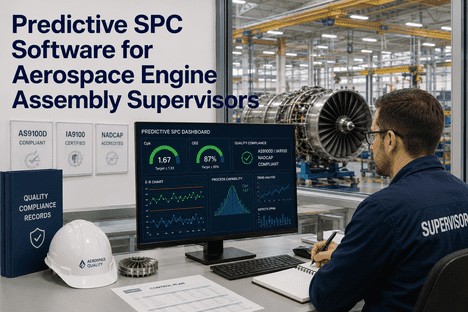
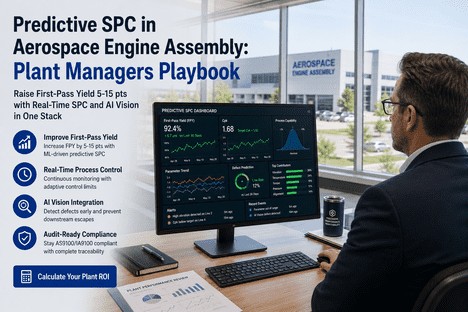
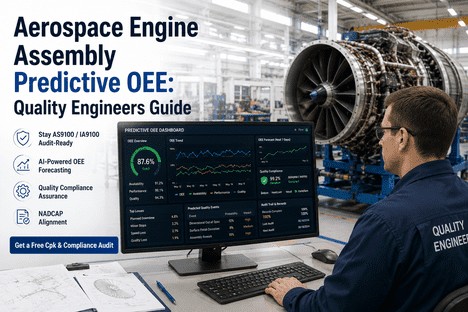
Predictive SPC Software for Aerospace Engine Assembly Supervisors
By Grace on June 12, 2026
Every shift supervisor in aerospace engine assembly knows the compliance record is only as good as the SPC data behind it. The AS9100 auditor asks for control limit rationale. The NADCAP auditor wants evidence of in-process quality monitoring. The customer quality engineer requests Cpk trend history by part number. Each of these requests pulls from the same source: the control chart. If the limits on that chart were set during qualification a year ago and have not moved since, the compliance position is weak. The auditor sees limits that may not reflect the current process, and the supervisor has no documented rationale for why those limits are still valid. Predictive SPC replaces this static compliance position with a dynamic one — where every limit adjustment is logged with its statistical justification, every Cpk trend is projected forward before the next part is produced, and every part record includes a complete audit trail of what was inspected, what was predicted, and what was confirmed. This is the supervisor's guide to using predictive SPC to stay audit-ready while the line is running.
Supervisors Using Predictive SPC Stay Audit-Ready on Every Shift — with Documented Control Limit Rationale, Forward-Looking Cpk, and Zero Manual Compliance Compilation.
iFactory's predictive SPC platform gives engine assembly supervisors a single stack for dynamic control limits, ML-driven quality forecasts, and AS9100/NADCAP audit records that are generated automatically from every part, every measurement, and every shift.
The Compliance Gap That Traditional SPC Cannot Close
Every AS9100 and NADCAP audit includes the same line of questioning. Show me the SPC records. How were the control limits established? When were they last reviewed? What is the rationale for the current UCL and LCL values? The supervisor with traditional SPC answers these questions with a capability study from the last qualification run. The auditor sees a static limit set that may or may not describe the process that exists on the floor today. The documented rationale is dated. The compliance position is vulnerable. Predictive SPC changes this by making every control limit a documented, auditable event. Every recalculation is logged with the process data that triggered it, the algorithm used, and the statistical justification. The auditor sees not a frozen limit from a past study, but a live limit that is actively maintained against current production data — a materially stronger compliance position that demonstrates continuous quality management rather than periodic qualification.
Traditional SPC — Auditor View
Control limits calculated during qualification. No documented rationale for continued validity. Cpk history compiled manually from shift-end reports. Supervisor spends 4 to 6 hours compiling audit documentation from paper logs, machine records, and CMM printouts.
Predictive SPC — Auditor View
Every limit change logged with trigger event, previous and new values, and statistical rationale. Cpk trend live and projected forward. Every part record complete with in-process measurements, control limit history, and forecast outputs. Audit export available in one click.
How Predictive SPC Works for the Supervisor
Predictive SPC extends traditional SPC in three specific ways that directly serve the supervisor's compliance and quality management responsibilities. First, control limits are recalculated continuously from live production data, so they always reflect the current process baseline. Second, a machine learning model forecasts where each quality characteristic is heading — projecting Cpk 10, 20, and 50 parts forward — so the supervisor sees potential compliance risks before they materialise. Third, every limit change, every forecast, and every operator action is logged automatically against the part record, creating a complete audit trail that is exportable on demand.
Capability 01
Dynamic Control Limits with Full Audit Trail
Every limit recalculation is logged: the timestamp, the triggering event (material batch change, tool change, programme transition, statistical baseline shift), the previous UCL and LCL values, the new values, the data window used, and the algorithm applied. The supervisor exports the complete limit change log for any date range at any time.
Capability 02
Predictive Cpk Forecasting
The ML model projects the Cpk trend for every monitored characteristic 10, 20, and 50 parts forward based on the current multivariate parameter pattern. The supervisor sees not just that bore diameter Cpk is 1.42 now, but that it is forecasted to be 1.28 in 15 parts at the current drift rate — enabling intervention before the characteristic crosses the compliance threshold.
Capability 03
One-Click Audit Export
Every piece of documentation the AS9100 or NADCAP auditor requires — control limit change log, Cpk trend report by part number, defect event log with corrective actions, SPC compliance summary, and operator intervention records — is generated automatically and exportable as a structured document covering any date range, part number, or process zone.
100%
Of control limit changes logged automatically with documented rationale — every recalculation is audit-ready without supervisor intervention
4-6h
Of manual audit preparation eliminated per event — predictive SPC generates compliance documentation automatically from live quality data
15-25
Parts of early warning from predictive Cpk forecasting — the ML model detects and projects drift 15 to 25 parts before it reaches the compliance boundary
92%
Forecast accuracy achieved by ML-driven predictive SPC models in aerospace manufacturing — validated against actual CMM outcomes
What Predictive SPC Compliance Looks Like on the Supervisor Dashboard
The supervisor's dashboard is organised around the three questions that every AS9100 and NADCAP auditor asks. Are your control limits current and justified? Is your process capable and stable? Do you have complete records for every part produced? The dashboard answers each question with live data, forecast projections, and one-click access to the complete audit trail.
Audit View 01
Control Limit Rationale Log
Every active control limit on every characteristic displays the date of last recalculation, the triggering event, and the data window used. The supervisor sees that bore diameter UCL was recalculated 14 parts ago following a material batch change, with 38 data points in the rolling window and a Cpk of 1.62 supporting the current limit.
Audit View 02
Cpk Compliance Status by Part Number
Every active part number displays its Cpk for every critical characteristic. The status is green for Cpk above 1.67, amber for Cpk between 1.33 and 1.67, and red for Cpk below 1.33. The supervisor also sees the forecasted Cpk at current trajectory — a characteristic at 1.42 now but trending to 1.31 in 20 parts is flagged for investigation before it crosses the threshold.
Audit View 03
Part Record — Complete Quality History
Every part serial number links to a complete quality history: all in-process measurements, the adaptive control limits at time of production, the forecasted vs actual Cpk, any defect events flagged by AI vision, operator interventions recorded, and final CMM confirmation if applicable. The auditor or quality engineer can pull any part number and see the full production quality record.
Audit View 04
Export Centre — Audit Package Generator
The supervisor selects the date range, part numbers, and process zones, and the system generates a complete audit package including the control limit change log, Cpk trend report by part number, defect event log with corrective actions, SPC compliance summary, and operator intervention history. The export includes a cover page with the date range, data sources, and system version for the auditor's reference.
The Predictive SPC Audit Cycle — How Each Component Supports Compliance
Every element of the predictive SPC platform maps to a specific AS9100 or NADCAP audit requirement. The supervisor does not need to translate quality data into compliance evidence — the system generates the evidence in the format the auditor expects.
AS9100 / NADCAP Requirement
Predictive SPC Response
Control limit rationale (Clause 8.3)
Automatic limit change log with trigger event, previous and new values, data window, and algorithm — exportable by date range and part number
Process capability evidence
Live Cpk per characteristic with trend projection. Historical Cpk report by part number for any date range. Forecasted Cpk showing proactive compliance management.
Nonconformance and corrective action (Clause 10.2)
Every defect event linked to the SPC alert, the operator action, and the Cpk outcome. Effectiveness tracking confirms or re-opens CAPA automatically.
Inspection and test record (Clause 8.6)
Complete part record with in-process measurements, control limits at time of production, AI vision inspection results, CMM confirmation, and operator dispositions
The Supervisor's Compliance Workflow with Predictive SPC
Predictive SPC changes the supervisor's compliance workflow from reactive compilation to proactive verification. Instead of spending the days before an audit gathering records from paper logs, machine data exports, and CMM printouts, the supervisor verifies that the live dashboard shows green across all compliance indicators and exports the complete audit package in a single action.
1
Daily
Supervisor reviews the compliance dashboard at shift start. Checks that all active characteristics have green Cpk status and that the control limit change log has no un-reviewed entries. If any characteristic is amber or red, the supervisor investigates and logs the action.
2
Weekly
Supervisor exports the weekly Cpk trend report for review. Compares forecasted Cpk against actual outcomes. Identifies any characteristics where forecast accuracy is declining and flags for model retraining. Reviews the CAPA effectiveness log for any recurring patterns.
3
Before Audit
Supervisor selects the audit date range, part numbers, and process zones in the Export Centre. Generates the complete audit package in one click. Reviews the cover page and spot-checks a sample of part records for completeness. Audit package is ready in minutes, not days.
Our last AS9100 audit used to require two full days of preparation — pulling SPC charts, compiling Cpk histories, gathering control limit documentation, printing part records. With predictive SPC, I exported the complete audit package in 12 minutes. The auditor reviewed the control limit change log and asked me how we maintained limits so current across 24 part numbers. I showed them the live dashboard. They spent the rest of the audit verifying records instead of questioning methodology. The audit closed with zero nonconformances. That was the first audit in six years where I did not have to explain why a control limit was set where it was — the system documented it automatically.
The AS9100 and NADCAP auditor does not ask whether your quality programme is compliant. They ask whether it is current. A control limit calculated during qualification a year ago is not current. A Cpk history compiled from shift-end reports is not current. A corrective action record that was closed without verifying effectiveness is not current. Traditional SPC creates a compliance position that is defensible only in the moment of the audit — and vulnerable the day after the auditor leaves.
Predictive SPC establishes a compliance position that is current on every shift, not just on audit day. Control limits are recalculated continuously with documented rationale. Cpk is forecasted forward so compliance risks are visible before they materialise. Every part record includes the complete quality history — measurements, limits, forecasts, interventions, and outcomes — generated automatically without manual compilation. The supervisor's compliance workflow shifts from days of reactive documentation to minutes of proactive verification.
iFactory's predictive SPC platform is designed for aerospace engine assembly supervisors who need to stay audit-ready on every shift. Book a Demo to see predictive SPC configured for your engine assembly compliance requirements, or talk to an expert about a free compliance readiness assessment for your operation.
Frequently Asked Questions
AS9100 Clause 8.3 requires that control limits be established and maintained with documented rationale. Predictive SPC addresses this through an automatic limit change log that records every recalculation event. The log includes the timestamp of the change, the triggering event (material batch change, tool replacement, programme transition, or statistical baseline shift), the previous limit values along with the new limit values, and the statistical basis for the recalculation including the data window size, the algorithm applied, and the current Cpk supporting the change. The log is searchable by part number, characteristic, and date range, and is exportable in a structured format suitable for direct inclusion in AS9100 audit documentation. Auditors reviewing the predictive SPC limit log see a controlled, documented process where every limit adjustment has a clear rationale — a materially stronger compliance position than static limits with a single qualification record. Talk to an expert about configuring the limit change log format for your AS9100 documentation requirements.
No. Predictive SPC deploys as an integrated layer that connects to your existing data sources — machine controllers, CMM equipment, AI vision systems, tool management databases, and MES — and adds predictive forecasting and automated compliance documentation on top of the quality data you already collect. The platform integrates with standard industrial protocols and can read from existing SPC databases, process historians, and quality management systems without requiring data migration or system replacement. The supervisor dashboard and compliance export centre present the predictive SPC data alongside any existing quality records in a single unified view. Existing AS9100 documentation workflows are preserved and enhanced with automatically generated records. Book a Demo to see how predictive SPC integrates with your existing quality system infrastructure.
The ML model is trained on historical data from your specific production environment — typically 6 to 12 months of in-process measurements paired with CMM outcomes. During deployment, the model runs in shadow mode for 2 to 4 weeks, generating forecasts in parallel with existing quality processes without influencing compliance decisions. The supervisor can compare forecasted Cpk values against actual CMM outcomes during this period, building documented accuracy evidence. After the shadow period, the validated accuracy data supports transitioning the forecast into a primary compliance input. The model continues to self-tune as new production data accumulates, and the supervisor receives periodic accuracy reports showing the forecast vs actual comparison. For characteristics where the model achieves validated accuracy above the configurable threshold — typically 90% or higher — the forecasted Cpk can be used as evidence of proactive compliance management. Characteristics below the threshold continue to rely on confirmed measurement until model accuracy improves. Talk to an expert about configuring the validation framework for your AS9100 quality system.
Yes. The platform supports multiple quality management system profiles that can be configured for different customer programmes, audit standards, or facility locations. Each programme can have its own control limit configuration, Cpk threshold settings, documentation format preferences, and audit record retention policies. The supervisor selects the active programme context from the dashboard, and the system automatically applies the correct compliance rules and documentation formats for that context. Historical records are maintained separately per programme, so the supervisor can generate an audit package for a specific customer programme without mixing records from other programmes. The export centre includes a programme filter that allows the supervisor to generate audit documentation for any combination of programmes, date ranges, and part numbers. This is particularly valuable for facilities that produce engine components for multiple OEM customers, each with their own quality system requirements and audit schedules. Book a Demo to see multi-programme compliance configuration for your customer quality requirements.
A Static Control Limit Stops Being Defensible the Day After It Is Set. Predictive SPC Keeps Your Compliance Position Current on Every Shift. Get a Free Compliance Readiness Assessment.
iFactory's predictive SPC platform for aerospace engine assembly supervisors — dynamic control limits with documented rationale, ML-driven Cpk forecasting, and AS9100/NADCAP audit records generated automatically from the quality data your line already produces.