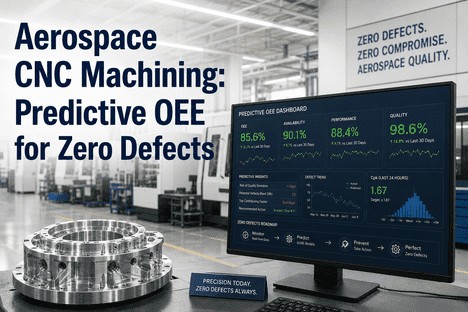
Every engine assembly supervisor has seen it. The shift-end OEE report arrives. Availability is 78%. Performance is 82%. Quality is 91%. The composite OEE is 58%. The line lost 42% of its productive potential. The numbers are precise. The calculation is correct. And the information is useless for the one decision the supervisor needed to make two hours ago — whether to stop the line, replace the tooling, or adjust the parameter before the next part came off the station. OEE has always been a lagging indicator. It tells you exactly what went wrong after it already went wrong. By the time the quality factor dropped, the defect was already produced, the nonconformance report was already written, and the investigation was already underway. Predictive OEE closes this gap by forecasting the Availability, Performance, and Quality components before they materialise — giving the supervisor the lead time to prevent the loss rather than report it.
Availability Forecast · Performance Trend · Quality Factor Prediction · Real-Time Intervention Alerts
When OEE Arrives at Shift End, the Defects Have Already Escaped. Predictive OEE Alerts the Supervisor Hours Before the First Nonconformance.
iFactory's predictive OEE platform converts every engine assembly station into a live forecasting node — machine learning models trained on torque trends, cycle time variation, and quality test outcomes project the OEE trajectory forward and alert supervisors when intervention is needed before the loss occurs.
Traditional OEE — What the Supervisor Sees
A composite number at shift handover. Availability was lost 3 hours ago. The quality factor dropped 4 hours ago. The defect was produced 6 hours ago. The OEE number is accurate. The actionable window is closed. Supervisor documents the loss and moves to the next shift.
Predictive OEE — What the Supervisor Sees
A live forecast that updates with every part. Availability projected to decline in 2 hours unless a spindle bearing is addressed. Quality factor trending toward 85% in 4 hours at current drift rate. Supervisor intervenes now. The loss does not materialise. No defect. No NCR.
2-8h
Lead time for Availability interventions before unplanned downtime occurs — detected from spindle vibration and cycle time trends
30-70%
Defect reduction documented across aerospace operations deploying predictive OEE — shifting from reactive quality to proactive prevention
15-25%
Sustained OEE improvement within 6 months of predictive OEE deployment — availability, performance, and quality gains across the line
4-6x
Faster detection of process drift compared to static SPC — predictive OEE catches quality factor decline at the trend onset, not at the limit breach
The Three Pillars of Predictive OEE in Engine Assembly
Predictive OEE retains the standard OEE calculation defined by ISO 22400 — Availability times Performance times Quality — but replaces retrospective data with ML-driven forecasts for each component. In engine assembly, where each OEE component has a distinct failure mechanism, the prediction models are tuned to the specific loss patterns of torque stations, clearance verification gates, and leak test cells. The supervisor sees not a single composite number but a three-part forecast that identifies exactly which component is at risk and why.
A
Availability — Predicting Unplanned Downtime Before It Stops the Line
In engine assembly, availability losses come from three primary sources: tooling degradation (fastener driver clutch wear, torque tool calibration drift), equipment failure (spindle bearing, conveyor drive, CMM axis), and process-related stops (waiting for material kitting, fixture clearance issues). Predictive OEE trains ML models on historical spindle vibration, cycle time extension, and temperature data to detect mechanical degradation patterns 2 to 8 hours before failure. The model outputs a continuous availability forecast per station — showing the probability of unplanned downtime within the current shift. When a torque driver shows a vibration signature change with a predicted failure probability of 68% within 4 hours, the supervisor receives an alert with the specific tool identification and a recommended intervention window. The tool change happens during a planned break. Zero unplanned downtime.
Supervisor action: Schedule intervention during planned window. Availability loss prevented.
P
Performance — Detecting Cycle Time Drift at the Part Level
Performance losses in engine assembly are subtle. A fastener driver that takes 0.4 seconds longer per run-down. A clearance check that requires an extra 15 seconds because the fixture alignment has drifted. A leak test that cycles 8% longer because the seal condition has changed. Each individual delay is negligible. Accumulated across 50 parts, the performance factor drops from 95% to 82%. Predictive OEE monitors cycle time per operation against the programme baseline and flags deviations at the individual cycle level. The ML model detects when a torque station's cycle time trend shifts from 12.1 seconds per fastener to 12.9 seconds over 20 parts — a shift that is invisible to the operator but statistically significant. The supervisor receives an alert with the specific station, the current drift rate, and the recommended root-cause investigation. The seal is replaced, the fixture is re-indexed, and the performance factor returns to baseline within 10 parts.
Supervisor action: Investigate station-level drift. Cycle time recovered to baseline within 10 parts.
Q
Quality — Forecasting Defect Risk From Process Parameter Trends
The quality factor is the most impactful OEE component in engine assembly, and the one with the longest detection lag in traditional OEE. A torque drift that produces an out-of-spec fastener junction is not detected until the end-of-line CMM or leak test — potentially hours after the defect was introduced. Predictive OEE closes this lag by scoring every assembly operation for defect risk in real time. The ML model analyses torque curve shape, fastener driver angle, seal compression force, and clearance measurement trends against the historical profile of conforming and non-conforming assemblies. When a torque curve shows a shape deviation that historically correlates with fastener pull-through risk, the quality factor forecast drops from 98% to 91% within the same cycle. The supervisor receives an alert with the specific operation at risk, the current drift direction and magnitude, and the recommended corrective action. The intervention happens before the next torque cycle begins — not after the CMM confirms the escape.
Supervisor action: Quality factor forecast drops below threshold. Pre-emptive intervention before defect is produced.
C
Composite Forecast — The Single Number That Tells the Supervisor Where to Act
The power of predictive OEE is not the individual forecasts — it is the composite view. The supervisor sees a single projected OEE number for the next 4 hours, 8 hours, and end of shift, with a breakdown of which component is driving any projected decline. When the composite forecast drops from 64% to 52%, the supervisor knows immediately that the quality factor is the primary driver, that the torque curve trend on station 4 is the root cause, and that a pre-emptive tool recalibration will recover 10 points of the projected loss. The forecast updates with every part cycle. The supervisor is never looking at stale data. The decision support is always current.
Supervisor action: Composite forecast alerts on primary loss driver. Targeted intervention recovers projected loss.
The Predictive OEE Timeline — From Data Ingestion to Supervisor Alert
Predictive OEE is not a dashboard refresh — it is an end-to-end ML pipeline that transforms raw sensor data into an actionable supervisor alert within a single assembly cycle. Understanding the pipeline helps the supervisor trust the forecast and respond with confidence.
Stage 1
Data Ingestion
Per-cycle sensor data
Every assembly cycle generates a data vector: torque curve from each fastener driver, angle encoder readings, seal compression force, clearance measurement, cycle time, and operator ID. These data points stream into the predictive OEE engine in real time. No manual data entry. No batch upload at shift end. Every part cycle updates the model.
Stage 2
Feature Extraction
Anomaly detection per parameter
The engine extracts 15-20 features per assembly cycle — torque curve shape parameters, fastener angle deviation from nominal, seal compression rate, cycle time components, and quality test results where applicable. Each feature is evaluated against its adaptive baseline. Deviations from the expected range are scored for statistical significance. The ML model weights each feature by historical correlation with defect outcomes.
Stage 3
OEE Forecast
Availability, Performance, Quality projection
The ML model projects each OEE component forward based on the current feature vector and trend trajectory. The Availability forecast outputs a probability distribution for unplanned downtime within the next 1, 2, 4, and 8 hours. The Performance forecast projects cycle time trend for the next 20 parts. The Quality forecast outputs a defect probability per assembly cycle and a projected quality factor for the shift. The composite OEE forecast is calculated from all three components.
Stage 4
Supervisor Alert
Actionable intervention recommendation
When any OEE component forecast drops below its configurable threshold — typically 90% for Availability, 90% for Performance, and 95% for Quality — the supervisor receives an alert with the specific component at risk, the station or characteristic driving the decline, the forecast trajectory, and the recommended corrective action. The alert includes the confidence level of the forecast and the lead time available for intervention. The supervisor acts, the alert closes, and the forecast updates with the next cycle.
What the Predictive OEE Dashboard Shows the Supervisor
The predictive OEE dashboard is not a replication of the traditional OEE board. It is organised around the decisions the supervisor needs to make, not the metrics that need to be reported. Every element on the dashboard answers a specific operational question.
Composite OEE Forecast — Next 8 Hours
A single projected OEE number for the end of the current shift, plus the trajectory — improving, holding, or declining. Below the composite, a component breakdown shows which of the three pillars is driving the trajectory. When the composite forecast is declining, the dashboard identifies the primary loss driver and the specific station contributing the most to the projected loss.
Station-Level Risk Map
Every assembly station displayed as a tile with a status indicator — green, amber, or red — based on the forecasted OEE component risk. A torque station tile shows green when all three component forecasts are above threshold. It shows amber when one component is trending toward threshold. It shows red when any component forecast has crossed the intervention threshold. The supervisor scans the risk map at shift start and knows exactly which stations need attention.
Active Alert Queue
A filtered list of current alerts ranked by severity and projected impact. Each alert shows the component (Availability, Performance, or Quality), the station, the current forecast value, the threshold, the lead time available, and the recommended intervention. Alerts that require immediate action are highlighted. Alerts with sufficient lead time for planned intervention are grouped separately. The supervisor works the queue in priority order.
Forecast Accuracy Tracker
For every alert that fired and was acted upon, the dashboard displays the actual outcome — was the projected loss avoided? The forecast accuracy tracker shows the percentage of alerts where the supervisor's intervention prevented the projected OEE decline. This builds documented confidence in the prediction models and gives the supervisor the data needed to justify the predictive OEE programme to plant management and auditors.
Defect Prevention Log
Every predictive OEE intervention that prevented a defect is logged automatically — the alert that fired, the action taken, the part number, and the quality outcome. This log is the documented evidence that the quality programme is proactively preventing defects, not just recording them after escape. For AS9100 and NADCAP audits, the defect prevention log demonstrates proactive quality management.
AS9100 Compliance Export
All predictive OEE records — forecasts, alerts, interventions, outcomes — are stored in an audit-ready format. The supervisor can export the OEE forecast log, the defect prevention log, the intervention record, and the forecast accuracy report for any date range. Export takes one click. No manual compilation.
Traditional OEE told me what I already knew — that quality was trending down. It never told me why or what to do about it before the next part arrived. Predictive OEE does. The first time the dashboard alerted me to a quality factor decline from a torque curve shape deviation 12 parts before it would have reached the CMM station, I knew the system was different. We caught the tool wear before it produced a nonconforming fastener junction. That single intervention recovered the entire shift's quality loss and prevented an NCR that would have taken 4 hours to process. The defect prevention log now shows 37 interventions in the first quarter. That is 37 defects that never reached the CMM station and 37 NCRs that were never written.
— Shift Supervisor, Low-Pressure Turbine Assembly — AS9100 Rev D Certified Aerospace Facility
Conclusion
The shift-end OEE report has been the standard metric for decades. It is precise, standardised, and auditable. It also arrives too late. Every point on that report — every loss of availability, every cycle time extension, every quality defect — represents an event that could have been prevented if the supervisor had known about it in time. Predictive OEE changes the timing of quality information from retrospective to real-time. It gives supervisors not a scorecard of what went wrong last shift, but a forecast of what will go wrong next shift — with enough lead time to make the intervention that prevents the loss.
The documented evidence across aerospace operations is consistent. Predictive OEE deployments achieve 30-70% defect reduction by forecasting the quality factor at the assembly cycle level, detecting torque, clearance, and seal compression trends before they produce nonconforming features. Sustained OEE improvement of 15-25% within 6 months is achievable because the supervisor is no longer reacting to losses that have already materialised — they are preventing losses that the ML model detects before they form. The shift from reactive OEE to predictive OEE is the shift from managing a scorecard to managing a process.
iFactory's predictive OEE platform for aerospace engine assembly supervisors transforms the standard OEE calculation into a real-time forecasting engine. Book a Demo to see predictive OEE configured for your engine assembly line, or talk to an expert about a free OEE assessment and zero-defect readiness review for your operation.
Frequently Asked Questions
An OEE Number That Arrives at Shift End Is a Report. An OEE Forecast That Updates Every Cycle Is a Decision Support System. Get a Free OEE Assessment for Your Engine Assembly Line.
iFactory's predictive OEE platform for aerospace engine assembly supervisors — machine learning models that forecast Availability, Performance, and Quality losses before they materialise, with real-time alerts, defect prevention logging, and AS9100-compliant audit documentation generated automatically from the data your line already produces.