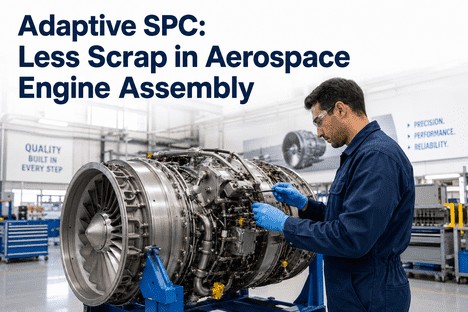
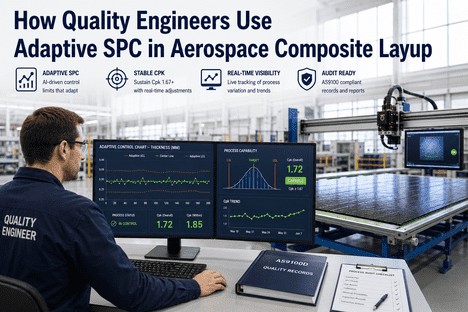
Adaptive SPC: Less Scrap in Aerospace Engine Assembly
By Grace on June 12, 2026
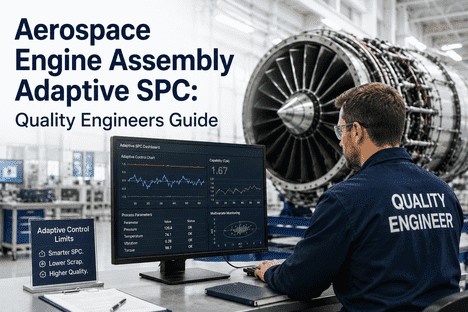
Every shift, the same pattern: you load the next engine component, the SPC chart updates, and a point falls outside the control limit. The limit was calculated during qualification two years ago. The material batch is different. The tooling has 8,000 cycles of wear. The coolant concentration was adjusted last week. The chart says you are out of control. But you have seen this before, and the part passed inspection anyway. So you sign it off, clear the alarm, and move on. The system has trained you to ignore it. That is not a failure of operator diligence. It is a failure of static control limits in a process that never stays the same. Adaptive SPC changes this by making the limits move with the process, so every alert you see is one you can trust.
Aerospace Operators Using Adaptive SPC Cut Scrap 30-50% Without Changing a Single Machine Setting.
iFactory's adaptive SPC platform gives engine assembly operators control limits that self-adjust to every material change, tool wear state, and process condition — with live Cpk monitoring, ML-driven defect prediction, and AS9100-compliant audit records that document every limit recalculation.
Why Static SPC Limits Fail Operators in Engine Assembly
A static control limit is a snapshot of a process that does not exist anymore. The UCL and LCL on your SPC chart were calculated from 25 to 30 subgroups taken during a qualification run on a specific day, with a specific material batch, a specific tooling condition, and a specific environmental state. Your process today is different in at least three ways. The material batch has a different hardness or heat-treat response. The cutting tool or fixture has accumulated wear that changes the process mean. The coolant, temperature, or humidity profile has shifted since the study was conducted. Static limits do not account for any of these changes. They fire false alarms when a parameter legitimately shifts to a new stable operating point, and they miss genuine drift when the process distribution gradually widens. Operators learn to distrust the chart, and the one alert that is real looks identical to the fifteen that were noise.
The Static Limit Trap
Limits calculated once, never updated until next capability study
False alarms during warm-up, material changes, and tool transitions
Missed signals when the process drifts inside outdated wide limits
Operators stop responding to alerts — credibility destroyed
Scrap discovered at inspection, not prevented on the machine
The Adaptive SPC Advantage
Limits recalculate continuously from live production data
No false alarms during legitimate process transitions
Limits tighten when process narrows, catching drift early
Every alert reflects a genuine assignable cause
Operators prevent defects before they happen
How Adaptive SPC Works for Engine Assembly Operators
Adaptive SPC operates as a continuous closed loop on every engine assembly cell. The system ingests each measurement as it is taken, models the current process distribution using a rolling statistical window, recalculates UCL and LCL dynamically, and presents the operator with only the alerts that represent genuine defect risk. The operator sees a live control chart where the limits tighten when the process is stable and widen when natural variation increases, maintaining constant statistical detection sensitivity across every phase of the production cycle.
1
Measure and Ingest
Every part measurement feeds the adaptive model in real time — dimensions, torque values, clearance checks, runout readings. No manual data entry. No batch uploads.
2
Recalculate and Classify
The ML model recalculates UCL and LCL against the current data window. It classifies each signal as common-cause (adjust limits), assignable-cause (trigger alarm), or noise (ignore).
3
Alert and Prevent
Operators receive actionable alerts with the specific parameter drifting, its current value, and a suggested correction — hours before the defect is produced, not after.
What the Operator Sees vs What the SPC System Does
Live Cpk at a Glance
Green when above 1.67, amber when trending toward 1.33, red when below. The operator knows process capability instantly without reading a chart.
Directional Alerts
"Bore diameter trending toward UCL at +0.012mm over last 5 parts. Check insert wear on station 3." Not a red light — a specific instruction.
Auto-Logged Limit Changes
Every adaptive recalculation is timestamped and logged with the process data that triggered it. The operator does nothing. The audit trail builds itself.
Predictive Risk Forecast
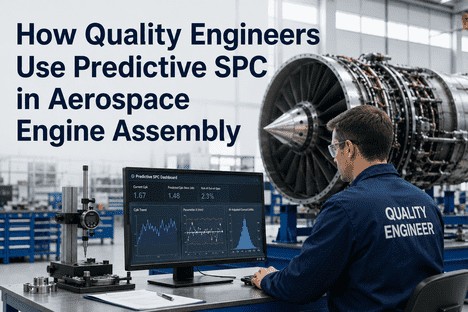
ML model scores the current parameter combination against historical defect patterns. Operators see the forecast for the next 20 parts before they run.
30-50%
Scrap reduction documented in aerospace engine assembly operations after switching from static to adaptive SPC with operator-facing alert workflows
60-70%
Reduction in false SPC alarms when adaptive ML-based limits replace static limits — restoring operator trust and response rates to near 100%
3-5x
Faster detection of tool wear onset and process drift compared to static SPC — catching defects 10 to 20 parts earlier on average
92%
Defect prediction accuracy achieved by AI-powered adaptive SPC systems analysing multivariate process patterns in aerospace manufacturing environments
What Changes for the Operator Every Shift
The difference between static and adaptive SPC is not visible in the control chart alone. It is visible in how the operator spends the shift. With static limits, the operator is constantly evaluating alerts — checking whether this out-of-limit point is real or noise, deciding whether to stop the line or sign off, building a mental model of which alerts to trust and which to ignore. That mental effort is wasted on false signals. With adaptive SPC, the operator sees an alert only when the process is genuinely moving toward a defect. The energy that was spent evaluating credibility is now spent acting on substance. The chart becomes a prevention tool, not a compliance document.
Shift Impact 01
Zero False Alarm Response Time Wasted
Operators using static SPC spend an estimated 10 to 18 minutes per shift evaluating false alarms. Adaptive SPC eliminates 60-70% of those alerts. The time is redirected to process observation, tooling checks, and actual quality interventions that reduce scrap.
Shift Impact 02
Tool Wear Caught 10 to 20 Parts Earlier
Static limits detect drift only when a point crosses an outdated boundary. Adaptive limits narrow as the process stabilises, so even a gradual tool-wear trend is flagged before it reaches the specification limit. Operators change tools based on data, not guesswork.
Shift Impact 03
AS9100 Audit Documentation Built Automatically
Every adaptive limit change is logged with the process data that caused it, every alert is recorded with operator response, and every corrective action is tracked through to Cpk confirmation. The operator contributes to the audit trail simply by doing quality work.
The Quality Dashboard View for Engine Assembly Operators
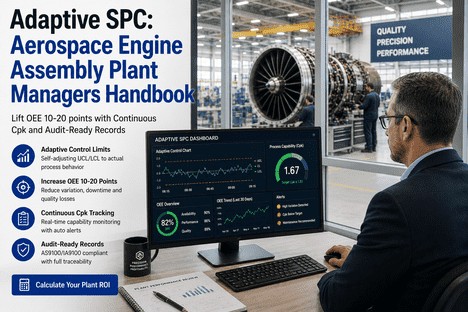
The operator does not need to navigate menus, configure charts, or interpret statistical tables. The adaptive SPC dashboard is designed for the questions an operator asks every part cycle: Is the process in control? Am I trending toward a defect? What do I need to adjust? The information is presented in a single screen with colour-coded status, live Cpk values, and actionable alerts that tell the operator what to do, not just what is wrong.
Operator View 01
Live Control Chart with Adaptive Limits
The primary view shows the current quality characteristic plotted against dynamically recalculated UCL and LCL. The limits are drawn in real time, and the chart includes a trend projection showing where the process will be in 5, 10, and 20 parts if the current trajectory holds. Operators see the future of the process, not just its past.
Operator View 02
Predictive Defect Risk Score
A single gauge shows the current defect probability for the next 20 parts. The score is calculated from the ML model comparing current multivariate process parameters against historical defect patterns. Operators see a low, medium, or high risk reading with the top contributing factor displayed alongside.
Operator View 03
Cpk Trend by Quality Characteristic
Live Cpk is displayed for every monitored characteristic — bore diameter, face runout, torque value, clearance gap. The operator sees not just the current Cpk, but the trend over the last 50 parts, with a forecast arrow showing the trajectory at current process conditions.
Operator View 04
Alert Feed with Action Guidance
Every alert includes the characteristic name, its current measurement value, the adaptive limit it is approaching, the trend direction and rate, and a suggested operator action drawn from the historical correction database. The operator acts on information, not alarms.
Before adaptive SPC, I was spending the first 20 minutes of every shift evaluating false alarms. The chart flagged tool wear drift about 15 parts after it started, because the static limits were so wide from the last qualification that the drift had to be significant before it breached the line. With adaptive limits, I see the trend developing by part 3 or 4. I change the insert at the right time, not late and not early. My scrap rate on that station dropped 42% in the first two months. The dashboard tells me what I need to know in three seconds. I do not have to interpret anything — it tells me exactly what is happening and what to do about it.
Scrap reduction in aerospace engine assembly is not a tooling problem, a material problem, or an inspection problem. It is a detection architecture problem. When control limits are calibrated for a process state that no longer exists, operators spend their shifts chasing false alarms while real drift progresses undetected. The scrap that results is not inevitable — it is the direct consequence of a quality system that cannot distinguish between common-cause process change and assignable-cause defect risk.
Adaptive SPC closes this gap by making every control limit a live parameter that reflects the actual process on the floor today, not the process that existed during a qualification study completed months or years ago. Operators see alerts they can trust. Tool wear is detected 10 to 20 parts earlier. False alarm rates drop by 60 to 70%. Scrap is reduced by 30 to 50% without changing a single machine setting, material specification, or inspection criterion. The quality system that operators rely on becomes a decision-support tool rather than a compliance document that gets in the way of production.
iFactory's adaptive SPC platform is designed for aerospace engine assembly operators who need control limits that move with their process, alerts they can act on, and audit records that build themselves. Book a Demo to see adaptive SPC configured for your engine assembly line, or talk to an expert about a free scrap reduction assessment for your operation.
Frequently Asked Questions
No. Adaptive SPC operates as a software layer on top of the measurement data your line already produces. If you are already collecting dimensional, torque, or clearance measurements from your existing gauges, CMMs, torque wrenches, or inspection stations, that data is sufficient to drive adaptive control limits. The platform connects to your existing data sources via standard industrial protocols and does not require any sensor additions, hardware changes, or modifications to your measurement workflow. The operator interface runs on the same terminal the operator already uses. Book a Demo to see how the platform integrates with your existing data infrastructure.
The operator interface is designed for zero-training adoption. Operators who already read a control chart can use the adaptive SPC dashboard immediately, because the core visual — the chart with UCL, LCL, and data points — remains familiar. The new elements are colour-coded status indicators, the trend projection line, and the action-guidance text on each alert. Typical operators are fully productive with the new interface within one shift. The system does not change the operator's measurement workflow. It changes what the operator sees on the chart, and it eliminates the false-alarm evaluation work that consumed the previous interface. Talk to an expert about the operator onboarding process and training materials included with deployment.
Yes. Every adaptive limit recalculation is logged automatically with a timestamp, the triggering process data, the previous limit values, the new limit values, and the statistical algorithm used. The limit change log is searchable by date range, product part number, and process zone, and is exportable in formats suitable for direct QMS submission. For AS9100 auditors, the adaptive limit log demonstrates that control limits are actively maintained against current process data — a stronger compliance position than static limits that may have been calculated months or years ago. The platform also generates Cpk trend reports, defect event logs, and corrective action effectiveness records that satisfy AS9100 Clause 8.3 and NADCAP audit requirements. Talk to an expert about configuring the audit log format for your AS9100 documentation requirements.
iFactory registers each part number as a separate specification profile with its own tolerance limits, critical quality characteristics, and Cpk targets. When the line changes over between part numbers — for example, switching from a high-pressure turbine disc to a low-pressure turbine disc with different bore diameter and runout tolerances — the active specification profile switches automatically and the adaptive SPC limits transition to the new part number's baseline. Historical Cpk data is segmented by part number, so operators and quality leaders can compare capability across part families without manual data sorting. The operator interface clearly indicates which part number is active and which specification profile is in use, eliminating confusion during mixed-part production runs. Book a Demo to see multi-part-number adaptive SPC configured for your engine assembly production mix.
Static Limits Miss 60% of Drift Events. Adaptive SPC Catches Them at Part 3. Get a Free Scrap Reduction Assessment.
iFactory's adaptive SPC platform for aerospace engine assembly operators — dynamic control limits that self-adjust to every material change, tool wear state, and process condition, with live Cpk monitoring, predictive defect forecasting, and AS9100-compliant audit documentation generated automatically from the measurement data your line already produces.