You check the OEE board at the end of every shift. Availability 78%, Performance 85%, Quality 96%. The number tells you what already happened. The spindle bearing that failed at 10:30 — already in the number. The tool change that ran 12 parts past the optimal window because the edge wore faster than expected — already in the number. The three parts at the end of the run that measured 0.0005 inches above the bore tolerance — already in the number. Every loss is captured, calculated, and reported after it is too late to act. Predictive OEE changes this by running the same calculation forward instead of backward. It reads the machine data, tooling data, and dimensional data together in real time, learns the pattern of a healthy process, and tells you where Availability, Performance, and Quality are heading before the losses hit. What follows is the operator's guide to understanding and using predictive OEE on the engine assembly line.
Real-Time Forecasts · Multivariate ML · Cpk-Linked OEE · AS9100 Logged
Operators Using Predictive OEE Cut Unplanned Downtime 40%+ by Fixing Problems Before They Stop the Line.
iFactory's predictive OEE platform monitors every engine assembly station in real time — spindle load, dimensional drift, tool wear, cycle time, vibration — and alerts operators with ranked forecasts of where each OEE component is heading and what specific action will protect it.
The Problem with OEE That Lands on the Board at Shift End
Traditional OEE is a perfect record of what went wrong. It tells you that Availability was 78% because the spindle stopped for 47 minutes at 10:30. It tells you that Performance was 85% because cycle time stretched from 14.2 to 16.8 minutes per part during the tool wear phase. It tells you that Quality was 96% because 2 of 48 parts measured out of tolerance on bore diameter. Every number is accurate. None of them could prevent the loss. The operator saw the spindle vibration increasing at 09:45. The operator noticed the cycle time creeping up at part 22. The operator felt the finish change at part 35. But the OEE system had no way to turn that observation into a forecast — so the loss was recorded, not prevented. Predictive OEE closes this gap by linking the operator's observations with ML pattern recognition that catches what even an experienced operator cannot see across 30 parameters at once.
Traditional
A
Availability
Records stoppage after the machine stopped. Reports downtime as a shift-end number. No warning that bearing vibration was trending for 3 hours before failure.
Traditional
P
Performance
Compares actual cycle time to ideal at end of run. Confirms the slowdown after the fact. Cannot flag that cycle time has been drifting since part 18.
Traditional
Q
Quality
Counts defects after inspection. Reports scrap rate at shift end. Cannot predict that bore diameter will cross the limit at part 44.
Predictive
A
Availability
ML model detects bearing vibration signature at 09:15. Forecasts failure in 4.5 hours. Operator schedules intervention during planned changeover. Zero unplanned downtime.
Predictive
P
Performance
Cycle time trend monitored per part. At part 18, the 0.8 second increase combined with spindle load shift flags tool wear. Operator changes insert at planned break. No production impact.
Predictive
Q
Quality
Live Cpk monitored per characteristic. Bore diameter trend projected forward. Alert fires at part 36: "Cpk will cross 1.33 at part 44 if current trend holds." Operator adjusts before defect.
How Predictive OEE Works on the Engine Assembly Line
Predictive OEE does not replace the operator's judgment. It adds a layer of pattern recognition that reads every signal the machine produces and compares it against thousands of historical part cycles to distinguish normal variation from the early signature of a developing loss. The system runs three parallel ML models — one for each OEE component — and presents the operator with a single forecast: where each component is heading, how confident the forecast is, and what specific action will protect the loss that is about to occur.
The Three ML Models Behind Predictive OEE
Monitors vibration, temperature, spindle load, and axis torque patterns. Learns the signature of mechanical degradation — bearing wear, spindle misalignment, coolant pump degradation — 4 to 24 hours before failure. Forecasts the probability of an unplanned stop within the next N parts or N hours.
Tracks cycle time per part against the programme baseline. Detects gradual increases that signal tool wear, coolant temperature drift, or feed rate degradation. Correlates cycle time creep with spindle load and dimensional trends to distinguish between thermal stabilization, insert wear, and fixture issues.
Evaluates every measurement against the adaptive SPC control limits and the historical defect pattern database. Projects Cpk forward 10, 20, and 50 parts. Alerts the operator when the current multivariate parameter combination has historically preceded a defect — even if no single parameter has breached its individual limit.
40%+
Unplanned downtime reduction documented in aerospace engine assembly operations using ML-driven predictive OEE with real-time availability forecasting
4-24h
Lead time for predictive availability alerts — the ML model detects mechanical degradation patterns hours before they cause an unplanned stop that would be invisible to static threshold monitoring
15-25
Parts of early warning from Cpk trend forecasting — the quality model detects dimensional drift 15 to 25 parts before it crosses the specification limit and generates a nonconformance
92%
Defect prediction accuracy achieved by multivariate ML models analysing 50+ process parameters simultaneously in aerospace manufacturing environments
What Predictive OEE Looks Like on the Operator Dashboard
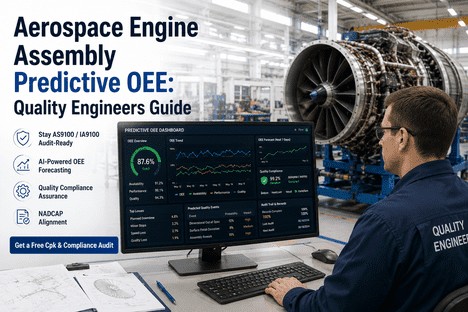
The predictive OEE dashboard does not add a new screen, a new log, or a new data-entry burden to the operator's shift. It runs on the same terminal the operator already uses and presents the same information the operator already looks at — but with a forecast added to every number. The operator sees not just the current Cpk, but the projected Cpk at the current trend. Not just the cycle time for the last part, but the forecasted cycle time for the next 20 parts. Not just the machine status, but the predicted probability of an unplanned stop based on the current vibration and temperature signature.
Dashboard Module 01
OEE Forecast Gauges — One Per Component
Three colour-coded gauges show Availability, Performance, and Quality as both the current value and the forecasted value at the current trajectory. The operator sees at a glance: Availability is 97% now, forecasted 96% in 2 hours. Performance is 93% now, forecasted 88% in 2 hours — attention needed. Quality is 99% now, forecasted 99% — stable. The forecast turns the gauge from a report into a decision tool.
Dashboard Module 02
Top Loss Driver Ranked by Forecasted Impact
The system ranks every active loss driver by its forecasted impact on OEE over the next 4 hours. The operator sees a ranked list: Tool wear on station 3 — forecasted to reduce OEE by 4.2 points in 2.5 hours. Spindle vibration trending — forecasted to reduce OEE by 2.1 points if trend continues. Each item includes the confidence score and the recommended action.
Dashboard Module 03
Live Cpk + Cpk Trend with Forecast Arrow
Every critical quality characteristic displays its current Cpk, its trend over the last 50 parts, and a forecast arrow showing the projected value at the current drift rate. Bore diameter: Cpk 1.58, trending down, forecast 1.42 in 15 parts at current rate. The operator sees the trajectory, not just the snapshot, and knows exactly when intervention will be required.
Dashboard Module 04
Intervention Log with Effectiveness Score
Every operator action triggered by a predictive alert is logged with the forecast at alert time, the action taken, and the OEE outcome after the action. The system calculates an effectiveness score for each intervention type. The operator builds a personal record of which interventions work best on each station — data that improves decision accuracy over time.
A Shift with Predictive OEE — The Timeline View
06:45 — Shift Start
Dashboard shows all three OEE components in green. Forecast for next 2 hours shows no developing loss. Operator proceeds with standard production start.
08:30 — Performance Alert
Cycle time on station 4 has increased 1.2 seconds over the last 6 parts. Combined with a spindle load shift of 3%, the ML model identifies the pattern as insert wear with 89% confidence. Recommended action: change insert at next planned break. Operator confirms.
09:15 — Insert Changed During Planned Break
Operator changes insert at 09:15 as planned. Cycle time returns to baseline. The forecasted 3.1-point OEE impact from the developing tool wear trend is avoided. No unplanned downtime, no performance loss.
10:50 — Quality Alert (Cpk Trending)
Bore diameter Cpk on station 2 has dropped from 1.62 to 1.48 over 18 parts. At the current drift rate, the forecast projects Cpk crossing 1.33 at part 44. Operator inspects fixture — finds 0.0003 inch debris buildup on locating surface. Cleaned. Cpk stabilizes at 1.55.
14:00 — Shift End
Final OEE for the shift: 87.2%. Two losses were forecasted and prevented. Zero unplanned downtime. Zero defects. Operator logs interventions with effectiveness scores.
How Predictive OEE Changes the Operator's Role
The operator using predictive OEE works differently from the operator using traditional OEE. The traditional operator monitors the machine, reacts to alarms, records stoppages, and fills in the OEE log at shift end. The predictive operator reviews the forecast at shift start, prioritises interventions based on forecasted impact, acts on alerts during the shift, and logs the effectiveness of each action. The difference is not in the data-entry burden — it is in the relationship with the process. The traditional operator receives information after the loss. The predictive operator receives information before the loss. That timing difference changes what the operator can do.
Traditional Operator
- Monitors machine status reactively
- Records downtime after the stop
- Reports scrap at end of shift
- Relies on experience to judge severity
- Fills OEE log manually
- Sees the loss only after it is complete
Predictive Operator
- Reviews forecast at shift start
- Acts on alerts before the loss
- Prevents defects, does not count them
- Uses ML confidence scores to prioritise
- Logs intervention effectiveness automatically
- Sees the loss forecasted before it occurs
I have been running engine assembly cells for fourteen years. You learn to hear and feel when something is off. But you cannot watch 35 machine parameters, 6 part dimensions, and 4 tool wear states at the same time across 3 stations. The predictive OEE system caught a spindle bearing degradation pattern on machine 2 that I would not have noticed for at least another week. The alert said the vibration signature was 73% correlated with a bearing failure pattern. I called maintenance mid-shift. They found measurable play in the bearing. We scheduled the replacement for the weekend instead of losing a full Tuesday production run to a catastrophic failure. That single event saved about 14 hours of unplanned downtime. The system was watching the things I could not watch all at once.
-- Engine Assembly Operator, Turbine Module Line -- Tier 1 Aerospace Supplier, 2025
Conclusion
The OEE number on the shift-end board is the most accurate record of what already went wrong. It is also the least useful information an operator can receive about the next shift. Predictive OEE transforms the same data — machine status, cycle time, dimensional measurements — into a forward-looking forecast that tells the operator where each component of OEE is heading before the loss materialises. The operator sees not just the current Cpk but the projected Cpk at the current drift rate. Not just the last cycle time but the forecasted cycle time for the next 20 parts. Not just the machine running status but the probability of an unplanned stop in the next 4 hours based on vibration and temperature trends.
The documented impact across aerospace engine assembly operations is consistent: a 40% or greater reduction in unplanned downtime, 15 to 25 parts of early warning on dimensional drift before it produces a defect, and a structural shift from reporting losses to preventing them. The operator using predictive OEE does not work harder — they work with better information, arriving earlier, with specific action guidance and confidence scores that let them prioritise the interventions that protect OEE the most.
iFactory's predictive OEE platform is designed for aerospace engine assembly operators who need to prevent losses, not just record them. Book a Demo to see predictive OEE configured for your engine assembly line, or talk to an expert about a free OEE improvement assessment for your operation.
Frequently Asked Questions
The OEE Number Tells You What You Lost. Predictive OEE Tells You What You Are About to Lose. Get a Free OEE Improvement Assessment.
iFactory's predictive OEE platform for aerospace engine assembly operators — real-time ML-driven forecasts for Availability, Performance, and Quality, with ranked intervention recommendations, live Cpk trending, and AS9100-compliant audit logs generated automatically from the machine data your line already produces.