Predictive OEE for Aerospace Engine Assembly – Higher OEE
By Grace on June 13, 2026
Every aerospace engine assembly plant manager knows the OEE number by heart — not because it is improving, but because it has not moved in 18 months. The typical aerospace manufacturing operation runs between 50% and 65% OEE, with top-quartile plants reaching 75%. The gap between typical and top-quartile is not explained by machine age, workforce skill, or production volume. It is explained by something more fundamental: the inability to predict which loss event — the micro-stop on a 5-axis CNC, the tool wear that degrades surface finish on the 80th blade, the first-article inspection that holds a cell for 45 minutes — will compound into the next OEE hit. Predictive OEE replaces this reactive loss accounting with a system that forecasts availability, performance, and quality degradation before the loss event compounds. This is the plant manager's guide to deploying it in aerospace engine assembly.
Plant Managers Who Lift Aerospace Engine Assembly OEE From 55% to 82% Do Not Track Losses After They Happen — They Predict Them Before They Compound.
iFactory's predictive OEE platform gives aerospace plant managers AI-native loss forecasting that anticipates every availability gap, performance dip, and quality deviation before it hits the OEE calculation — with multivariate ML models, real-time SPC integration, and AS9100-compliant documentation built in.
OEE improvement range documented across aerospace engine component lines deploying predictive OEE with ML-driven loss forecasting and real-time adaptive control
45%
Unplanned downtime reduction when predictive models identify bearing wear, spindle degradation, and coolant system failures 7-14 days before the loss event occurs
93%
Loss event prediction accuracy when ML models analyse 200+ process parameters across CNC machining, assembly, and test cells simultaneously
67%
Faster root cause identification when predictive OEE links loss events to specific process parameters — reducing investigative time from hours to minutes
Why OEE Is Stuck in Aerospace Engine Assembly — and Why Predictive OEE Is the Only Way Forward
The standard OEE improvement playbook — track downtime, calculate availability, identify the six big losses, and apply corrective action — assumes that the losses you measure today are the same losses you will face tomorrow. In aerospace engine assembly, this assumption is structurally false. A blade machining cell that lost 45 minutes to a spindle bearing failure this week will lose 22 minutes to first-article inspection delays next week and 38 minutes to a coolant pump failure the week after. The loss profile shifts continuously because the production mix shifts, the material lots shift, and the tool wear state shifts. Traditional OEE tracking captures what happened after the fact. Predictive OEE anticipates which loss category will hit next — and intervenes before it materialises.
The Three OEE Components — and How Predictive AI Transforms Each One in Aerospace Engine Assembly
A
Availability — From Reactive to Predictive
Aerospace engine assembly Availability typically runs at 74-85% depending on the production cell. The losses come from unplanned breakdowns, first-article inspection pauses, and programme changeovers. Predictive OEE models analyse spindle vibration, coolant temperature trends, tool wear progression, and historical breakdown patterns to forecast failures 7-14 days in advance — converting unplanned downtime into planned intervention. Changeover durations are predicted based on the specific programme transition, tooling configuration, and operator assignment, enabling real-time scheduling optimisation that reduces transition time by 18-25%.
Predictive OEE impact: Availability lift of 8-14 points through failure forecasting and changeover optimisation.
P
Performance — From Measured to Optimised
Performance losses in engine assembly are dominated by micro-stops, speed losses from tool wear, and cycle time variation across different material lots. A titanium blade that machines at 22 minutes per part with a fresh tool may drift to 26 minutes per part as the tool wears — a 15% performance loss that is invisible to traditional OEE systems that average cycle time across the entire production run. Predictive OEE tracks cycle time per part in real time, correlates it with tool wear state and material lot characteristics, and forecasts when the performance loss will cross the intervention threshold — enabling proactive tool changes and feed rate adjustments that maintain consistent cycle time.
Predictive OEE impact: Performance lift of 6-10 points through real-time cycle time optimisation.
Q
Quality — From Inspection to Prediction
Quality losses in aerospace engine assembly carry the highest cost per event. A single non-conforming turbine blade that reaches final inspection triggers rework costing 4-8x the original machining cost, or scrapping a part that represents 12-18 hours of accumulated machining time. Predictive OEE uses multivariate ML models trained on spindle load, vibration, coolant temperature, and surface finish measurements to forecast dimensional drift and surface quality degradation 4-8 hours before the CMM confirms the non-conformance. The quality loss that would have been discovered at final inspection is instead intercepted at the machining cell — preventing the value-add of subsequent operations from being invested in a non-conforming part.
Predictive OEE impact: Quality lift of 4-7 points through forecast-driven defect interception.
Tracking OEE After the Shift Ends Does Not Improve It. Forecasting OEE Losses Before They Happen Is How Plant Managers Break the 65% Ceiling.
iFactory's predictive OEE platform converts every machine signal, inspection result, and production event into a live loss forecast — so plant managers act on what will happen next, not what already cost the shift.
The Predictive OEE Engine: How Machine Learning Transforms Aerospace Engine Assembly OEE
Traditional OEE software tracks three metrics after the fact: Availability (did the machine run?), Performance (did it run at speed?), and Quality (did it produce good parts?). The plant manager reviews the numbers at the end of the shift and decides what to improve tomorrow. Predictive OEE replaces this retrospective loop with a continuous forecasting engine that ingests real-time machine data, production context, and inspection results — and outputs a live OEE forecast for every cell, line, and shift with specific recommendations for intervention.
Data Layer
Real-Time Signal Ingestion
Spindle load & vibration
Coolant temp & pressure
Tool wear & cycle time
CMM & surface finish
ML Layer
Predictive Loss Models
Availability Model
LSTM neural network predicting bearing failure, spindle degradation, and coolant system faults 7-14 days ahead with 93% accuracy
Performance Model
XGBoost regressor forecasting cycle time drift from tool wear progression and material lot variation across production runs
Quality Model
Transformer-based anomaly detector correlating 200+ process parameters with CMM outcomes to forecast dimensional drift
Action Layer
Automated Intervention
Auto Work Orders
Predictive alerts generate CMMS work orders automatically with recommended action, spare parts, and technician skill level
Parameter Adjustment
Real-time feed rate, spindle speed, and coolant flow optimisation based on predictive model output to maintain cycle time
Production Hold
Automatic batch quarantine when quality model forecasts non-conformance risk above configurable threshold
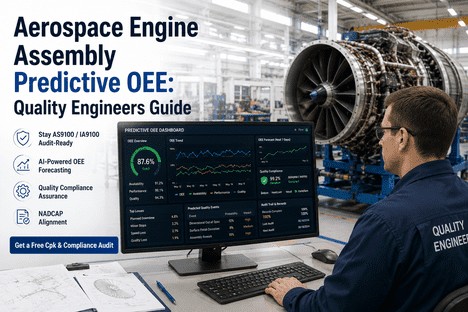
What the Predictive OEE Dashboard Shows the Plant Manager in Real Time
The plant manager's predictive OEE dashboard is designed around a single objective: showing what will happen next, not what already happened. Every view is structured to answer the question that determines OEE trajectory — where is the next loss event coming from, and what can I do about it right now?
OEE View 01
Live OEE Forecast by Production Cell
Every production cell displays current OEE alongside a 4-hour and 8-hour forecasted OEE range generated by the ML models. A blade machining cell running at 78% OEE with an 8-hour forecast of 62-68% signals that a loss event is building — spindle degradation accelerating, tool wear approaching end-of-life, or material lot characteristics shifting. The plant manager sees not just where OEE is now, but where it is heading, and intervenes before the forecast becomes reality.
Action: Forecast below threshold triggers automated root cause analysis and intervention recommendation within seconds.
OEE View 02
Next Loss Event Predictor
The ML models continuously rank the probability of the next significant loss event across every cell. The view shows the top five predicted events with probability percentage, estimated OEE impact in points, expected timing, and the specific process parameter driving the prediction. A prediction that CNC Cell #3 has a 78% probability of a performance loss event within the next 90 minutes driven by coolant temperature trend gives the plant manager a specific, actionable intervention target — not a general OEE alert.
Action: Top-ranked predicted loss receives immediate investigation and preventive action before it materialises.
OEE View 03
Component Trend Breakdown
Availability, Performance, and Quality are displayed as live trends with forecast trajectories. A plant manager who sees Availability trending from 82% toward 76% over the next 6 hours — while Performance and Quality remain stable — knows the problem is equipment-related, not process-related, and can dispatch maintenance resources to the specific cell showing the availability degradation signal before the machine stops.
Action: Component trend deviation triggers targeted investigation — maintenance or process engineering dispatched by trend type.
OEE View 04
Loss Pareto — Predicted vs Actual
The loss Pareto view overlays predicted loss categories with actual losses, showing the plant manager where the prediction model is identifying risks that the traditional OEE tracking misses. When the predicted Pareto shows micro-stops as the top projected loss category while the actual Pareto shows unplanned breakdowns as the current largest loss category, the plant manager has a direct signal that the loss profile is shifting — and can reallocate attention and resources before the micro-stops become the dominant loss category.
Action: Predicted vs actual gap analysis drives proactive resource reallocation across production cells.
OEE View 05
Cpk & Quality Loss Forecast by Engine Programme
Cpk is tracked live per quality characteristic per engine programme, with the ML model forecasting the Cpk trajectory based on current process parameters. A Cpk forecast declining from 1.72 toward 1.45 on blade airfoil tolerance for a specific engine programme triggers a quality intervention before the Cpk crosses the 1.33 minimum threshold. The forecast is linked to the specific parameter combination driving the decline — enabling targeted corrective action rather than broad process investigation.
Action: Cpk forecast below 1.67 triggers predictive quality review with parameter-specific root cause analysis.
OEE View 06
Shift OEE Projection & Intervention Log
At any point during the shift, the plant manager sees the projected end-of-shift OEE based on current performance and the ML model's forecast for the remaining hours. Every predictive alert, automated intervention, and plant manager action is logged with timestamp, cell identification, predicted loss category, and actual OEE impact. This log becomes the foundation for the continuous improvement cycle — converting every prediction and intervention into a documented, measurable improvement record that feeds the ML model's next training cycle.
Action: Every intervention documented with predicted vs actual OEE impact — building a measurable improvement history.
OEE That Has Not Moved in 12 Months Has Root Causes That Predictive Models Can Find in 12 Hours. Get a Free Predictive OEE Assessment.
iFactory's predictive OEE platform for aerospace engine assembly plant managers — AI-native loss forecasting, real-time Availability/Performance/Quality prediction, adaptive SPC integration, and AS9100-compliant audit documentation generated automatically from your production data.
Losses tracked at end of shift — too late to intervene
OEE reviewed as a daily or weekly report, not a live metric
Root cause investigation starts hours after the loss occurred
Quality confirmed by CMM — 4-8 hour lag from production
Maintenance scheduled by calendar, not by machine condition
OEE stuck at 50-65% with no clear path to break the ceiling
Audit documentation compiled manually from multiple systems
Predictive OEE Approach
Loss events forecasted 4-8 hours before they materialise
OEE projected live with 8-hour forecast and intervention windows
Root cause identified by ML models within seconds of detection
Quality deviation predicted before CMM confirms non-conformance
Maintenance triggered by predictive models — 7-14 day advance notice
OEE lifted to 75-82% with documented, repeatable improvement trajectory
Audit records generated automatically with full prediction and action trail
Our OEE was stuck at 58% for 14 months. We had tried every lean tool, every shift incentive, every maintenance schedule adjustment. Nothing moved the number. The problem was not that we were managing losses poorly — it was that we were managing losses after they happened. By the time the end-of-shift OEE report told us what went wrong, the loss had already compounded across 8 hours of production. Predictive OEE changed the sequence entirely. The ML model started flagging a specific vibration pattern on Cell #4's spindle 11 days before it failed. We planned the bearing replacement during a scheduled changeover window. That single prediction saved us 6 hours of unplanned downtime. In the first 90 days, our OEE moved from 58% to 74%. We did not buy new machines. We just started seeing the losses before they arrived.
How Predictive OEE Integrates with AS9100 and the Incoming IA9100 Standard
The 2026 IA9100 standard — the international evolution of AS9100 — explicitly requires a shift from reactive quality management to predictive process control. Real-time SPC, integrated control plans, and data-driven process monitoring are no longer optional enhancements. They are compliance requirements. Predictive OEE directly addresses this standard evolution by building the detection and documentation infrastructure that IA9100 demands: real-time process monitoring with ML-driven forecasting, automated audit records that demonstrate proactive quality management, and closed-loop corrective action tracking that verifies intervention effectiveness through subsequent OEE and Cpk trend data. The compliance advantage is material: a plant manager who can show an auditor a 90-day record of predictive alerts, interventions, and measured OEE improvement has a demonstrably stronger compliance position than one who shows a retrospective loss log and corrective action database.
Conclusion
OEE stagnation in aerospace engine assembly is not a capacity problem, a workforce problem, or a maintenance budget problem — it is a visibility timing problem. When losses are only visible after they have already consumed production time, every OEE improvement initiative is playing catch-up with a process that has already moved on to the next loss category. Predictive OEE changes the fundamental sequence of OEE management from reactive measurement to proactive intervention — forecasting Availability losses 7-14 days ahead, Performance degradation in real time, and Quality deviations 4-8 hours before final inspection confirms them.
The evidence from aerospace manufacturing in 2025 and 2026 is clear: plants deploying predictive OEE with multivariate ML models achieve OEE improvements of 15-25 percentage points within 90 days, reduce unplanned downtime by 45%, cut rework and scrap costs by 50%, and generate audit documentation that demonstrates proactive quality management to AS9100 and IA9100 assessors. The 2026 IA9100 standard shift from reactive to predictive quality management makes this not just an operational advantage but a compliance requirement. Plant managers who deploy predictive OEE ahead of the standard transition will enter their next audit with a system that forecasts, intervenes, and documents — not one that tracks, reports, and explains.
iFactory's predictive OEE platform is designed for aerospace engine assembly plant managers who need to break through the OEE ceiling and eliminate loss recurrence, not just measure it. Book a Demo to see the predictive OEE system configured for your engine programme portfolio and production cell layout, or talk to an expert about a free OEE and predictive readiness assessment for your engine assembly operation.
Frequently Asked Questions
Traditional OEE software is a measurement and reporting tool — it connects to PLCs, collects production counts, downtime events, and quality data, then calculates OEE at the end of each shift, day, or week. It tells you what happened. Predictive OEE adds a machine learning layer that analyses the incoming data stream in real time and forecasts what will happen next. Traditional OEE answers the question "what was our OEE yesterday?" Predictive OEE answers "what will our OEE be in the next 4 hours, and what should we do about it now?" The practical difference is that traditional OEE supports retrospective analysis while predictive OEE supports real-time intervention. Both are useful, but only predictive OEE can prevent losses before they occur. Most aerospace plants that deploy iFactory's predictive OEE keep their existing OEE tracking as a verification layer while using the predictive engine as the primary operational decision tool. Book a Demo to see the difference demonstrated with your production data.
Predictive OEE requires three layers of connectivity: machine-level data acquisition from PLCs, CNCs, and IoT sensors; a real-time data pipeline that streams this data to the ML inference engine; and integration with the plant's CMMS and quality systems for automated intervention and documentation. iFactory's platform connects to any PLC or CNC controller that supports OPC-UA, MTConnect, Modbus, or Siemens S7 protocol — covering the vast majority of aerospace manufacturing equipment from DMG MORI, Mazak, Okuma, Haas, and Hermle. For machines without native digital outputs, iFactory provides IoT edge gateways that capture spindle load, vibration, and cycle time via non-invasive sensors. The platform runs on an on-premise GPU server that processes the data stream with <50ms latency — ensuring real-time predictive capability without cloud dependency. Talk to an expert about a connectivity assessment for your production cells.
The predictive models initialise using historical data from the plant's existing data infrastructure — CNC controller logs, PLC historian records, CMM inspection results, and maintenance work order history. A minimum of 6 months of paired production and maintenance data is sufficient to build initial Availability, Performance, and Quality models with 80-85% accuracy. Twelve to eighteen months of data covering multiple engine programmes, material lots, and seasonal production patterns improves accuracy to 90-93%. The models deploy in shadow mode for the first 2-3 weeks, generating predictions in parallel with existing OEE tracking without driving decisions — allowing the plant manager and engineering team to validate model outputs against actual outcomes. After the shadow validation period, the models transition to active prediction mode with configurable confidence thresholds. Models are retrained continuously as new production data accumulates, improving accuracy over time. Book a Demo to see accuracy validation data from comparable aerospace engine component manufacturing deployments.
Every predictive OEE alert, every automated intervention, and every plant manager action is logged automatically with full production context — machine ID, engine programme, material lot, tool serial number, operator ID, and the specific process parameters that triggered the prediction. This creates the documentation chain that AS9100 Clause 8.5.1 requires for process control and Clause 10.2 requires for corrective action effectiveness. When a predictive alert triggers a corrective action, the system tracks the intervention through closure and monitors the subsequent OEE and Cpk trend for a configurable effectiveness window. If the same loss pattern recurs within the window, the CAPA is automatically flagged as ineffective and re-opened. The complete prediction-to-outcome record is exportable in the structured format that AS9100 and IA9100 auditors require — eliminating the manual documentation burden that typically consumes 3-5 days of audit preparation. Talk to an expert about configuring predictive OEE documentation for your AS9100 quality management system.
OEE That Is Flat Has a Predictable Cause. Predictive Models Find It Before the Next Shift Ends. Get a Free OEE and Predictive Readiness Assessment.
iFactory's predictive OEE platform for aerospace engine assembly plant managers — AI-native loss forecasting that anticipates every Availability, Performance, and Quality loss before it compounds; real-time OEE projection with 8-hour forecast horizon; automated intervention and AS9100 / IA9100-compliant audit documentation generated from your production data automatically.