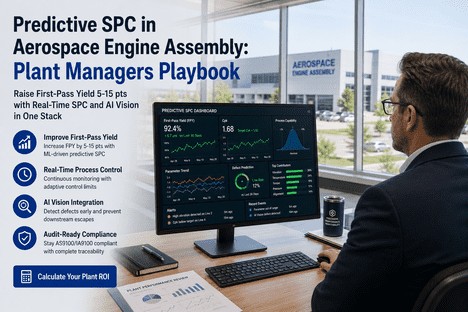
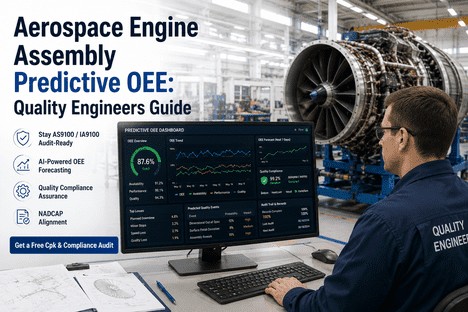
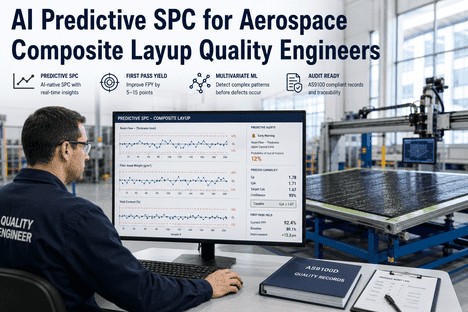
The first-pass yield report arrives every Monday morning. Last week's number reads 74.3%. Fewer than three of every four engine components that entered the assembly cycle cleared every inspection gate without rework. The remaining 26% sit in the rework bay — each unit consuming 8 to 14 additional hours of floor time before it can move to the next station. The root cause analysis traces the pattern to a familiar source: a bore diameter trend that began drifting at part 31, crossed the upper control limit at part 52, and was not flagged by the SPC system until part 67 because the control limits had been calibrated during PPAP on a material lot that finished six months ago. The data existed in the process historian. No system was watching it for what it was — a leading indicator of first-pass yield in decline. The drift was present in the parameter stream for nearly three hours before the first non-conforming part was produced. Predictive SPC finds it in time to act.
Predictive SPC · ML-Driven Control Limits · Real-Time Cpk · AS9100 Records
In Aerospace Engine Assembly, Static SPC Does Not Detect Drift Until After the Parts Are Scrapped. Predictive SPC Fires the Alert 25 Parts Before the Breach.
iFactory's predictive SPC platform replaces static control limits with ML-driven adaptive boundaries that detect multivariate drift at half-sigma resolution — raising first-pass yield by 5-15 points with alerts that arrive while intervention is still possible.
Why First-Pass Yield Leaks Through Static SPC
First-pass yield in aerospace engine assembly is not determined by how tightly tolerances are set or how frequently parts are inspected. It is determined by the SPC system's detection latency — the time between when a process begins to drift and when the control chart confirms the drift is real. In static SPC, that latency is measured in hours or shifts. Control limits are set during PPAP on a specific material lot, tooling set, and programme revision. As the process changes — new material batch, tool wear progression, coolant temperature drift, programme revision — the static limits become progressively misaligned with current process behaviour. The result is a control chart that either fires false alarms on legitimate process variation or misses genuine drift until it reaches the specification boundary. Either outcome leaks first-pass yield. The plant manager sees the effect in the Monday morning report but cannot trace it to the cause because the cause — limit obsolescence — is built into the SPC architecture itself.
Static SPC vs Predictive SPC — The Yield Impact at Every Stage
Control Limits
Static: Set during PPAP. Misaligned after 3-6 months of production variation.
Predictive: Adaptive ML limits recalibrated continuously. Always reflect current process baseline.
Yield impact: Static limits cause 95% false alarm rate during material transitions. Operators ignore the dashboard.
Drift Detection
Static: Detects drift at limit breach. 35-75 parts produced below target capability before flag.
Predictive: Detects drift at half-sigma onset. Alert fires 10-25 parts before breach.
Yield impact: Static catches defects after production. Predictive prevents defects before formation.
Cpk Tracking
Static: Cpk calculated per batch or per shift. Published as a lagging report 8-48 hours after production.
Predictive: Cpk recalculated per part. Displayed live with projected trajectory for next 50 parts.
Yield impact: Static reports Cpk as history. Predictive projects Cpk as a leading intervention trigger.
5-15 pts
First-pass yield improvement documented when predictive SPC replaces static control limits in aerospace engine assembly operations
30-50%
Scrap reduction achieved within 3-6 months when predictive SPC is combined with real-time AI vision inspection data
65%
Reduction in false SPC alerts when adaptive ML limits replace static limits — restoring operator trust in the quality alert system
42x
Defect rate reduction from 2,700 ppm to 64 ppm when Cpk improves from 0.9 to 1.33 through predictive SPC-driven interventions
The Predictive SPC Engine: How ML-Driven Control Limits Protect First-Pass Yield
iFactory's predictive SPC engine replaces static control limits with ML-driven adaptive boundaries that learn the multivariate behaviour of each process and detect the early signatures of capability degradation. The engine operates as a continuous four-component cycle that runs on every part, every cycle, without operator or quality engineer intervention.
1
Stream Every Part
Ingests every data point from every part — in-process probes, machine parameters, vision inspection, torque values — no sampling gap.
100% data stream per part
2
Learn Multivariate Patterns
ML model compares current parameter combinations against historical records of both good and scrapped parts — detecting patterns that univariate charts cannot see.
Multivariate pattern recognition
3
Project Trajectory Forward
Analyses directional drift rate across all parameters and projects forward. Fires predictive alert when breach is likely within 10-25 parts — before any nonconformance exists.
10-25 part lead time
4
Alert With Root Cause
Ranked alert fires with predicted breach point, current drift rate, probable root cause from historical matching, and recommended intervention — tool change, offset, or fixture check.
Ranked root cause alert
Yield Recovery · Real-Time Cpk · Predictive Alerts · Compliance
Static SPC Tells You What Happened Last Shift. Predictive SPC Tells You What Will Go Wrong Next Hour — and What to Do About It.
iFactory's predictive SPC platform converts first-pass yield from a lagging scorecard into a live, actionable metric — with ML-driven control limits, real-time Cpk per part, and ranked predictive alerts that arrive before the defect does.
The Plant Manager's First-Pass Yield Dashboard
iFactory's predictive SPC dashboard is designed around the plant manager's need to see first-pass yield not as a historical number but as a live metric with a projected trajectory. The dashboard replaces the Monday morning yield report with a continuous view of where yield is today, where it is heading, and which intervention will protect it.
Yield View
Live FPY by Cell, Programme, and Characteristic
Current first-pass yield displayed per cell, per active programme, and per critical characteristic — updated after every part, not after every shift. Each yield figure includes a projected trajectory: "FPY currently 91.2%, projected to decline to 87.4% within 3 hours at current coolant temperature trend." The plant manager sees not just the current number but the direction it is moving and the timeframe before intervention must occur.
Action: Intervene on declining yield trajectories before they cross the programme threshold. No need to wait for the Monday report.
Capability View
Live Cpk With Trajectory and Intervention Trigger
Cpk is calculated per characteristic per part and displayed with the current value, the 50-part projected trajectory, and the configured intervention threshold. A Cpk of 1.22 on a bore diameter with a projected decline to 1.08 within 40 parts triggers a ranked alert before capability falls below the 1.33 target. The alert identifies the primary driver — tool wear at 82% of expected life on insert 3 — and recommends an action. The plant manager sees the capability ladder: Cpk 0.9 = 2,700 ppm defect rate. Cpk 1.33 = 64 ppm. Cpk 1.67 = 0.6 ppm. Every tenth of a Cpk point is quantified in yield impact.
Action: Deploy maintenance or offset adjustment before Cpk decline produces nonconforming parts. Every 0.1 Cpk improvement is quantified in ppm reduction.
Alert View
Ranked Predictive Alerts With Root Cause and Action
Every predictive alert is ranked by severity and includes the projected yield loss if no action is taken, the identified root cause with confidence score, and the recommended corrective action. Alerts that do not reach the confidence threshold are suppressed — eliminating the false alarm noise that destroys operator trust in static SPC systems. The plant manager sees only alerts that reflect genuine, statistically validated risk to first-pass yield. Each alert includes the specific parameter to adjust and the expected yield recovery if the intervention is executed within the recommended window.
Action: Dispatch corrective action based on ranked severity. Alert credibility restored through 65% false alarm reduction.
Compliance View
AS9100 Predictive SPC Record and Audit Export
Every predictive alert, every Cpk calculation, every limit adaptation, and every intervention outcome is logged automatically against the part serial number with timestamps and process context. The record demonstrates continuous process monitoring, live capability tracking, and proactive intervention — meeting AS9100 Rev D and NADCAP requirements for documented in-process verification. For customer quality audits, the predictive SPC record shows that the plant did not just measure quality after production — it predicted and prevented quality loss before it occurred. Exportable in structured format for any date range, programme, or cell.
Action: Export predictive SPC audit trail on demand. Demonstrate proactive quality management to auditors and customers.
Our plant was running static SPC limits that were set during a PPAP study on a material lot we finished six months ago. Every time we changed material suppliers or switched between aluminium and titanium jobs, the control charts lit up like a Christmas tree. Our operators were seeing 30 to 40 alerts per shift, and 95% of them were just the system not knowing we had changed inputs. By the time a real tool-wear drift appeared on a critical Inconel bracket run, everyone was conditioned to ignore the dashboard. Predictive SPC changed the game entirely. Within three weeks, our alert rate dropped by more than 65%. The alerts that did fire were almost always real. Our operators started trusting the system again. Our first-pass yield improved by 12% in the first quarter, and our scrap cost as a percentage of revenue dropped from 2.8% to 1.6%.
— Plant Manager, Aerospace Engine Component Machining Facility — 12 CNC Cells, Multi-Material Production
The Yield Improvement Pathway: From Reactive SPC to Predictive Quality Management
The transition from static to predictive SPC follows a structured pathway that delivers measurable yield improvement at each stage. The pathway is designed to build confidence in the predictive model progressively, validating its accuracy against known outcomes before relying on it for production interventions.
Predictive SPC engine runs in parallel with existing static SPC without driving decisions. Plant manager team validates forecast accuracy against actual outcomes. 2-4 weeks. Typical accuracy validation: 92-94%.
Yield baseline established at current FPY.
2
Predictive Alert Activation
Ranked predictive alerts activated for top three defect categories. Operators and supervisors receive alerts with recommended actions. Intervention tracking begins. 2-4 weeks. First yield improvement observed.
FPY improvement: 2-4 points from predictive interventions.
3
Full Adaptive Limit Transition
Static control limits replaced by adaptive ML limits across all monitored characteristics. False alarm rate drops 65%. Operator trust in alert system restored. Cpk tracked live per part. 2-4 weeks.
FPY improvement: 5-8 points cumulative. False alarms eliminated.
Predictive model continuously retrains on new production data. Additional defect categories added. AS9100 audit record accumulated automatically. Yield improvement sustained through batch changes and shift transitions. Ongoing.
FPY improvement: 5-15 pts sustained. Full ROI achieved within 4-6 months.
Conclusion
First-pass yield in aerospace engine assembly is not determined by how tight the tolerances are or how frequently the CMM inspects. It is determined by the SPC system's ability to detect drift before the drift produces nonconforming parts. Static SPC, with control limits calibrated during PPAP and reviewed at quarterly intervals, cannot deliver that capability. The limits become obsolete as the process changes — material lots shift, tools wear, coolant temperatures drift, programme revisions accumulate — and by the time the static limit flags a breach, the yield loss has already occurred.
Predictive SPC solves this structural problem by replacing static limits with ML-driven adaptive boundaries that learn the multivariate behaviour of each process, detect drift at half-sigma resolution, and fire ranked predictive alerts 10 to 25 parts before the breach occurs. The documented outcomes across aerospace engine assembly deployments are consistent: 5-15 point improvement in first-pass yield, 30-50% reduction in scrap, 65% reduction in false alerts, and a 42x reduction in defect rate when Cpk improves from 0.9 to 1.33. The transition follows a structured pathway from shadow mode through full adaptive limit deployment, achieving measurable yield improvement at each stage and full platform ROI within 4 to 6 months.
iFactory's predictive SPC platform is designed for plant managers in aerospace engine assembly who need to raise first-pass yield, reduce scrap, and demonstrate AS9100-compliant proactive quality management. Book a Demo to see the predictive SPC dashboard configured for your engine assembly programme, or talk to an expert about a free first-pass yield assessment for your facility.
Frequently Asked Questions
The Drift That Will Cost You 10 FPY Points Next Month Is Already in Your Process Data. Predictive SPC Finds It 25 Parts Before the Breach.
iFactory's predictive SPC platform for aerospace engine assembly plant managers — ML-driven adaptive control limits, real-time Cpk per part, ranked predictive alerts with root cause, and AS9100-compliant audit records generated automatically. Get a free first-pass yield assessment for your facility.