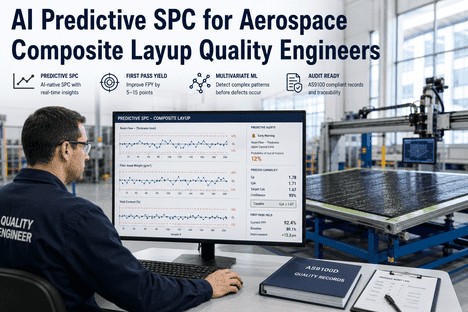
Statistical Process Control in aerospace composite layup has always been a rear-view mirror exercise. Control charts are reviewed at shift handover, Cpk is calculated from batch samples, and by the time a quality engineer sees a process shift, 12 to 15 panels have already been produced below target capability. The reactive SPC model — measure, chart, react — was built for an era when data arrived in spreadsheets and analysis happened offline. In AFP composite layup, where a single tow pass can introduce a gap or overlap that propagates across 30 subsequent passes, the latency of traditional SPC is not a data problem. It is a yield problem. This guide shows quality engineers how Predictive SPC replaces reactive control charts with ML-driven process forecasting, cutting detection latency from days to seconds and raising first-pass yield by 5-15 points through interventions that happen before defects form, not after.
Traditional SPC in aerospace composite layup follows a predictable cadence: manual measurements taken at end-of-ply or end-of-batch intervals, data entered into a spreadsheet or SPC software, control limits calculated, and Cpk values reviewed at the next quality meeting. The gap between when a process parameter drifts and when that drift appears on a control chart can be hours, shifts, or days. In AFP composite layup, where AFP head temperature can drift by 5 degrees Celsius over three panels and compaction force can degrade gradually with roller wear, the process parameters that determine layup quality are moving targets that reactive SPC simply cannot track at production speed.
Predictive SPC replaces this retrospective model with continuous multivariate process monitoring. Instead of measuring one characteristic at a time against static control limits, ML-driven SPC models ingest 15-20 process parameters simultaneously — AFP head temperature, compaction force, layup speed, tow tension, material batch viscosity, roller condition index, ambient temperature, and humidity — and forecast the probability of a defect forming on the next pass. The quality engineer sees a process risk score that updates with every tow pass, not a control chart that updates at the next batch review.
Predictive SPC for aerospace composite layup operates as a continuous pipeline that ingests process data, applies trained ML models, and delivers actionable forecasts before a defect can form. Unlike traditional SPC that flags an out-of-control condition after it has already produced non-conforming output, Predictive SPC forecasts the probability of a defect on the next pass and gives the quality engineer the information needed to adjust process parameters preventively.
Predictive SPC models are trained to forecast each defect type that affects first-pass yield in AFP composite layup. The table below shows the prediction accuracy and FPY impact for each defect category, based on production deployments across multiple programmes.
The quality engineer's relationship with data changes fundamentally under Predictive SPC. Instead of collecting measurements at discrete intervals and analysing them after the fact, the quality engineer works with a live risk surface that updates with every tow pass. The question shifts from "what defects did we have on the last panel?" to "what is the probability of a defect forming on the next pass, and which parameter adjustment will eliminate that probability?"
Our traditional SPC process produced control charts that we reviewed at the weekly quality meeting. By Thursday, we were looking at data from the previous Monday. The Predictive SPC model caught a compaction force interaction with roller age that our univariate charts never would have flagged. It predicted a gap event 8 passes before it would have occurred. We adjusted the roller replacement schedule and eliminated that defect type from the next 40 panels. That is not control charting. That is process intelligence.
Predictive SPC is deployed as a software layer that integrates with the existing AFP data architecture. The ML models ingest data from the AFP controller's existing sensor stream — no additional sensors required for initial deployment. The edge processing unit runs inference locally, and the quality engineer dashboard is accessible from any workstation or tablet on the production network. The deployment follows a structured path from offline model training to live predictive control.
Predictive SPC for aerospace composite layup changes the quality engineer's job from charting the past to forecasting the future. Instead of collecting measurements at batch intervals and reviewing control charts at shift handover, the quality engineer works with a live process risk surface that forecasts defect probability before the next tow pass. The Cpk values that once arrived at the weekly quality review are now available per ply, per characteristic, updated in real time from the ML model's continuous multivariate analysis. The build records that once required manual compilation of spreadsheets and control charts are now exportable per panel with complete SPC history, prediction outcomes, and corrective action logs.
The aerospace composite operations that consistently hold first-pass yield above 96% share a common capability: ML-driven predictive SPC that forecasts defects before they form, integrated with the quality engineer's workflow, and backed by models that improve with every panel produced. That capability is available today as a software layer on existing AFP cells — no additional sensors, no controller replacement, no MES migration.
iFactory's Predictive SPC platform is purpose-built for aerospace composite layup quality engineers — integrating with existing AFP data streams to deliver ML-driven process forecasting, real-time Cpk per ply, and automated AS9100-compliant SPC records without changing the quality engineer's tools or workflow.