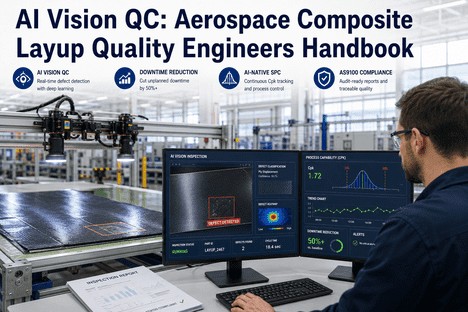
AI Vision QC: Aerospace Composite Layup Quality Engineers Handbook

By Grace on June 8, 2026

ai-vision-qc-aerospace-composite-layup-quality-engineers-handbook

Quality Engineers in aerospace composite layup operations face a paradox: the inspection methods designed to ensure quality are themselves the largest source of unplanned downtime. Manual ply-by-ply inspection consumes 32-50% of AFP production time, and the defects that human inspectors catch are typically found 30-60 minutes after they form — by which point 10-15 additional tow passes have been laid over the affected area. Every one of those passes must be reworked or scrapped. The cost is not just labour. It is capacity. It is material. It is first-pass yield that hovers at 88-92% while the cell's theoretical output waits on inspection sign-off. This handbook shows quality engineers how AI vision inspection for aerospace composite layup eliminates inspection-generated downtime, brings SPC and Cpk tracking to the tow-pass level, and transforms the quality engineer's role from retrospective auditor to real-time process authority.

The Quality Engineers Handbook
AI Vision QC for Aerospace Composite Layup
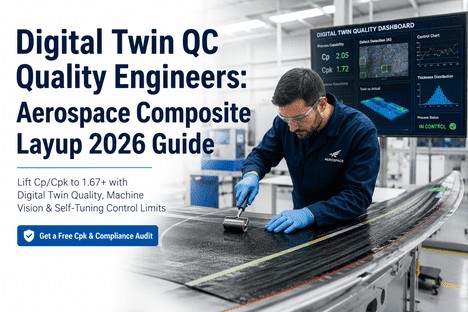
Real-time defect detection at the tow-pass level. AI-native SPC and Cpk tracking that flags quality drift before it generates a scrap event. A quality engineer's workflow that replaces retrospective audit with live process control.
The Downtime That Does Not Show Up on the OEE Dashboard

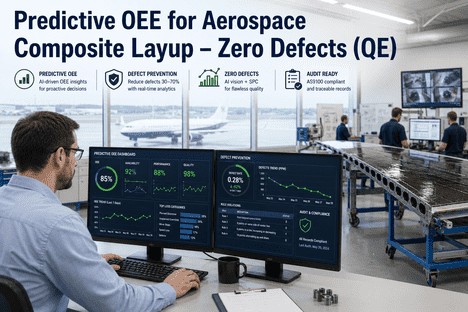
When a quality engineer reviews OEE at shift handover, the Availability and Performance factors capture every minute the AFP cell is not running. But the Quality factor — the one that tracks first-pass yield — hides a specific form of downtime that manual inspection creates: the time between defect occurrence and defect detection. During that window, the cell continues laying material over a non-conforming condition, compounding the rework scope with every tow pass. The quality engineer does not see this latency as downtime. It is logged as production. But every minute spent laying material that will be reworked is, in economic terms, negative-value production.

Published industry studies show that manual visual inspection in AFP composite layup accounts for 32-50% of total production cycle time. For an 8-ply panel, that is 6 hours of inspection during which the cell is not laying material. When you add the rework hours generated by defects that were missed at the ply level and detected only at post-cure, the total quality-related time impact can exceed 60% of available production capacity. AI vision inspection eliminates both components: the inspection time and the rework time, by detecting every defect at the moment it forms.

The Hidden Downtime Chain in Manual Inspection
1
Defect occurs at pass 47
Gap forms between tows at ply 8. AFP cell continues depositing material.
2
15 passes laid over defect
Cell continues uninterrupted. Rework scope grows with every pass.
3
End-of-ply inspection finds it
45-minute walkaround. Defect documented. Rework decision made.
4
Rework + missed production
30-60 min rework. Panel delayed. Next panel starts late.
Total hidden cost: 6+ hours of inspection per panel + rework from compounded defects = up to 60% capacity lost to quality-related delays
How AI Vision QC Eliminates Inspection Downtime

AI vision inspection for aerospace composite layup replaces the end-of-ply walkaround with continuous in-process monitoring at the tow-pass level. The system architecture is designed around a single objective: detect every defect within 300 milliseconds of occurrence, before the next pass compounds the error. For the quality engineer, this changes the fundamental economics of quality control. Instead of allocating 30-50% of production time to inspection, the cell allocates zero production time to inspection — detection happens at deposition speed, and the quality engineer's time shifts from walking the tool to analysing process data.

Capture at Deposition
Structured light sensors and high-res cameras mounted on the AFP head capture 2D and 3D data of every tow pass. Sub-mm point cloud reconstructed in real time.
AI Inference at the Edge
On-device GPU runs YOLOv7 or PointNet++ models trained on 5,000-8,000+ labelled AFP defect images. Inference completes in less than 300 ms per tow pass. No cloud dependency.
SPC and Cpk in Real Time
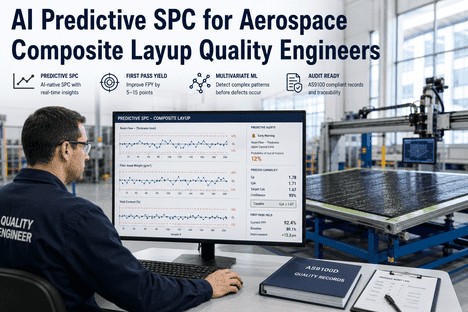
Every detection event feeds the quality database. Defect type, severity, ply coordinate, and timestamp. SPC control limits and Cpk values update per ply, not per shift.
Alert and Correct
Defect alert routed to quality engineer dashboard and AFP controller. Structural defects trigger pause. Cosmetic anomalies logged. Rework decision made before next pass.
Quality Metric
Manual Inspection
AI Vision QC
Improvement
Inspection time per 8-ply panel
6 hours
Continuous (0 hrs downtime)
100% reduction
Defect detection latency
30-60 min
300 ms
99.99% faster
First-pass yield
88-92%
95-97%
+5-8 points
Cpk update frequency
Per shift / batch
Per ply
Real-time SPC
Post-cure scrap rate
8-12%
2-4%
-65% average
Quality engineer time on inspection
40-50% of shift
Under 10%
-80%
AS9100 build record compilation
3-5 days pre-audit
Exportable per panel
Instant
What Changes for the Quality Engineer

The quality engineer's role in AFP composite layup has historically been defined by walking: walking the tool to inspect plies, walking the rework area to verify corrections, walking the storage area to check post-cure panels. AI vision inspection collapses this physical workflow into a single dashboard. The quality engineer sees every defect, its severity, its exact ply coordinate, and the trend line of defect frequency across the shift — without leaving the workstation. The deeper change is in what the quality engineer can now do with time that was previously consumed by inspection travel and data compilation.

Live SPC Dashboard
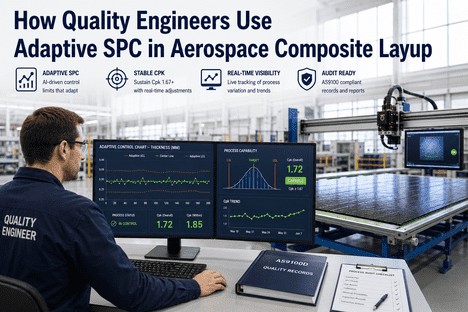
Control charts update with every ply completion. X-bar and R charts for gap width, overlap height, and tow angle deviation. Cpk values calculated per characteristic per ply. Quality engineers see statistical process shifts as they develop, not at the next batch review.
Correlated Defect Maps
Every defect is plotted on a visual panel map with type, severity colour code, and coordinates. Quality engineers overlay defect maps with AFP head parameters — temperature, compaction force, layup speed — to identify process settings that correlate with defect formation.
Cross-Shift Trend Analysis
When the same defect type appears at the same ply coordinate across consecutive panels, the system alerts the quality engineer to a systematic process issue before it generates a batch scrap event. Root cause analysis begins during production, not after.
Cure Authorisation with Confidence
One-page quality summary per panel at cure commit: every defect detected, its severity, the disposition applied, and current Cpk per critical characteristic. Quality engineers approve cure from the dashboard without walking the tool for a final visual check.

We were running SPC reviews once per week. By the time we saw a Cpk shift, we had already produced 12 panels below target capability. The AI vision system now gives us Cpk per ply. We caught a compaction force drift at ply 3 of the first panel — before it generated a single non-conforming part. That is the difference between managing quality and merely reporting it.

Quality Engineer, Tier 1 Aerospace Structures Supplier
Deploying AI Vision QC on the AFP Cell

AI vision inspection for aerospace composite layup does not require replacing the AFP controller, rewiring the cell, or adding new operator steps. The vision hardware mounts on the existing AFP head or as a fixed array above the layup table. The deep learning model processes all data on an edge GPU — no cloud dependency, no image data leaving the facility. Integration with the AFP controller enables the system to correlate defect location with ply coordinate and AFP head parameters, building a process-quality correlation database that improves model accuracy over time. The deployment follows a structured timeline designed to build confidence before the system becomes the primary inspection method.

Week
1-2
Assessment and hardware install
Technical review of AFP cell configuration, camera mounting positions, lighting conditions. Hardware installation during scheduled maintenance. No production interruption.
Week
3-4
Shadow mode data collection
System captures production data in shadow mode — logging detections without alerting. Quality engineer compares AI detections against manual findings. Model fine-tuned to programme-specific defect types.
Week
5-6
Parallel running and validation
AI system runs alongside manual inspection. SPC and Cpk dashboards go live. Quality engineer validates model outputs. Discrepancies reviewed, accuracy optimised.
Week
7+
Full production deployment
AI vision becomes primary inspection method. Manual inspection reduced to spot checks. Quality engineer monitors live SPC dashboard. FPY improvement tracking begins.
Conclusion: From Quality Auditor to Process Authority

AI vision inspection for aerospace composite layup changes the quality engineer's job from retrospective auditor to real-time process authority. Instead of spending 40-50% of the shift walking the tool to find defects that have already been laid down under compounded passes, the quality engineer monitors a live dashboard that flags each defect at the moment of deposition — with type, severity, coordinate, and the SPC context to determine whether it is a random event or the start of a process shift. The inspection hours that once consumed half the production cycle are recovered as layup time. The Cpk updates that once arrived at the weekly batch review are now delivered per ply, per characteristic. The build records that once took three to five days to compile before an AS9100 audit are now exportable per panel, per click.

The aerospace composite operations that are moving toward zero-defect manufacturing share a common capability: real-time AI vision inspection at the point of deposition, integrated with SPC and Cpk tracking, and backed by deep learning models that improve with every panel produced. That capability is available today as a retrofit to existing AFP cells — no controller replacement, no MES migration, no operator workflow disruption.

iFactory's AI vision inspection platform is purpose-built for aerospace composite layup quality engineers — integrating with existing AFP hardware to deliver deep learning defect detection, real-time SPC and Cpk tracking, and automated AS9100 build records without changing the quality engineer or operator workflow.

Start Your AI Vision QC Deployment
See How Much Downtime AI Vision Can Recover on Your AFP Cell
Get a free Cpk and compliance audit with a 30-minute walkthrough of iFactory AI vision inspection running on an AFP use case matched to your programme's part geometry and defect profile.
Frequently Asked Questions

Published industry studies show manual visual inspection consumes 32-50% of AFP production time. AI vision eliminates end-of-ply walkarounds by inspecting every tow pass continuously during deposition. For an 8-ply panel requiring 6 hours of manual inspection, AI vision recovers those 6 hours as available layup time. At a programme running 200 panels per month, this translates to 1,200 hours per month of additional production capacity without adding a shift or a cell. The time recovery is direct: the cell lays material instead of waiting for inspection sign-off. Book a Demo to see a cycle time projection for your specific panel geometry.

Traditional SPC in AFP composite layup relies on manual measurement samples taken at end-of-ply or end-of-batch intervals. Data is entered into spreadsheets, control limits are calculated offline, and Cpk values are typically reviewed at shift handover or weekly batch reviews. AI vision SPC updates every control chart with each ply completion. X-bar and R charts for gap width, overlap height, tow angle deviation, and other critical characteristics are calculated automatically from continuous sensor data. Cpk values are available per characteristic per ply — not per batch. The quality engineer sees a process shift at ply 3 of the first affected panel, not after 12 panels have been produced below target capability. Talk to an Expert about SPC integration with your existing quality management system.

Production-deployed deep learning models for AFP defect detection achieve 93-97% accuracy across the full spectrum of surface defect types: gaps between tows (97%), overlaps (95%), wrinkles and out-of-plane defects (96%), FOD (94%), tow twist (94%), and fibre waviness (93%). Detection combines 3D point cloud data from structured light sensors for geometric defects with high-resolution RGB imaging for FOD. Human visual inspection at end-of-ply typically catches 70-80% of defects under production conditions, with miss rates increasing under time pressure and on dark carbon fibre surfaces. AI vision also detects defects at the tow-pass level rather than the ply level, identifying issues 30-60 minutes earlier on average. Book a Demo to see accuracy comparisons for your specific defect types.

Yes. The dark, glossy surface of carbon fibre prepreg creates poor contrast for traditional threshold-based vision systems. AI addresses this through three mechanisms: structured light projection that reconstructs 3D surface topology independent of colour and reflectivity, laser profilometry that captures sub-mm surface height data unaffected by surface finish, and deep learning models trained specifically on dark-surface defect images. The most effective production systems combine 3D point cloud data for geometric defect detection with high-resolution RGB for FOD detection, ensuring coverage across all defect types regardless of surface appearance. Talk to an Expert about vision system configuration for your material and lighting conditions.

iFactory's AI vision platform integrates with existing AFP cell architecture without requiring controller replacement. The vision system interfaces with the AFP controller to receive pass-by-pass position data, enabling defect location mapping to exact ply coordinates and correlation with AFP head parameters. Quality data exports in standard formats compatible with SAP, Siemens Opcenter, and custom quality management systems. For NADCAP compliance, the system generates process parameter logs automatically per pass. The AS9100 build record package is exportable in PDF and structured data formats. Integration scope is confirmed during the deployment assessment, which includes a technical review of your AFP controller model and MES architecture. Talk to an Expert about integration for your specific cell configuration.

Every Defect You Catch at Deposition Is a Panel That Will Not Need Rework After Cure.
iFactory AI vision inspection for aerospace composite layup — deep learning defect detection at tow-pass resolution, real-time SPC and Cpk tracking, and automated AS9100 compliance records. Purpose-built for quality engineers in AFP composite operations.

Share This Story, Choose Your Platform!