AI Vision QC Ops Directors: Aerospace Composite Layup 2026 Guide
By Grace on June 10, 2026
The Q1 audit at a Tier-1 aerospace composites facility revealed 14 non-conformances across three work cells. Every one of them was traced to defects that originated in the composite layup stage — ply gaps, fiber misalignment, foreign object debris, and resin-rich zones. Every one of those defects was visible to a camera before the part entered the autoclave. None were flagged by the existing inspection process. The autoclave cycle transformed a repairable layup defect into a cured composite part that either required costly rework or became scrap. The OEE for that quarter settled at 61%. The operations director's review acknowledged the obvious: the quality data existed, but the inspection process could not read it fast enough or consistently enough to drive real-time correction. AI vision inspection closes that gap by reading every ply, every edge, and every surface at production speed — flagging defects before the autoclave locks.
Deep Learning Defect Detection · Self-Tuning SPC · OEE Optimisation · AS9100 Audit-Ready Records
Every Defect That Grounds a Composite Part Was Visible in the Layup Stage. AI Vision Catches It Before the Autoclave Does.
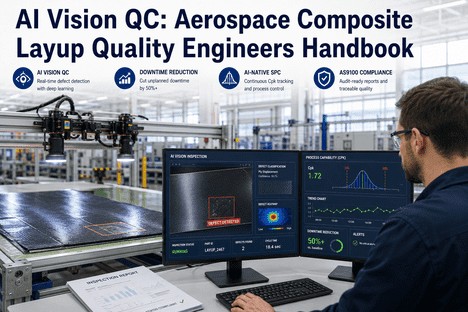
iFactory's AI vision inspection platform ingests high-resolution layup imagery in real time, detects 40+ defect classes across carbon fiber and glass composite plies, and alerts operations directors before a single non-conforming part reaches cure — sustaining OEE above 78% and AS9100 audit readiness across every shift.
Sustained OEE target for aerospace composite manufacturing — achievable only when layup defects are detected before autoclave cure commits the scrap cost
40+
Defect classes detectable by AI vision in composite layup — ply gaps, overlaps, fiber waviness, FOD, bridging, wrinkles, and resin anomalies across all weave patterns
3-5x
Faster than manual visual inspection — AI vision covers full layup surface area in seconds per panel, replacing hours of inspector time per shift
AS9100
Every inspection event logged automatically — timestamped defect image, classification, severity score, and disposition record, audit-ready on demand
Why Composite Layup Is the Highest-Impact Quality Control Point in Aerospace Manufacturing
Composite layup occupies a unique position in the aerospace production sequence. It is the last stage before the irreversible autoclave cure, the point at which every preceding material preparation, cutting, and kitting operation converges into a single stacked assembly. A defect introduced or missed in layup — a one-millimeter ply gap, a stray piece of backing film, a subtle fiber misorientation — becomes a permanent structural feature after cure. Detection after cure requires ultrasonic scanning, x-ray inspection, or destructive testing, each adding hours or days of inspection time per part. Repair, when possible, involves complex patch procedures that require engineering approval and recertification. Scrap, when repair is not feasible, means the loss of the full material and labor investment — prepreg carbon fiber, cutting, kitting, layup labor, and the autoclave cycle itself. All of this cost exists because a defect was not detected during the layup window when correction was simply a ply replacement or a repositioning.
The Three Categories of Composite Layup Defects That Drive OEE Loss — and How AI Vision Detects Each
Category 1 — Ply Geometry
Gaps, Overlaps, and Ply Boundary Defects
Ply gaps and overlaps occur when adjacent plies do not meet at the specified butt joint or when a ply exceeds its boundary. The resulting gap creates a resin-rich zone that becomes a stress concentration under load. An overlap produces a thickness variation that disrupts the aerodynamic surface or the fit with adjacent structure. AI vision models trained on thousands of ply boundary images detect these defects at sub-millimeter resolution, classifying gap width, overlap extent, and location relative to the ply edge — providing the operations director with a quantitative defect report, not a subjective inspector judgment.
Sub-mm gap and overlap detection
Ply boundary verification against CAD
Layer-by-layer stack-up recording
Category 2 — Fiber Architecture
Waviness, Misalignment, and Bridging
Fiber waviness — out-of-plane undulation in the reinforcement fibers — reduces compressive strength by 15 to 30 percent depending on severity. Fiber misalignment shifts the load path away from the design orientation, degrading structural performance in the affected zone. Bridging occurs when a ply lifts away from a radius or corner instead of conforming to the mold surface, creating a void that fills with resin. These defects are nearly invisible to manual inspection on dark carbon fiber surfaces. AI vision systems using multi-angle illumination and transformer-based segmentation models detect waviness patterns, angular deviations, and lift-off zones that human eyes consistently miss.
Fiber orientation angle measurement
Waviness severity classification
Radius bridging detection in corners
Category 3 — Contamination
FOD, Resin Anomalies, and Foreign Material
Foreign object debris in composite layup includes bagging film fragments, release film remnants, tool debris, fibers from adjacent work areas, and even human hair. Each creates a discontinuity that becomes a delamination initiation site after cure. Resin-rich and resin-starved zones appear as localized gloss or matte variations on the prepreg surface, indicating improper resin distribution that affects the fiber-to-resin ratio in the cured laminate. AI vision models trained on contamination datasets detect these anomalies by learning the normal surface texture distribution for each material type and flagging statistical outliers at production line speed.
The Defect That Fails the Final NDT Was a Visible Anomaly in the Layup Stage. AI Vision Sees It. Your Operations Team Corrects It.
iFactory's AI vision inspection platform detects, classifies, and records every layup defect across all three categories — ply geometry, fiber architecture, and contamination — delivering a real-time quality signal that operations directors use to stop defects before they become cured scrap.
How AI Vision Inspection Transforms OEE in Aerospace Composite Layup
OEE is the metric that operations directors own — the composite of availability, performance, and quality that determines whether a work cell is running at its full potential. In composite layup, every component of OEE is affected by inspection accuracy and speed. Traditional manual inspection constrains all three: availability suffers because parts wait for inspector availability, performance drops because inspection creates a bottleneck between layup and autoclave, quality depends on inspector fatigue and attention level on any given shift. AI vision inspection changes each component by replacing the variable-speed human inspection with a consistent, high-speed, data-driven process.
OEE
Availability
Eliminating the Inspection Bottleneck Between Layup and Autoclave
In a typical composite layup work cell, a completed layup stack waits for manual inspection before proceeding to bagging and autoclave. With one inspector covering multiple cells, wait times of 30 to 90 minutes per part are common — direct availability loss. AI vision inspection completes the same inspection in 30 to 90 seconds per panel. The inspection is triggered automatically when the layup is complete, and the result is available immediately. Parts move from layup to autoclave without queuing. The availability gain from eliminating inspection wait time alone typically recovers 6 to 10 OEE points in cells where inspector coverage is the constraint.
OEE
Performance
Faster Inspection Throughput Without Adding Headcount
Performance loss in composite layup is rarely about machine cycle speed — it is about the throughput constraint created by the inspection step. Manual inspection of a single-layer panel may take 15 to 20 minutes for an experienced inspector. Multi-layer or complex geometry parts can require 45 to 60 minutes. AI vision inspection of the same part completes in under 2 minutes with consistent coverage across the entire surface area. The throughput gain enables the cell to operate at its true layup rate rather than the inspection-constrained rate. Operations directors report 15 to 25 percent throughput improvement in cells where AI vision replaced manual layup inspection.
OEE
Quality
Defect Detection Before Cure Eliminates Rework and Scrap
Quality loss in composite layup OEE is dominated by two costs: rework of cured parts detected by post-cure NDT, and scrap of parts that cannot be repaired. Both are preceded by a defect that existed in the layup stage. AI vision inspection detects ply gaps, fiber waviness, misalignment, FOD, and resin anomalies before the part enters the autoclave. The operator corrects the defect — replaces a ply, repositions a ply, removes the FOD — in minutes at the layup table. The part proceeds to cure as a conforming assembly. Operations directors at facilities running AI vision inspection report first-pass yield improvements of 12 to 18 percent and a reduction in post-cure rework of 40 to 60 percent.
OEE
SPC
Self-Tuning Statistical Process Control on Every Defect Class
Cpk on composite layup quality is traditionally calculated from post-cure inspection results — meaning the data arrives after the defect is already committed. AI vision inspection generates Cpk on every defect class at the layup stage, in real time. The self-tuning SPC algorithm distinguishes between common-cause variation — normal ply-to-ply variation within specification — and assignable-cause events that signal process drift: a gradual increase in ply gap frequency that indicates a kitting precision problem, or a sudden rise in FOD events that points to a contamination source in the work cell. Operations directors see the SPC trend on their dashboard with specific intervention guidance, not a raw data dump.
The Operations Director Playbook: Four Decisions That Change When AI Vision Drives Quality
Operations directors who adopt AI vision inspection for composite layup report that the technology does not just improve inspection accuracy — it changes the operational decision cadence across the entire work cell. Four specific decisions become fundamentally different when quality data arrives at production speed rather than inspection cycle speed.
1
Shift Handover Becomes a Real-Time Quality Briefing
Without AI vision, shift handover in composite layup relies on the outgoing inspector's recollection of defects found during the shift — which parts were flagged, which were cleared, which are pending re-inspection. The information is incomplete and subjective. With AI vision, every inspection result is timestamped, classified, and stored. The incoming operations director reviews a dashboard showing all defects detected across the shift, their severity distribution, the trend by defect class, and the current quality status of every part in the work cell. The handover conversation shifts from "we think these parts are good" to "here is the defect map for the last eight hours and the recommended focus areas for the incoming shift."
Before: Subjective shift report from inspector memory. After: Quantitative defect summary per part, per shift, per cell.
2
Process Drift Is Detected in Hours, Not Weeks
A gradual increase in ply gap frequency may indicate that the CNC kitting program has drifted, the laser projection calibration has shifted, or the ply handling procedure is degrading. Without AI vision, this trend is detectable only when post-cure NDT data reveals a cluster of gap-related defects — typically two to four weeks after the drift began. AI vision detects the frequency increase on the same day, because every layup is inspected and every gap measurement is recorded. The operations director sees the trend on the SPC dashboard and authorizes a kitting program review or a laser projection recalibration before a single additional part is affected.
Before: Process drift detected by post-cure defect clustering — 2 to 4 weeks late. After: Process drift visible in same-shift SPC trends — corrected same day.
3
Work Cell Staffing Decisions Are Driven by Quality Data
Defect rates in composite layup vary by operator experience, shift time (end-of-shift fatigue effects), and part complexity. AI vision inspection data reveals these patterns with statistical significance. An operations director who can see that defect frequency in a specific cell increases by 30 percent in the fourth hour of the shift can adjust break schedules or rotation patterns. A director who sees that a specific operator has a higher ply alignment defect rate on complex curvature parts can assign that operator to flat-panel work and schedule the complex parts for the operator with the relevant skill profile. These staffing decisions are informed by measured data rather than anecdotal observation.
Before: Staffing decisions based on supervisor impressions. After: Staffing decisions based on defect rate correlation data.
4
Customer and Regulator Audit Preparation Is Automated
Every AS9100 audit and every prime customer quality assessment requires documented evidence of inspection activity: what was inspected, when, by what method, what was found, and what was done about it. Without AI vision, this evidence is assembled manually from paper inspection records, sign-off sheets, and shift logs — a process that consumes operations director time for days before each audit. AI vision generates the complete audit trail automatically: every inspection event has a timestamp, an image, a defect classification, a severity score, and a disposition record. The documentation is searchable, filterable, and exportable. Audit preparation moves from a fire drill to a dashboard export.
Before: Manual audit prep — days of binder assembly from paper records. After: Automated audit trail — exportable per part, per cell, per quarter.
"
We had nineteen non-conformances on a single program quarter. Every one was a layup defect that survived inspection and became a post-cure finding. The rework cost alone was over a quarter million dollars. We installed AI vision at the layup stations. The first week, the system flagged seventeen defects that manual inspection missed. The operators corrected them at the table — minutes each. That quarter we had two non-conformances. The OEE went from 61 to 76 percent. The AS9100 auditor spent less than an hour on our layup records because the system produced the entire inspection history on demand. The technology does not just find defects. It changes how you manage the entire cell.
— Operations Director, Aerospace Composites Tier-1 Supplier — Hand Layup and AFP Work Cells, 15-Station Facility
What Changes Across a Full Year When AI Vision Replaces Manual Layup Inspection
The difference between manual and AI vision inspection in composite layup is not evident in a single shift comparison. It accumulates across quarters as prevented defects compound, inspection data reveals process improvement opportunities, and the quality management system transitions from reactive correction to proactive prevention.
Quality Outcome
Manual Visual Inspection
AI Vision Inspection
First-pass yield
68-75 percent — defects missed at layup caught at post-cure NDT, requiring rework or scrap
85-93 percent — defects detected and corrected at layup, parts pass NDT on first attempt
74-82 percent — inspection completes in seconds, defects corrected in-process, throughput at line rate
Post-cure rework
12-18 percent of parts require rework — NDT findings traced to layup defects, each rework costs 4-12 hours
4-7 percent of parts require rework — majority are NDT-detected subsurface issues not visible in layup
Scrap rate
4-8 percent of cured parts scrapped — defects beyond repair threshold, full material and labor investment lost
1-3 percent of cured parts scrapped — scrap primarily from material defects not visible at layup surface
AS9100 audit readiness
72-96 hours of manual preparation per audit — paper records assembled from shift logs, sign-off sheets, and inspection reports
Under 1 hour — digital inspection records exportable per part, per work cell, per date range, with defect images and dispositions
Conclusion
Composite layup is the highest-leverage quality control point in aerospace manufacturing. Every defect that will fail post-cure NDT, every rework hour that will consume autoclave capacity, every cured part that will become scrap — each one was a visible anomaly in the layup stage. The inspection technology to detect those anomalies at production speed exists now. AI vision systems operating at commercial aerospace scale have demonstrated that they can detect ply gaps, fiber waviness, misalignment, FOD, and resin anomalies faster and more consistently than manual inspection — and that detecting these defects at the layup table rather than the NDT station transforms the economics of the work cell.
The structural advantage is not just that AI vision finds more defects. It is that finding defects before cure changes the operational decision model. First-pass yield improves because correction happens at the layup table in minutes. OEE improves because the inspection bottleneck disappears. SPC becomes a real-time process control tool rather than a retrospective reporting exercise. Audit readiness becomes an automated output rather than a manual fire drill. These changes compound across quarters and programs — producing the OEE trajectory and quality record that differentiates top-tier aerospace suppliers in a market where every prime customer is tightening its quality requirements.
iFactory's AI vision inspection platform is built for operations directors managing composite layup in aerospace manufacturing — delivering deep learning defect detection across all defect categories, real-time OEE dashboards, self-tuning SPC on every quality characteristic, and AS9100-compliant audit records generated automatically. Book a Demo to see the platform inspecting your layup parts in a live configuration, or talk to an expert about scheduling an OEE and audit-readiness assessment for your composite layup operation.
Frequently Asked Questions
iFactory's model initialization process uses transfer learning from pre-trained vision transformer architectures, requiring 20 to 50 labeled defect images per defect class to achieve production-grade accuracy. Most composite layup facilities have historical inspection records or retained defect samples that provide these images. The initial model is typically ready for live validation within 2 to 4 weeks of project start, including camera installation, model training, and system integration with the work cell. A shadow-mode validation period of 2 to 3 weeks follows, where the system runs alongside manual inspection without affecting disposition decisions — giving the operations director and quality team time to validate accuracy metrics before relying on the AI output for production decisions. Model accuracy improves continuously as new defect images from production are incorporated, with the system typically exceeding 95 percent detection accuracy on trained defect classes within 4 to 6 weeks of live deployment. Talk to an expert about the data requirements and timeline for your specific part types and defect categories.
Yes — material variability is a primary design consideration in iFactory's AI vision platform. The system maintains a model library where each model is trained on the specific material-weave-ply orientation combination for a given part program. When a work cell switches part programs, the system loads the corresponding model automatically — typically in under 5 seconds — without operator intervention. The model distinguishes between normal weave texture variation — which differs between plain weave, twill, satin, and unidirectional materials — and actual defect patterns. Each model learns the specific surface texture distribution of its target material, so a twill weave gap defect is recognized by its deviation from twill weave patterns, not from a generic defect template. For facilities running multiple concurrent programs, the system supports per-station model assignment, so each layup table runs the model appropriate for its current part. Book a Demo to see the platform switch between material types and part programs in a live demonstration configured for your product mix.
iFactory's platform is built with open integration protocols — REST APIs, MQTT, OPC-UA, and direct database connectors — that interface with the major MES platforms used in aerospace manufacturing (Siemens Opcenter, SAP DMC, iBASEt Solumina, and others). Every inspection event generates a structured data packet that includes the part serial number, defect class, severity score, location coordinates on the part, defect image, and disposition decision. This data is written to the MES quality record and the AS9100 documentation repository automatically. The integration eliminates the manual data entry step that traditional inspection requires — the inspector who found a defect would log it on a paper form or a spreadsheet, then a quality engineer would enter it into the system hours or days later. With AI vision, the defect record exists in the quality management system at the same moment the system flags it on the layup table. Talk to an expert about the integration timeline and data mapping for your specific MES and QMS environment.
Operations directors at aerospace composites facilities report an ROI period of 6 to 12 months for AI vision inspection deployment in composite layup cells. The ROI calculation includes three primary sources of value: rework and scrap reduction — typically 40 to 60 percent reduction in post-cure rework, saving 8 to 15 percent of direct labor and material cost per work cell; OEE improvement — 10 to 15 points of OEE gain from eliminating the inspection bottleneck and reducing rework, equivalent to adding production capacity without capital investment; and audit preparation cost — reducing AS9100 audit preparation from days to hours, freeing operations director and quality team time for improvement activities. In multi-station deployments covering four or more layup cells, the combined savings typically generate full ROI within 8 months, with the system producing ongoing annual savings of 5 to 8 percent of work cell operating cost. Book a Demo to see a detailed ROI model built for your specific part volumes, defect rates, and work cell configuration.
The Defect That Failed Last Quarter's NDT Was Visible in the Layup Stage. AI Vision Catches It Before Cure. Get a Free OEE Assessment.
iFactory's AI vision inspection platform detects 40+ defect classes across all composite material types, delivers real-time OEE dashboards per work cell, sustains AS9100 audit readiness with automated inspection records, and identifies process drift before it produces scrap — all without adding headcount or manual reporting to the operations team's workload.