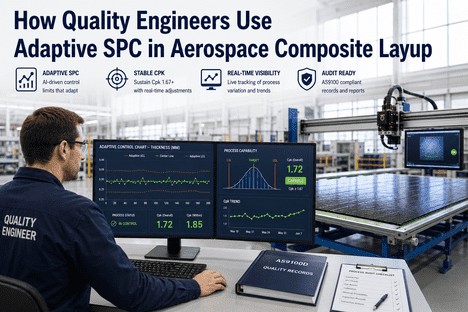
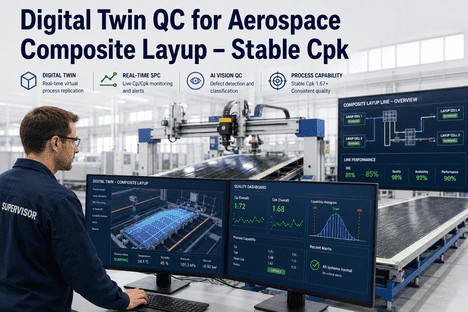
At 09:00 you approve a compaction force adjustment on AFP head 3 based on the shift supervisor's observation that the tow placement looks inconsistent on ply 7 of a 22-ply wing skin panel. The adjustment takes effect immediately on the physical laminate. The parameter change is logged. Layup continues. But the question that every plant manager in aerospace composite manufacturing faces at this moment remains unanswered: what is the actual impact of that adjustment on final panel capability? In conventional production, the answer arrives 24 to 72 hours later when the panel emerges from the autoclave and the ultrasonic inspection report quantifies every deviation that occurred during layup — including the ones that happened before the supervisor spotted the inconsistency. Those 24 to 72 hours are the quality visibility gap. Every ply laid during that gap is a decision made without feedback on its effect. Every parameter adjustment authorised in that window is a guess validated only by post-cure NDI. Digital Twin Quality closes this gap by keeping the AFP panel's digital model alive and synchronised throughout production — mirroring every tow pass, every temperature gradient, every compaction cycle in real time, and computing a live Cpk against specification limits before the panel leaves the layup tool.
Before DT → After DT
1.27
→
1.67+
Cpk improvement across all quality dimensions within 6 months of digital twin deployment on AFP programmes
Before DT → After DT
48 hrs
→
Real-time
Quality detection timeline compressed from post-cure NDI wait to live per-ply capability monitoring as each pass is deposited
Non-Conformance Reduction
50-70%
Reduction in final inspection non-conformance documented from AFP composite layup operations using digital twin QC with inline ply verification
Audit Traceability
100%
Ply-level traceability per AS9100D and NADCAP — every fiber orientation, compaction parameter, and temperature reading logged per part
The Gap the Digital Twin Closes: 48 Hours of Blind Production vs Continuous Capability Visibility
The difference between conventional AFP quality management and Digital Twin Quality is not a difference in data volume. The same AFP sensors generate the same process parameters in both cases. The difference is what happens to that data: in conventional production it is logged for retrospective analysis; in a digital twin environment it is synchronised with the design model, compared against specification limits in real time, and used to update a live Cpk that tells the plant manager whether the panel on the tool right now will meet requirements at cure.
AFP sensor data is logged to the process historian during layup. No real-time comparison is performed between as-built parameters and the design specification. Quality deviations — a fiber orientation drift of 3 degrees, a compaction force drop of 6%, a temperature gradient outside the process window — are not identified until the post-cure ultrasonic inspection, 24 to 72 hours after the deviation occurred. By that time, the affected plies are buried beneath subsequent layers, the root cause can only be inferred from the logged data, and the panel is committed to rework or scrap. The plant manager reviews the NDI report, approves a corrective action, and the same pattern recurs on the next panel because the process conditions that caused the deviation were never correlated with the outcome in a way that prevents recurrence.
Every AFP sensor reading is synchronised with the digital twin in real time — tow tension, compaction force, nip-point temperature, deposition speed, and geometric position are compared against specification limits at the moment each pass is deposited. The digital twin computes a live Cpk for each quality dimension and an aggregate panel-level Cpk that updates with every new ply. When a parameter trends toward the control limit, the system generates an advisory alert before the deviation produces a non-conforming condition. The plant manager sees the capability trend for every active panel on a single dashboard. The quality decision that once required a 48-hour NDI cycle is made immediately, at the AFP head, while the panel is still on the tool.
Live Cpk · Real-Time Twin · What-If Simulation · AS9100 Digital Thread
The 48-Hour Quality Blackout Between Layup and NDI Is the Largest Source of Undetected Capability Drift in AFP Production. Digital Twin QC Eliminates It.
iFactory's Digital Twin Quality platform synchronises every AFP head's sensor stream with a live panel model, computes Cpk per ply in real time, and alerts plant managers before a parameter deviation becomes a non-conforming condition — sustaining programme-wide capability above 1.67.
Four Quality Dimensions Under Continuous Digital Twin Surveillance
The digital twin does not monitor a single quality characteristic. It tracks four independent quality dimensions simultaneously — each with dedicated sensor inputs, a prediction model, and a real-time Cpk computation that feeds into the aggregate panel-level capability score. The plant manager sees all four dimensions on a single dashboard, with Cpk trends that reveal which dimension is drifting before the panel-level score drops below threshold.
Fiber Orientation
Cpk 1.74
The digital twin compares each tow's as-placed fiber angle against the CAD ply book specification using AFP head position data and vision system feedback. Deviations beyond the process window — typically +/- 3 degrees for structural plies — are flagged at the moment the tow is deposited, before the next ply covers the affected area. The fiber orientation Cpk trends across the programme reveal whether a recurring angular deviation correlates with a specific tool geometry, material batch, or AFP head configuration.
Compaction Force
Cpk 1.68
Roller compaction force is the single AFP parameter most correlated with interlaminar bond quality. The digital twin monitors compaction force at 50-millisecond intervals during each pass, comparing actual force against the process window defined for the material and ply geometry. A drift of 5-8% below setpoint — which research correlates with a measurable increase in void content and reduced interlaminar shear strength — triggers a real-time Cpk alert before the trend produces a non-conforming ply sequence.
Temperature Profile
Cpk 1.71
Nip-point temperature, substrate temperature, and ambient conditions are fused into a continuous thermal model of the deposition zone. The digital twin correlates thermal data with the material's specified processing window — identifying gradients that predict incomplete consolidation, residual stress development, or crystallinity variation before they are locked into the laminate. Thermal deviations are the earliest precursors to void formation, often detectable 10 to 30 passes before the mechanical consequence appears.
Geometric Conformance
Cpk 1.66
Ply position, tow gap/overlap dimensions, and steering radius are measured against the CAD model as each ply is completed. The digital twin maintains a spatial map of geometric deviations across the panel surface — showing the plant manager precisely where on the tool the capability drift is occurring. This spatial intelligence enables targeted intervention: adjusting a single AFP head parameter that affects the specific tool region where gap defects are clustering, rather than applying a programme-wide process change that may introduce variation in regions that were running within specification.
The Simulation Advantage: What-If Analysis That Returns Cpk Impact in Seconds
The most operationally valuable capability of a digital twin is not real-time monitoring — it is forward simulation. When a plant manager considers a process change — increasing deposition speed to recover schedule, adjusting compaction force in response to a roller wear indicator, modifying tow tension for a new material batch — the digital twin simulates the impact on final panel Cpk before the change is applied to physical production. The simulation runs in 5 to 15 seconds, using the current panel state as the starting condition and projecting the quality outcome across the remaining plies.
Digital Twin Simulation Scenarios — Typical Plant Manager Decisions, Predicted Cpk Impact
Scenario 1
Deposition Speed Increase of 8% to Recover Schedule
The programme is two panels behind schedule due to an upstream material delay. The plant manager considers increasing AFP deposition speed by 8% across the remaining three panels of the work order. The digital twin simulates the speed increase against the current material batch, tool temperature, and roller condition — and returns a predicted Cpk impact of -0.08 on geometric conformance and -0.03 on compaction force, with the aggregate panel Cpk remaining above 1.67.
Simulation result: Speed increase viable. Panel Cpk remains above 1.67.
Scenario 2
Compaction Force Reduction Due to Roller Wear Indicator
The compaction force trend on AFP head 2 shows a gradual decline of 3% over the last 40 production hours — consistent with roller wear. The maintenance team recommends reducing the force setpoint by 5% to maintain consistent contact pressure until the scheduled roller change. The plant manager simulates the reduction on the digital twin before approving. The simulation returns a predicted Cpk impact of -0.15 on compaction force and -0.07 on geometric conformance, dropping the aggregate panel Cpk to 1.58 — below the programme threshold. The plant manager overrides the reduction and schedules an early roller change.
Simulation result: Force reduction not viable. Early roller change scheduled.
Scenario 3
Material Batch Change With Different Tack Properties
A new prepreg batch is introduced with higher tack than the previous batch. The layup team reports that tows are sticking to the compaction roller more frequently. The plant manager simulates the batch change on the digital twin, which has been trained on the previous batch's parameter-to-quality correlation. The simulation predicts that the higher tack will reduce geometric conformance Cpk by -0.05 but will have no measurable impact on compaction force or temperature. The aggregate panel Cpk remains above 1.67. The plant manager approves the batch with a note to monitor fiber orientation Cpk for the first three panels.
Simulation result: Batch change approved. Monitor fiber orientation for first 3 panels.
Digital Thread · AS9100 Traceability · NADCAP Compliance · Automated Capability Reports
Every Parameter Adjustment You Authorise Today Has a Quality Consequence That Won't Be Visible Until NDI Tomorrow. The Digital Twin Shows It Now.
iFactory's Digital Twin Quality platform closes the 24-to-72-hour feedback gap between parameter decisions and quality outcomes — computing live Cpk per ply, running what-if simulations in seconds, and generating AS9100-compliant digital thread documentation for every panel produced.
The Digital Thread: From Design Intent to As-Manufactured Record
Digital Twin Quality generates something that reactive quality management cannot: a complete digital thread that links every parameter decision made during AFP programming to every sensor reading captured during layup, every deviation detected by the digital twin, every plant manager intervention authorised, and every cure cycle outcome. This digital thread satisfies AS9100D requirements for operational planning, controlled production conditions, and identification and traceability — and it is generated automatically, without manual data compilation or post-production reconciliation.
Design
Programme
Layup
Cure & NDI
CAD ply book, fiber orientation specification, material specification, tolerance stack-up, and Cp/Cpk targets per quality dimension are loaded into the digital twin as the baseline as-designed record.
AFP program parameters — deposition path, speed, compaction force setpoint, temperature targets — are captured and linked to the design requirements. The digital thread records which programme version was used for each panel.
Every sensor reading, every parameter deviation, every Cpk update, every alert generated, and every plant manager intervention is logged against the specific ply and pass where it occurred. The as-manufactured record is built in real time during layup.
Cure cycle parameters are appended, NDI results are correlated with the digital twin's predicted capability, and the final as-built record is closed. The complete digital thread is exportable per panel for AS9100 and NADCAP audit submission.
Reactive Quality vs Digital Twin Quality: The Plant Manager's Scorecard Across a Full Programme Quarter
The cumulative difference between operating with and without a digital twin is not visible in a single panel — it accumulates across quarters as prevented rework events, sustained capability above 1.67, and audit-ready records that replace manual evidence compilation. The comparison below reflects aggregated outcomes from AFP composite layup programmes using iFactory's Digital Twin Quality platform for a minimum of two production quarters.
Capability Dimension
Reactive Quality Management
Digital Twin Quality
Cpk consistency
Fluctuates 1.00-1.33 across panel types and shifts. Capability drift undetected until NDI. Corrective actions applied retrospectively.
Sustained 1.67-1.85. Real-time per-ply Cpk alerts enable intervention before drift produces non-conformance. Capability improves continuously through simulation-guided optimisation.
Quality feedback timeline
24-72 hours post-cure. Parameters cannot be adjusted during layup because the quality outcome is unknown until NDI. Corrections apply to future panels, not the current one.
Real-time per-ply. Parameters can be adjusted during layup based on live Cpk feedback. Corrections apply to the current panel, preventing defects before the next ply is deposited.
Rework event rate
18-26% of panels require rework. Each rework event consumes 12-18 hours of technician time and $8,000-14,000 in direct cost. Programme schedule impact is unpredictable.
4-8% of panels require rework. Rework events are predominantly caused by material anomalies that the digital twin flags at the point of detection. Programme schedule impact is managed proactively.
Process change decisions
Based on historical data and operator judgement. Each parameter change is a hypothesis tested by NDI results 2-3 days later. Iteration is slow and carries scrap risk.
Based on simulation results returned in 5-15 seconds. The digital twin shows predicted Cpk impact before the change is applied. Decisions are data-driven, not hypothesis-driven. Scrap risk eliminated.
Audit evidence readiness
Manual assembly of process logs, NDI reports, and shift records for each audit. Incomplete records create findings and follow-up evidence requests. 15-20% of quality engineer time spent on documentation.
Complete digital thread per panel, exportable on demand. Every parameter, deviation, intervention, and outcome timestamped and linked. AS9100D and NADCAP compliance documentation generated automatically. Zero documentation time for plant manager.
Conclusion
Process capability in aerospace composite layup is not determined by post-cure NDI. It is determined at the AFP head, during the fraction of a second when each tow is deposited and compacted. The parameters that govern that moment — compaction force, temperature, deposition speed, tow tension — are measurable. The sensor technology to capture them exists on every modern AFP system. The gap has never been a data gap. It has always been a synchronisation gap: the data exists but it is not compared against the design specification in real time, and the quality feedback loop is measured in days, not seconds.
Digital Twin Quality closes that gap. The panel on the AFP tool is mirrored in the digital twin at every moment, its Cpk computed and compared against specification limits before the next ply is deposited. The plant manager who once waited 48 hours for NDI results now sees the quality impact of every parameter decision before the decision is made — not through a dashboard of raw sensor readings, but through a live capability score that reflects the panel's current state and its projected final outcome. The what-if simulation that once required a week of engineering analysis runs in seconds. The digital thread that once took a quality engineer two days to compile for an audit is generated automatically, per panel, with every measured value linked to the design requirement and the production timestamp.
iFactory's Digital Twin Quality platform is purpose-built for plant managers in aerospace composite layup operations — delivering real-time Cpk per ply across four quality dimensions, what-if simulation for every process change decision, and an AS9100-compliant digital thread that is generated automatically without manual data compilation. Book a Demo to see the platform configured for your AFP cell's sensor infrastructure and panel types, or talk to an expert about a free Cpk improvement assessment for your composite layup programme.
Frequently Asked Questions
The Cpk Drift That Produced Last Quarter's Rework Events Was Visible in the AFP Sensor Data at the Moment It Occurred. Digital Twin QC Detects It Before the Next Ply Is Laid.
iFactory's Digital Twin Quality platform monitors every active panel in real time, computes Cpk per ply across four quality dimensions, runs what-if simulations in seconds, and generates an AS9100-compliant digital thread automatically — all without changing the plant manager's existing AFP programming or production workflow.