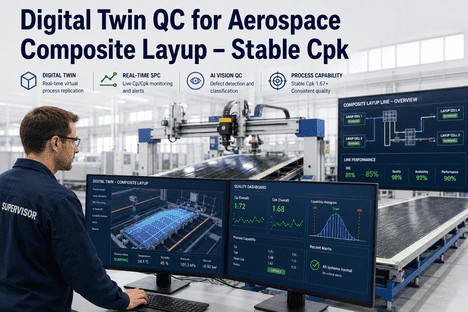
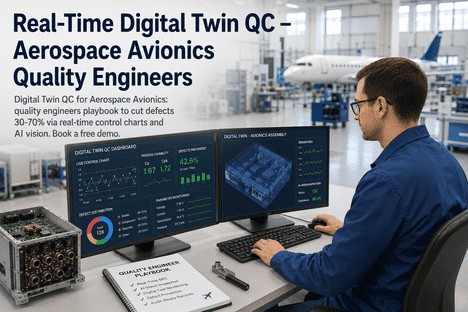
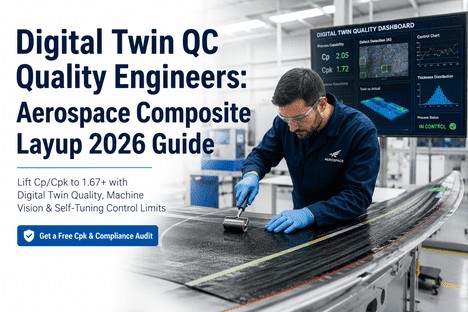
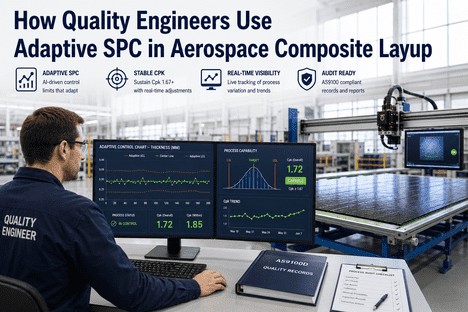
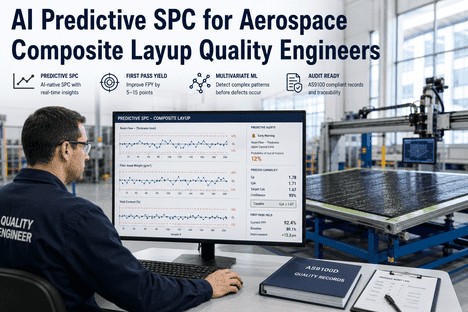
In aerospace composite layup, every panel exists twice before it is produced — once as a digital model programmed into the AFP system and once as a physical structure deposited tow by tow on the tool surface. In conventional production, the digital model is archived when layup begins, and the physical process proceeds without further synchronisation. The gap between the design intent captured in the digital model and the actual outcome measured at post-cure inspection is where quality deviations originate — and that gap is not quantified until the panel emerges from the autoclave, sometimes days after the root cause occurred. Digital Twin Quality closes this gap by keeping the digital model alive throughout production, synchronising it with real-time sensor data so that every physical event — every tow pass, every compaction cycle, every ply completion — is mirrored in the digital twin as it happens. For the composite layup supervisor, this means process capability is no longer a monthly report calculated from historical data. It is a live metric updated with every measurement, computed against a digital twin that reflects the current state of the panel on the tool, not the design intent programmed weeks before production began.
Digital Twin Quality · Real-Time Synchronisation · Process Capability
The Physical Panel Tells You What Happened. The Digital Twin Tells You What Will Happen.
A real-time digital twin synchronised with AFP sensor data gives supervisors continuous process capability visibility — detecting deviations at the point of occurrence and simulating their impact on final Cpk before the panel leaves the layup tool.
Physical AFP Cell and Digital Twin: Two Sides of the Same Process
Digital Twin Quality works by maintaining a live bidirectional connection between the physical AFP cell and its digital counterpart. Sensors on the physical cell stream real-time data to the twin. The twin updates its model, simulates quality outcomes, and sends actionable information back to the supervisor. The table below shows the parallel structure between the physical and digital domains.
AFP Head
Physical deposition head with tow feed, compaction roller, and cut/clamp mechanism. Sensors monitor vibration, temperature, torque, and roller position at 100 Hz.
3D Kinematic Model
Digital replica of the AFP head with real-time position, orientation, and load state. Updates from encoder data with sub-millimetre accuracy. Mirrors every head movement within 50 ms.
Tooling & Mandrel
Physical tool surface with embedded temperature sensors and laser tracking targets. Tool geometry defines the reference surface for all tow placements.
Virtual Tool Surface
Digital representation of the tool with live temperature mapping and deformation model. Updates as thermal gradients and compaction forces affect the physical tool geometry during layup.
Vision & Laser Sensors
In-situ measurement system capturing tow gap width, tow angle, and ply registration at every pass. Data volume: 500-2000 measurements per panel.
Quality State Model
Digital twin maintains a ply-by-ply quality state that aggregates all measurement data into a continuous capability assessment. Each ply is scored for Cpk against specification limits before the next ply begins.
Operator & Supervisor
Human decision-makers who interpret quality data and adjust process parameters — feed rate, compaction force, tow tension — based on inspection results and experience.
Simulation & Advisory Engine
The digital twin runs what-if simulations on demand. Supervisor asks "What happens to final Cpk if I increase compaction force by 5%?" and receives an answer in seconds, not days.
How Digital Twin Quality Works: Sense, Model, Simulate, Optimise
Digital Twin Quality operates through four continuous phases that run in loop for every panel, from the first tow pass through to cure authorisation. Each phase feeds the next, creating a closed-loop quality control system that updates in real time.
01
Sense
Real-time data acquisition from AFP sensors, vision systems, and laser profilometers at 50-100 Hz per channel. Data is streamed to the digital twin with sub-100 ms latency.
Data Source
AFP controller + vision + laser
02
Model
The digital twin updates its kinematic, thermal, and material models with incoming sensor data. The virtual panel state is recalculated after each tow pass to reflect the actual deposited geometry.
Processing
Real-time model update per pass
03
Simulate
The twin runs forward simulations to predict final quality outcomes based on current process state. Supervisors can run what-if scenarios — "What if compaction force increases 5%?" — and see predicted Cpk impact in seconds.
Output
Predicted Cpk + risk assessment
04
Optimise
The advisory engine recommends process adjustments — feed rate change, compaction force correction, tension adjustment — based on simulation results. Supervisors implement the recommendation and the cycle repeats with the next sensor reading.
Action
Process adjustment + closed loop
The digital twin gives us something we never had before — the ability to see the quality state of a panel while it is still on the tool. Before digital twin quality, we would lay up an entire panel, cure it, inspect it, and then discover a deviation that began at ply 4 and propagated through the remaining 12 plies. With the digital twin, we detected the deviation at ply 4, ran a simulation that showed it would degrade Cpk below 1.33 by ply 9, and corrected the compaction parameters at ply 6. The panel completed at Cpk 1.52. Without the twin, that panel would have been a post-cure reject.
— Shift Supervisor, Aerospace Composite Structures Manufacturer
Four Quality Dimensions the Digital Twin Monitors Continuously
The digital twin monitors four independent quality dimensions that collectively determine final panel Cpk. Each dimension has its own sensor inputs, prediction models, and capability targets. The supervisor sees all four on a single dashboard with real-time Cpk for each dimension and an aggregate panel-level Cpk that rolls up from the four individual scores.
Tow Placement Geometry
Cpk 1.67+
Gap width, overlap distance, tow angle deviation, and tow steering radius measured by vision system at every pass. The digital twin compares each measurement against specification limits and updates the placement Cpk in real time.
Prediction: Final gap distribution
Compaction Force Profile
Cpk 1.50+
Compaction roller force measured at 50 Hz across the full head width. The twin detects pressure gradients, roller wear patterns, and force drop-off at steering zones. Recommended force corrections are displayed on the supervisor dashboard.
Prediction: Consolidation uniformity
Ply Orientation Accuracy
Cpk 1.60+
Fibre orientation measured per ply via laser profilometry. The twin tracks deviation from programmed orientation across the full ply and computes the impact on laminate stiffness and strength properties.
Prediction: Laminate property deviation
Cure Readiness Index
Cpk 1.33+
Aggregate score combining tow placement, compaction, and ply orientation data into a single cure readiness metric. Panels below the Cpk threshold are flagged for engineering review before autoclave commitment.
Prediction: Post-cure Cpk outcome
Process Capability Impact: Digital Twin Quality at Programme Scale
The measurable impact of Digital Twin Quality on process capability is documented across iFactory deployments on AFP composite layup programmes. The figures below represent the aggregated improvement from running a real-time digital twin alongside physical production for a minimum of six months.
+0.4
Cpk Improvement
Average Cpk increase from 1.27 to 1.67 across all monitored quality dimensions within 6 months of digital twin deployment. The improvement is driven by early detection of capability drift and simulation-guided corrective action.
52%
Defect Reduction
Reduction in post-cure defects attributable to real-time deviation detection and simulation-based intervention. The digital twin identifies deviations at the pass level that traditional inspection would miss until post-cure.
94%
Simulation Accuracy
Correlation between digital twin-predicted Cpk and post-cure measured Cpk achieved after model calibration on the first 25 panels of each programme. Accuracy continues to improve as more data is incorporated.
$1.8M
Annual Scrap Cost Avoidance
Average annual savings from reduced post-cure scrap and rework across iFactory digital twin deployments on programmes producing 200+ panels per month at values above $10,000 per panel.
How Supervisors Use the Digital Twin on the AFP Cell Floor
The digital twin changes the supervisor's relationship with quality data. Instead of receiving quality information at discrete inspection points — end of ply, end of panel, post-cure — the supervisor has continuous visibility into the evolving quality state of every panel on the tool. The daily workflow focuses on three recurring actions.
Live Capability Dashboard
The supervisor's primary view shows current Cpk for all four quality dimensions across all active panels. Panels with Cpk trending below target are highlighted. One click opens the detailed view showing pass-level data and the digital twin's simulation results.
Key metric: Panel Cpk trend vs target
What-If Scenario Analysis
When a deviation is detected or a process change is planned, the supervisor runs a simulation on the digital twin. Typical scenarios: compaction force adjustment, feed rate change, tow tension modification. The twin returns predicted Cpk impact in 5-15 seconds.
Key metric: Simulated vs current Cpk delta
Simulation-Driven Correction
Based on simulation results, the supervisor approves or modifies the recommended process adjustment. The change is logged in the digital twin, and the system tracks the actual Cpk outcome against the simulated prediction, closing the learning loop.
Key metric: Simulation accuracy per adjustment type
Sense · Model · Simulate · Optimise · Real-Time Digital Twin
You Are Currently Producing Panels Without Knowing Their Quality State Until Post-Cure Inspection. The Digital Twin Closes That Gap.
iFactory Digital Twin Quality for aerospace composite layup — real-time sensor synchronisation, continuous Cpk monitoring, what-if simulation, and closed-loop process optimisation that lets supervisors see and shape final panel quality before the autoclave door closes.
Deploying Digital Twin Quality on Your AFP Cell
Digital Twin Quality deployment follows a phased approach that builds the twin incrementally, starting with the most readily available sensor data and expanding as additional data sources are integrated. The deployment pathway is designed to deliver value at each phase rather than requiring a complete build before benefits are visible.
Phase 1: Sensor Connect (Weeks 1-3)
Connect AFP controller data, vision system outputs, and laser profilometer streams to the digital twin platform. Establish the real-time data pipeline with sub-100 ms latency. The twin begins mirroring physical cell activity from day one.
Phase 2: Model Calibration (Weeks 4-8)
Calibrate the digital twin's kinematic, thermal, and material models against 10-15 completed panels. Validate simulation accuracy against post-cure inspection data. Tune model parameters per programme and material type.
Phase 3: Simulation Go-Live (Weeks 9-12)
Activate the what-if simulation capability for supervisors. Begin with compaction force and feed rate scenarios. Train supervisors on simulation workflow. Track simulation accuracy against actual outcomes.
Phase 4: Closed-Loop Optimisation (Week 13+)
Enable automated advisory recommendations based on simulation results. The system suggests optimal process parameters for each panel and tracks actual Cpk outcomes against predicted Cpk. Continuous model improvement through feedback loop.
Conclusion
Digital twin technology in aerospace composite manufacturing is not new. AFP programmes have used digital models for path programming and simulation for years. What is new — and what Digital Twin Quality delivers — is the extension of the digital twin from the design phase into the production phase, keeping it synchronised with the physical process in real time and using it as a continuous quality monitoring and simulation tool rather than a pre-production planning artefact.
The difference between a design twin and a quality twin is the data connection. A design twin models what should happen. A quality twin models what is actually happening by ingesting real-time sensor data — tow geometry from vision systems, compaction force from roller sensors, temperature from tool-mounted thermocouples — and updating its state with every measurement. The quality twin does not replace the design twin. It overlays live production data onto the design intent, highlighting the gap between the two and providing the supervisor with the information needed to close that gap before it produces a non-conforming panel.
iFactory's Digital Twin Quality platform brings real-time synchronisation, continuous Cpk monitoring, what-if simulation, and closed-loop optimisation together in a single supervisor interface designed for AFP composite layup operations — connecting to existing sensors and AFP controllers, calibrating models against production data, and providing simulation-driven process adjustments that keep Cpk above target from the first tow pass to cure authorisation. Book a Demo to see Digital Twin Quality configured for your AFP cell's sensor infrastructure, or Talk to an Expert to discuss Cpk improvement targets for your specific programme.
Frequently Asked Questions
Every Panel Exists Twice — Once in the Digital Twin and Once on the Tool. The Digital Twin Tells You the Quality State of Both in Real Time.
iFactory Digital Twin Quality for aerospace composite layup — real-time sensor synchronisation, four-dimensional Cpk monitoring, what-if simulation, and closed-loop optimisation that keeps process capability above target from the first tow pass through cure authorisation.