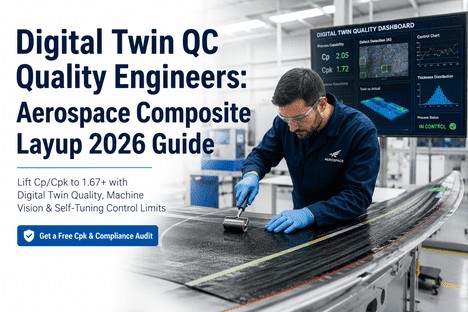
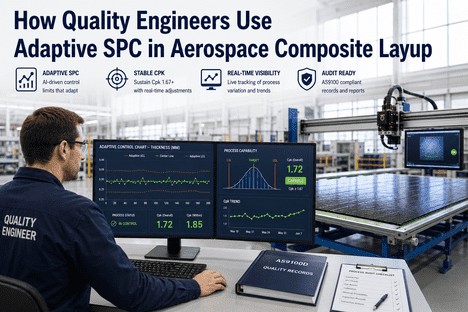
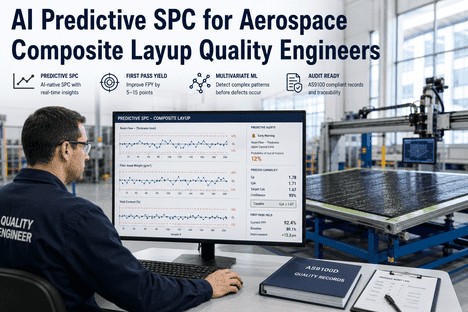
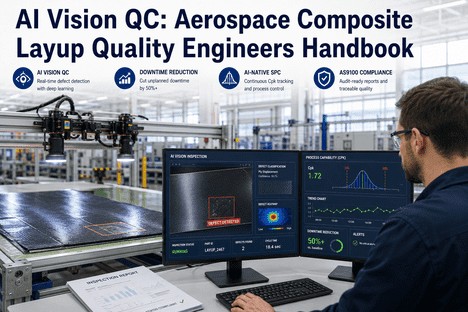
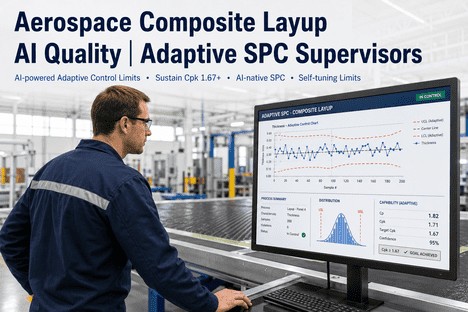
You are standing at the AFP cell. Ply 18 just completed. The control chart on the screen shows fibre orientation holding at 44.8° — within tolerance, but trending. The UCL is fixed at 48°, set six months ago during process qualification. The question no static SPC system can answer: is this trend about to become a defect, or is it normal drift for this material batch and ambient temperature? Adaptive control limits answer that question — dynamically, in real time, at every pass. This is what separates an operator who reacts to failures from one who prevents them.
Adaptive SPC · Real-Time Cpk · AS9100 · Composite Layup
Static Control Limits Cannot Predict What Adaptive AI Already Knows About Your Next Defect
iFactory's adaptive SPC engine continuously recalculates UCL and LCL from live ply data — keeping your Cpk above 1.67 and surfacing process drift before it becomes scrap.
1.67+
Target Cpk for critical-to-quality characteristics in aerospace — the threshold where defect risk becomes statistically negligible under AS9100 process controls
6.3%
CAGR projected for smart composite layup systems through 2035 — driven by production rate acceleration and tighter quality mandates across narrowbody and widebody programmes
27%
More defects detected by AI-integrated vision systems versus manual inspection alone — the gap that adaptive SPC closes between what operators see and what the process is actually doing
What Adaptive Control Limits Actually Mean on the Shop Floor
Traditional SPC gives every operator a fixed UCL and LCL derived from a process qualification run completed weeks or months ago. Those limits assume the process behaves the same way at 07:00 on a Monday in January as it does at 14:00 on a Thursday in August — with the same material batch, the same ambient humidity, the same layup head wear state. It does not. Adaptive control limits recalculate continuously from the live data stream, factoring in current process conditions to maintain the statistical validity that static limits lose as soon as real-world conditions drift from the baseline. For operators, this means fewer false alarms from limits that no longer reflect today's process — and fewer missed signals from limits that have drifted too wide to catch genuine deviation.
Static SPC vs. Adaptive SPC — What Changes for the Operator
Limits set once during qualification and frozen — no adjustment for material batch variation, tool wear, or seasonal temperature change
False alarms increase as process drifts from qualification baseline — operators begin ignoring alerts over time
Cpk reported against static limits overstates process capability when conditions have shifted
Root cause investigations start without current-state data — each occurrence treated as a new event
Limits recalculate in real time from live ply data — reflecting actual process behaviour at the current operating point
Alert thresholds remain statistically valid — operators act on genuine signals, not noise from stale qualification data
Live Cpk reflects today's process — enabling accurate disposition decisions and cure authorisation with current-state confidence
Cross-panel pattern detection links recurring deviations to root process parameters — investigation time collapses from days to minutes
The Four Process Variables That Defeat Static Limits in Composite Layup
Static SPC works in processes where the underlying physics do not change. Composite layup is not that process. Four variables routinely shift the process distribution far enough to invalidate qualification-era limits — and every one of them is invisible to a chart that was built on last quarter's data.
Variable 01
Material Batch Variation
Prepreg tack and drapability vary measurably between material batches — even within the same specification. A new batch arriving mid-production run will shift gap width and tow adhesion distributions from the pattern your static limits were calibrated on. Adaptive SPC detects this shift within the first few plies of the new batch and updates the control model before a systematic gap pattern accumulates.
Adaptive response: Control model updated within 3–5 ply passes of new batch introduction
Variable 02
AFP Head Wear and Compaction Roller Condition
Compaction roller wear changes the pressure distribution applied during tow placement. As wear accumulates over a production run, gap width at tow edges increases gradually — a trend that static limits flag only when the cumulative drift crosses the original qualification sigma. Adaptive limits tighten around the live process distribution, surfacing the drift trend before it reaches a level that generates out-of-tolerance plies.
Adaptive response: Drift detection triggers maintenance alert before tolerance breach occurs
Variable 03
Ambient Temperature and Humidity
Prepreg tack is highly sensitive to layup room temperature and humidity — both of which change seasonally and intraday. A layup specification qualified in winter conditions will produce different gap and overlap distributions in summer. Static limits derived from winter qualification data generate false alarms in summer and miss genuine deviation in autumn. Adaptive limits track the environmental envelope and separate real process signals from environment-driven noise.
Adaptive response: Environmental conditioning removes seasonal false-alarm rate from operator alerts
Variable 04
Part Geometry and Steering Radius
Fibre orientation deviation distribution is not uniform across a part — steering sections and tight-radius zones produce systematically higher deviation than flat regions. A single global UCL applied across the whole ply surface is either too tight on the steering zones (constant false alarms) or too loose on the flat zones (genuine deviations pass). Adaptive limits apply geometry-aware control models — tighter on flat regions where deviation is structurally critical, calibrated correctly on steering sections where a degree of deviation is expected.
Adaptive response: Zone-specific control models aligned to ply coordinate geometry
Live Cpk · Dynamic UCL/LCL · Operator Alerts
Your Static Limits Were Calibrated on Last Quarter's Process. Your AFP Cell Is Running Today's.
iFactory's adaptive SPC platform keeps control limits statistically valid at all times — so every Cpk reading reflects where the process actually is, not where it was at qualification.
How iFactory Builds Adaptive Control Limits Into the Layup Cell
The adaptive SPC architecture operates across three interconnected layers — real-time data ingestion from ply inspection, continuous model updating, and operator-facing alert and Cpk display. Each layer feeds the next, creating a closed loop where the quality control system gets more accurate as production data accumulates.
Layer 01
Live Ply Data Ingestion
Every tow pass, every ply, every panel
AI vision arrays capture gap width, fibre orientation angle, overlap dimension, surface height deviation, and tow count at every pass — feeding a continuous measurement stream into the SPC engine. Unlike end-of-ply manual checks, the data density is sufficient to detect within-ply trends before the ply is complete. The measurement stream includes contextual metadata — material batch ID, ambient conditions, AFP head hours, and ply position — so the adaptive model has the inputs it needs to separate process signals from environmental variation.
Sub-mm gap measurement per pass
Contextual metadata tagging
Continuous stream, not end-of-ply snapshot
Layer 02
Adaptive Model Update
UCL/LCL recalculated from live production data
The multivariate ML model processes the incoming measurement stream against the current process model — updating the control limit calculation as new data arrives. Control limits narrow when the process is running in tight, stable condition; they widen appropriately when steering-zone geometry or new material batch conditions introduce expected variation. The Cpk calculation updates with each new ply measurement — giving the operator a real-time capability index that reflects the panel in production, not the qualification run from last quarter. The model also tracks cross-panel trends: a gap width distribution drifting right across six consecutive panels signals an AFP head parameter issue before any single panel breaches its individual control limit.
Per-ply Cpk update
Geometry-zone-aware UCL/LCL
Cross-panel drift trending
Layer 03
Operator Alert and Disposition Interface
Actionable signal, not raw data
Operators receive a display showing the live Cpk for each quality characteristic, the current control chart with adaptive limits clearly marked, and a colour-coded capability status that shifts from green through amber to red as the process approaches and crosses control thresholds. Alerts trigger before the limit is breached — when the process is trending toward the control boundary — giving the operator time to adjust AFP parameters and prevent the out-of-tolerance condition rather than respond to it. Each alert includes the specific quality characteristic drifting, its current value, the adaptive limit it is approaching, and a suggested parameter adjustment derived from the historical correction database. This is not a data dump — it is a decision prompt that an operator can act on in seconds.
Pre-breach drift alert
Live Cpk per characteristic
Suggested AFP parameter correction
What Operators Gain: The Direct Impact on Your Daily Workflow
The shift from static to adaptive SPC is not just a quality improvement — it changes how operators experience every shift. Three direct workflow changes stand out above all others.
Fewer False Alarms. More Meaningful Signals.
When static limits generate constant alerts that experienced operators learn to dismiss, the alarm is no longer a safety net — it is background noise. Adaptive limits maintain statistical validity so that when an alert fires, it corresponds to a real process event. Operators respond to alerts because they trust them. Defect catch rate goes up. Response time goes down.
Cure Authorisation Based on Live Cpk, Not Operator Judgement Under Pressure
The decision to commit a panel to an 8–48 hour autoclave cycle should not rest on a static chart from six months ago and an inspector's visual check under time pressure. Adaptive SPC gives the operator and quality team a current-state Cpk for every measured characteristic — a documented, data-backed basis for cure authorisation that meets AS9100 Clause 8.6 release requirements and protects against post-cure scrap.
Root Cause at the First Recurrence, Not the Tenth
Cross-panel pattern detection links defect occurrences to process parameters — identifying whether a recurring gap pattern traces to material batch, AFP head wear, ambient conditions, or tool geometry. Without this capability, the same root cause investigation repeats every time a defect cluster appears. With adaptive SPC accumulating structured data across every panel, the pattern becomes visible before it becomes a programme-level quality escape.
"
We were running static control limits set at our FAI. Eighteen months later, same limits. The process had shifted — material supplier changed, new layup room conditioning system, different operators. The SPC data said we were in control. We weren't. Three panels scrapped post-cure in one month, all tracing back to a fibre orientation drift that was inside our static UCL. Adaptive limits would have flagged that trend on panel one. The recalibration cost us a month of engineering time that the software would have replaced with an afternoon's investigation.
— Process Engineering Lead, Tier 1 Aerostructures — Wing Skin Programme
Conclusion
The gap between a Cpk of 1.33 and a Cpk of 1.67 is not just a number on a report — in aerospace composite layup it is the difference between a process that tolerates borderline conditions and one that prevents defects before they are created. Static control limits cannot close that gap when the process that generated them no longer exists. Adaptive control limits close it continuously, updating from live ply data, filtering environmental noise, and surfacing genuine deviation before it reaches a cured panel. For operators on the shop floor, the practical difference is this: fewer alerts that mean nothing, more alerts that mean everything, and a Cpk that tells the truth about today's process rather than yesterday's qualification run.
iFactory's adaptive SPC platform integrates with AFP and manual composite layup operations — delivering live adaptive control limits, per-ply Cpk tracking, and AS9100-aligned build records that keep your process at 1.67 and your panels out of the scrap bin. Book a Demo to see adaptive control limits running on a composite layup use case matched to your part and process profile, or Talk to an Expert to discuss deployment for your layup cell.
Frequently Asked Questions
Every Ply. Every Pass. Every Panel. Live Cpk That Reflects Where Your Process Is Right Now.
iFactory adaptive SPC keeps your composite layup at Cpk 1.67+ — with dynamic UCL/LCL, operator alerts before breach, and AS9100 build records generated without manual data entry.