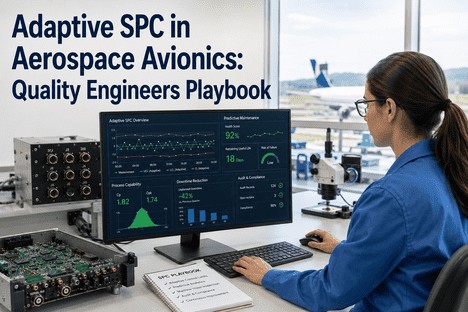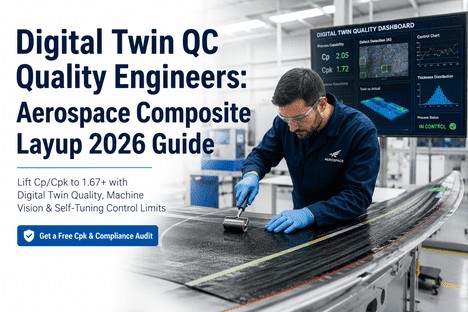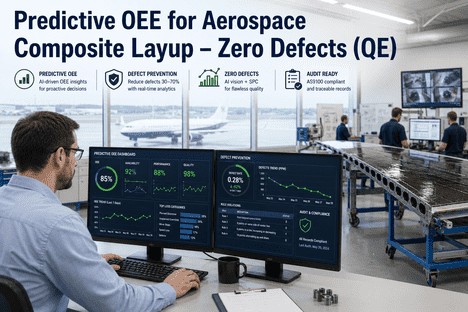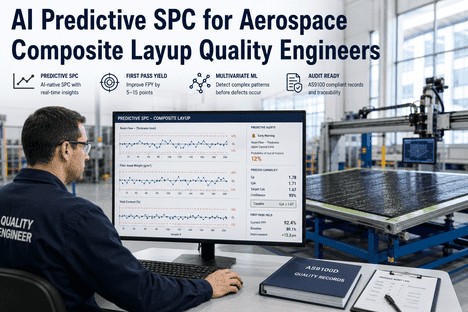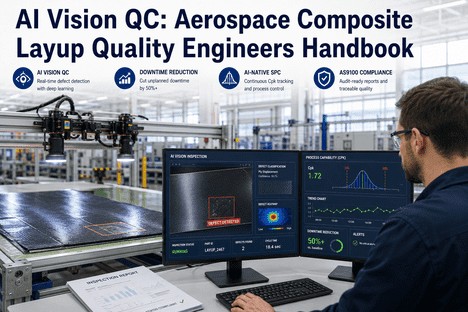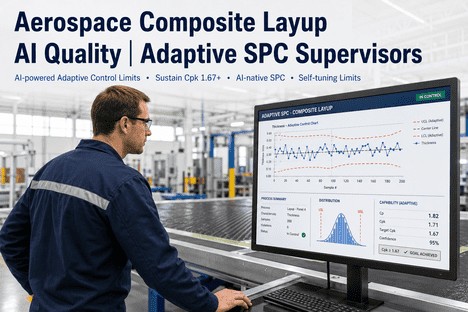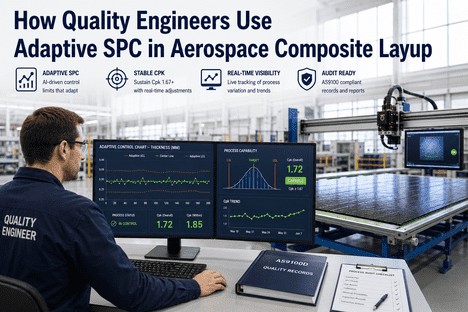
Every quality engineer in aerospace composite layup knows the frustration of a control limit that was set three months ago, based on a material batch that has since changed, on an AFP head that has since accumulated 400 hours of roller wear, in environmental conditions that bear no resemblance to today's shop floor. Static upper and lower control limits — calculated once and applied until the next manual recalculation — are the default practice in most AFP operations, and they are the single largest contributor to false alarms and missed signals in SPC. When control limits do not adapt to changing process conditions, the quality engineer either chases noise (over-adjusting to false alarms) or misses real signals (accepting drift as normal). Adaptive control limits solve this by recalculating UCL and LCL dynamically — per ply, per panel, per batch — using real-time process data and ML-driven variation modelling. This guide shows quality engineers how adaptive SPC for aerospace composite layup replaces static limits with dynamic control bands that shrink as the process stabilises and expand when variation increases, keeping Cpk consistently above 1.67 without manual recalculations or subjective judgement.
Static control limits are calculated from a historical data sample — typically 20-30 subgroups collected during a process qualification or capability study. Once set, these limits remain fixed until the next manual recalculation, which in many AFP operations happens quarterly or only when a Cpk drop triggers an investigation. The problem is that AFP composite layup is not a static process. AFP head temperature drifts with ambient conditions, compaction force degrades with roller wear, tow tension varies with spool depletion, and material batch changes introduce shifts in viscosity and tack. A control limit calculated in January on a new roller with a specific material lot does not reflect the process reality in March with 200 hours of roller wear and a different batch of prepreg.
Adaptive control limits solve this by treating the control limit as a living parameter that updates continuously. Instead of one UCL and one LCL per characteristic, the adaptive system maintains a dynamic control band that narrows when the process demonstrates stability and widens when conditions change — ensuring that the quality engineer is always comparing current output against limits that reflect the current process capability, not the capability from three months ago.
Adaptive control limits operate through a four-stage cycle that runs continuously on the edge processing unit, ingesting AFP sensor data and updating control limits with every tow pass. The system maintains separate dynamic limits for each critical characteristic — gap width, overlap height, tow angle, compaction force — and adjusts them independently based on the real-time variation of that specific parameter.
Adaptive control limits directly improve Cpk by ensuring that process capability is calculated against limits that reflect actual current variation — not outdated static limits. The table below shows the Cpk improvement observed across key AFP parameters after switching from static to adaptive control limits.
For the quality engineer, the shift from static to adaptive control limits changes the daily experience of SPC. Instead of spending shift time investigating out-of-control signals that turn out to be false alarms caused by outdated limits, the quality engineer sees only true special-cause variation. The control chart becomes a reliable indicator of process health, not a source of noise that demands investigation time. The deeper change is in what adaptive limits enable: the quality engineer can trust the control chart to reflect current process capability, making SPC a decision-support tool rather than a compliance exercise.
Our static control limits were generating so many false alarms that our quality engineers had stopped trusting the control charts entirely. They were spending 60% of their shift investigating signals that turned out to be normal process variation under current conditions. The adaptive limits eliminated 85% of those false alarms in the first week. Our quality engineers now investigate 2-3 real signals per shift instead of 15-20 false ones. Cpk went from 1.35 to 1.72 on gap width within one production cycle. The control chart is finally a tool we can trust.
Adaptive control limits are deployed as a software upgrade to the existing SPC infrastructure. The adaptive model runs on the same edge GPU that processes AI vision inference, sharing the real-time data stream from the AFP controller. No additional sensors or hardware are required. The deployment is designed to allow parallel running so quality engineers can compare adaptive limits against static limits before committing to the new system.
Adaptive control limits for aerospace composite layup change the quality engineer's relationship with SPC. Instead of maintaining control limits that become progressively less relevant as process conditions change, the quality engineer works with dynamic limits that reflect the real capability of the process at every moment. The false alarms that once consumed 60% of investigation time are eliminated. The Cpk values that once drifted between recalibrations are sustained above 1.67. The control chart that was once a compliance document becomes a real-time decision-support tool.
The AFP operations that consistently deliver Cpk above 1.67 across batch changes, shift transitions, and production rate increases share a common capability: adaptive control limits that update with every ply, backed by ML-driven variation models that distinguish special-cause from common-cause in real time. That capability is available today as a software layer on existing AFP cells — no hardware changes, no sensor additions, no disruption to the operator workflow.
iFactory's adaptive SPC platform is purpose-built for aerospace composite layup quality engineers — integrating with existing AFP data streams to deliver dynamic control limits, real-time Cpk per ply, and automated AS9100-compliant capability records without changing the quality engineer's tools or workflow.