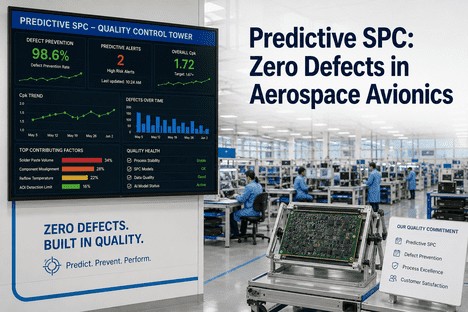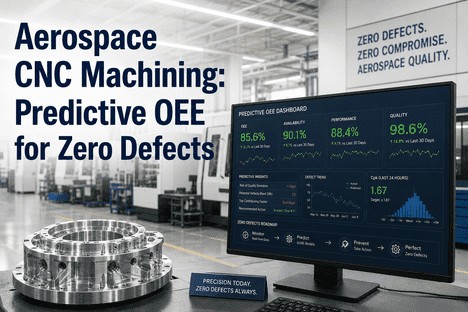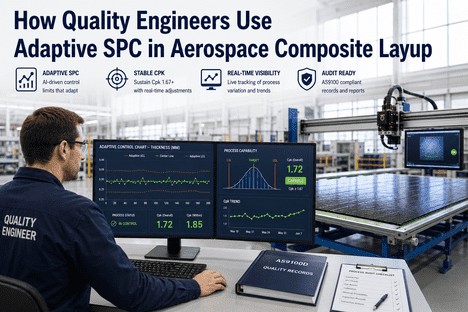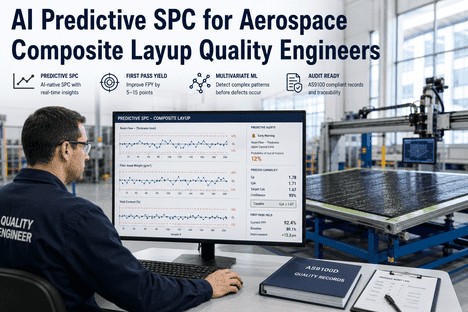
OEE in aerospace composite layup has always been a rear-view mirror. The availability, performance, and quality factors are calculated at shift handover from data that is already 8 to 12 hours old. By the time a quality engineer sees an OEE quality factor of 85%, the defects that caused that number have already been laid down, compounded across subsequent passes, and committed to cure. Predictive OEE changes this by forecasting the quality factor before defects form — giving the quality engineer a forward-looking OEE that updates with every tow pass and flags defect risk before it impacts yield. Instead of measuring OEE after the fact, Predictive OEE uses ML-driven models that analyse real-time AFP process parameters — temperature, compaction force, layup speed, tow tension, roller condition — and compute a real-time defect probability that feeds directly into a live OEE quality factor. When the forecasted quality factor drops below threshold, the quality engineer intervenes before the first non-conforming pass is laid. This guide shows quality engineers how Predictive OEE for aerospace composite layup transforms OEE from a lagging scorecard into a leading prevention tool, cutting defect rates by 30-70% through Western Electric rule triggers applied to dynamic control boundaries.
Traditional OEE is calculated at the end of a shift or batch. The quality factor is determined by dividing the good parts produced by the total parts produced. In AFP composite layup, where a single panel takes 8 to 16 hours to build and the cure cycle adds another 4 to 8 hours, the quality factor for a given shift is not known until the panel reaches post-cure inspection — sometimes 24 hours after the last tow pass was laid. By that time, the defects that drove the quality factor down have already been shipped to cure, and the root cause has been buried under 30 additional passes and a shift change. The OEE number is accurate, but it is also useless for defect prevention.
Predictive OEE solves this by computing a real-time forecasted quality factor that updates with every tow pass. Instead of waiting for the end-of-panel quality check, the ML model analyses AFP sensor data in real time, compares current process parameters against the model's learned profile of conforming and non-conforming passes, and outputs a live defect probability. That probability is translated into a forecasted OEE quality factor that the quality engineer sees on the dashboard — updated every 300 milliseconds. When the forecasted factor drops below a configurable threshold, the system triggers predefined Western Electric rules that alert the quality engineer to intervene before the next pass compounds the defect.
Predictive OEE combines two proven quality methodologies — Western Electric run rules and dynamic control boundaries — into a single real-time engine. Western Electric rules detect non-random patterns in process data: a run of seven points on one side of the mean, a trend of six points increasing or decreasing, or two of three points beyond two sigma. These rules have been used in SPC for decades, but they have always been applied retrospectively to static control limits. Predictive OEE applies them to dynamic control boundaries that update with every tow pass, and uses the pattern detection to forecast the OEE quality factor before the first non-conforming part is produced.
Each Western Electric rule detects a specific type of process behaviour. When applied to dynamic control boundaries on AFP parameters, these rules provide early warning of defect formation — typically 5 to 15 passes before the defect becomes visible.
For the quality engineer, Predictive OEE transforms the daily workflow from retrospective analysis to forward-looking process control. Instead of opening the OEE report at shift handover to see what went wrong on the previous shift, the quality engineer monitors a live dashboard that shows the forecasted quality factor for the current panel — updated with every tow pass — and alerts on Western Electric rule violations before they produce defects. The question shifts from "what was our OEE last shift?" to "what will our OEE be at cure if we do not intervene now?"
OEE was always a number we reported, never a number we used. By the time we saw the quality factor drop, the damage was done. Predictive OEE changed that completely. We now see a forecasted OEE for every panel before it reaches cure. Last month, the model flagged a Rule 4 trend on compaction force at pass 23 of a 180-pass panel. We replaced the roller at pass 25. The forecasted OEE dropped from 97% to 91% during those two passes, then recovered to 96% after the roller change. Without the forecast, we would have lost 15-20 passes to a widening gap that would have scrapped the panel at post-cure.
Predictive OEE is deployed as a software layer on the existing edge GPU that runs AI vision inference. The Western Electric rule engine and the ML-based quality forecast model share the same real-time data stream from the AFP controller. No additional hardware is required. The deployment is structured to allow quality engineers to validate the forecast against actual outcomes before relying on it for decisions.
Predictive OEE for aerospace composite layup changes the quality engineer's relationship with OEE. Instead of receiving a quality factor at shift handover that reflects defects already committed to cure, the quality engineer works with a live forecast that updates with every tow pass and flags defect risk before the first non-conforming pass is laid. The Western Electric rules that once identified patterns in historical data are now applied to dynamic control boundaries in real time, catching trends that would have been invisible against static limits. The defect prevention scorecard tracks interventions that would never have been possible with retrospective OEE.
The AFP operations that are moving toward zero-defect manufacturing share a common capability: predictive OEE that forecasts quality in real time, applies Western Electric rules to dynamic boundaries, and intervenes before defects form. That capability is available today as a software layer on existing AFP cells — no hardware changes, no sensor additions, no disruption to the operator or quality engineer workflow.
iFactory's Predictive OEE platform is purpose-built for aerospace composite layup quality engineers — integrating with existing AFP data streams to deliver ML-driven quality forecasts, Western Electric rule triggers on dynamic boundaries, and automated OEE reporting without changing the quality engineer's tools or workflow.