Predictive OEE for Aerospace Composite Layup – Zero Defects
By Grace on June 8, 2026
Overall Equipment Effectiveness in aerospace composite layup has always been a lagging indicator. The OEE number that lands on the supervisor's dashboard at the end of the shift is a precise calculation of what already went wrong — availability losses from unplanned AFP head stops that occurred three hours earlier, performance losses from reduced layup speed that accumulated across multiple cycles, quality losses from tow gap defects that will not be confirmed until post-cure inspection. By the time the OEE figure is available, the production loss is complete and the defect is irreversible. Predictive OEE transforms this dynamic by applying machine learning models trained on real-time AFP process data to forecast availability degradation, performance drift, and quality events before they materialise. The supervisor stops receiving a report on what was lost and starts receiving an alert about what will be lost — with enough lead time to intervene. For composite layup operations running 200 panels per month at programme value above $10,000 per panel, the difference between reporting OEE after the fact and predicting OEE before the loss is the difference between chronic scrap rates and a trajectory toward zero-defect manufacturing.
Traditional OEE Tells You What You Lost. Predictive OEE Tells You What You Will Lose.
ML-driven predictive OEE forecasts availability degradation, performance drift, and defect events before they occur — shifting the composite layup supervisor from reporting losses to preventing them, with documented defect reduction of 30-70% across mature deployments.
OEE Is Not a Single Number. It Is Three Independent Risks That Must Be Predicted Separately.
The OEE formula — Availability multiplied by Performance multiplied by Quality — collapses three fundamentally different failure modes into a single percentage. Each component requires a distinct prediction model tuned to the specific failure mechanisms of AFP composite layup. Predictive OEE does not calculate a single forecasted number. It runs three parallel ML models — one for each OEE component — and surfaces the forward-looking risk for each axis independently. The supervisor sees not just a predicted OEE value but a breakdown of which component is most at risk and what specific corrective action will protect it.
A
Availability
Traditional OEE: 92%
Predictive OEE Target: 97%
Traditional limitation
Availability is calculated after downtime occurs. AFP head stops, material reload delays, and tool changeover losses are recorded retrospectively. No mechanism exists to predict a stop before it happens.
Predictive solution
ML models trained on AFP head vibration, temperature, and torque data predict mechanical degradation 8 to 24 hours before failure. Supervisors receive maintenance alerts with specific component identification and remaining useful life estimates.
P
Performance
Traditional OEE: 88%
Predictive OEE Target: 95%
Traditional limitation
Performance losses from reduced layup speed, micro-stops, and AFP programming inefficiencies are calculated from cycle time data that arrives after the fact. Speed losses are buried in shift-level averages.
Predictive solution
Cycle time forecasting models compare real-time layup speed against historical baselines and flag deviations before they accumulate into measurable performance loss. Supervisors see live performance trend lines with forecasted end-of-shift impact.
Q
Quality
Traditional OEE: 93%
Predictive OEE Target: 99%
Traditional limitation
Quality losses are confirmed at post-cure inspection — days after the panel was laid up. Defect data is aggregated monthly. No mechanism exists to predict a quality event while the panel is still on the AFP tool.
Predictive solution
Real-time gap width, tow angle, and compaction force data feeds a quality prediction model that scores each ply for defect risk as it is laid. Tow passes flagged above the risk threshold are flagged for immediate visual inspection before the next ply is deposited.
Traditional OEE vs Predictive OEE: From Retrospective Reporting to Forward-Looking Prevention
The difference between traditional and predictive OEE is not the calculation — both use the same Availability × Performance × Quality formula. The difference is the time axis. Traditional OEE looks backward at completed production and calculates what was lost. Predictive OEE looks forward at current process data and calculates what will be lost if no intervention occurs. Each paradigm produces fundamentally different actions from the supervisor.
Traditional OEE — Retrospective
-
Availability reported after downtime
Unplanned AFP head stop at 09:47 is recorded at end of shift. Root cause investigation begins 6+ hours after the event.
-
Performance calculated from shift averages
Cycle time data is aggregated across the shift. A slow layup sequence at pass 33 is invisible within the shift average.
-
Quality confirmed post-cure — days later
Gap width drift that began at pass 12 is detected at NDT inspection 48 hours later. Eight panels produced in the gap are all affected.
-
Monthly OEE report drives quarterly action
OEE trends are reviewed in monthly quality meetings. Corrective actions are planned for the next quarter — 90 days after the losses occurred.
Predictive OEE — Forward-Looking
+
Availability predicted 8-24 hours before failure
ML model detects AFP head vibration signature change at 08:15. Alert predicts component degradation within 14 hours. Maintenance scheduled during planned changeover at 15:00. Zero unplanned downtime.
+
Performance trended per pass in real time
Live cycle time monitoring flags pass 33 at 12% above baseline. Supervisor receives alert at pass 35. AFP programmer adjusts feed rate for remaining passes. End-of-shift performance loss: 1.2% instead of 4.8%.
+
Defect risk scored per ply during layup
Quality prediction model flags ply 7 at gap-width risk score 0.82. Operator performs in-process inspection, identifies developing wrinkle, and corrects tow tension before ply 8. Zero post-cure defect on that panel.
+
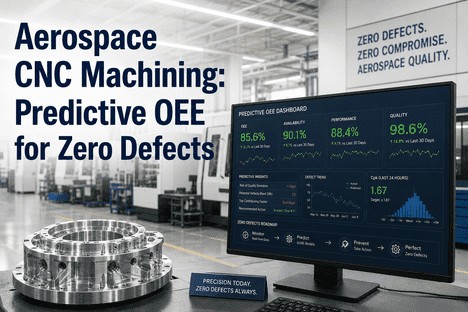
Real-time OEE dashboard with 4-hour forecast
Supervisor sees current OEE, forecasted end-of-shift OEE, and the component most at risk — updated every measurement cycle. Corrective actions are taken within the same shift, not the same quarter.
We ran traditional OEE for three years and watched the number bounce between 78 and 84 percent. Every month the quality meeting reviewed the same OEE trend. Every quarter we planned the same corrective actions. Nothing changed because the feedback loop was 90 days long. Predictive OEE collapsed that feedback loop to minutes. The first week we saw the live forecasted OEE dropping during a shift, we intervened before the loss materialised — and that single intervention recovered 3.2 percent OEE that traditional OEE would have reported as lost three weeks later at month end. The metric did not change. The time axis changed. And that made all the difference.
— Production Supervisor, Composite Aerostructures Tier 1 Supplier
How Predictive OEE Prevents Defects at Every Stage of the Composite Layup Process
Defect prevention through predictive OEE operates across four distinct stages of the composite layup process. Each stage has specific prediction models that forecast the type of loss most relevant to that production phase. When the stages are linked, the supervisor sees a continuous risk profile for every panel from the first tow pass through to cure authorisation.
STAGE 1
AFP Layup
Real-time tow placement monitoring
Predictive model:
The ML model scores each tow pass for gap width, tow angle, and compaction force deviation. Passes exceeding the risk threshold trigger in-process inspection before the next ply is deposited. Defect prevention starts at the point of deposition, not at post-cure inspection.
→
STAGE 2
In-Process Inspection
Automated vision + laser profiling
Predictive model:
Vision inspection data feeds a defect propagation model that estimates whether a detected anomaly will grow or stabilise across subsequent plies. Anomalies predicted to propagate are flagged for immediate correction. Stable anomalies are tracked but do not stop production.
→
STAGE 3
Cure Authorisation
Pre-cure quality risk assessment
Predictive model:
Before each panel enters the autoclave, the aggregate quality risk score — derived from all tow-level and ply-level predictions — is displayed alongside the panel's current-state Cpk for each critical characteristic. Panels with composite risk scores above the threshold are routed for engineering disposition before cure commitment.
→
STAGE 4
Post-Cure Validation
NDT + CMM verification
Predictive model:
Post-cure inspection results are fed back into the ML training pipeline, closing the prediction loop. Each verified defect or confirmed accept updates the prediction models for future panels. The system learns from every cure cycle and continuously improves its forward-looking accuracy.
The Six Big Losses in AFP Composite Layup — and How Predictive OEE Addresses Each
The Six Big Losses framework is the standard OEE taxonomy for manufacturing. In AFP composite layup, these six losses take specific forms that require tailored prediction models. Predictive OEE addresses each loss with a dedicated ML model that forecasts the loss event before it occurs.
Availability Loss 1
AFP Head Failure
Unplanned AFP head stops from motor overload, encoder fault, or tow feed jam. Typical duration: 35-90 minutes per event. Frequency: 2-4 per month per cell.
Predictive model: Vibration + temperature + torque anomaly detection forecasts degradation 8-24 hours before failure.
Availability Loss 2
Material Reload & Changeover
Downtime from prepreg creel changeover, tooling swap, and programme change. Typical duration: 20-45 minutes per event. Frequency: 3-5 per shift.
Predictive model: Creel depletion forecast based on layup rate and remaining material predicts changeover windows 30-60 minutes in advance.
Performance Loss 1
Reduced Layup Speed
AFP operating below programmed feed rate due to material tack variation, roller wear, or programming inefficiency. Typical impact: 8-15% speed reduction.
Predictive model: Cycle time forecasting compares real-time speed against part-programme baseline and predicts end-of-cycle performance loss at pass 3 of each sequence.
Performance Loss 2
Micro-Stops & Idle Time
Short-duration stops under 5 minutes from tow breaks, sensor resets, or operator adjustments. Typical impact: 12-18 events per shift, 3-7 minutes each.
Gaps, overlaps, wrinkles, and tow angle deviation in deposited tows. Detected at layup but confirmed at post-cure. Typical first-pass yield: 88-93%.
Predictive model: Tow-level quality prediction scores each pass for defect risk. Passes exceeding 0.7 risk threshold trigger in-process inspection. Catches defects at deposition, not at post-cure.
Quality Loss 2
Post-Cure Rejects & Rework
Panels rejected after autoclave cure for porosity, delamination, or dimensional deviation. Each reject costs $8,000-15,000 in material and cycle time.
Predictive model: Pre-cure aggregate risk model combines all ply-level predictions into a single Panel Risk Score. Panels above threshold are routed for engineering disposition before autoclave commitment.
Predictive OEE Impact: What the Numbers Show at Programme Scale
The measurable impact of transitioning from traditional to predictive OEE is documented across multiple aerospace composite layup deployments. The figures below represent aggregated data from iFactory deployments on AFP cells running 150 to 250 panels per month at programme values of $8,000 to $15,000 per panel.
+12-18%
OEE improvement within 6 months of predictive OEE deployment — driven primarily by reduced unplanned downtime and lower post-cure defect rates.
30-70%
Defect reduction across all quality categories — from tow placement defects detected during layup through post-cure rejects prevented by pre-cure risk assessment.
65-80%
Reduction in unplanned AFP head downtime — predictive maintenance alerts shift from reactive repairs to scheduled interventions during planned changeover windows.
$1.2-2.8M
Annual cost avoidance at programme scale through combined availability, performance, and quality improvements — calculated against baseline OEE of 75-82%.
The Supervisor's Predictive OEE Dashboard: Three Views, One Objective
The predictive OEE dashboard organises information into three focused views that correspond to the supervisor's natural decision-making workflow. Each view answers a specific question and drives a specific action. Together, the three views replace the traditional end-of-shift OEE report with a continuous real-time decision support system.
View 1: Current OEE vs Forecast
Shows real-time OEE calculation alongside a 4-hour forecast. When forecasted OEE falls below the target threshold, the dashboard highlights the most at-risk component Availability, Performance, or Quality and the specific loss driver.
Action: Supervisor identifies the component causing the forecasted decline and navigates to the detailed view for that risk axis.
View 2: Risk Axis Deep Dive
Expands the selected OEE component into specific loss categories with live trend charts, prediction models, and alert history. Each loss category shows current value, forecasted trajectory, and recommended corrective action.
Action: Supervisor reviews the top-ranked alert, examines the supporting data, and logs a corrective action or delegates to the appropriate team.
View 3: Shift Impact Summary
Aggregates all predictive OEE activity into a single-shift summary: alerts generated, actions taken, losses prevented, and forecasted vs actual OEE comparison. Serves as the shift handoff document for the incoming supervisor.
Action: Supervisor reviews shift performance, confirms all alerts are closed or escalated, and transfers awareness to the next shift with continuity of forecast.
Six Big Losses · Defect Prevention · Forward-Looking OEE
Your End-of-Shift OEE Report Tells You What You Already Lost. Predictive OEE Tells You What You Are About to Lose — With Time to Prevent It.
iFactory predictive OEE for aerospace composite layup — ML-driven availability forecasting, real-time performance tracking, ply-level quality prediction, and live OEE dashboards that give supervisors a forward-looking view of every panel from first tow pass through cure authorisation.
Transitioning from traditional OEE to predictive OEE follows a structured pathway that begins with data connectivity and progresses through model training, parallel validation, and full deployment. The system is designed to run alongside existing OEE tracking without displacing current reporting processes during the transition period.
1
Data Connect
Connect AFP controller logs, vision inspection data, and maintenance records to the predictive OEE platform. Standard API connectors support OPC UA, MTConnect, and REST. Duration: 1-2 weeks.
2
Model Train
ML models are trained on 3-6 months of historical data for each OEE component. Models are validated against known events and calibrated for the specific AFP cell characteristics. Duration: 3-4 weeks.
3
Parallel Run
Predictive OEE runs alongside traditional OEE for 4-6 weeks. Forecasts are compared against actual outcomes. Model accuracy is validated per OEE component. Duration: 4-6 weeks.
4
Full Deploy
Predictive OEE becomes the primary dashboard. Traditional OEE retained for audit and baseline comparison. Supervisor training and workflow integration completed. Duration: 1-2 weeks.
Conclusion
Overall Equipment Effectiveness was designed as a manufacturing benchmark — a way to compare the performance of one cell against another, one shift against another, one quarter against another. It was never designed as a real-time decision support tool. The traditional OEE calculation answers the question "What happened?" but it cannot answer the question the supervisor needs answered most: "What will happen next?" Predictive OEE closes this gap by applying machine learning to the same data that traditional OEE uses — AFP head logs, inspection data, cycle time records — and transforming it from a historical record into a forward-looking forecast.
The three components of OEE — Availability, Performance, and Quality — each require a distinct prediction model tuned to the specific failure mechanisms of AFP composite layup. Availability models detect mechanical degradation patterns in AFP head vibration and temperature data 8 to 24 hours before failure. Performance models compare real-time cycle time against programme baselines and flag deviations at the individual pass level. Quality models score every tow pass for defect risk and aggregate those scores into a panel-level assessment that informs cure authorisation decisions. When these three models are linked in a single dashboard, the supervisor sees not just the current OEE but a continuous forecast of where OEE is heading — and which specific loss driver will cause the decline if no action is taken.
iFactory's predictive OEE platform brings these three prediction models together in a single supervisor dashboard designed for AFP composite layup operations — connecting to existing AFP controllers and inspection systems, training models on historical data, running alongside traditional OEE during the validation period, and transitioning to full predictive mode with live forecasting, real-time risk scoring, and shift-level impact summaries. Book a Demo to see predictive OEE configured for your AFP cell's production profile, or Talk to an Expert to discuss OEE improvement targets for your specific programme.
Frequently Asked Questions
The OEE calculation itself is identical — Availability times Performance times Quality. Predictive OEE does not change the formula. What changes is when and how the calculation is applied. Your MES calculates OEE at the end of each shift, each day, or each month using completed production data. It tells you what the OEE was. Predictive OEE uses the same input data — AFP controller logs, inspection results, cycle time records — but applies ML models to forecast what the OEE will be at the end of the current shift if current trends continue. The difference is the time axis: historical vs forward-looking. The two systems complement each other — your MES provides the validated actuals, and predictive OEE provides the forecast that enables prevention. Most iFactory deployments run both systems in parallel, using the MES OEE as the audit record and predictive OEE as the real-time decision support tool. Book a Demo to see how predictive OEE integrates with your existing MES data streams.
Model accuracy varies by OEE component and depends on data quality and volume. Availability prediction models typically reach 85-92% accuracy for 8-to-24-hour failure forecasts after 3 to 4 weeks of model training and validation against historical maintenance records. Performance forecasting models achieve 90-95% accuracy for end-of-shift cycle time prediction after 2 to 3 weeks of calibration on programme-specific baselines. Quality prediction models show the widest variance — 75-88% accuracy for tow-level defect risk scoring, improving to 85-93% after the first 50 panels of post-deployment feedback data is incorporated into the training pipeline. The parallel run phase is specifically designed to validate model accuracy against actual outcomes before transitioning to predictive OEE as the primary dashboard. During this phase, every prediction is compared against the actual result, and model parameters are tuned to improve forecast accuracy. Talk to an Expert to discuss model accuracy expectations for your specific AFP cell configuration and data history.
Predictive OEE requires three primary data sources: AFP controller logs (cycle time, head status, alarm history, torque and vibration data if available), inspection data (vision system outputs, laser profilometer measurements, CMM results), and maintenance records (component replacement history, work order timestamps, root cause codes). For AFP cells with existing digital data output through OPC UA, MTConnect, or REST interfaces, the infrastructure requirement is minimal — the platform connects to existing data streams without requiring additional sensors or hardware. For cells with limited digital data collection, the platform supports phased data infrastructure buildout, beginning with the most readily available data sources and expanding as additional sensors and data collection points are added. The ML models can operate with incomplete data during the initial deployment and improve as data density increases. Book a Demo to discuss data infrastructure requirements for your specific AFP cell configuration.
Yes. Predictive OEE maintains separate models for each AFP cell and each part programme within each cell. A cell-level OEE model aggregates across programmes running on that cell, while programme-specific models track OEE at the individual part level. The supervisor dashboard provides both views — cell-level OEE for overall line management and programme-level OEE for identifying which programmes absorb the most loss. When a cell transitions between programmes, the system automatically loads the correct programme-specific prediction models — including programme-specific performance baselines, quality risk thresholds, and maintenance history relevant to that programme's material and tooling configuration. For high-mix operations running multiple programme changes per shift, the system supports rapid model switching without disrupting the continuous OEE forecast. Talk to an Expert to discuss multi-cell, multi-programme predictive OEE configuration for your production profile.
Predictive OEE is designed to accelerate existing continuous improvement programmes rather than replace them. Lean manufacturing tools like value stream mapping, 5S, and standardised work identify process improvement opportunities through observation and analysis. Predictive OEE augments these tools by providing data-driven evidence of where losses are occurring and when they are forecasted to occur — enabling Lean teams to prioritise improvement efforts on the losses with the highest predicted impact. Six Sigma DMAIC projects benefit from predictive OEE during the Measure and Analyse phases, where the forecast models provide baselines and root cause hypotheses that reduce the time spent on manual data collection and analysis. The Control phase of Six Sigma projects uses predictive OEE alerts as an ongoing monitoring mechanism to detect when process improvements begin to degrade. In practice, iFactory deployments report that predictive OEE reduces the data collection and analysis phase of improvement projects by 40-60%, allowing teams to reach the Improve phase faster and with higher-confidence baselines. Talk to an Expert to discuss how predictive OEE integrates with your existing continuous improvement framework.
Your End-of-Shift OEE Is a History Lesson. Predictive OEE Is a Forecast That Lets You Change the Outcome.
iFactory predictive OEE for aerospace composite layup — ML-driven availability forecasting, real-time performance tracking, ply-level quality prediction, and a three-view supervisor dashboard that transforms OEE from a retrospective metric into a forward-looking prevention tool.