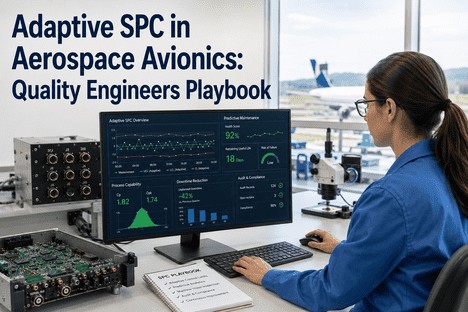
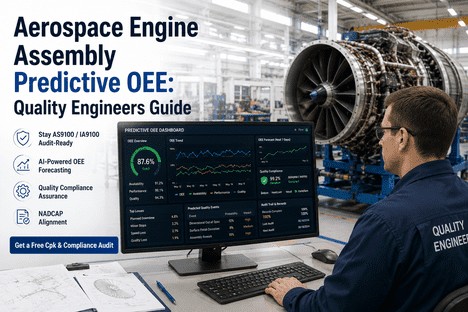
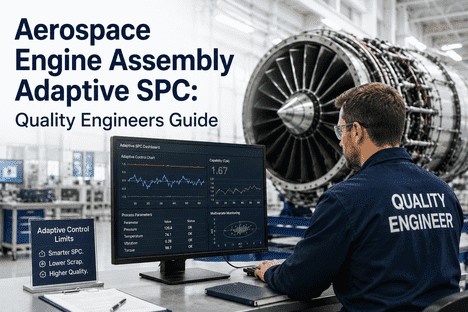
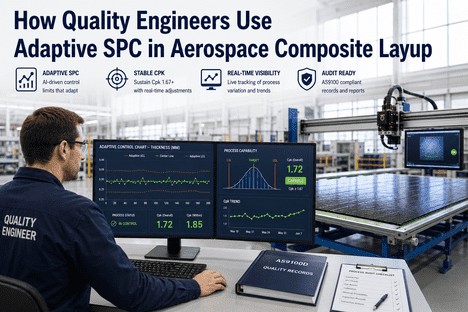
Adaptive SPC in Aerospace Avionics: Quality Engineers Playbook
By Grace on June 15, 2026
Every quality engineer in aerospace avionics assembly knows the moment when a control chart generates its third false alarm of the shift. The X-bar point sits outside the UCL, but the operator has already seen this pattern twice today — each time the investigation concluded the same thing: the process was fine, the limits were wrong, and the corrective action log records another closed event that changed nothing. The real cost is not the investigation time. The real cost is the gradual erosion of alert credibility that leaves the one real signal undetected while the quality team investigates noise. In avionics production, where IPC Class 3 zero-defect requirements intersect with AS9100 process control mandates, the gap between static control limits and a multi-state manufacturing process is the single largest source of preventable defects, wasted investigation hours, and unplanned downtime. Adaptive SPC closes this gap by replacing static UCL/LCL with dynamic boundaries that recalibrate automatically to every material lot change, solder profile transition, and component family switch — giving the quality engineer a control system that generates alerts only when the process genuinely deviates from its current operating norm.
Quality Engineers in Aerospace Avionics Who Deploy Adaptive SPC Cut Unplanned Downtime by 43% and False Alarms by 60–70% — Without Compromising AS9100 Compliance.
iFactory's adaptive SPC platform gives avionics quality engineers dynamic control limits that recalibrate to every material lot, solder profile, and product family change — with ML-driven predictive maintenance alerts, automated AS9100 audit documentation, and a 48-hour advance warning window before defect events.
of aerospace manufacturers now deploy AI for predictive maintenance and equipment monitoring — the fastest-growing quality technology adoption rate in the sector
43%
reduction in unscheduled maintenance events documented across aerospace operations using predictive failure detection driven by adaptive SPC data streams
60–70%
false alarm reduction when adaptive ML control limits replace static limits — restoring operator alert credibility and driving corrective action response rates above 95%
48h
advance anomaly detection delivered by AI-driven predictive maintenance — enabling quality engineers to intervene before defects are produced or equipment fails
Why Static Control Limits Create the False Alarm Crisis in Avionics Assembly
Aerospace avionics assembly operates across multiple distinct process states within a single production day: the warm-up phase when reflow ovens stabilise, the steady-state production window, the component family changeover, the solder paste batch transition, and the end-of-run cool-down. Each state produces a different natural band of process variation. Static control limits — set during a single process capability study that may be six to eighteen months old — cannot describe all of these states correctly. The result is a control chart that generates false alarms during warm-up and changeover phases while simultaneously failing to detect genuine drift during the stable production window, because the limits are too wide for one state and too narrow for another. The quality engineer spends 60 to 80% of investigation time chasing false signals. Operators learn to silence alerts. The one genuine defect precursor that fires during a critical assembly pass is indistinguishable from the fifteen false alarms that preceded it. This is the structural failure mode that static SPC introduces into avionics quality management.
The Three-Stage SPC Maturity Progression in Avionics Quality Engineering
01
Static SPC — Reactive Quality
Control limits are set during process qualification and remain frozen until the next capability study, typically every 6–18 months. The quality engineer manually monitors charts for ±3-sigma violations and Western Electric rule breaks. Every material lot change, solder profile adjustment, and product family switch generates false alarms because limits calibrated for one process state are applied to all states.
60–80% false alarmsManual chart reviewDefects found post-production
02
Adaptive SPC — Active Control
Dynamic UCL and LCL recalculated continuously against a rolling window of current production data. Regime change detection distinguishes common-cause shifts (material lot, recipe change) from assignable-cause events (tool wear, equipment fault). Limits tighten when the process narrows and expand when variation increases. False alarms drop 60–70%. Quality engineers investigate only genuine signals.
ML-driven predictive layer ingests adaptive SPC data alongside equipment sensor telemetry. Cross-parameter correlation identifies precursor patterns 48 hours before failure. Predictive alerts with ranked root causes replace reactive alarms. Maintenance shifts from scheduled to condition-based. Work orders are generated automatically from predictive model outputs.
48h advance warningAuto work order generation43% less unscheduled downtime
Progression delta: Stage 1 to Stage 3 delivers a 10–20 point OEE improvement, 45% scrap reduction, and AS9100 audit documentation generated automatically from live process data.
The Predictive Maintenance Trigger Chain: From Adaptive Limit to Automated Work Order
The operational value of adaptive SPC for the quality engineer is not the control chart itself — it is the predictive maintenance capability that adaptive data enables. When control limits are recalculated continuously, every data point carries process state context that static charts discard. The ML model ingests this context-rich data and correlates it with equipment telemetry, identifying early precursors to failure that no single-variable chart can detect. The chain from measurement to maintenance action follows a seven-step sequence that runs automatically, generating a preventive action before the quality engineer would have received the first static-chart false alarm.
01
Sensor Measurement Collection
Reflow oven thermocouple, SPI solder paste height, AOI post-placement, and pick-and-place force data streamed continuously at 1-second to 1-minute intervals depending on parameter criticality.
Data source: Oven TC, SPI, AOI, PnP
02
Adaptive Limit Evaluation
Rolling statistical model evaluates each measurement against dynamic UCL/LCL calibrated to the current product family, solder paste batch, and oven profile. Regime change detection identifies transitions.
Threshold: Dynamic UCL/LCL
03
Cross-Parameter Correlation
ML model correlates drift across multiple parameters — solder paste height trend + reflow zone 3 temperature + pick-and-place force — to determine if a single root cause explains the pattern.
ML model: Multi-parameter
04
Predictive Forecast Generation
Model forecasts probability of defect event or equipment failure within configurable window (2–48 hours). Forecast includes predicted defect type, affected zone, and confidence interval.
Window: 2–48 hours
05
Quality Engineer Alert
Predictive alert sent to quality engineer dashboard with ranked root cause, drift trend graph, and recommended intervention. Alert includes direct link to the adaptive control chart showing the parameter behaviour.
Delivery: Dashboard + notification
06
Corrective Action or Maintenance Trigger
Quality engineer evaluates alert, confirms the prediction, and either adjusts the process parameter or triggers a maintenance work order. The system logs the decision and links it to the predictive alert and forecast data.
Action: Parameter adjust or WO
07
CAPA Effectiveness Verification
System monitors the same parameter combination for 30–90 days after corrective action closure. If the pattern recurs, the CAPA is re-opened automatically with a recurrence notification to the quality engineer.
Window: 30–90 day monitor
Quality Engineer's Predictive Maintenance Console
The quality engineer's dashboard is designed around the specific workflows of avionics quality management. Each view addresses a discrete operational question — from "is my process in control now?" to "what is the projected Cpk trend for this critical characteristic?" to "is my AS9100 documentation ready for the next audit?" — and every view is populated automatically from the adaptive SPC data stream without manual data compilation or spreadsheet work.
Console View 01
Live Adaptive Control Charts by Assembly Line and Product Family
Control charts for every monitored parameter across all active avionics assembly lines, with dynamic UCL and LCL that have already incorporated the current product family, solder paste batch, and reflow profile. Quality engineers see every parameter against limits that reflect the real-time process state. Charts are colour-coded by risk status: green for in control, amber for trending, red for alert. Each chart is one click away from a detailed view with the full parameter history, regime change log, and corrective action history.
Quality engineer action: One-click drill-down to regime change log and corrective action history for any parameter.
Console View 02
Predictive Maintenance Alert Feed with Ranked Root Cause
The predictive alert feed surfaces every forecast generated by the ML model — ranked by probability, time-to-event, and severity. Each alert displays the predicted defect or failure type, the parameter combination driving the forecast, and the recommended corrective action. Alerts that require immediate attention are highlighted at the top of the feed. Resolved alerts remain visible for audit trail completeness, with the corrective action and outcome linked to the original forecast record.
Quality engineer action: Predictions ranked by probability and severity — focus on highest-risk alerts first.
Console View 03
Cpk Trend by Critical Characteristic with Projection
Continuous Cpk calculation for every critical characteristic — solder paste height, component placement offset, reflow peak temperature, bond pull strength — displayed as a live trend line with the current value, the AS9100 minimum target of 1.67, and a projected trajectory based on current process behaviour. When Cpk approaches 1.67, the view flags the characteristic and recommends investigation before the threshold is breached. Historical Cpk is segmented by product family and material lot for comparative analysis.
Quality engineer action: Falling Cpk trend triggers investigation before it crosses the 1.33 warning threshold.
Console View 04
CAPA Effectiveness Tracking with Recurrence Detection
Every alert, corrective action, and parameter adjustment is tracked through the complete quality loop. When a corrective action is closed, the system monitors the same parameter combination for a configurable effectiveness window. If the defect pattern recurs, the CAPA is automatically re-opened and linked to both the original event and the recurrence. The quality engineer sees a clear effectiveness rate for each CAPA category — and can differentiate between corrective actions that resolved the root cause and those that merely closed the event.
Upcoming Maintenance Forecast by Equipment and Line
For each piece of critical assembly equipment — reflow oven, pick-and-place machine, AOI system, X-ray inspection station — the ML model forecasts the probability of a maintenance event within configurable time windows. Each forecast is linked to the adaptive SPC parameters that drove the prediction. The quality engineer can review the parameter trends that triggered the forecast and decide whether to schedule proactive maintenance, adjust the process, or monitor the parameter for confirmation before acting.
Quality engineer action: Forecast linked to triggering parameters — decide with visibility into the data that drove the prediction.
Console View 06
AS9100 Audit Export — Complete Quality Record Package
Every piece of documentation required for AS9100 and AS9103 compliance is generated automatically and held in a structured, searchable repository — adaptive control limit change log with statistical rationale for every recalculation, Cpk trend history by characteristic, product family, and date range, predictive alert log with forecast parameters and outcomes, CAPA records with effectiveness verification, and complete Western Electric rule compliance for the audit period. The entire package exports in under one minute for any date range, product family, or assembly line.
Quality engineer action: Export complete AS9100 audit package on demand — no manual data compilation required.
The Quality Engineer's Console Replaces the Shift Report. Every Alert Has a Root Cause. Every Corrective Action Has an Effectiveness Record. Every Audit Has a One-Click Export.
iFactory builds the quality engineer's daily workflow into the adaptive SPC platform — so the console you use to monitor the process is the same system that generates your AS9100 documentation.
Adaptive SPC Architecture for Predictive Maintenance in Avionics Assembly
The transition from static control limits to adaptive SPC with integrated predictive maintenance requires an architecture that ingests real-time process data, maintains a continuously updating statistical model of the process baseline, and generates both control chart updates and maintenance forecasts from the same data stream. The iFactory platform implements this as a three-layer architecture that the quality engineer configures once and monitors continuously.
Layer 01
Adaptive Control Engine
Ingests all monitored process parameters — solder paste height, reflow temperature profile, pick-and-place force, AOI defect classification, X-ray inspection results — and maintains a rolling statistical model of the current process baseline. Control limits are recalculated continuously against this model using configurable subgroup windows (20–200 subgroups depending on parameter criticality and product family mix). The engine distinguishes common-cause shifts (material lot change, product family switch, solder paste batch) from assignable-cause events (nozzle wear, stencil damage, oven zone fault) using pattern classification and regime change detection.
Rolling limit recalculationRegime change detection
Layer 02
ML Predictive Forecasting
The ML layer ingests the adaptive control engine's output — parameter values, deviation magnitudes, regime change events, and historical corrective action outcomes — alongside equipment telemetry (vibration, temperature, cycle count, cumulative parts produced) and maintenance history. The model identifies cross-parameter correlation patterns that precede defect events and equipment failures. For each pattern detected, the model generates a predictive forecast with the predicted event type, probability, time-to-event window, and the parameter combination that drives the forecast.
Cross-parameter correlation48h forecast window
Layer 03
AS9100 Compliance Documentation
Every layer 1 and layer 2 event is logged automatically with a timestamp, product family identifier, material batch code, equipment ID, and the full parameter state at event time. The documentation layer generates the complete AS9100 record set — adaptive limit change log with statistical rationale for every recalculation, Cpk trend history by characteristic and product family, predictive alert log with forecast parameters and outcomes, CAPA effectiveness tracking with recurrence detection, and Western Electric rule compliance record for the entire audit period.
Auto audit trailOne-click export
"
The transition from static to adaptive control limits changed our quality engineering workflow more than any software implementation in the last decade. Before adaptive SPC, our team of three quality engineers spent approximately 70% of investigation time chasing false alarms generated by static limits that had not been recalibrated since the product family was qualified. The charts were AS9100-compliant on paper — they existed, they were maintained, they had data points — but nobody trusted them. Operators treated every alert as noise because 60% of them were. The adaptive system reduced our false alarm rate by 65% within the first sixty days. The remaining alerts are almost always real, and our corrective action response time dropped from an average of four hours to under forty minutes because the quality team now acts on alerts rather than investigating them first. The predictive maintenance layer has been even more transformative. We received our first predictive alert forty-six hours before a pick-and-place head showed any measurable performance degradation. The model had detected a vibration pattern correlated with a placement force drift across three product families. We scheduled the head replacement during a planned changeover window. No unplanned downtime. No defective assemblies. That would have been a scrap event and a four-hour emergency maintenance call under our static SPC system.
The quality engineer's role in aerospace avionics assembly is not to maintain control charts. It is to ensure that every assembly that leaves the production floor meets IPC Class 3 requirements, that the process is capable of sustaining Cpk above 1.67 across product families and material lot changes, and that the AS9100 audit documentation demonstrates active, effective quality management. Static control limits — frozen at the last capability study and applied uniformly across a multi-state process — undermine all three objectives simultaneously. They generate false alarms that consume investigation time, they miss genuine drift that produces defects, and they produce an audit trail of alerts that were investigated and closed without correct action because the limits were wrong. Adaptive SPC replaces this structural failure mode with a system that recalibrates itself continuously, surfaces only genuine signals, and generates documentation automatically from the data the process already produces.
The industry evidence for 2025 and 2026 is unequivocal: aerospace manufacturers deploying adaptive SPC with ML-driven predictive maintenance recover 10–20 OEE points within 90 days, reduce unscheduled maintenance events by 43%, cut false alarm rates by 60–70%, and sustain Cpk above 1.67 across product families and material lot changes. The predictive maintenance market in aviation alone is projected to grow from USD 6.3 billion in 2025 to USD 16.8 billion by 2035, driven by the measurable operational impact — 43% fewer unscheduled events, 29% lower maintenance costs, 18% better asset utilisation — that adaptive SPC data enables. The quality engineers achieving the upper end of these improvement ranges are the ones who deployed adaptive limits early, configured cross-parameter ML correlation, and used the automated AS9100 documentation to convert audit preparation from a weeks-long exercise to a one-click export.
iFactory's adaptive SPC platform is built for quality engineers in aerospace avionics assembly who need to maintain Cpk above 1.67 across product families, reduce unplanned downtime through predictive maintenance, and generate AS9100-compliant documentation without manual data compilation. Book a Demo to see the adaptive SPC system configured for your avionics assembly lines, or talk to an expert about a free Cpk and predictive maintenance readiness assessment for your avionics quality programme.
Frequently Asked Questions
iFactory connects to existing AOI, SPI, X-ray, and in-circuit test systems through standard data output interfaces — typically CSV export, database connection (SQL Server, PostgreSQL, MySQL), or direct API integration via OPC-UA or REST endpoints. The adaptive engine ingests inspection results (pass/fail status, measured values, defect classifications) as control chart data points alongside the process parameter telemetry from pick-and-place machines and reflow ovens. No changes to the inspection equipment's operating configuration are required. The integration runs in parallel with the existing inspection workflow: the AOI continues generating pass/fail results as before, and the adaptive SPC engine consumes those results to update control limits and generate predictive forecasts. During initial deployment, a parallel run of 2–4 weeks validates that the adaptive system's predictions correlate with actual AOI outcomes before the predictive alerts are used for quality hold decisions. Talk to an expert about configuring the data connector for your specific inspection equipment models.
The predictive model initialises using historical process data and maintenance records from the facility's existing data sources — the process historian, LIMS, CMMS, and AOI/SPI databases. A minimum of 6 months of paired process-parameter-to-maintenance-event data is sufficient to build an initial model for the primary failure modes affecting critical assembly equipment. Twelve to eighteen months captures more seasonal and product-mix variability, which improves forecast accuracy during transitions between product families. The model deploys in shadow mode for 2–4 weeks, generating forecasts in parallel with existing quality and maintenance processes without driving decisions. During this period, the quality engineering team validates forecast accuracy against actual events. After shadow mode validation, the model transitions to active mode where predictive alerts are surfaced in the quality engineer's dashboard alongside adaptive SPC alerts. The comparison report from shadow mode — showing forecast accuracy, false positive rate, and detection lead time — serves as the validation evidence for quality management system review and can be included in AS9100 documentation. Book a Demo to see shadow mode validation data from comparable avionics assembly deployments.
AS9100 Rev D Clause 8.5.1 requires that production processes be controlled and monitored using documented methods. AS9103 requires variation management of key characteristics with statistical techniques and documented process capability. Neither standard specifies that control limits must be static. The strongest compliance position is a quality system that demonstrates actively maintained, current control limits with documented rationale for every adjustment. iFactory's adaptive SPC generates exactly this documentation: a timestamped limit change log recording every dynamic recalculation, including the statistical basis (rolling data window size, algorithm applied, previous and new UCL/LCL values), the process context at the time of recalculation (product family, material batch, equipment configuration), and the classification of the triggering event (common-cause shift, assignable-cause event, or regime change detection). An auditor reviewing this log sees a complete, defensible record of control limit management that demonstrates the quality system is actively maintaining current process control boundaries — a materially stronger position than static limits calibrated at qualification and operated without documented recalculation for months or years. The same export function generates the complete control limit history, Cpk trends, and capability analysis required for AS9103 Clause 5 variation management evidence. Talk to an expert about configuring the audit export format for your QMS structure.
Yes. The product family architecture registers each avionics assembly as a separate specification profile with its own control limit targets, Cpk thresholds (typically 1.67 for critical characteristics), and Western Electric rule configuration. When the production line switches between product families — for example, from a flight control computer assembly to a navigation receiver assembly — the active specification profile transitions automatically, and the adaptive control limits recalibrate to the new product family's baseline within the configurable subgroup window. The quality engineer sees clearly which product family is currently active on each line, which specification profile governs the control limits, and what the current Cpk is for each critical characteristic against the active family's targets. Historical Cpk data is segmented by product family automatically, enabling the quality engineer to compare capability trends across families without manual data sorting. The Pareto analysis and CAPA tracking are also segmented by product family, so the quality engineer managing a mixed-family production line sees separate defect patterns and corrective action effectiveness data for each family — the same visibility a single-product line provides. Book a Demo to see multi-family adaptive SPC configured for your avionics product portfolio.
During the initial deployment phase, the adaptive engine loads the existing static control limits from the current SPC system as the starting baseline. These limits are used as the initial UCL and LCL values while the rolling data window accumulates. As each new measurement arrives, the engine calculates whether the data window has sufficient subgroup count (configurable, typically 20–25 subgroups minimum) to support dynamic recalculation. Until the minimum is reached, the static limits remain in effect and the engine operates in learning mode — logging all data, evaluating all Western Electric rules, and generating alerts for static limit violations, but not adjusting the limits dynamically. Once the minimum subgroup count is reached, the engine begins dynamic recalculation and the transition from static to adaptive limits is automatic. The quality engineer sees the current operating mode (learning vs. adaptive) on the control chart header and receives a notification when each parameter transitions to adaptive mode. The learning mode duration depends on the production volume and sampling frequency: for a high-volume avionics assembly line with per-board AOI inspection, the minimum subgroup count is typically reached within 1–2 shifts. For lower-volume lines with batch sampling, the learning period may extend to 2–5 production days. The limit change log records the transition from static to adaptive operation with the full initialisation parameters, providing the AS9100 documentation trail from day one. Talk to an expert about configuring the learning mode parameters for your specific production volumes and sampling rates.
Static Control Limits Were Designed for a Process That Does Not Exist in Avionics Assembly. Adaptive SPC Matches the Reality of Your Production Floor. Get a Free Cpk and Predictive Maintenance Readiness Assessment.
iFactory's adaptive SPC platform for aerospace avionics quality engineers — dynamic UCL/LCL that recalibrate to every material lot and product family change, ML-driven predictive maintenance alerts with 48-hour advance warning, and AS9100-compliant audit documentation generated automatically from the process data your assembly lines already produce.