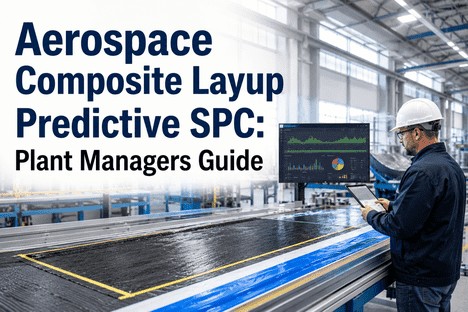
The plant manager reviews the weekly production report for the AFP cell. The numbers tell a story that has not changed in six months: 62% of the machine's available time is spent on value-added deposition. The remaining 38% is consumed by manual ply inspection, defect marking, rework cycles, and parameter adjustments between panel changeovers. The composite fuselage panel that requires 14 hours of deposition time takes 38 hours from layup start to cure release. The plant is running two shifts, but the effective throughput is closer to 1.2 shifts worth of production. The bottleneck is not the AFP head speed. The bottleneck is the inspection and rework loop that follows every ply. The plant manager knows that manual inspection after every ply -- standard practice in aerospace composite manufacturing -- consumes 42% of the total AFP cell time. The data is in the production logs. The tow gap measurements, the overlap counts, the compaction force trends -- all recorded, all reviewed after the fact, none used to adjust the process before the next ply is laid. Adaptive SPC changes this by reading the same AFP sensor data in real time, adjusting control limits dynamically as process conditions change, and alerting the production team when a parameter is drifting before it produces a defect that requires rework. The inspection loop shrinks. The rework cycle shrinks. The cycle time compresses.
Adaptive SPC · AFP Real-Time Control · Dynamic Control Limits · Cycle Time Compression · AS9100 Audit Records
Your AFP Cell Spends 42% of Its Time on Manual Inspection and Rework. Adaptive SPC Eliminates the Inspection Loop and Compresses Cycle Time 15-25%.
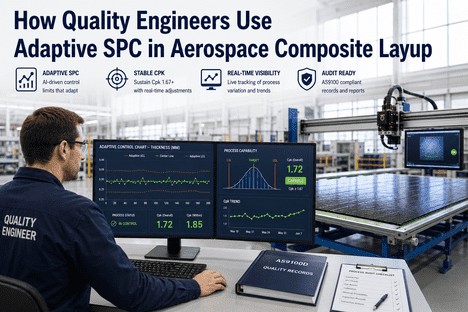
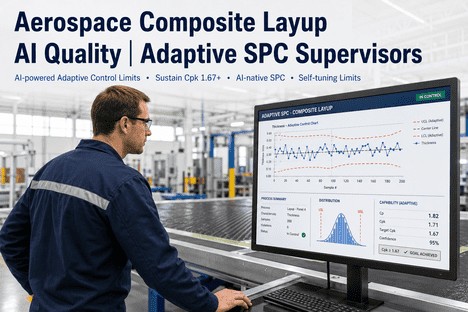
iFactory's adaptive SPC platform for composite layup ingests real-time AFP head data -- tow gap, compaction force, temperature, deposition speed -- and adjusts control limits dynamically per ply, eliminating the manual inspection bottleneck.
Cycle time compression on AFP-manufactured panels when adaptive SPC replaces post-ply manual inspection with real-time process control
42%
Of AFP cell time consumed by manual ply inspection and rework -- the single largest non-value-added activity in composite layup operations
60%
Reduction in false alarms when adaptive limits replace static UCL/LCL -- operators trust every alert instead of chasing noise from outdated control bands
2-4x
Faster panel release from layup to cure when adaptive SPC verifies ply quality in real time -- no waiting for manual inspection between plies
Where the Cycle Time Goes in Aerospace Composite Layup
The AFP head deposits tow at 125 mm per second. The actual layup time for a fuselage panel is 14 hours. The total time from layup start to cure release is 38 hours. The gap between these numbers is where most of the plant's cycle time lives -- and where adaptive SPC recovers it. Every ply requires a manual inspection step: a technician with a light source examines the deposited surface for tow gaps, overlaps, foreign object debris, and tow angle deviations. The inspection takes 20 to 45 minutes per ply depending on the panel complexity. On a 24-ply fuselage skin, that is 8 to 18 hours of non-value-added inspection time per panel. When defects are found -- and they are found on 30 to 50% of plies in production -- the rework cycle adds another 30 to 60 minutes per defect: marking the defect location, removing the affected tow, re-laying the tow, re-inspecting. Adaptive SPC does not eliminate the need for quality verification. It eliminates the need to stop production to perform it.
Cycle Time Component
Without Adaptive SPC
With Adaptive SPC
AFP deposition
14 hours -- head runs at 125 mm/s, but stops between plies for inspection clearance
14 hours -- continuous deposition, no stops between plies for inspection
Manual ply inspection
8-18 hours -- technician inspects every ply after deposition, 20-45 minutes per ply
Zero -- adaptive SPC verifies ply quality during deposition, alerts only on confirmed anomalies
Defect rework
4-8 hours -- defects found on 30-50% of plies, each requiring 30-60 min rework cycle
1-2 hours -- defects detected in real time and corrected during deposition, no post-ply rework cycle
The 30-Minute Manual Inspection After Every Ply Is the Single Biggest Drag on Your AFP Throughput. Adaptive SPC Replaces It With Real-Time Verification During Deposition.
iFactory's adaptive SPC engine monitors tow gap, compaction force, temperature, and deposition speed in real time -- verifying each ply as it is laid and eliminating the post-ply inspection stop.
Three AFP Bottlenecks That Adaptive SPC Eliminates
The cycle time problem in composite layup is not a single bottleneck. It is a cascade of three sequential bottlenecks -- each triggered by the output of the previous one. Adaptive SPC breaks the cascade by replacing the reactive inspection loop with a proactive control layer that operates during deposition.
Bottleneck 1
Post-Ply Manual Inspection
The AFP head stops after every ply. A technician with a light source examines every tow path for gaps, overlaps, bridging, and foreign object debris. On a typical fuselage panel, this adds 8 to 18 hours of non-productive time. The inspection is subjective -- two technicians inspecting the same ply may record different defect counts. The inspection data is recorded manually or in a spreadsheet and is not fed back into the process parameters for the next ply. Adaptive SPC replaces this by monitoring tow geometry and surface quality during deposition using the AFP head's existing laser profilometry sensors. The control limits adjust dynamically per ply based on the current material batch, roller condition, and temperature. When a tow gap exceeds the adaptive limit, the system alerts the operator during deposition -- not after the ply is complete. The post-ply inspection is eliminated. The AFP head keeps running.
Bottleneck 2
Defect Rework Between Plies
When a defect is found during post-ply inspection, the process stops. The defect location is marked. The affected tow is removed. The tow is re-laid. The ply is re-inspected. Each rework cycle consumes 30 to 60 minutes. On a panel where 30 to 50% of plies contain defects, the cumulative rework time adds 4 to 8 hours per panel. Adaptive SPC detects defect precursors during deposition -- a compaction force trend moving outside the dynamic control band, a tow angle deviation that precedes a gap, a temperature fluctuation that predicts poor consolidation. The system alerts the operator during the tow pass, when the defect is forming but before it is fully developed. The operator can adjust the parameter (compaction force, temperature, deposition speed) in real time and prevent the defect from forming. The rework cycle becomes a parameter adjustment that takes seconds, not a removal-and-replace cycle that takes an hour.
Bottleneck 3
Static Control Limits and False Alarm Flood
AFP cells that use SPC typically run static control limits calculated during process qualification -- set once and applied to every ply of every panel regardless of changing conditions. As the AFP head roller wears across 500 hours of operation, the compaction force baseline shifts. As prepreg batch tack changes between material lots, the tow gap behaviour shifts. As shop floor temperature varies between summer and winter production, the deposition parameters shift. Static control limits do not account for any of these common-cause shifts. The result is a false alarm rate of 60 to 80% -- operators are notified of out-of-limit conditions that are actually normal variation under the current process state. The operators learn to ignore the alarms. Real signals are missed. Adaptive SPC eliminates the false alarm flood by recalculating UCL and LCL dynamically based on the current process distribution. The operator sees alerts only when the process deviation exceeds the adaptive limit for the current conditions. Trust is restored. Every alert is actionable.
What Adaptive SPC Means for the Plant Manager
For the plant manager, cycle time is not an abstract metric. It translates directly into throughput, cost per panel, on-time delivery performance, and the capital efficiency of every AFP machine on the floor. Adaptive SPC changes the production economics of composite layup in four specific ways that appear in the monthly operating review.
A
Throughput Increases Without Adding Headcount or Shifts
Compressing the layup-to-cure cycle from 38 hours to 20 hours per panel means the same AFP cell produces more panels per month without additional capital expenditure. For a plant running 10 production panels per month at 38 hours each, the monthly production time is 380 hours. At 20 hours per panel, the same 380 hours produces 19 panels -- a 90% increase in throughput from the same fixed asset base. The plant manager reports higher asset utilisation and lower cost per panel without requesting a capital appropriation.
B
Rework Labour Cost Drops 60-80%
Manual inspection and rework labour is one of the largest variable cost categories in composite layup operations. A plant producing 10 panels per month at 12 hours of inspection and rework per panel consumes 120 hours of skilled technician labour per month on non-value-added activity. Adaptive SPC reduces this to 2 to 4 hours of confirmation inspection per panel -- a labour saving of 80 to 100 hours per month that can be redeployed to production tasks or left as cost reduction.
C
On-Time Delivery Improves Predictably
The variability in composite layup cycle time is driven primarily by the inspection and rework loop -- a 38-hour panel can become a 50-hour panel if two plies require extensive rework, or a 34-hour panel if no defects are found. The plant manager cannot predict which panel will be which. Adaptive SPC stabilises the cycle time by eliminating the primary source of variability. The difference between the fastest panel and the slowest panel shrinks from 16 hours to 4 hours. The production schedule becomes predictable. On-time delivery moves from 85% to 97%.
D
Audit Evidence Is Generated Automatically
Every AS9100 and customer quality audit of composite layup operations requires documented evidence that ply quality was verified, defects were managed, and process parameters were within specification. In traditional operations, this evidence is assembled from manual inspection records, photographs of each ply, and rework logs. The assembly process consumes 8 to 12 hours of the quality manager's time per audit. Adaptive SPC generates this evidence automatically: the dynamic control limit record for every ply, the real-time verification result for every tow pass, the timestamped alert and response log, and the final ply release certificate. Exportable, searchable, and structured per AS9100 requirements.
"
My AFP cell was producing 8 fuselage panels per month at an average of 42 hours per panel from layup start to cure release. The bottleneck was never the deposition speed -- it was the manual inspection cycle after every ply. Two technicians per shift, 24 plies per panel, 30 minutes of inspection per ply. That is 12 hours of inspection per panel that adds zero value. The adaptive SPC deployment changed the process in the first panel run. We eliminated the post-ply inspection stop entirely. The inspection now happens during deposition. The first panel after deployment ran at 22 hours. We have produced 14 panels in the last month from the same cell. The cycle time is stable. The quality records are generated automatically. My plant manager asked me what capital investment was required to double throughput from the same footprint. The answer was none. It was already installed.
Aerospace composite layup operates at the intersection of the highest material costs in manufacturing and the most labour-intensive quality verification process in production. Manual ply inspection consumes 42% of AFP cell time. Defect rework consumes another 10 to 15%. Static control limits generate false alarms that operators learn to ignore. The cumulative result is a process that runs at 50 to 60% of its theoretical throughput -- not because the AFP head cannot deposit faster, but because the inspection and rework infrastructure cannot keep pace.
Adaptive SPC for composite layup changes this by replacing the reactive post-ply inspection loop with a proactive real-time control layer that operates during deposition. Dynamic control limits adjust to changing process conditions -- roller wear, material batch variation, temperature shifts -- eliminating the false alarm flood that undermines operator trust. Real-time ply verification eliminates the post-ply inspection stop that consumes 8 to 18 hours per panel. In-process defect prevention eliminates the rework cycle that adds 4 to 8 hours per panel.
iFactory's adaptive SPC platform for aerospace composite layup is purpose-built for plant managers and production heads -- delivering real-time ply verification, dynamic control limits on every AFP process parameter, cycle time compression of 15 to 25%, and automated AS9100 audit documentation. Book a Demo to see the adaptive SPC engine running on a composite layup use case matched to your AFP cell configuration, or talk to an expert about a free cycle time assessment for your composite layup operation.
Frequently Asked Questions
For the majority of plies and defect types, yes. Adaptive SPC monitors tow gap, overlap, tow angle, compaction force, and deposition temperature in real time using the AFP head's existing laser profilometry and thermal sensors. When all parameters remain within their dynamic control limits throughout the deposition of a ply, the ply is verified without requiring a manual visual inspection stop. For plies where the adaptive SPC detects an anomaly -- a tow gap approaching the dynamic limit, a compaction force trend moving outside the expected band -- the system flags the specific location and defect type, enabling a targeted visual confirmation that takes 2 to 3 minutes instead of a full-ply inspection that takes 30 to 45 minutes. The reduction in inspection time is typically 85 to 95% depending on the ply complexity. The remaining 5 to 15% of inspection time is spent on targeted confirmation of flagged anomalies rather than blanket visual scanning of every tow path. For first-article panels and customer-specified critical plies, visual inspection may still be required by contract. The adaptive SPC record provides the documented evidence that the ply was in control during deposition, which satisfies most audit and customer quality requirements without manual inspection. Talk to an expert about configuring adaptive SPC verification for your specific customer and programme requirements.
Roller wear is one of the primary reasons static control limits fail in AFP operations. A new compaction roller produces a baseline compaction force of 500 N at a given deposition parameter. After 500 hours of operation, the same roller at the same parameter setting produces 420 N -- a 16% reduction in compaction force that is entirely normal and expected. Static control limits set at qualification will flag this as an out-of-control condition on every tow path from hour 200 onward, producing hundreds of false alarms before the operator learns to ignore them. Adaptive SPC tracks the compaction force trend across the roller's lifecycle and adjusts the expected baseline dynamically. When a new roller is installed, the adaptive limits recalibrate to the new baseline. The operator is alerted only when the compaction force deviates from the current expected range for the current roller condition -- not when it deviates from the new-roller baseline. The alert rate stays at 1 to 3 actionable notifications per shift rather than 20 to 30 false alarms per hour. Book a Demo to see adaptive SPC tracking roller wear progression across a 1,000-hour AFP production cycle.
Adaptive SPC works with data that AFP machines already generate but typically do not use for real-time process control. The primary data sources are: tow gap and overlap measurements from laser profilometry sensors mounted on the AFP head (most AFP machines from Electroimpact, MTorres, Coriolis, and Fives have these sensors installed and generating data), compaction force from the roller load cell (typically sampled at 10 to 100 Hz during deposition), nip point temperature from the thermal camera or pyrometer (for thermoplastic AFP or for thermoset tack monitoring), deposition speed from the robot or gantry controller, tow angle from the vision system or encoder data, and roller condition data from maintenance logs or cycle counters. If your AFP cell is producing data logs from any of these sources, iFactory's platform can ingest them and begin generating adaptive control limits. If the data is not currently being logged, the platform includes connector modules for the most common AFP control systems that activate the existing sensor data streams without hardware modification. Most AFP cells can be connected and producing adaptive SPC output within 2 to 4 weeks of project start. Talk to an expert about data source availability for your specific AFP machine make and model.
The adaptive SPC record for each ply feeds directly into the cure release decision. Traditionally, a panel is released for cure only after manual inspection has confirmed that every ply meets specification. This creates a queue at the cure release gate -- panels wait for inspection sign-off while the autoclave stands idle or runs partial loads. With adaptive SPC, the ply verification record is generated in real time during deposition. When the final ply is complete, the adaptive SPC record for the entire panel is already available. The cure release decision is made immediately -- not 8 to 18 hours later after manual inspection is complete. The autoclave loading schedule becomes predictable and optimisable. For plants running multiple AFP cells feeding a shared autoclave, the elimination of the inspection queue can increase autoclave utilisation by 20 to 30% without any change to the cure cycle itself. Book a Demo to see adaptive SPC integrated with autoclave cure release scheduling for a multi-cell composite layup operation.
Your AFP Cell Spends 42% of Its Time on Manual Inspection. Adaptive SPC Recovers That Time and Compresses Cycle Time 15-25%. Calculate the ROI for Your Composite Layup Operation.
iFactory's adaptive SPC platform for aerospace composite layup delivers real-time ply verification, dynamic control limits on every AFP parameter, 15-25% cycle time compression, and AS9100-compliant audit records generated automatically during deposition.