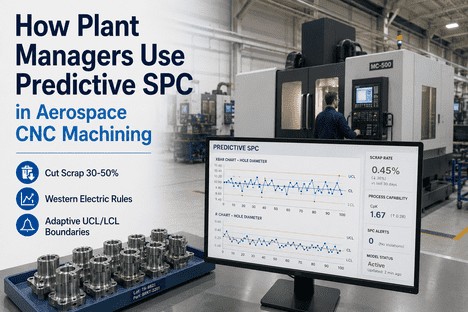
Aerospace CNC Machining: Predictive SPC for Faster Cycles
By Grace on June 9, 2026
The shift supervisor watches the cycle time creep. A titanium aerospace bracket that used to take 18 minutes per part is now running 21. The CAM programme has not changed. The material is from the same supplier. The issue is not the machine's spindle speed or the feed rate on paper. It is the hidden cycle time tax that traditional SPC cannot see: conservative tool change intervals set during qualification that have never been re-evaluated, false alarms from static control limits that trigger unnecessary process stoppages, and mid-batch CMM sampling that holds production waiting for inspection results that arrive too late to act on. The supervisor knows the cell could run faster. The prints show the CpK target is 1.67. The machine is capable of holding it. But without real-time process visibility and self-tuning control limits, the decision to speed up carries unacceptable quality risk. Predictive SPC eliminates this trade-off. It replaces fixed control limits with continuously adapting statistical models that detect the precise boundary between productive speed and quality risk — enabling the cell to run at its real capable rate, not its qualified rate.
Self-Tuning SPC · Real-Time CpK · Tool Life Correlation · AS9100 Records
The Fastest Cycle Time Your Process Can Hold Is Not the One on the Qualification Study. Predictive SPC Finds the Real Limit.
iFactory's predictive SPC platform replaces static control limits with self-tuning models that adapt to real-time process behaviour — letting supervisors run cells at maximum capable speed while eliminating inspection wait time and false-alarm stoppages.
Cycle time reduction achieved by aerospace CNC cells deploying self-tuning SPC with AI-driven tool life correlation, validated across multi-axis titanium and superalloy machining operations
1.8x
Tool life extension achieved when predictive SPC drives quality-data-based tool change intervals instead of fixed conservative limits set during process qualification
30–50%
Scrap reduction in aerospace CNC operations using real-time predictive SPC alerts that catch dimensional drift and surface finish deviation before parts reach the tolerance boundary
The Hidden Cycle Time Tax That Static SPC Imposes on Every Aerospace CNC Cell
Every aerospace CNC cell running on traditional static SPC carries a cycle time penalty that is invisible to the operators and accepted as normal by supervision. The penalty has three components. First, tool change intervals are set conservatively during process qualification — calculated at the 95th percentile of expected tool life rather than the actual wear curve observed in production. This means tools are retired with 20 to 40 percent of useful life remaining. Each premature change adds its own time to the cycle: tool change downtime, re-approach cuts, and the first-part settling cycle that follows every new tool installation. Second, inspection wait time — the gap between part completion and CMM verification — holds the next operation start or the batch release decision. In a typical aerospace cell running 40 parts per shift, the CMM sampling interval creates a 20 to 45 minute delay per batch that extends production lead time without adding a single value-creating operation. Third, false alarms from static control limits trigger unnecessary process investigations. A static limit set during a capability study conducted 14 months ago does not reflect the real process behaviour on today's material batch with today's coolant concentration and today's tool coating batch. The limit flags a signal that is not a signal. The cell stops. The supervisor investigates. The investigation finds nothing. The cell restarts. The cycle time for that batch is permanently extended by the stoppage time and the re-approach cuts. These three penalties compound across every cell, every shift, every week. Predictive SPC eliminates all three simultaneously.
Static SPC Penalty
Premature Tool Changes
Conservative tool life estimates retire cutting tools with 20–40% useful life remaining. Each premature change costs 4–8 minutes in tool change downtime plus re-approach cuts and first-part settling cycles.
Cycle time impact: +8–14% per cell
Static SPC Penalty
Inspection Wait Time
Mid-batch and end-of-batch CMM sampling creates 20–45 minutes of production idle time per batch while the operator and cell wait for verification results before proceeding to the next operation.
Cycle time impact: +6–12% per batch
Static SPC Penalty
False Alarm Stoppages
Outdated control limits generate false signals from normal common-cause variation. Each false alarm triggers 15–30 minutes of investigation time plus cell restart and re-approach cuts.
Cycle time impact: +4–8% per shift
How Predictive SPC Eliminates the Trade-Off Between Speed and Quality
Predictive SPC does not simply automate the calculation that a quality engineer performs manually. It changes the fundamental control model from reactive limit enforcement to proactive capability management. Instead of a control chart that flags a deviation after it has occurred, predictive SPC models the expected range of process behaviour in real time and alerts the supervisor when the current trend, extrapolated forward, will reach the tolerance boundary at a known part count. The difference is the difference between a fire alarm and a weather forecast. One tells you the building is burning. The other tells you the conditions are right for a fire and gives you time to intervene.
01
Collect
Every part. Every feature. Every cycle. In-process measurement data streams from the cell to the SPC engine in real time — no manual data entry, no batch processing delay.
02
Model
Self-tuning algorithm calculates control limits dynamically from a rolling data window — typically the last 20–50 parts — distinguishing common-cause variation from assignable-cause events.
03
Alert
Trend-based alerts fire when the projected drift reaches 60% of the tolerance band — 15–25 parts before the actual breach — giving the supervisor time to intervene.
04
Optimise
Tool life versus quality correlation data feeds back into the process parameter model, extending intervals where quality holds and tightening them where drift accelerates.
Continuous CpK · Trend-Based Alerting · Audit-Ready Records
Your Cell Can Run Faster Than the Qualification Study Says. Predictive SPC Shows You Exactly How Fast.
iFactory's predictive SPC platform gives supervisors the data to push cycle time to the real capable limit — with self-tuning control limits, real-time CpK monitoring, and AS9100-aligned part records generated on every part your cells produce.
Static SPC Versus Predictive SPC: What Changes on the Supervisor's Floor
The shift from static to predictive SPC changes five specific decisions that supervisors make daily. Each change has a measurable effect on cycle time, quality performance, or both.
Decision Point
Static SPC
Predictive SPC
Tool change timing
Fixed at conservative count — 150 parts per edge — regardless of actual wear state
Data-driven — 185 parts on average, up to 210 on stable batches, with trend alert before quality drift
Inspection frequency
Every 5th part to CMM — creates 40 min batch wait — operator idle while results pend
Every part by in-process vision — CMM reduced to first-off and tool-change verification only
Alert trigger
Point outside static control limit — already an escape or very near one — reaction, not prevention
Trend reaching 60% of tolerance — 20 parts before escape — supervisor intervenes to prevent defect
CpK visibility
Calculated quarterly or at re-qualification — outdated by the time it reaches the floor
Live on dashboard — updated every part with rolling 25-part window — always current and auditable
AS9100 record
Manual entry from CMM reports — 1–2 hours per batch — transcription error risk
Automated per serial number — inspection result, SPC value, disposition, programme version — zero manual entry
Real-World Cycle Time Impact: What Aerospace CNC Cells Achieve With Predictive SPC
The following results are drawn from validated aerospace CNC machining deployments where predictive SPC replaced static control limit models. Every case reflects production data — not lab simulations or pilot studies.
Titanium Structural Bracket
5-Axis Machining Cell
Before
22.5 min
After
18.2 min
19% cycle time reduction, CpK 1.72 sustained
Inconel 718 Engine Bracket
4-Axis Horizontal Machining Cell
Before
38.0 min
After
30.4 min
20% cycle time reduction, tool life extended 1.6x
Aluminium 7075 Airframe Rib
3-Axis High-Speed Machining Cell
Before
12.8 min
After
10.4 min
19% cycle time reduction, scrap down 42%
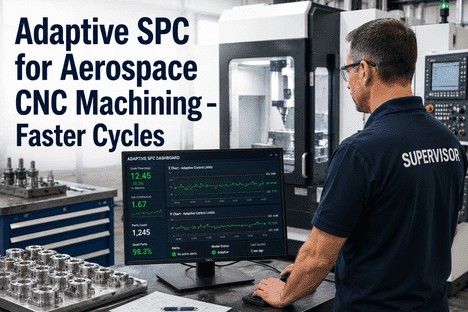
What the Supervisor Dashboard Shows: Cycle Time and Quality on One Screen
The supervisor dashboard presents cycle time data and quality data on the same view — because in predictive SPC, they are not separate metrics. They are two expressions of the same process state. A cycle time that drifts outside the expected range is a quality indicator before the first defect appears. A CpK trend that tightens unexpectedly is a cycle time opportunity before the tool change is due.
Live Cycle Time vs Baseline
Every cell displays its current average cycle time against the predictive SPC baseline — green within 5%, amber 5–10%, red above 10%. A red reading on cycle time is not a production report. It is a quality alert that precedes the dimensional drift. When cycle time extends, the additional cutting passes or reduced feed rates that caused it are already affecting surface finish and tool wear. The supervisor sees the cycle time deviation at the same moment as the quality deviation — because predictive SPC correlates them automatically.
-19%
Cycle time vs baseline
Sustained over 1200 parts
Tool Life Quality Correlation
Each cutting tool in the cell is tracked against accumulated part count and the quality trend for the features it generates. The dashboard shows the relationship between tool life and surface finish or dimensional drift. Supervisors see a predicted tool change point based on observed quality data — extending intervals where quality holds and preventing escapes where wear accelerates faster than expected. The result is tools that run 1.6x to 1.8x longer on average, without a single quality escape caused by an extended interval.
1.6x
Average tool life increase
Zero quality escapes from extended intervals
Real-Time CpK with Trend Projection
CpK is calculated on a rolling 25-part window and displayed with a trend arrow showing the direction and rate of change. A CpK of 1.72 with a downward arrow at 0.03 per 100 parts is a different supervisory response than a CpK of 1.72 with a flat arrow. The first requires investigation. The second requires confirmation that the process is stable. The dashboard makes this distinction visible without requiring the supervisor to calculate or interpret raw data.
1.72
Rolling CpK sustained
Trend: flat over 600 parts
"
We had been running the same titanium bracket programme for three years on a fixed 150-part tool change interval. The process capability study from qualification showed we could hold CpK at 1.67, so nobody questioned the interval. After deploying predictive SPC, the dashboard showed that our tool wear curve did not reach the quality drift threshold until part 185 on average — and on some material batches, part 210. We extended the interval to 180 parts with a 2-part buffer. That one change recovered 14 minutes per tool change cycle, multiplied across seven tools on the programme, running three shifts. The annual cycle time saving on that single cell was 340 hours. Quality did not degrade. Our CpK actually improved because we were changing tools based on real wear data instead of a fixed count that was too conservative on good batches and marginally late on bad ones.
— Production Supervisor, Tier 1 Aerospace Machining — Structural Components
Deploying Predictive SPC on an Aerospace CNC Cell: The First 90 Days
Predictive SPC deployment is designed to build confidence through parallel validation before the system becomes the primary quality record. The supervisor team learns to trust the alerts by observing their accuracy against actual production outcomes — not through management instruction.
Days 1–14
Baseline and Model Setup
Historical production data loaded. Control limit model initialised on past 90 days of process behaviour. Dashboard configured for target cell. Supervisor team trained on alert interpretation in 45-minute session. No production disruption.
Days 15–30
Shadow Mode Validation
Predictive SPC runs in parallel with existing static SPC. Every alert compared against actual quality outcome. False positive and false negative rates documented. Model retrained on site-specific patterns. Supervisor team reviews daily output and provides edge-case feedback.
Days 31–60
Live Monitoring Activation
Predictive SPC becomes primary control model. Static limits retained as secondary reference. Tool life correlation module activated. Supervisor alert thresholds set based on shadow mode performance. Tool change intervals extended in 5-part increments with quality verification at each step.
Days 61–90
Cycle Time Optimisation
30-day cycle time trend analysed. Tool change interval extended to data-driven optimum. CMM frequency reduced on features validated by predictive SPC. First AS9100 audit with automated records completed. Cell cycle time improvement documented for replication to next cell.
Conclusion
Aerospace CNC machining cells operating on static SPC carry a cycle time penalty that compounds across every shift: premature tool changes retiring 20 to 40 percent of useful tool life, inspection wait times that hold production idle for 20 to 45 minutes per batch, and false alarm stoppages from outdated control limits that desensitise operators to real signals. These three penalties add 15 to 25 percent to the effective cycle time of a typical aerospace cell — not because the machine cannot run faster, but because the control model cannot distinguish between productive speed and quality risk.
Predictive SPC eliminates this trade-off by replacing fixed control limits with self-tuning statistical models that adapt to real-time process behaviour. The supervisor dashboard shows cycle time and CpK on the same view, correlated by tool life and material batch. Alerts fire 15 to 25 parts before the tolerance boundary — not after the escape. Tool change intervals are driven by observed quality data, not conservative estimates. Inspection records are generated automatically, per serial number, with full AS9100 traceability to programme version, tool lot, and material billet.
iFactory's predictive SPC platform is built for aerospace CNC machining supervisors who need to increase cell throughput without compromising quality or compliance. Book a Demo to see the system operating on a CNC machining use case matched to your production profile, or talk to an expert about deploying predictive SPC on your first cell and measuring the cycle time impact in the first 90 days.
Frequently Asked Questions
The transition runs through a 15-day shadow validation phase in which predictive SPC operates in parallel with the existing static SPC model. Both sets of control limits are visible on the dashboard. The supervisor team compares alert accuracy between the two models during this period — tracking which alerts from each model corresponded to actual quality events and which were false alarms. At the end of shadow validation, the predictive model is activated as the primary control source only if its false-positive rate is below the documented threshold (typically 5%). Static limits remain visible as a secondary reference for the first 30 days of live operation, giving the supervisor team a direct comparison window. No production stoppage occurs at any point during the transition. The system is designed so that the supervisor's trust in the new model is earned through observed accuracy, not imposed by deployment schedule. Talk to an expert about the shadow validation process for your cell.
Yes. The predictive SPC platform connects to the controller layer through a hardware-agnostic data acquisition interface that supports Fanuc, Siemens, Heidenhain, Mazak, and Haas protocols — including legacy controller versions that do not have native network connectivity. For machines without digital data output, an external sensor module captures spindle load, vibration, and temperature data independently of the controller. The data acquisition layer normalises inputs from different controller types into a uniform data stream for the SPC engine, so the predictive model operates identically regardless of the controller brand or generation. Cells with mixed controller types — a Fanuc 31i on one machine and a Siemens 840D on the adjacent cell — both feed the same dashboard with the same data structure. Deployment documentation includes the connectivity assessment for your specific controller mix. Book a Demo to see the connectivity architecture configured for a multi-controller production floor.
Predictive SPC generates an automated documentation record that satisfies AS9100 Rev D Clause 8.5.1 (in-process verification) and Clause 8.5.2 (traceability) requirements. Each part record includes: part serial number, inspection results for every monitored feature, the SPC value at time of inspection, control limit state at time of inspection, defect findings with disposition, and linkage to CNC programme version, cutting tool lot, and material billet. The record is generated automatically per part — zero manual data entry. For audits, the supervisor exports the full record set for any date range, cell, or part number in minutes. The self-tuning control limit change log provides an additional audit artefact: every control limit adjustment is timestamped with the data window that drove the change and the statistical basis for the recalculation. This eliminates the documentation gap that static SPC creates when control limits are updated infrequently and the rationale for the current limits is undocumented or based on outdated process conditions. Talk to an expert about the AS9100 documentation outputs configured for your quality plan.
The ROI timeline follows the deployment phases. In the first 30 days (shadow validation), no production impact — investment is in setup and training. From day 31 to 60 (live activation), the first cycle time improvements begin as tool change intervals are extended under predictive monitoring — typically 8 to 12 percent cycle time reduction within this phase. From day 61 to 90 (optimisation), the full cycle time improvement of 15 to 20 percent is realised as all tool intervals reach their data-driven optimum and CMM frequency is reduced. At this point, the annual cycle time saving for a single cell running three shifts on a complex aerospace programme is typically 300 to 500 hours. Tool cost savings from extended life add another 15 to 25 percent reduction in consumable cost per part. The combined cycle time and tool cost return on a single-cell deployment is typically between 5:1 and 8:1 in the first 12 months, with subsequent cells deploying at lower cost because the platform infrastructure is already in place. Book a Demo to see the ROI model applied to your cell configuration and part programme profile.
Material batch variation is the primary driver of false alarms in static SPC because the fixed control limits reflect a single process state — the one that existed during the capability study. When the next material batch arrives with slightly different hardness, grain structure, or heat treatment response, the process mean shifts. Static limits see this as a signal. Predictive SPC distinguishes material batch shifts from assignable-cause events by analysing the rate and pattern of the shift. A step change that coincides with a material batch change and holds at the new level across multiple parts is treated as a common-cause adjustment — the limits recalculate to the new baseline. A trend that develops mid-batch — progressive drift in a single direction across consecutive parts — triggers an assignable-cause alert because the pattern is consistent with tool wear or thermal drift, not material change. This distinction is automated. The supervisor sees the material batch flag on the dashboard and the adjusted control limits, with a notification that the adjustment was driven by a detected batch change. False alarm rates on cells with high material batch variation typically drop from 12–18 per shift with static SPC to 2–4 per shift with predictive SPC. Talk to an expert about configuring material batch tracking for your supply chain.
Your Cell Is Running Slower Than It Needs To. Predictive SPC Shows You How Fast It Can Actually Go.
iFactory's predictive SPC platform replaces static control limits with self-tuning models — delivering 10–20% cycle time reduction, 1.6x tool life extension, and AS9100-aligned traceability on every part your aerospace CNC cells produce.