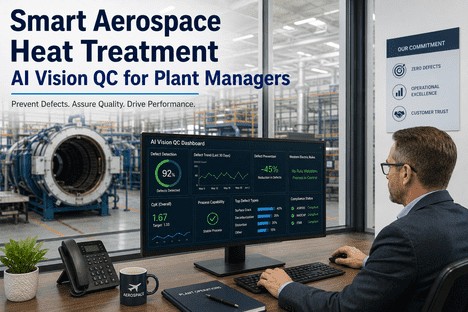
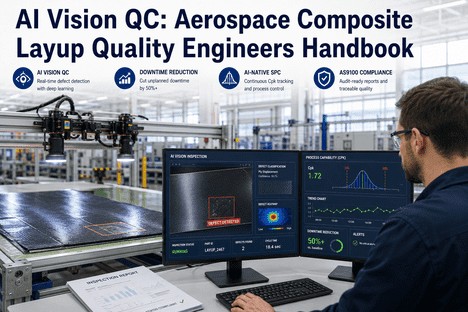
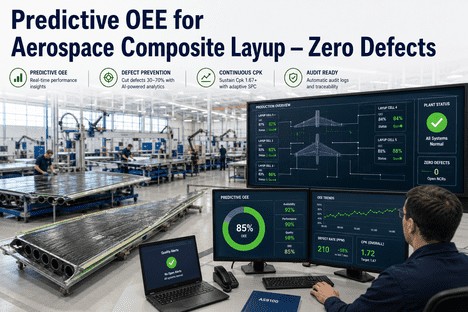
Smart Aerospace Composite Layup AI Vision QC for Plant Managers
By Grace on June 8, 2026
The composite layup plant manager operates at the intersection of production rate and regulatory compliance. Every ply placed on the tool surface carries a traceability obligation under AS9100D and NADCAP AC7118, but the inspection methods that verify those plies have not kept pace with the production pressure that 2026 aerospace programs demand. The in-process composite layup monitoring sensor market is projected to reach USD 394.1 million by 2036, growing at 8.9 percent CAGR, driven by a single operational truth: waiting for final inspection to discover a ply-level defect is too expensive for the production schedules that next-generation aircraft programs require.
AI Vision QC for Plant Managers
The Ply You Cannot Inspect Today Becomes the Non-Conformance You Investigate Tomorrow. AI Vision QC Closes That Gap.
Plant managers overseeing composite layup operations face a structural problem that no amount of operator training will solve. A 2025 study in the Journal of Composite Materials confirms that manual layup defect rates in prepreg composites range between 5 and 15 percent, depending on environmental controls and process discipline. The root cause is rarely skill. It is the absence of measurement at the moment of placement.
When a ply is positioned, compacted, and covered by subsequent layers before inspection occurs, the quality engineer is working with historical data. The deviation was already locked into the laminate stack. The ZEISS Manufacturing Insights Report found that 47 percent of aerospace manufacturers identify time-consuming inspection as their top bottleneck. For the plant manager, that bottleneck translates into direct cost: rework events that consume engineering hours, schedule slips that cascade across downstream assembly stations, and audit findings that erode customer confidence.
The digital twin QC approach replaces that delay with immediate feedback. Machine vision, thermal sensing, and compaction force measurement stream data from every ply placement event into a synchronized digital model. The deviation is detected not after cure, but before the next ply is laid. The plant manager sees the quality state of every ply in real time, not at the end of the production run.
What AI Vision QC Looks Like on the Plant Floor
The distinction between traditional QC and AI vision QC is not incremental. It is structural. Traditional quality control samples a fraction of the process variables at a few inspection gates. AI vision QC measures every variable on every ply at every placement event. For the plant manager, this is the difference between managing by lagging indicator and managing by real-time process signal.
Traditional QC Gate
Manual ply check after placement
Operator visual inspection. No digital record. Deviations of 2-3 mm routinely pass undetected.
SPC from final inspection samples
Control limits calculated from 5-10 percent sample rate. Process drift detected days or weeks after occurrence.
NDT after autoclave cure
Defect discovered after part is fully cured. Root cause investigation required. Production delayed.
AI Vision QC Inline
Machine vision verifies every ply
Fiber orientation measured to +/- 1 degree. Ply position compared to CAD. Alert triggered before next ply.
Real-time SPC on 100 percent of data
Control limits self-tune from inline sensor data. Trend alerts fired when capability drifts toward LSL.
Quality confirmed ply by ply
As-manufactured digital record created for every layer. Final inspection becomes verification, not discovery.
Data flow: Inline sensorsright arrowDigital twinright arrowReal-time QC alert
What the Plant Manager Gains at Each Layer of the Architecture
Digital twin QC is a three-layer architecture. Each layer solves a specific plant-floor problem that plant managers in aerospace composite manufacturing deal with daily. The following capability framework maps each layer to a measurable operational outcome.
Layer 1: Sensor and Data Acquisition
Machine vision cameras, thermal sensors, force transducers, and vacuum monitors capture 50-80 variables per placement event at sub-second intervals. All data is timestamped and spatially referenced to the ply coordinate system. Retrofit to existing layup cells without altering operator workflow.
Plant manager outcome: 100 percent data capture per ply. Zero inspection gaps between placement events.
Layer 2: Digital Twin Modeling and Analysis
Sensor data fused into a synchronized digital model of each ply. As-built parameters compared against CAD specification. Deviations flagged and ranked by severity. ML models trained on historical data identify precursor patterns that precede recurring defects.
Plant manager outcome: Defect detection rate above 95 percent. Root cause identified from pattern data, not investigation.
Layer 3: Real-Time QC and Closed-Loop Feedback
Deviations trigger real-time alerts on operator display and quality dashboard. Out-of-spec conditions communicated before next ply is placed. Cp/Cpk calculated in real time, trended across parts, shifts, and material lots. Corrective actions logged against the digital twin record.
Plant manager outcome: Rework rate below 2 percent. Closed-loop quality system that improves with every production cycle.
AS9100 and NADCAP Compliance Layer
Complete as-manufactured record for every ply including fiber orientation, position coordinates, consolidation parameters, temperature profile, and operator identification. Deviation events, corrective actions, and process adjustments logged with timestamps. Audit-ready reports generated automatically.
Plant manager outcome: 100 percent ply-level traceability. Zero manual documentation burden for audits.
Process Capability: From CpK 1.00 to 1.67 and Beyond
Aerospace critical composite structures require process capability of Cp/Cpk 1.67 or higher. Most layup operations operate between 1.00 and 1.33. The gap is not a quality problem. It is a measurement problem. Digital twin QC closes that gap by identifying and controlling variability at every ply, in real time, at the source.
Without Inline AI Vision QC
Cp/Cpk 1.00 to 1.33
Uncontrolled layup parameters. Manual inspection after cure. Rework rate 5-12 percent. Engineering hours consumed by root cause investigations.
With AI Vision QC Inline
Cp/Cpk 1.67 to 2.00
Every ply verified inline. Process parameters controlled within spec. Defects prevented before propagation. Rework rate below 2 percent.
50-70%
Reduction in final inspection non-conformance
60-80%
Fewer rework events per production month
40-60%
Reduction in manual inspection labor hours
100%
Ply-level traceability per AS9100 / NADCAP
The Four-Phase Deployment Path for Plant Managers
Digital twin QC is deployed incrementally, building capability at each phase without disrupting production. The typical timeline from sensor installation to closed-loop quality control spans 10-14 weeks.
1
Sensor Integration and Baseline
Machine vision, thermal, and force sensors installed as non-intrusive retrofit. Two-week baseline captures current process variability without disrupting production. Non-conformance data correlated with sensor data.
Weeks 1-4
2
Digital Twin Calibration
CAD specification loaded into digital twin. Sensor data mapped to each ply and location. Deviation thresholds calibrated against 30 days of production history. Detection accuracy validated.
Weeks 5-7
3
Shadow-Mode Parallel Operation
Digital twin runs alongside production. Alerts routed to quality engineer review. Discrepancies between twin and final inspection reviewed weekly. Model thresholds tuned. Baseline trending initiated.
Weeks 8-10
4
Active QC and Continuous Improvement
Operator-facing deviation alerts with corrective guidance. Quality dashboard showing Cp/Cpk trending and defect precursor patterns. Monthly model retraining. Closed-loop corrective action tracking.
Week 11+
Before digital twin QC, we were running at CpK 1.18 on our primary wing skin line. The non-conformance rate was consistent at eight percent, and every event consumed three to four engineering days for root cause investigation. Deployment took 11 weeks from sensor installation to active quality control. In the first 90 days, CpK moved from 1.18 to 1.52. Non-conformance dropped to 2.1 percent. The engineering time recovered from investigations was redeployed to process optimization. Eighteen months later, we run at CpK 1.82, and our quality team is focused on capability improvement, not defect investigation.
The plant manager who consistently achieves Cp/Cpk 1.67 in aerospace composite layup is not the one with the most rigorous final inspection process. It is the one whose quality control system verifies every ply at the moment it is laid, captures 100 percent of process variables, and prevents defects from propagating before the next ply is placed. AI vision QC transforms quality assurance from a final inspection gate into a continuous, in-process verification discipline.
The 50-70 percent reduction in final inspection non-conformance is documented from aerospace composite layup operations that have deployed digital twin quality control with inline ply verification. The 60-80 percent reduction in rework events confirms that AI vision QC does not just detect defects faster. It prevents them from occurring. The 100 percent ply-level traceability satisfies the most demanding AS9100D and NADCAP audit requirements without the manual documentation burden that quality teams spend 15-20 percent of their week producing.
iFactory Digital Twin QC is purpose-built for aerospace composite layup operations, connecting to your existing layup cells with machine vision, thermal sensing, and real-time process capability monitoring that integrates with your quality management system and production workflow.
Frequently Asked Questions
Traditional SPC relies on sampling a limited number of measurements at defined intervals. Control limits are calculated from historical data and updated periodically. AI vision QC replaces sampling with continuous 100 percent inspection of every ply at every placement event. Control limits self-tune to current process variability in real time. The digital twin correlates fiber orientation, temperature, compaction force, and geometry in a single synchronized model, whereas traditional SPC treats each variable independently. Published research shows AI vision QC achieves defect detection rates above 95 percent for critical aerospace defects, compared to 60-75 percent for traditional sampling-based approaches.
The system covers the full spectrum of composite layup defects. Fiber-related defects include misalignment beyond +/- 1 degree, tow gaps and overlaps, wrinkle formation, and foreign object debris. Consolidation defects include porosity above aerospace thresholds, incomplete inter-ply bonding, and insufficient compaction. Geometric defects include ply position deviation beyond tolerance, edge lift, and bridging at radii. Thermal defects include temperature excursions outside the process window and excessive thermal gradients. Detection uses three modalities: machine vision for fiber orientation, thermal imaging for temperature profile analysis, and force sensing for compaction pressure verification. Each defect is classified by type, severity, and location.
Yes. For AFP cells and automated systems that generate process data, the digital twin ingests data through OPC-UA, Modbus TCP, and MQTT interfaces without hardware modification. For manual layup operations, machine vision cameras, thermal sensors, and force transducers are added as a non-intrusive retrofit mounted on existing tooling fixtures without altering operator workflow. All hardware meets aerospace cleanroom and ESD requirements. The platform integrates with existing MES, QMS, and PLM systems through REST APIs. Talk to an Expert to schedule a data integration assessment.
The platform operates with standard plant networking infrastructure. A local edge computing device performs real-time data fusion, deviation detection, and alert generation without depending on cloud connectivity, ensuring uninterrupted QC during network outages. Process data transmits to the digital twin server for long-term trending and dashboard visualization. Bandwidth requirements are under 10 Mbps per layup cell. The platform supports deployment on facility servers, private cloud, or iFactory cloud depending on security requirements. A data readiness assessment conducted during deployment planning confirms the specific connectivity and computing requirements for your facility.
The digital twin maintains a complete as-manufactured record for every ply, including fiber orientation, position coordinates, consolidation parameters, temperature profile, and operator identification. This satisfies AS9100D clauses 8.1, 8.5.1, and 8.5.2 for operational planning, controlled production, and traceability. For NADCAP AC7118, the system generates process parameter documentation without manual data compilation. Deviation events, corrective actions, and process adjustments are logged automatically. Cp/Cpk reports are generated in standard audit format, trended by part number, material lot, shift, and operator. Electronic signature workflows and document control integration support compliant record retention. Book a Demo to review compliance documentation for your specific audit requirements.
Every Ply You Lay Has Quality Variables That Final Inspection Will Never Capture. AI Vision QC Captures Them All, in Real Time, at the Source.
iFactory Digital Twin QC for aerospace composite layup. Machine vision ply verification, real-time SPC with Cp/Cpk 1.67+ targeting, and closed-loop parameter control. Purpose-built for plant managers and quality engineers.