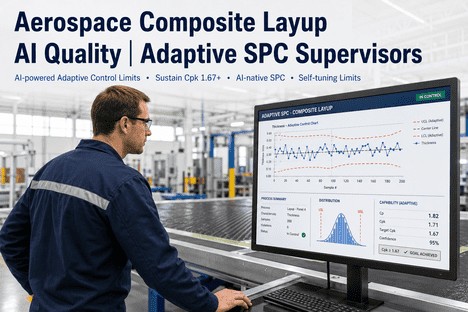
The shift supervisor on the AFP cell sees the yield number at handover. 91%. Acceptable. But the deeper number is the one that does not show up on the dashboard: 17 hours of manual inspection per production cycle that catch defects only after they have already been laid down. Two panels scrapped last month, both post-cure, both traced to defects that a machine vision system with deep learning would have flagged within 300 milliseconds of occurrence. The supervisors who close the gap between defect occurrence and defect detection are the ones who consistently deliver first-pass yield above 96% and hold it through batch changes, shift transitions, and production rate increases. This guide shows aerospace composite layup supervisors how AI vision inspection for aerospace composite layup replaces manual ply-by-ply inspection with real-time deep learning defect detection, what it means for shift-level OEE, and how to deploy it on the AFP cell floor without disrupting production.
Manual visual inspection in AFP composite layup consumes between 32% and 50% of total production time according to industry studies. That is time the AFP cell is not laying material. But the larger cost is not the inspection labour — it is the latency between defect occurrence and defect detection. A gap or overlap that forms at ply 8 is typically not detected until the end-of-ply visual check, which means 10 to 15 additional tow passes may have been laid over a condition that already violates the engineering specification. Every one of those passes must be reworked or scrapped.
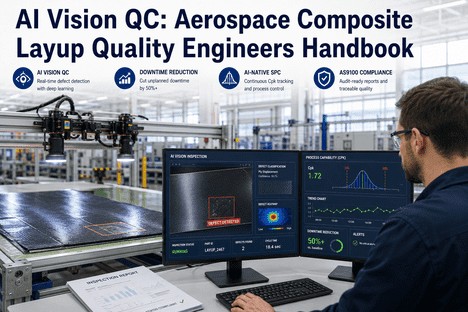
AI vision inspection eliminates this latency by placing detection at the point of deposition. High-resolution cameras and laser profilometers mounted on the AFP head or positioned as a fixed array over the layup table capture every tow pass as it is laid. Deep learning models trained on thousands of defect examples classify each pass in real time — flagging gaps, overlaps, foreign object debris, fibre waviness, and tow twist within milliseconds. The supervisor sees the defect alert on the dashboard at the same moment the AFP controller registers the pass. Correction can begin before the next tow is placed.
AI vision inspection replaces the end-of-ply visual walk-around with continuous in-process monitoring. The system architecture follows a four-stage pipeline that runs at deposition speed, processing each tow pass as it is laid and delivering a quality verdict before the next pass begins.
A production-grade AI vision system for AFP composite layup detects the full spectrum of surface defects that affect structural performance. The detection capability extends to defect types that human inspectors routinely miss under production pressure — particularly small gaps, subtle overlaps, and foreign object debris that blends with the carbon fibre surface.
Before we deployed AI vision on the AFP cell, our supervisors were doing 45-minute end-of-ply walkarounds for every 8-ply panel. That is 6 hours of inspection per panel that the machine was not laying material. The AI system now inspects every tow in under 300 milliseconds. We recovered the inspection time as production time — 6 hours per panel. The first-pass yield impact was a 7-point improvement in the first two months, driven entirely by catching gaps and overlaps at the pass level instead of finding them at the ply level. Our supervisors went from being inspectors to being process managers. That changes how you staff a shift.
— Production Supervisor, Large Commercial Aerostructures ProgrammeThe shift supervisor's role in composite layup is caught between production targets and quality outcomes. Every panel that reaches cure commits material, autoclave capacity, and schedule. The supervisor who approves the cure decision needs to know the quality state of that panel at that moment — not what it was at the last inspection stop. AI vision inspection delivers a per-panel quality summary at cure authorisation that includes every defect detected, its severity, its location, and the disposition applied. The supervisor sees a green, amber, or red status for each panel and can approve cure with confidence or send for rework with specific location data — eliminating the need to walk the tool and visually re-check before signing off.
The table below compares key operational metrics across two identical AFP cells — one running manual visual inspection, one running AI vision inspection. The data is drawn from published aerospace composite production studies and iFactory deployment benchmarks.
Deploying AI vision inspection on an AFP cell does not require replacing the machine controller or retooling the cell. The vision hardware mounts on the existing AFP head or positions as a fixed array above the layup table. The deep learning model is trained on the specific defect types relevant to the programme — gaps, overlaps, wrinkles, FOD, tow twist — and deployed on an edge GPU that processes image data locally. No cloud dependency, no image data leaving the facility. Integration with the AFP controller enables the system to correlate defect location with ply coordinate and AFP head parameters, building a process-quality correlation database that improves model accuracy over time.
AI vision inspection on an AFP cell follows a structured deployment path designed to minimise production disruption while building confidence in the system's detection capability before it becomes the primary inspection method.
AI vision inspection for aerospace composite layup changes the supervisor's job from reactive defect catcher to proactive process manager. Instead of walking the tool at the end of every ply, looking for defects that have already been laid down, the supervisor monitors a live dashboard that flags each defect at the moment of deposition — with type, severity, coordinate, and suggested corrective action. The inspection hours that once consumed half the production cycle are recovered as layup time. The defects that once reached cure undetected are caught and corrected before the next pass.
The AFP operations that are moving toward zero-defect manufacturing share a common capability: real-time defect detection at the point of deposition, integrated with the supervisor's workflow, and backed by deep learning models that improve with every panel produced. That capability is available today as a retrofit to existing AFP cells — no controller replacement, no MES migration, no operator workflow disruption.
iFactory's AI vision inspection platform is purpose-built for AFP composite layup operations — integrating with existing AFP hardware to deliver deep learning defect detection, real-time supervisor alerts, and automated AS9100 build records without changing the operator or supervisor workflow. Book a Demo to see AI vision inspection running on an AFP use case matched to your part geometry and process profile, or Talk to an Expert to discuss defect prevention targets for your specific programme.