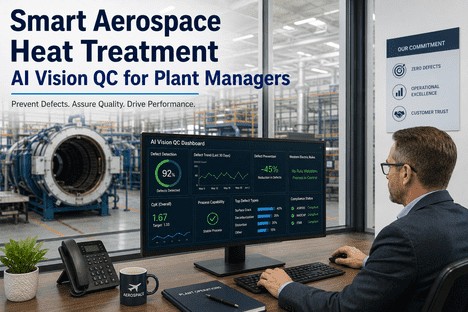
Smart Aerospace Heat Treatment AI Vision QC for Plant Managers
By Grace on June 16, 2026
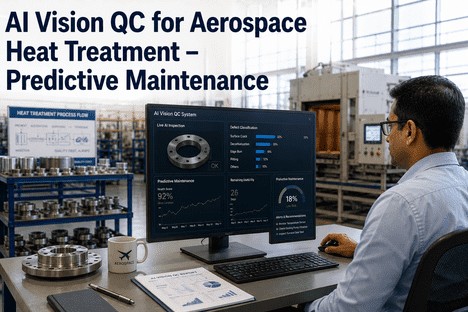
For a plant manager running aerospace heat treatment operations, the quality conversation starts and ends with the same question: what is the defect cost per part, and how do we drive it toward zero without increasing inspection headcount or slowing production throughput? The answer, for most facilities in 2026, sits at the intersection of three converging pressures. The first is customer expectation — aerospace primes and Tier 1 integrators are increasingly requiring suppliers to demonstrate AI-enhanced quality management as a condition of contract renewal, with AS9100 Rev D audits now routinely evaluating whether statistical process control is augmented with real-time defect detection capabilities. The second is margin pressure — a single furnace excursion event that scraps a load of titanium or nickel-alloy components can erase a week of operating profit, and the $520,000 average annual cost of unplanned downtime and quality escapes per facility is no longer treated as an unavoidable operating expense. The third is technological feasibility — the cost of deploying AI vision inspection has dropped by approximately 70% since 2022, while model accuracy on aerospace defect categories has crossed the 93% precision threshold, making the business case for plant-wide deployment compelling at current pricing. This is the plant manager's playbook for navigating that convergence.
ZERO-DEFECT MANUFACTURING · WESTERN ELECTRIC RULES · ADAPTIVE UCL/LCL · AS9100 COMPLIANCE
Plant Managers Delivering Zero-Defect Heat Treatment in 2026 Are Not Inspecting Quality Into Parts at End of Line. They Are Using AI Vision to Prevent Defects at the Furnace Level — With Adaptive Control Limits That Move With Their Process.
iFactory's AI Vision QC platform gives plant managers a single integrated system for defect prevention across every furnace, every alloy, and every shift — with real-time Western Electric rules, adaptive UCL/LCL that respond to process changes without generating false alarms, and automated AS9100 audit documentation that eliminates manual compliance work.
The Business Case for AI Vision QC in Aerospace Heat Treatment
The decision to deploy AI vision inspection across a heat treatment operation is a capital allocation decision, and plant managers evaluate capital allocation against measurable return. The data from aerospace manufacturing deployments in 2025 and 2026 provides a consistent evidence base that the return on AI vision QC investment is not theoretical. It is documented across facilities processing flight-critical components under AS9100 and NADCAP quality systems, with first-year ROI ranging from 3x to 8x against total deployment cost.
38%
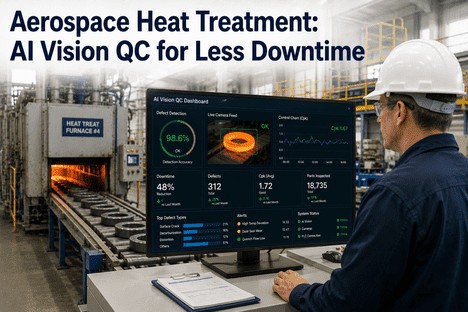
First-pass yield reject reduction achieved within 9 months of deploying computer vision quality control across aerospace component production
$14.5M
Annual recovered value from in-process defect reduction across 280,000 critical aerospace components using AI vision inspection
3x to 8x
First-year ROI for AI vision QC deployment in aerospace manufacturing — documented from scrap reduction, downtime prevention, and labor savings
24%
Defect escape rate reduction documented when computer vision augmented human inspection across 2,500+ aerospace part variants
ROI BUSINESS CASE — MID-SIZE AEROSPACE HEAT TREATMENT FACILITY
COST CATEGORY
BEFORE AI VISION QC
AFTER AI VISION QC
ANNUAL SAVINGS
Scrap from heat treat defects
$200,000
$130,000
$70,000
Furnace unplanned downtime
$275,000
$165,000
$110,000
Quality documentation labor
$95,000
$35,000
$60,000
Audit preparation and NADCAP compliance
$45,000
$10,000
$35,000
TOTAL ANNUAL SAVINGS
$615,000
$340,000
$275,000
Based on documented data from aerospace manufacturing deployments. Actual results vary by facility size, furnace count, alloy portfolio, and existing quality infrastructure. Platform cost range $5,000-$15,000 per month. First-year ROI is 3x to 8x against total deployment cost.
Three Strategic Imperatives for the Plant Manager
The deployment of AI vision QC across a heat treatment operation is not primarily a technology implementation. It is a strategic decision that affects production throughput, quality capability, compliance posture, and competitive positioning. Plant managers who have deployed successfully focus on three strategic imperatives that shape every implementation decision.
A
Shift from Detection to Prevention at the Process Level
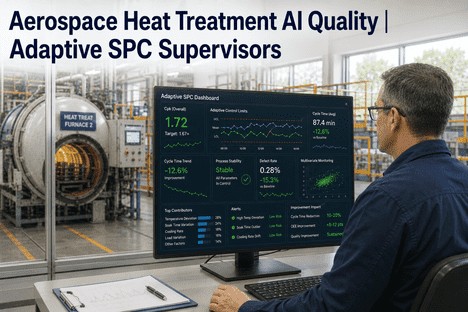
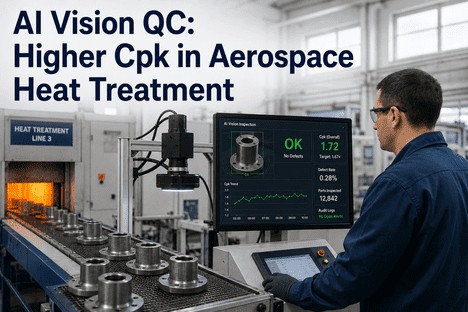
Traditional quality management in heat treatment detects defects after the furnace cycle completes — when the tensile test fails, when the hardness traverse reveals a soft zone, when the customer non-conformance report arrives. The cost of detection at end-of-cycle includes the scrapped part, the lost furnace capacity, the rework labor, and the schedule delay. AI vision QC shifts detection to the process level — monitoring heating element current signatures, refractory surface temperatures, quench cooling curves, and load-position thermal gradients in real time, and applying Western Electric rules to detect the developing condition before it produces a defect. The preventive approach eliminates the scrap cost instead of managing it.
Plant manager metric: Defect cost moves from P&L expense to prevented loss. Cpk trend becomes a forward-looking KPI, not a retrospective report.
B
Replace Calendar-Based Maintenance With Condition-Based Predictive Scheduling
Calendar-based preventive maintenance for heat treatment furnaces is based on the assumption that degradation follows a predictable timeline. In practice, heating element degradation accelerates with load cycling frequency, refractory wear depends on thermal cycling severity, and quench media degradation varies with usage intensity and contamination load. The result is that calendar-based PM either over-maintains (replacing components with remaining useful life) or under-maintains (allowing degradation to produce quality escapes between PM intervals). AI vision surveillance tracks the actual degradation trajectory of every furnace component — element current draw, refractory hot spot growth rate, quench cooling curve Cpk — and generates maintenance alerts at the point where intervention is economically optimal, which is typically 30 to 180 days before the condition would cause a quality event.
Plant manager metric: Unplanned furnace downtime moves from P&L surprise to scheduled event. Maintenance cost per part declines as component life is fully utilized.
C
Automate Compliance Documentation as a Production Output, Not an Administrative Overhead
AS9100 Rev D, NADCAP, and customer-specific audit requirements collectively demand documented evidence of process control, defect detection, corrective action, and continuous improvement. In most heat treatment operations, this documentation is produced through manual data compilation — exporting furnace logs, formatting control charts, writing CAPA reports, assembling audit binders. The labor cost of this manual documentation averages $45,000 to $95,000 per year for a mid-size facility, and the audit preparation cycle typically consumes two to three weeks of quality team time. AI Vision QC generates every required document automatically: cycle records with vision defect overlay, Western Electric rule violation logs with timestamps and disposition records, Cpk trend reports by furnace and alloy, CAPA records with root-cause linkage, and complete audit packages exportable for any date range. The quality team shifts from compiling compliance evidence to acting on the insights the evidence contains.
Plant manager metric: Audit preparation time drops from weeks to minutes. Quality FTE hours reallocated from documentation to defect prevention.
The Zero-Defect Maturity Model: A Framework for Plant Managers
Plant managers evaluating AI vision QC deployment benefit from a structured maturity model that defines the progression from manual, reactive quality management to automated, predictive defect prevention. Each maturity stage has specific capability requirements, implementation timelines, and measurable outcomes that allow plant managers to track progress and justify investment at each stage.
LEVEL 1
Reactive
Defects detected by end-of-cycle destructive testing. CAPA process documents individual events without cross-event correlation. Control charts generated from weekly data pulls. Audit documentation compiled manually for each audit cycle.
Defect rate: 3-8% Scrap cost: $200K+
LEVEL 2
Connected
Furnace sensors and control systems connected to data platform. Real-time monitoring of zone temperatures, ramp rates, and quench parameters. Static control charts with Western Electric Rule 1 alerts. Automated cycle record generation for compliance.
Defect rate: 2-5% Scrap cost: $150K
LEVEL 3
Predictive
AI vision with thermal and optical surveillance installed on all furnaces. All 8 Western Electric rules evaluated in real time. Adaptive UCL/LCL that transition with recipe changes and material batch variations. Predictive maintenance alerts from component degradation trends.
Defect rate: 1-3% Scrap cost: $100K
LEVEL 4
Zero-Defect
Full AI vision QC integration with QMS, CMMS, and ERP. Root-cause ML generates statistically validated correlations between process parameters and defect outcomes. Defects prevented before furnace cycle completes. Audit documentation generated automatically for every cycle, every part, every shift.
Defect rate: <1% Scrap cost: $50K
Key Deployment Decision Points for Plant Managers
Start with Level 2 connectivity and validate the data infrastructure before deploying AI vision. The highest-ROI first deployment is on the furnace with the highest scrap cost, highest utilization, or most critical part portfolio. Expect Level 2 to Level 3 transition within 90-120 days for a single-furnace pilot. Plant-wide Level 4 deployment typically requires 9-12 months for a facility with 4-8 furnaces and requires dedicated quality engineering resources for ML model validation.
The $14.5 Million Reference Case
A European aerospace components manufacturer producing 280,000 critical components per year reduced first-pass yield rejects by 38% in nine months using AI vision inspection. The reduction of in-process defects across that production volume delivered approximately $14.5 million in annual recovered value. The plant manager's decision to deploy was based on a pilot project on a single high-volume component line that demonstrated ROI within 60 days.
The Plant Manager's Decision Framework: What to Deploy, When, and Why
Plant managers evaluating AI vision QC for heat treatment operations consistently ask the same five questions. The answers determine deployment scope, timeline, and expected return. The framework below is based on deployment patterns observed across aerospace heat treatment facilities that have successfully implemented AI vision QC at plant-wide scale.
Q1
Which furnaces should be equipped first?
The first deployment should target the furnace or furnace line with the highest combination of scrap cost, utilization rate, and part criticality. For most facilities, this is the vacuum furnace processing turbine components or the atmosphere furnace running landing gear parts. A single-furnace pilot limits capital exposure, generates measurable ROI within 60-90 days, and provides the data needed to justify plant-wide expansion. The pilot furnace should have existing sensor infrastructure (control thermocouples, quench probes, SAT capability) to minimize installation complexity.
Q2
What is the measurable KPI improvement target for the first deployment?
Plant managers who achieve the highest first-year ROI define specific, measurable targets before deployment: scrap reduction of 30% minimum on the pilot furnace within 90 days, unplanned downtime reduction of 40% within 180 days, audit preparation time reduction from weeks to hours within 90 days. These targets are tracked against baseline data from the 12 months preceding deployment and reported monthly to operations review. When the pilot demonstrates achievement of all three targets, plant-wide expansion funding is approved based on documented returns rather than projected estimates.
Q3
How does this integrate with our existing QMS and CMMS?
iFactory's AI Vision QC platform is designed for integration with existing quality management systems and computerized maintenance management systems. Real-time SPC alerts generate CAPA records directly in the QMS with full traceability to the vision detection event and process parameter state. Predictive maintenance alerts generate work orders in the CMMS with the specific component identification, failure probability, and recommended intervention window. The platform supports standard integration protocols and has pre-built connectors for major QMS and CMMS platforms. Plant managers should verify integration compatibility during the pilot phase and plan for full data synchronization during the expansion phase.
Q4
What team structure is needed to sustain the system?
Sustaining AI vision QC at plant-wide scale requires one quality engineer trained on the platform for model validation and correlation review, one maintenance planner for predictive alert disposition, and shift supervisors trained on dashboard interpretation and alert response. The platform is designed for operator-level use — the shift supervisor views the furnace health score and defect Pareto without needing data science skills. The total additional FTE requirement is typically 1.5 to 2.0 positions for a 4-8 furnace facility, which is offset by the 2-3 FTE of manual quality documentation labor that the platform eliminates.
PLANT MANAGER CASE STUDY · AEROSPACE HEAT TREATMENT
"We deployed AI vision on our largest vacuum furnace as a 90-day pilot. The system detected a heating element current signature drift in week three that our calendar-based PM schedule would have caught in month seven — four months after the drift would have produced a temperature uniformity excursion. That single detection, combined with the scrap reduction from real-time Western Electric rule monitoring, gave us a 5.2x ROI on the pilot investment within the first quarter."
Conclusion: Zero-Defect Heat Treatment Is a Management Decision, Not a Technology Problem
The technology to prevent defects in aerospace heat treatment rather than detecting them after the cycle completes exists, is production-deployed, and delivers documented returns of 3x to 8x in the first year of deployment. AI vision inspection with real-time Western Electric rules and adaptive UCL/LCL boundaries gives plant managers the capability to monitor every furnace, every part position, and every quality characteristic continuously — with predictive alerts that provide 30 to 180 days of lead time before a developing condition produces a quality escape or unplanned downtime event. The gap between current defect rates and zero-defect heat treatment is not a technology gap. It is a deployment decision.
The documented outcomes across aerospace heat treatment facilities that have deployed AI vision QC provide the evidence base that plant managers need: 38% reduction in first-pass yield rejects within nine months, $14.5 million in annual recovered value across 280,000 components, 24% defect escape rate reduction across 2,500+ part variants, and first-year ROI ranging from 3x to 8x against total deployment cost. These are not laboratory projections or vendor benchmarks. They are measured results from production operations processing flight-critical hardware under AS9100 and NADCAP quality systems. The plant managers achieving these results followed a consistent pattern: pilot on one high-value furnace, validate measurable KPI improvement, and expand plant-wide based on documented returns.
The 2026 aerospace manufacturing environment — with primes requiring AI-enhanced quality management, margin pressure eliminating the buffer for scrap cost, and the cost of AI vision technology at an all-time low — creates a strategic window for plant managers to move from reactive defect detection to predictive defect prevention. iFactory's AI Vision QC platform is designed for plant managers who need to close the gap between the furnace control system's logged parameters and the actual thermal conditions inside every cycle — with a single integrated platform that delivers defect prevention, predictive maintenance, and automated audit-ready compliance across every furnace, every alloy, and every shift. Book a Demo to see the AI Vision QC platform configured for your furnace portfolio, or talk to an expert about a free ROI assessment for your heat treatment operations.
Frequently Asked Questions
The total investment for plant-wide AI vision QC deployment across 4-8 furnaces typically ranges from $60,000 to $180,000 in first-year platform costs, plus $20,000 to $50,000 in camera and edge computing hardware depending on furnace configuration and existing sensor infrastructure. The platform cost is structured as a monthly subscription of $5,000 to $15,000 per month for plant-wide deployment, which includes the AI inference engine, real-time SPC engine with all 8 Western Electric rules, adaptive UCL/LCL calculation, root-cause ML correlation, automated audit documentation, and QMS/CMMS integration. Against the documented annual savings of $275,000 from scrap reduction, downtime prevention, and labor elimination for a mid-size facility, the first-year ROI ranges from 3x to 8x. Plant managers should note that the single-furnace pilot phase requires significantly lower investment — typically $15,000 to $30,000 for a 90-day pilot that generates the documented ROI evidence needed to justify plant-wide deployment. Talk to an expert about a detailed ROI assessment for your specific furnace portfolio and production volume.
The platform maintains separate model instances and control limit configurations per alloy family and recipe specification. When the operator selects a new recipe, the system automatically loads the corresponding AI vision model (trained on defect patterns specific to that alloy's thermal processing characteristics), switches to the adaptive UCL/LCL baseline calibrated for that recipe's specification range, and activates the appropriate Western Electric rule thresholds for that alloy's critical quality characteristics. The transition occurs in under one second and does not require any quality engineer intervention to configure. For alloys or recipes that have not been previously processed on the platform, the system enters a supervised learning mode for the first 3-5 cycles — generating defect predictions and control chart alerts in parallel with existing quality processes without driving automated actions — until sufficient correlation data confirms model accuracy for that specific alloy-recipe combination. This eliminates the false alarm problem that occurs when static SPC systems are applied across multiple product specifications with different acceptable ranges. Book a Demo to see multi-alloy adaptive SPC configured for your heat treat recipe portfolio.
The typical timeline from decision to plant-wide deployment follows a phased approach: Phase 1 (Days 1-30) — single furnace pilot with thermal camera installation, AI model deployment, real-time SPC engine activation, and baseline KPI measurement. Phase 2 (Days 31-90) — pilot validation, ROI documentation, Western Electric rule threshold tuning, and root-cause ML model training on pilot furnace data. Phase 3 (Days 91-180) — expansion to 3-5 additional furnaces, QMS and CMMS integration, and quality engineer training. Phase 4 (Days 181-365) — plant-wide deployment across all furnaces, full integration with enterprise systems, and transition to automated audit documentation. The critical decision gate is at Day 90, when the plant manager reviews documented ROI from the pilot phase and approves expansion funding based on measured returns rather than projected estimates. Facilities with existing furnace connectivity and sensor infrastructure typically complete the pilot phase faster, as the data integration work is already in place. Talk to an expert about a deployment timeline assessment for your facility's current connectivity level.
The platform maintains a complete validation record for every AI vision model deployed, including training dataset composition and size, model architecture and version, precision and recall metrics per defect category, false positive rate per part variant, and the date and scope of the last model validation. For NADCAP and AS9100 audit purposes, the system generates an inspection method validation report that documents the AI vision model's performance against the acceptance criteria defined in the facility's quality plan. The platform is designed to operate as an inspection augmentation tool — every defect flagged by the AI vision system is reviewed by a qualified inspector before final disposition, and the inspector's disposition decision is recorded alongside the AI detection. The AS9100 Rev D requirement for documented information on inspection methods is satisfied by the combination of the model validation record, the live detection log, and the human disposition record for every flagged defect. For facilities that require AI-generated defect detection to be integrated into the formal inspection record without human review for specific low-risk defect categories, the platform supports configurable disposition authority levels that are documented in the quality plan and subject to internal audit. Book a Demo to see the audit documentation package generated for NADCAP and AS9100 compliance.
Zero-Defect Heat Treatment Is Not a Technology Problem. It Is a Deployment Decision. Get a Free ROI Assessment for Your Facility.
iFactory's AI Vision QC platform for aerospace heat treatment plant managers — real-time Western Electric rules and adaptive UCL/LCL boundaries across every furnace, predictive maintenance alerts 30-180 days before failure, root-cause ML correlation, and automated AS9100 and NADCAP audit documentation that eliminates manual compliance work.