AI Vision QC: Aerospace Heat Treatment Ops Directors Handbook
By Grace on June 17, 2026
Heat treatment is where aerospace parts either earn their certification or lose it. Titanium landing gear forgings, nickel superalloy turbine discs, high-strength steel fastener blanks — every one of them passes through a furnace where temperature uniformity, atmosphere control, and quench timing determine whether the metallurgical transformation happens correctly. Get it right and you have a part that will survive 40,000 flight cycles. Get it wrong and you have scrap you may not discover until a downstream NDT inspection, a dimensional check, or — worst of all — a customer return notification. For operations directors managing aerospace heat treatment lines under AS9100D and Nadcap audit schedules, the defect cost is never just the scrapped part: it is the rework queue, the production hold, the corrective action record, and the audit finding that follows. AI vision inspection changes this equation. This is the operations director's handbook for deploying it.
AI Vision · Predictive Scrap Analytics · AS9100D Audit Logs · Real-Time Process Control
Aerospace Heat Treatment Operations Directors Who Sustain Sub-2% Defect Rates Do Not Rely on End-of-Cycle Inspection. They See Defects Before They Form.
iFactory's AI vision inspection platform gives aerospace heat treatment operations directors 100% surface and dimensional coverage on every part, predictive scrap alerts before the furnace cycle completes, and fully automated AS9100D and Nadcap audit documentation — built for the compliance environment you operate in.
Defect rate reduction documented in aerospace and metal processing operations deploying AI vision inspection integrated with adaptive process control
100%
Part coverage per cycle — AI vision inspects every surface of every part, replacing the statistical sampling that lets defective parts reach downstream operations
27%
More defects detected by AI-powered visual inspection compared to manual inspection methods, across aerospace component manufacturing environments
24 hrs
Predictive scrap forecast lead time — AI models flag at-risk batches before the furnace cycle completes, giving operations directors an intervention window
Why Defects Keep Reaching Downstream in Aerospace Heat Treatment — and Why Inspection Sampling Is the Wrong Answer
The operations director's quality problem in aerospace heat treatment is structural, not procedural. Furnace load sizes range from dozens to hundreds of parts. Temperature uniformity surveys are performed periodically, not continuously. Atmosphere control instrumentation detects drift in the furnace environment, but it does not detect what that drift produced on the surface of each individual part. The hardness test at the end of the cycle samples a percentage of the load. The visual inspection — if it exists as a formal step — is manual, shift-dependent, and physically limited by part geometry and the inspector's fatigue level at hour seven. The parts that pass are the parts that were checked. The parts that were not checked are the population that generates customer returns, rework discoveries, and corrective action records. AI vision inspection eliminates this coverage gap by applying 100% automated inspection to every part every cycle — and by integrating that inspection data back into the process control system so the next cycle starts with knowledge the current one did not have.
The Five Defect Categories That Drive Scrap and Rework Cost in Aerospace Heat Treatment
Surface Oxidation and Intergranular Attack
Atmosphere control failures allow oxygen infiltration during high-temperature soaking phases. The result is surface oxidation on titanium alloys and intergranular attack on nickel superalloys — damage that compromises fatigue life and is often not visible to the naked eye at the surface scale that matters. AI vision systems using multi-spectral imaging detect the discolouration signatures and surface texture changes associated with atmospheric contamination before parts progress to downstream machining or coating operations.
Detection method: Multi-spectral surface imaging at part exit, flagged against alloy-specific contamination signatures.
Quench Distortion and Dimensional Drift
Quench rate variation — driven by bath temperature drift, agitation inconsistency, or load positioning — produces differential thermal gradients that distort part geometry. For close-tolerance aerospace components, distortion outside the allowable envelope means rework machining or scrap. AI vision systems with structured-light 3D scanning measure critical dimensions at the quench exit point and compare against the nominal geometry for each part number, flagging distortion before parts enter the machining queue.
Detection method: Structured-light 3D dimensional scan at quench exit, compared against part-number-specific tolerance envelope.
Case Depth Non-Uniformity in Carburised and Nitrided Parts
Load shadowing, gas flow restrictions, and temperature non-uniformity across the furnace zone produce case depth variation that the end-of-cycle hardness test only partially captures, since hardness testing is inherently sampled. AI vision integrated with eddy-current or X-ray fluorescence sensors provides a 100% case depth proxy measurement for each part, correlating surface response signatures with the case depth that destructive testing would confirm — without cutting the part.
Detection method: Eddy-current response mapped per-part, correlated to case depth via AI model trained on destructive test pairs.
Hydrogen Embrittlement in Plated and Electroprocessed Parts
High-strength steel parts processed through electroplating or acid cleaning prior to or after heat treatment are susceptible to hydrogen embrittlement — a defect that produces no external surface indication but creates catastrophic delayed fracture risk under sustained tensile stress. The AI platform detects bake-out cycle deviations that are the primary controllable risk factor, flagging batches where time or temperature parameters fell outside the specification window before the parts are released to stock.
Detection method: Bake-out parameter monitoring integrated with hydrogen embrittlement risk model, flagged at batch level before release.
Microstructural Non-Conformance from Incorrect Cycle Parameters
Soak time deviations, ramp rate errors, and cooling rate variances that fall outside the specification window for a given alloy and condition class produce microstructural outcomes that the hardness test alone cannot fully characterise. The AI platform's predictive model — trained on historical cycle-parameter-to-hardness-test correlation data — generates a microstructural conformance probability score for each batch before the physical test result is available, enabling the operations director to flag at-risk batches for expanded sampling rather than discovering the non-conformance through a customer incoming inspection.
Detection method: Cycle parameter deviation score per batch, with predictive conformance probability updated in real time during the furnace run.
The Defects That Cost the Most in Aerospace Heat Treatment Are the Ones That Pass the Sampling Inspection. AI Vision Inspects Every Part — Not the Sample.
iFactory integrates AI vision, sensor fusion, and predictive cycle analytics into a single quality intelligence platform — so operations directors have complete defect coverage, not statistical probability coverage, across every furnace load.
How iFactory's AI Vision Platform Works in an Aerospace Heat Treatment Operation
The platform operates across three integrated capability layers that together cover the full defect risk timeline — from in-process prediction before the cycle completes, to 100% part inspection at process exit, to automated compliance documentation for the audit that follows.
Before the Cycle Ends
Predictive Scrap Forecasting
Flag at-risk batches while there is still time to intervene
The predictive layer monitors in-furnace parameters — thermocouple zone readings, atmosphere gas ratios, load weight and geometry classification, quench bath temperature, and agitation rate — and continuously updates a scrap risk score for the active batch. The model is trained on historical cycle data paired with hardness test and inspection outcomes for the same alloy family and heat treat specification. When the risk score crosses the threshold associated with out-of-specification outcomes for this alloy and cycle type, the operations director receives a predictive alert with the parameter deviation driving the risk — while the furnace is still running, before the load is quenched. This is the intervention window that end-of-cycle inspection cannot provide: adjust the remaining soak time, modify the quench parameters, or flag the batch for expanded post-cycle inspection, all before the defect is committed.
Real-time cycle risk score
Parameter deviation identification
Alloy-specific threshold calibration
At Part Exit
100% AI Vision Inspection
Every part inspected, every cycle, with no sampling gap
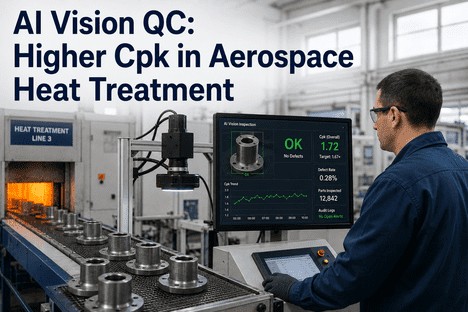
The vision inspection layer deploys industrial cameras and structured lighting at the process exit point — post-quench, pre-temper staging, or at the final inspection station, depending on the line layout — and inspects every part for surface quality, dimensional conformance, and geometry anomalies. The deep learning model is trained per alloy family and part number, learning to distinguish genuine defect signatures from acceptable surface variation — the heat treatment scale texture that is normal for this alloy, the forging parting line that is a feature not a flaw, the quench mark pattern that falls within the specification. Defects that fall outside the acceptable signature set are flagged with location, severity classification, and the image evidence logged to the batch record. No human inspector subjectivity, no shift-to-shift variation in what constitutes a reject, no sampling plan that allows defective parts to pass uninspected.
Per-part-number model training
Image evidence logged per defect
Severity classification and location
After Every Cycle
Automated AS9100D and Nadcap Records
Audit-ready documentation generated without manual compilation
Every cycle, every part inspection result, every predictive alert, and every operations director action is logged automatically to the batch record with the process context — furnace ID, cycle specification number, load ID, alloy code, and customer part number — in use at the time. The AS9100D documentation requirements for Clause 8.5 process control evidence, Clause 10.2 nonconformance records, and Clause 9.1 monitoring and measurement are satisfied by the automated record, not by manual quality entry. For Nadcap heat treat audits, the system generates the furnace run records, temperature uniformity survey compliance history, atmosphere monitoring logs, and inspection records in a single exportable package covering any date range or furnace ID the auditor specifies. Operations directors who previously spent two to three days compiling audit packages now export them in under an hour.
AS9100D clause-mapped records
Nadcap heat treat audit package
One-click export by furnace and date
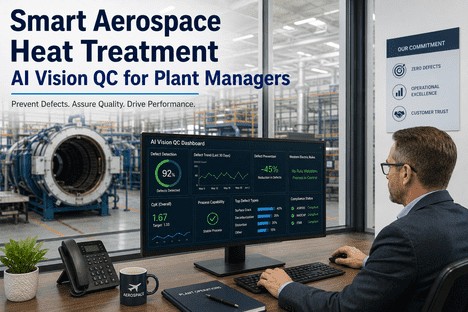
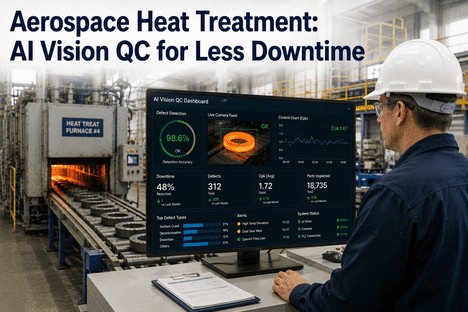
What the Operations Director Sees: The AI Vision Quality Dashboard
The operations director's dashboard is not an inspection report viewer — it is a production quality command surface. It answers the questions that matter at the start of every shift and the end of every audit: What is the defect rate by furnace and part number right now? Which batch is at risk before it exits the furnace? And when the Nadcap auditor arrives next quarter, is everything ready?
Live Defect Rate by Furnace and Part Family
A single-screen view of defect rate, first-pass yield, and scrap rate across all active furnaces and part families — updated after every inspection cycle. Operations directors see the full production quality picture in one place without pulling individual cycle records. Furnaces or part families trending above the target defect threshold are highlighted automatically with the defect category driving the deviation.
Action: Identify which furnace and alloy combination requires immediate investigation, before shift review.
Active Batch Risk Monitor with In-Furnace Alerts
Every active furnace run displays a live risk score based on the current cycle parameters versus the historical conformance model for that alloy and specification. When a batch crosses the risk threshold, the operations director receives an alert with the specific parameter driving the elevated risk — temperature zone deviation, atmosphere ratio drift, or soak time remaining — while the load is still inside the furnace. This is the decision window that end-of-cycle sampling cannot provide.
Action: Intervene in the active cycle or flag the batch for expanded post-cycle inspection before the load is quenched.
Defect Pareto by Alloy, Furnace Zone, and Cycle Type
The defect Pareto view surfaces patterns across the production history that isolated corrective action investigations never connect: that 60% of surface oxidation events on a specific nickel alloy family occur in a particular furnace zone across a three-month period is a systemic finding that drives an engineering investigation, not an individual corrective action. The Pareto is built automatically from the AI vision inspection event log without requiring manual data extraction or spreadsheet analysis.
Action: Escalate Pareto patterns to engineering as systemic input, not individual defect events.
CAPA Effectiveness Tracking — Closed Loop From Vision Alert to Resolution
Every AI vision defect that generates a corrective action is tracked through closure — the vision alert, the operations director action, the process parameter correction, and the subsequent inspection data confirming or failing to confirm the effectiveness of the intervention. If the same defect category and process parameter combination recurs within the effectiveness monitoring window after a CAPA was closed, the system automatically re-opens the investigation and links the events. AS9100D Clause 10.2 effectiveness verification is satisfied automatically, not by memory or manual follow-up.
Action: CAPA re-opened automatically on recurrence — effectiveness is verified by data, not by the person who closed the ticket.
Traceability Record — From Raw Material to Inspection Result
Every part that passes through the AI vision inspection station carries a full traceability record linking the alloy heat number, furnace run record, cycle specification, inspection image set, and disposition decision in a single searchable record. For aerospace customers requiring part-level traceability, the operations director can produce the complete quality history for any serial or lot number in seconds. For OEM quality audits, the traceability record demonstrates process control at the part level, not just the batch level — the standard that Tier-1 aerospace customers increasingly expect from heat treatment suppliers.
Action: Export part-level traceability record on customer request — no manual archive search required.
Audit Export — Nadcap and AS9100D Package in One Click
The complete audit documentation package — furnace run records, temperature uniformity survey compliance history, atmosphere monitoring logs, AI vision inspection records, defect event logs, CAPA records with effectiveness evidence, and nonconformance disposition records — is generated automatically and held in a searchable, exportable format. Operations directors who previously spent days compiling audit documentation now export the complete package in a single step, covering any furnace ID, date range, or part number the auditor specifies. The inspection image archive is included, providing the visual evidence of 100% part coverage that manual inspection programmes cannot produce.
Action: Export full Nadcap and AS9100D audit package on demand. No spreadsheet compilation, no archive search.
"
We were running a statistical sampling plan that was fully compliant with our customer's incoming inspection requirements — and we were still generating customer returns. The investigation always came back to the same conclusion: the defective parts passed the sampling inspection because they happened not to be selected. The AI vision platform changed the inspection model entirely. We went from sampling to 100% coverage on every part that exits the furnace. Within the first quarter, we identified a surface oxidation pattern on a specific nickel alloy family that was occurring during a particular furnace zone transition — something our sampling plan was not detecting because the defect rate was below the sampling trigger level. We modified the atmosphere control protocol for that transition. The defect category dropped to zero in the following quarter. That finding came from 100% coverage, not from a better sampling plan.
The AS9100D and Nadcap Compliance Advantage of AI Vision Inspection
Operations directors in aerospace heat treatment manage two overlapping compliance environments simultaneously: AS9100D, which governs the quality management system, and Nadcap, which governs the specific heat treatment process controls at the technical level. Both demand documented evidence of process control, inspection coverage, and corrective action effectiveness — and both are satisfied more defensibly by an AI vision system than by a manual inspection programme.
AS9100D Compliance
AS9100D Clause 8.5 requires that special processes — heat treatment is explicitly categorised as one — be controlled in a manner that ensures consistent outcomes. The AI vision platform provides the documented process monitoring evidence that Clause 8.5 demands: every cycle parameter logged, every deviation flagged, every inspection result recorded. Clause 10.2 requires that corrective actions be evaluated for effectiveness. The CAPA effectiveness tracking closes this loop automatically. Clause 7.5 requires that documented information be controlled. The automated batch record satisfies this without manual document management. The result is an AS9100D compliance posture that is not dependent on the quality team remembering to complete the documentation — it is generated as a byproduct of the inspection process itself.
Nadcap Heat Treat Compliance
Nadcap heat treat audits focus on four primary evidence areas: temperature uniformity survey records, atmosphere monitoring logs, load and rack control records, and inspection and test records. The AI vision platform generates all four automatically, with the inspection record additionally providing image evidence of 100% part coverage — a compliance position that is materially stronger than a sampling-based inspection programme when the Nadcap auditor reviews the inspection method justification. For facilities targeting Nadcap Merit status, the continuous documentation of process control and inspection coverage data supports the extended audit interval criteria by demonstrating sustained process control between audits, not just compliant performance at audit time.
Conclusion
Defect prevention in aerospace heat treatment is not an inspection frequency problem — it is a coverage and lead time problem. When inspection is sampled, defective parts pass uninspected. When inspection happens only after the cycle completes, there is no intervention window for the batches that are already off-specification. When audit documentation is manually compiled, the compliance posture is only as good as the last person who remembered to complete the record. AI vision inspection addresses all three simultaneously: 100% coverage that closes the sampling gap, predictive in-cycle alerts that create an intervention window before the defect is committed, and automated AS9100D and Nadcap documentation that is generated as a byproduct of the inspection process rather than as a separate manual task.
The evidence from aerospace manufacturing in 2025 and 2026 is consistent: AI-powered vision inspection detects 27% more defects than manual methods, and operations that achieve the upper end of the 30–70% defect reduction range are those that deployed AI vision early, integrated predictive cycle analytics with inspection data, and used the automated Pareto output to convert individual corrective actions into systemic process protocol improvements. The operations directors sustaining sub-2% defect rates under Nadcap and AS9100D audit pressure are not running better sampling plans — they have eliminated sampling as the primary inspection model entirely.
iFactory's AI vision inspection platform is designed for operations directors in aerospace heat treatment who need to eliminate defect escapes, not manage their rate. Book a Demo to see the platform configured for your furnace types and alloy families, or talk to an expert about a free AI Quality Roadmap Session for your heat treatment operation.
Frequently Asked Questions
The model is trained on a labelled image dataset specific to each alloy family and part number — images of conforming parts across the range of acceptable surface appearances, and images of non-conforming parts with labelled defect types and severity classifications. The training process learns the decision boundary between acceptable variation and genuine defect for the specific surface texture, geometry, and reflectance characteristics of each part in the system. For heat treatment specifically, this means the model learns to distinguish the scale texture that is normal for this alloy after normalising, from the discolouration pattern that indicates atmospheric contamination; the quench mark that is within the specification, from the surface crack that is not. Initial model training uses historical image data from your existing inspection records where available. For new part numbers, iFactory's implementation team supports data collection and labelling during the deployment period. Talk to an expert about the training data requirements for your alloy portfolio.
The inspection station hardware — cameras, structured lighting, and the edge compute unit — is installed at the part exit point from the furnace or quench station, typically on a fixed inspection conveyor or a manual presentation fixture, depending on part size and production flow. Installation is performed during a scheduled maintenance window and does not require extended production downtime: typical hardware installation for a single furnace exit point is completed in one to two shifts. The data integration with the plant historian or MES — for pulling the in-furnace cycle parameters that feed the predictive scrap model — is a software integration that runs in parallel with production and does not require downtime. The system runs in shadow mode for two to four weeks after installation, generating inspection results in parallel with the existing manual inspection process, allowing the operations team to validate detection accuracy before transitioning to AI-primary inspection disposition. Book a Demo to see the implementation timeline for your furnace configuration.
The Nadcap heat treat audit export covers the four primary evidence categories that Nadcap AC7102 and its slash sheets address: furnace run records (cycle ID, specification number, load ID, temperature zone data, atmosphere monitoring data, and time-temperature charts), temperature uniformity survey compliance records showing the most recent TUS results by furnace zone against the applicable AMS 2750 class requirements, load and rack records linking the batch ID to the load configuration, and inspection records for each batch showing the AI vision inspection result, defect findings, disposition, and the image evidence archive. The inspection record includes the 100% part coverage confirmation that manual sampling inspection programmes cannot produce — a positive differentiator in audits where the auditor reviews the inspection method and coverage justification. The export is configurable to the date range, furnace ID, and specification number the auditor specifies, and is produced in a structured format that matches the Nadcap audit checklist evidence sequence. Talk to an expert about configuring the export format for your specific Nadcap slash sheet requirements.
Yes. The platform's part number and specification architecture supports unlimited alloy families and heat treat specifications, each with its own AI vision model, predictive scrap threshold calibration, and inspection acceptance criteria. Each furnace run is tagged at the point of cycle initiation with the alloy code, specification number, and part number — and the platform automatically activates the correct AI vision model and predictive risk thresholds for that combination at the inspection station. For facilities running titanium normalising, steel carburising, and nickel solution heat treat on different furnaces in the same shift, each furnace's output is inspected against the correct alloy-specific and specification-specific acceptance criteria without any manual model switching. The operations director's dashboard shows defect rate, first-pass yield, and active batch risk scores by furnace and alloy family simultaneously — giving complete quality visibility across a mixed-production environment without navigating furnace by furnace. Book a Demo to see the multi-furnace configuration for your alloy and specification portfolio.
Every Defect That Passes a Sampling Inspection Has Already Beaten Your Quality Programme. AI Vision Inspects Every Part. Get a Free AI Quality Roadmap Session.
iFactory's AI vision inspection platform for aerospace heat treatment operations directors — 100% part coverage every cycle, predictive scrap alerts before the furnace completes, automated AS9100D and Nadcap documentation, and CAPA effectiveness tracking built into every defect event from day one.