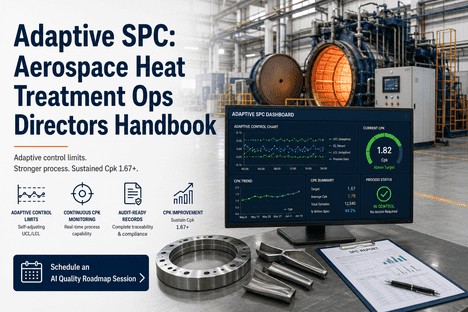
Every aerospace heat treatment operation has a Cpk story it would rather not tell. The furnace qualified at 1.67 during validation. The first three production batches ran clean. Then the alloy batch changed, the furnace load configuration shifted for a high-priority order, and the hardness readings started clustering toward the lower spec limit. Nobody caught it before the parts reached dimensional inspection. The corrective action described an isolated event. Six weeks later, a nearly identical event opened. Operations directors who have lived this sequence know exactly where the system failed — not at the furnace, and not at the operator. The SPC control chart was still showing limits calibrated during validation, limits that no longer matched the process reality. Adaptive control limits exist to close that gap, and this is the handbook for deploying them.
Aerospace Heat Treatment Operations Directors: Your Static Control Limits Are the Reason Cpk Keeps Slipping After Qualification.
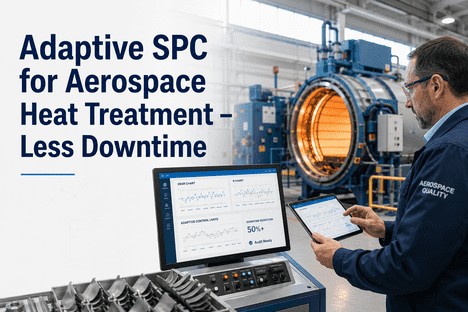
iFactory's adaptive SPC platform continuously recalibrates UCL/LCL to every alloy batch, furnace load, and recipe change — keeping your Cpk above 1.67 between audits, not just during them. Predictive quality alerts, AS9100-aligned documentation, and NADCAP-ready traceability built in from day one.
Minimum Cpk target for aerospace heat treatment — the threshold AS9100 and NADCAP auditors scrutinise first and the number adaptive SPC is specifically designed to sustain
50–70%
Reduction in false SPC alarms when adaptive ML control limits replace static limits — restoring operator credibility and driving real alert response rates back toward 100%
92%
Defect forecast accuracy achieved by AI-powered SPC analysing multi-parameter process data — predicting hardness and microstructure deviations up to 24 hours before lab confirmation
46%
Fewer defects documented in aerospace organisations with strong, data-driven quality cultures — the foundation adaptive SPC builds by making every control decision traceable and current
Why Cpk Drifts After Qualification — The Root Cause Operations Directors Do Not Always See
Aerospace heat treatment qualification is a snapshot. The furnace is characterised at a specific temperature uniformity class, with a specific alloy, on a specific load configuration. The Cpk result from that study becomes the number on the quality plan. It earns the NADCAP approval and satisfies the customer. Then production begins, and the process begins to diverge from the qualification snapshot in ways that are individually minor but cumulatively significant. Alloy batch chemistry varies within specification. Furnace load density changes as order mix shifts. Thermocouple calibration drifts between scheduled intervals. Quench media temperature varies with seasonal ambient. None of these individually trips an alarm. Together, they shift the process distribution — and static control limits, set against the qualification baseline, do not move with it.
The result is a process that looks in control on the chart and is moving toward a quality failure in reality. Operations directors who rely on post-induration hardness testing to catch this drift are always working one furnace cycle behind. By the time the test result confirms the deviation, the parts are already produced, the batch is already committed, and the corrective action is already reactive. The operational cost — rework, re-test, potential scrap, schedule impact, and the audit finding that follows — is an entirely preventable outcome. Adaptive control limits replace the static snapshot with a continuously updated baseline that moves with the process, so the alert fires at the drift, not after the defect.
The Five Process Variables That Consistently Drive Cpk Deviation in Aerospace Heat Treatment
01
Alloy Batch Chemistry Variation
Titanium, nickel superalloy, and aluminium alloy stock from certified suppliers varies in chemistry within specification tolerances — but that variation affects the solutionising temperature window and aging response. A batch with slightly elevated solute content requires a narrower soak window to avoid overaging. Static limits set on the previous batch do not reflect this. Hardness variability increases. Cpk falls.
Adaptive fix: Alloy batch registration triggers limit recalibration to the new material baseline.
02
Furnace Load Configuration Shifts
Load density, part geometry mix, and fixture positioning affect thermal uniformity within the qualified furnace class. A load heavier than the qualification configuration requires longer soak time to achieve centre-of-mass temperature — but the recipe is unchanged. Parts at the load periphery overheat while centre parts remain below target. Hardness distribution widens. The SPC chart shows individual readings inside static limits while the process distribution is failing.
Adaptive fix: Load configuration logged — limits adjusted for the thermal uniformity characteristics of that load profile.
03
Thermocouple Calibration Drift
Thermocouples in aerospace heat treatment furnaces are calibrated on a defined interval — but calibration drift accumulates between intervals and the drift is not linear. A thermocouple reading 2°C low on a titanium solutionising cycle at 960°C can translate directly into understrength parts. Static SPC limits on hardness or soak temperature do not account for the thermocouple offset that is accumulating in real time. Adaptive SPC integrates calibration state as a covariate in the limit calculation.
Adaptive fix: Calibration offset tracked as a process variable — limits adjust for measured thermocouple state.
04
Quench Media Temperature and Transfer Time Variation
For aluminium aerospace alloys, quench rate is the primary determinant of final mechanical properties. Quench bath temperature varies with facility ambient and production rate. Transfer time from furnace door to quench varies with operator and workflow. Both variables are logged but rarely integrated into SPC limit calculations — meaning the hardness reading that emerges from a warm-bath, slow-transfer quench is evaluated against limits calibrated for optimal quench conditions. The deviation looks minor. The property impact is significant.
Adaptive fix: Quench temperature and transfer time feed directly into the adaptive limit model as correlated inputs.
05
Recipe Transitions Between Part Numbers
When a furnace switches from a titanium structural component recipe to a nickel superalloy turbine disc recipe, every SPC limit in the system — temperature profile, soak time, quench delay, hardness target range — changes. Operations directors managing high-mix aerospace heat treatment lines often run multiple recipe transitions per shift. Each transition is a moment when the control system is running limits from the previous recipe against a process that has moved to a new one. The transition window is where defects are disproportionately produced.
Adaptive fix: Recipe transition logged — full limit set switches automatically to the new recipe profile at the moment of transition.
+
The Compounding Effect — When All Five Occur Together
In production, these variables do not occur in isolation. A new alloy batch running on a heavy load configuration with a thermocouple at late-interval calibration state, processed through a recipe transition during peak production, represents a multi-variable risk event that no individual static limit is designed to detect. Adaptive SPC evaluates the combination — not each variable independently — and generates a risk-weighted alert that reflects the aggregate deviation, not just each parameter against its own isolated limit.
Adaptive fix: Multi-variable risk model evaluates combinations — not just individual parameters — against current process context.
What Adaptive Control Limits Actually Do — A Technical View for Operations Directors
The term "adaptive" is used loosely in manufacturing software marketing. For operations directors evaluating platforms, the distinction that matters is between systems that recalculate limits on a schedule and systems that recalculate limits in response to detected process regime changes. Schedule-based recalculation is better than static limits, but it still produces a window of misalignment between every process change and the next recalculation cycle. True adaptive control limits respond to the event — the alloy batch change, the recipe transition, the furnace load shift — not to the calendar.
How iFactory Adaptive Control Limits Work: Three Mechanisms
01
Rolling Baseline Model
The system maintains a rolling statistical model of the current process baseline using a configurable data window — typically the last N batches or the last T hours of operation, whichever captures the most recent stable process state. UCL and LCL are calculated against this rolling model, not against the original qualification dataset. When the baseline shifts, the limits shift with it — automatically, without quality team intervention.
02
Regime Change Detection
When a registered process event occurs — alloy batch change, recipe transition, furnace maintenance completion, calibration cycle — the system enters a transition window. During this window, the rolling baseline model is paused from updating with potentially non-representative transition data, and the limits transition toward the expected new baseline profile associated with the incoming process state. False alarms during transitions drop to near zero because the system knows the process is legitimately changing.
03
Capability-Sensitive Tightening
When the process is running at high capability — Cpk consistently above 1.67 with low variation — the adaptive system tightens control limits to increase sensitivity to early drift signals. This is the behaviour that most benefits operations directors: the better your process runs, the earlier the system catches the first sign that it is beginning to change. High-performing processes get more protection, not less, from the adaptive limit algorithm.
Static Control Limits Were Set for a Process That No Longer Exists. Adaptive Limits Track the Process You Are Actually Running.
iFactory's adaptive SPC platform gives aerospace heat treatment operations directors dynamic UCL/LCL that recalibrate to every alloy batch, recipe, and furnace state change — with the audit documentation to prove every limit change was justified and traceable to a specific process event.
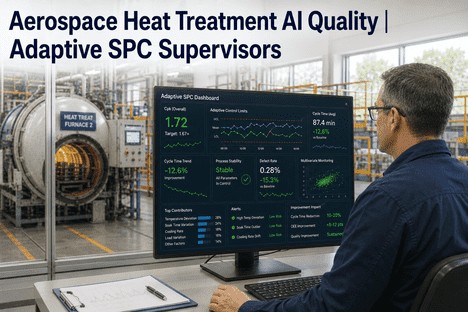
The Operations Director's Dashboard: What Adaptive SPC Shows You in Real Time
An operations director does not need a process engineer's view of the SPC system. The dashboard that drives operational decisions needs to answer five questions quickly: Where is Cpk right now, across all active furnaces and part numbers? What is the current defect risk and which furnace or parameter is driving it? Are there active alerts that have not received a response? Is the CAPA from last month's nonconformance actually preventing recurrence? And when the AS9100 auditor arrives, is the documentation complete? iFactory is built to answer all five without manual data assembly.
Dashboard View 01
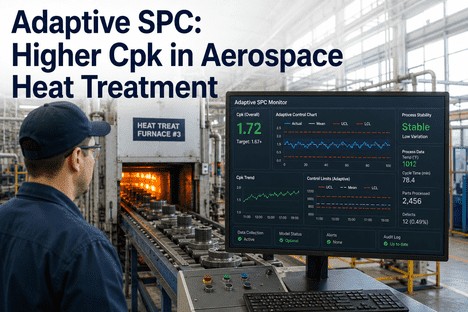
Live Cpk by Furnace, Part Number, and Quality Characteristic
Every active furnace, every active part number, and every monitored quality characteristic — hardness, tensile strength, microstructure rating, dimensional conformance — displays a live Cpk value calculated against the current adaptive limits. Operations directors see the full quality landscape in a single view, with traffic-light status indicators that immediately identify which furnace-part number combinations require attention. Cpk at 1.45 on Furnace 3 running titanium structural components is visible before it becomes an audit finding.
Operations director action: Cpk below 1.67 triggers investigation before it drops to 1.33 warning threshold.
Dashboard View 02
Predictive Hardness and Microstructure Deviation Alerts
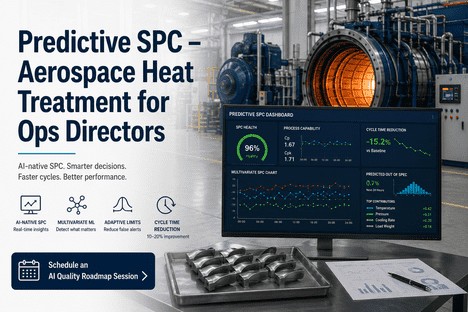
The predictive quality layer analyses real-time process parameter combinations against historical patterns associated with hardness failures and microstructure deviations. When the current furnace state matches a pattern that has historically produced off-spec results, the system generates a predictive alert — before the metallurgical test confirms the deviation. For heat treatment operations where the test result arrives 4 to 24 hours after the furnace cycle, this alert window gives operations directors the lead time to authorise additional testing, adjust the next cycle parameters, or place the affected batch on hold before additional production is committed.
Operations director action: Predictive alert triggers batch hold review before lab confirmation — not after.
Dashboard View 03
CAPA Effectiveness Tracking — Does the Correction Hold?
Every corrective action is linked to the adaptive SPC alert and the process state that generated it. After CAPA closure, the system continues monitoring the parameter combination that triggered the original event for a configurable effectiveness window. If the same pattern recurs within that window, the CAPA is automatically flagged as ineffective, the record is re-opened, and the operations director receives a direct notification — with both events linked in the documentation. This is the closed-loop verification that AS9100 Clause 10.2 requires and that most operations teams currently manage manually, inconsistently, and retrospectively.
Operations director action: CAPA re-opened automatically on recurrence — recurrence prevention, not event management.
Nonconformance events are automatically categorised, ranked, and cross-referenced by furnace, part number, alloy batch, recipe, and time period. Operations directors who review the Pareto view after three months of production routinely identify systemic patterns that individual corrective action investigations never connected — a specific furnace underperforming during high-load configurations, a particular alloy supplier's batches correlating with elevated hardness scatter, a recipe that consistently produces wider-than-expected distributions after any furnace maintenance event. These findings drive protocol changes that eliminate recurrence classes, not individual events.
Operations director action: Pareto patterns escalate to engineering as systemic inputs — eliminating defect categories, not individual events.
Dashboard View 05
AS9100 and NADCAP Audit-Ready Documentation Export
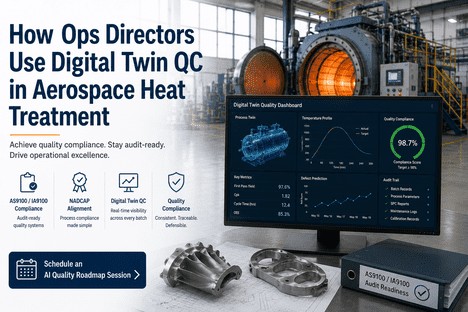
Every adaptive limit change, every SPC alert, every quality hold decision, every CAPA record with effectiveness evidence, and every Cpk trend history is logged automatically with timestamp and full process context — alloy batch, recipe version, furnace ID, operator, load configuration. The complete documentation package required for AS9100 Clause 7.5, Clause 10.2, and NADCAP audit preparation is exportable on demand for any date range, part number, or furnace. Audit preparation time drops from multi-day manual compilation to a single export. The adaptive limit change log — showing every recalculation, its trigger event, and its statistical justification — is the record that demonstrates the quality programme actively maintains defensible, current control limits rather than limits frozen at qualification.
Operations director action: Full audit package exported on demand — no manual compilation, no documentation gaps.
Dashboard View 06
Furnace OEE and Quality Loss Integration
Quality loss — rework, retest, scrap, and hold time — is the most under-reported component of furnace OEE in aerospace heat treatment. iFactory integrates quality event costs into the OEE calculation so operations directors see the true operational impact of Cpk drift: not just a quality metric declining, but furnace utilisation and schedule adherence deteriorating. When a batch hold for additional testing consumes four hours of furnace time that was scheduled for a flight-critical order, the OEE impact is calculated and attributed to the quality event that caused it. This is the connection that makes quality investment decisions legible to the broader operations leadership conversation.
Operations director action: Quality loss appears in the OEE dashboard — Cpk improvement becomes a throughput conversation.
"
We were running a high-mix heat treatment line — titanium structural components, nickel superalloy turbine hardware, aluminium landing gear parts — all on the same three furnaces in the same week. Our static SPC limits were a compromise between what was right for each recipe and what was manageable to administer. The result was a system that nobody fully trusted. After deploying adaptive limits, the recipe transition false alarm rate dropped immediately. Operators started responding to every alert because every alert was real. Within the first quarter, we identified that one furnace was consistently underperforming during transition cycles — something the old charts never showed clearly. We corrected the transition soak protocol. Hardness Cpk on that furnace went from 1.42 to 1.71 within six weeks. That single finding was worth the entire deployment cost.
The AS9100 and NADCAP Compliance Case for Adaptive SPC
A question that operations directors frequently raise before deploying adaptive limits is how dynamic control limit recalculation interacts with AS9100 documentation requirements. The concern is reasonable: AS9100 Clause 7.5 requires documented information to be controlled, and control limits are documented information. If limits change automatically, how is the change traceability maintained?
The answer is that adaptive SPC, implemented correctly, generates stronger documentation than static limits — not weaker. Static limits that have not been updated since qualification are increasingly indefensible as the process ages: they document a capability study that the current process no longer represents. Adaptive limits, with every recalculation logged with its trigger event and statistical rationale, document a quality programme that is actively maintaining current, evidence-based control limits. The limit change log — which records every recalculation, the process event that triggered it, the data window used, and the statistical method applied — is the document that demonstrates AS9100 Clause 7.5 compliance for a dynamic quality management programme. NADCAP auditors reviewing the adaptive limit history see a structured, controlled process with complete traceability from furnace event to limit adjustment to quality outcome.
AS9100 Clause Coverage — What the Adaptive SPC Platform Documents Automatically
Clause 8.5.1
Control of Production Processes
Every furnace cycle logged with full process parameter record, adaptive limit state, and operator ID. Control plan compliance evidence generated automatically for each batch.
Clause 10.2
Nonconformance and Corrective Action
Every nonconformance linked to the SPC alert that preceded it, the process state at alert time, and the CAPA record with effectiveness monitoring. Recurrence automatically re-opens closed CAPAs.
Clause 7.5
Documented Information Control
Adaptive limit change log with full recalculation audit trail. Every limit change has a documented trigger, data basis, and statistical method. Control limit history exportable by date range, furnace, or part number.
Conclusion: The Operations Director's Quality Programme Needs Limits That Move
Aerospace heat treatment quality management is a multi-variable problem operating under a single-variable assumption: that the control limits set at qualification remain valid throughout the production lifecycle of the part programme. They do not. Alloy batches change chemistry. Furnace loads shift thermal profiles. Thermocouples drift. Recipes transition. Each change moves the process baseline, and each baseline movement creates a gap between what the static limits are measuring and what the process is actually doing. Operations directors who close this gap with adaptive limits consistently achieve and sustain Cpk above 1.67, eliminate the false alarm fatigue that undermines operator response rates, and enter every AS9100 and NADCAP audit with documentation that demonstrates active, evidence-based quality management — not qualification-era limits applied to a process that has moved on.
The 2025 and 2026 quality management evidence is clear: AI-powered adaptive SPC systems that predict deviations before laboratory confirmation, reduce false alarms by 50 to 70%, and generate automatic compliance documentation represent the standard that aerospace operations directors are moving toward — not as a future investment but as the operational baseline required to sustain quality performance in a high-mix, high-scrutiny production environment. The operations directors achieving the strongest Cpk improvement results are the ones who deploy adaptive limits across the full variable set — not just temperature, but alloy batch, quench state, load configuration, and recipe transition context — and who use the cross-batch Pareto and CAPA effectiveness data to convert individual corrections into systemic protocol improvements.
iFactory's adaptive SPC platform is built specifically for aerospace heat treatment operations directors who need to sustain Cpk above 1.67 between audits, not just during them. Book a Demo to see the adaptive limit system configured for your furnace fleet and alloy portfolio, or talk to an expert about a free Cpk and NADCAP audit-readiness assessment for your heat treatment quality programme.
Frequently Asked Questions
Every adaptive limit recalculation in iFactory is logged automatically with a timestamp, the triggering event type (alloy batch change, recipe transition, statistical baseline shift, furnace maintenance completion), the previous limit values, the new limit values, the data window used for the recalculation, and the statistical method applied. This creates a complete, searchable limit change audit trail that satisfies AS9100 Clause 7.5 documented information control requirements. The argument for adaptive limits in an AS9100 audit context is that limits which demonstrably track the current process — with every change documented and justified — are more defensible than static limits that have not been updated since the original capability study, regardless of how much the process has changed since qualification. Operations directors can export the full limit change history for any date range or furnace as part of the standard audit documentation package. Talk to an expert about configuring the limit change log format for your specific QMS documentation requirements.
The predictive model is initialised using historical process historian data paired with metallurgical test records from the LIMS — the same data sources that already exist in the heat treatment facility. A minimum of six months of paired process-to-quality-outcome history across the alloy types and recipes in production is sufficient to build the initial predictive model for primary quality characteristics such as hardness and microstructure conformance. Twelve to eighteen months of history, covering seasonal ambient variation, multiple alloy batch transitions, and furnace maintenance cycles, produces a more accurate model for less common deviation patterns. The model deploys first in shadow mode — generating predictions alongside the existing quality programme without using them to drive decisions — typically for two to four weeks. The shadow mode period produces accuracy validation data against actual test outcomes. Operations directors review this data before authorising the predictive alert to drive production holds or corrective action. Book a Demo to see validation accuracy data from comparable aerospace heat treatment deployments.
Yes. iFactory registers each alloy type, heat treatment recipe, and part number family as a separate specification profile — with its own hardness target, temperature profile, soak time window, quench parameter range, and quality characteristic limits. When a furnace transitions between alloy types or recipe specifications, the active profile switches automatically and the adaptive SPC limits transition to the new profile's baseline. The operations director dashboard shows clearly which profile is active on each furnace and what the current Cpk is against that profile's limits. Historical Cpk, nonconformance, and CAPA data is segmented by alloy type, recipe, and part number automatically — so cross-type performance comparisons require no manual data sorting. For facilities running titanium, nickel superalloy, and aluminium alloys across the same furnace fleet in the same week, the system maintains fully independent quality histories for each material type while presenting the operations director with a unified production quality view. Book a Demo to see the multi-alloy adaptive SPC configuration for your specific furnace fleet and recipe portfolio.
iFactory connects to existing furnace control systems via standard OPC-UA, Modbus, and SCADA data protocols — ingesting real-time temperature profile data, soak time records, and furnace state information directly from the control system without requiring replacement or modification of the existing furnace infrastructure. LIMS integration for metallurgical test result ingestion is supported via standard API and flat-file import formats compatible with the major laboratory information management systems used in aerospace heat treatment. ERP integration for alloy batch traceability, work order tracking, and quality event cost attribution uses REST API connections with standard shop floor integration protocols. Operations directors manage the integration configuration through a single interface. The typical integration timeline from system connection to first adaptive limit activation runs four to eight weeks, depending on the number of furnaces, alloy types, and existing data system configurations in scope. Talk to an expert about an integration assessment for your specific furnace control, LIMS, and ERP environment.
Your Cpk Was 1.71 at Qualification. Where Is It Today? Get a Free Cpk and NADCAP Audit-Readiness Assessment.
iFactory's adaptive SPC platform for aerospace heat treatment — dynamic control limits that track every alloy batch, recipe, and furnace state change, predictive deviation alerts up to 24 hours ahead of lab confirmation, and AS9100 and NADCAP-aligned audit documentation generated automatically from the process data your furnaces already produce.